RankRizz
JEE ADVANCED 2023 · PAPER 1+4MEDIUM

JEE Advanced 2023 Physics question — Torque and the rotational form of Newton's second law

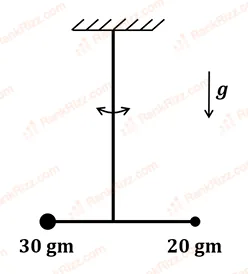
Two point-like objects of masses 20 gm and 30 gm are fixed at the two ends of a rigid massless rod of length 10 cm. This system is suspended vertically from a rigid ceiling using a thin wire attached to its center of mass, as shown in the figure. The resulting torsional pendulum undergoes small oscillations. The torsional constant of the wire is 1.2×10−81.2 \times 10^{-8} N m rad−1^{-1}. The angular frequency of the oscillations in n×10−3n \times 10^{-3} rad s−1^{-1}. The value of nn is ______.

Figure for JEE Advanced 2023 Physics question on Torque and the rotational form of Newton's second law
SOLUTION

Let the masses be m1=20 g=0.02 kgm_1 = 20\ \text{g}=0.02\ \text{kg} and m2=30 g=0.03 kgm_2 = 30\ \text{g}=0.03\ \text{kg}. The distance between them is the length of the rod, L=10 cm=0.10 mL = 10\ \text{cm}=0.10\ \text{m}.

Since the suspension wire is fixed at the centre of mass (COM), we first locate that COM along the rod. Let the distances of m1m_1 and m2m_2 from the COM be r1r_1 and r2r_2 respectively.

By definition of the centre of mass, m1r1=m2r2m_1 r_1 = m_2 r_2 −(1)-(1) and r1+r2=L=0.10 mr_1 + r_2 = L = 0.10\ \text{m} −(2)-(2).

From (1)(1), r1=m2m1 r2=0.030.02 r2=1.5 r2r_1 = \dfrac{m_2}{m_1}\,r_2 = \dfrac{0.03}{0.02}\,r_2 = 1.5\,r_2.

Substituting in (2)(2) gives 1.5 r2+r2=2.5 r2=0.101.5\,r_2 + r_2 = 2.5\,r_2 = 0.10, hence r2=0.10/2.5=0.04 mr_2 = 0.10/2.5 = 0.04\ \text{m} and r1=1.5×0.04=0.06 mr_1 = 1.5 \times 0.04 = 0.06\ \text{m}.

The moment of inertia of the two-mass system about the COM is
I=m1r12+m2r22I = m_1 r_1^2 + m_2 r_2^2

Substituting values:
I=0.02 (0.06)2+0.03 (0.04)2I = 0.02\,(0.06)^2 + 0.03\,(0.04)^2
I=0.02×0.0036+0.03×0.0016I = 0.02 \times 0.0036 + 0.03 \times 0.0016
I=7.2×10⁻⁵+4.8×10⁻⁵I = 7.2 \times 10^{-5} + 4.8 \times 10^{-5}
I=1.2×10⁻⁴ kg m2I = 1.2 \times 10^{-4}\ \text{kg m}^2.

For a torsional pendulum, the angular frequency of small oscillations is
ω=κI\omega = \sqrt{\dfrac{\kappa}{I}}
where κ\kappa is the torsional constant of the wire.

Given κ=1.2×10⁻⁸ N m rad−1\kappa = 1.2 \times 10^{-8}\ \text{N m rad}^{-1} and I=1.2×10⁻⁴ kg m2I = 1.2 \times 10^{-4}\ \text{kg m}^2,

κI=1.2×10−81.2×10−4=10−4 s−2\dfrac{\kappa}{I} = \dfrac{1.2 \times 10^{-8}}{1.2 \times 10^{-4}} = 10^{-4}\ \text{s}^{-2}.

Therefore,
ω=10−4=10−2 rad s−1=0.01 rad s−1\omega = \sqrt{10^{-4}} = 10^{-2}\ \text{rad s}^{-1} = 0.01\ \text{rad s}^{-1}.

This can be written as ω=10×10−3 rad s−1\omega = 10 \times 10^{-3}\ \text{rad s}^{-1}, hence n=10n = 10.

Final Answer: 10

Topic: Torque and the rotational form of Newton's second law

SubjectPhysics
TopicTorque and the rotational form of Newton's second law
TypeNumerical answer
Report an error in this question
What is wrong?

QUESTION pyq:497394