JEE Advanced 2016 Physics question — Angular momentum of particles and rigid bodies
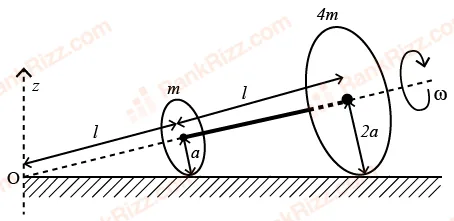
Two thin circular discs of mass m and 4m, having radii of a and 2a, respectively, are rigidly fixed by a mass less, rigid rod of length through their centers. This assembly is laid on a firm and flat surface, and set rolling without slipping on the surface so that the angular speed about the axis of the rod is . The angular momentum of the entire assembly about the point ‘O’ is (see the figure). Which of the following statement(s) is(are) true?
SOLUTION
Key idea: The rolling assembly acts like a cone with its apex at O. Its total angular velocity lies along the line of contact on the ground. Split that into the spin about the rod and a precession about .
Take (the in the statement appears to be a typo). The rod makes angle with the ground, where .
- No slipping means the contact line is the instantaneous axis, which is horizontal. So The centre of mass circles the z-axis at , so (A) is true.
- The centre of mass is at from O. Its angular momentum about O is This is not , so (B) is false.
- About the centre of mass, the precession adds to the spin term (from ), so (C) is false.
- Computing exactly from the inertia tensor about O with the full angular velocity gives about , not , so (D) is not supported.
Answer: (A)
Topic: Angular momentum of particles and rigid bodies