In the print dialog choose “Save as PDF”. Turn off the browser’s own headers and footers; the chapter has its own.

RankRizzFREE PDF

Vector Algebra JEE Main PYQs with answer key

MATHS · 294 PAST QUESTIONS · 7 TOPICS · 2004–2026

HOW TO USE THIS SHEET

Every JEE Main Vector Algebra question we hold, grouped by topic, most-asked topic first and newest first inside each. The answer key is at the end (291 of 294 questions have a checked key); the worked solution is on each question’s page, printed beside it.

Vector (cross) product and area 120

  1. 01 · JEE MAIN 2026 · 08 APR S2

    Let a⃗=4i^−j^+3k^\vec{a} = 4\hat{i} - \hat{j} + 3\hat{k}, b⃗=10i^+2j^−k^\vec{b} = 10\hat{i} + 2\hat{j} - \hat{k} and a vector c⃗\vec{c} be such that 2(a⃗×b⃗)+3(b⃗×c⃗)=0⃗2(\vec{a} \times \vec{b}) + 3(\vec{b} \times \vec{c}) = \vec{0}. If a⃗⋅c⃗=15\vec{a} \cdot \vec{c} = 15, then c⃗⋅(i^+j^−3k^)\vec{c} \cdot (\hat{i} + \hat{j} - 3\hat{k}) is equal to :

    1. (A)

      −6-6

    2. (B)

      −5-5

    3. (C)

      −4-4

    4. (D)

      −3-3

    rr2.rankrizz.com/jee-main/maths/vector-algebra/q/8-apr-2026-s2-q14

  2. 02 · JEE MAIN 2026 · 06 APR S2

    Let a⃗=2i^+3j^+3k^\vec{a} = 2\hat{i} + 3\hat{j} + 3\hat{k} and b⃗=6i^+3j^+3k^\vec{b} = 6\hat{i} + 3\hat{j} + 3\hat{k}. Then the square of the area of the triangle with adjacent sides determined by the vectors (2a⃗+3b⃗)(2\vec{a} + 3\vec{b}) and (a⃗−b⃗)(\vec{a} - \vec{b}) is :

    1. (A)

      450

    2. (B)

      900

    3. (C)

      1800

    4. (D)

      2400

    rr2.rankrizz.com/jee-main/maths/vector-algebra/q/6-apr-2026-s2-q15

  3. 03 · JEE MAIN 2026 · 05 APR S1

    Let a⃗=7i^+j^−k^\vec{a} = \sqrt{7}\hat{i} + \hat{j} - \hat{k} and b⃗=j^+2k^\vec{b} = \hat{j} + 2\hat{k}. If r⃗\vec{r} is a vector such that r⃗×a⃗+a⃗×b⃗=0⃗\vec{r} \times \vec{a} + \vec{a} \times \vec{b} = \vec{0} and r⃗⋅a⃗=0\vec{r} \cdot \vec{a} = 0, then ∣3r⃗∣2|3\vec{r}|^2 is equal to :

    1. (A)

      4444

    2. (B)

      5454

    3. (C)

      8686

    4. (D)

      132132

    rr2.rankrizz.com/jee-main/maths/vector-algebra/q/5-apr-2026-s1-q14

  4. 04 · JEE MAIN 2026 · 28 JAN S2

    Let P be a point in the plane of the vectors AB→=3i^+j^−k^ and AC→=i^−j^+3k^\overrightarrow{AB}=3\widehat{i} + \widehat{j}-\widehat{k} \text{ and }\overrightarrow{AC}=\widehat{i}-\widehat{j}+3\widehat{k} such that P is equidistant from the Lines AB and AC. If ∣AP→∣=52\mid \overrightarrow{AP} \mid=\frac{\sqrt{5}}{2} then the area of the triangle ABP is:

    1. (A)

      304\frac{\sqrt{30}}{4}

    2. (B)

      2

    3. (C)

      32\frac{3}{2}

    4. (D)

      264\frac{\sqrt{26}}{4}

    rr2.rankrizz.com/jee-main/maths/vector-algebra/q/28-jan-2026-s2-q4

  5. 05 · JEE MAIN 2026 · 24 JAN S1

    Let a→=2i^+j^−2k^,b→=i^+j^ and c→=a→×b→\overrightarrow{a}=2\widehat{i}+\widehat{j}-2\widehat{k}, \overrightarrow{b}=\widehat{i}+\widehat{j}\text{ and }\overrightarrow{c}=\overrightarrow{a}\times \overrightarrow{b}. Let d→\overrightarrow{d} be a vector such that ∣d→−a→∣=11,∣c→×d→∣=3|\overrightarrow{d}-\overrightarrow{a}|=\sqrt{11},|\overrightarrow{c}\times \overrightarrow{d}|=3 and the angle between c→ and d→\overrightarrow{c}\text{ and }\overrightarrow{d} is π4\frac{\pi}{4}. Then a→. d→\overrightarrow{a}. \overrightarrow{d} is equal to

    1. (A)

      11

    2. (B)

      0

    3. (C)

      1

    4. (D)

      3

    rr2.rankrizz.com/jee-main/maths/vector-algebra/q/24-jan-2026-s1-q16

  6. 06 · JEE MAIN 2026 · 24 JAN S2

    Let a→=2i^−5j^+5k^\overrightarrow{a}= 2\widehat{i}-5\widehat{j}+5\widehat{k} and b→=i^−j^+3k^\overrightarrow{b}= \widehat{i}-\widehat{j}+3\widehat{k}. If C→\overrightarrow{C} is a vector such that 2(a→×c→)+3(b→×c→)=0→2(\overrightarrow{a}\times\overrightarrow{c})+3(\overrightarrow{b}\times\overrightarrow{c})= \overrightarrow{0} and (a→−b→)⋅c→=−97,(\overrightarrow{a}-\overrightarrow{b})\cdot\overrightarrow{c}=-97, then ∣c→×k^∣2\mid \overrightarrow{c}\times\widehat{k} \mid^{2} is equal to

    1. (A)

      233

    2. (B)

      205

    3. (C)

      218

    4. (D)

      193

    rr2.rankrizz.com/jee-main/maths/vector-algebra/q/24-jan-2026-s2-q6

  7. 07 · JEE MAIN 2026 · 23 JAN S1

    Let a→=−i^+j^+2k^,b→=i^−j^−3k^,c→=a→×b→ and d→=c→×a→\overrightarrow{a}=-\widehat{i}+\widehat{j}+2\widehat{k},\overrightarrow{b}=\widehat{i}-\widehat{j}-3\widehat{k},\overrightarrow{c}=\overrightarrow{a} \times \overrightarrow{b}\text{ and }\overrightarrow{d}=\overrightarrow{c}\times\overrightarrow{a}. Then (a→−b→).d→\large (\overrightarrow{a}-\overrightarrow{b}).\overrightarrow{d} is equal to:

    1. (A)

      -2

    2. (B)

      4

    3. (C)

      -4

    4. (D)

      2

    rr2.rankrizz.com/jee-main/maths/vector-algebra/q/23-jan-2026-s1-q5

  8. 08 · JEE MAIN 2026 · 23 JAN S2

    Let a→=i^−2j^+3k^,b→=2i^+j^−k^,c→=λi^+j^+k^\overrightarrow{a}=\widehat{i}-2\widehat{j}+3\widehat{k}, \overrightarrow{b}=2\widehat{i}+\widehat{j}-\widehat{k}, \overrightarrow{c}=\lambda \widehat{i}+\widehat{j}+\widehat{k} and v→=a→×b→\overrightarrow{v}= \overrightarrow{a} \times \overrightarrow{b}. If v→⋅c→=11\overrightarrow{v}\cdot\overrightarrow{c}=11 and the length of the projection of b→\overrightarrow{b} on c→\overrightarrow{c} is p, then 9p29p^{2} is equal to

    1. (A)

      12

    2. (B)

      9

    3. (C)

      4

    4. (D)

      6

    rr2.rankrizz.com/jee-main/maths/vector-algebra/q/23-jan-2026-s2-q2

  9. 09 · JEE MAIN 2026 · 23 JAN S2

    Let a→,b→,c→\overrightarrow{a},\overrightarrow{b},\overrightarrow{c} be three vectors such that a→×b→=2(a→×c→).\overrightarrow{a}\times\overrightarrow{b}=2(\overrightarrow{a}\times\overrightarrow{c}). If ∣a→∣,∣b→∣=4,∣c→∣=2,\mid \overrightarrow{a}\mid, \mid\overrightarrow{b}\mid = 4, \mid \overrightarrow{c}\mid = 2, and the angle between b→\overrightarrow{b} and c→\overrightarrow{c} is 60o60^{o}, then ∣a→⋅c→\mid\overrightarrow{a}\cdot\overrightarrow{c} is

    1. (A)

      4

    2. (B)

      2

    3. (C)

      0

    4. (D)

      1

    rr2.rankrizz.com/jee-main/maths/vector-algebra/q/23-jan-2026-s2-q16

  10. 10 · JEE MAIN 2026 · 22 JAN S2

    Let a→=2i^−j^+k^\overrightarrow{a}= 2\widehat{i}-\widehat{j}+\widehat{k} and b→=λj^+2k^,λ∈Z\overrightarrow{b}= \lambda \widehat{j}+2\widehat{k}, \lambda\in Z be two vectors. Let c→=a→×b→and d→\overrightarrow{c}= \overrightarrow{a} \times \overrightarrow{b} \text{and } \overrightarrow{d} be a vector of magnitude 2 in yz-plane. If ∣c→∣=53|\overrightarrow{c}|=\sqrt{53}, then the maximum possible value of (c→⋅d→)2\left(\overrightarrow{c}\cdot\overrightarrow{d}\right)^{2} is equal to :

    1. (A)

      208

    2. (B)

      52

    3. (C)

      26

    4. (D)

      104

    rr2.rankrizz.com/jee-main/maths/vector-algebra/q/22-jan-2026-s2-q20

  11. 11 · JEE MAIN 2026 · 21 JAN S1

    Let a→=−i^+2j^+2k^,b→=8i^+7j^−3k^ and c→\overrightarrow{a}=-\widehat{i}+2\widehat{j}+2\widehat{k},\overrightarrow{b}=8\widehat{i}+7\widehat{j}-3\widehat{k} \text { and } \overrightarrow{c} be a vector such that a→×c→=b→\overrightarrow{a}\times\overrightarrow{c}=\overrightarrow{b}. If c→⋅(i^+j^+k^)=4\overrightarrow{c}\cdot(\widehat{i}+\widehat{j}+\widehat{k})=4, then ∣a→+c→∣2\mid\overrightarrow{a}+\overrightarrow{c}\mid^{2} is equal to :

    1. (A)

      35

    2. (B)

      30

    3. (C)

      27

    4. (D)

      33

    rr2.rankrizz.com/jee-main/maths/vector-algebra/q/21-jan-2026-s1-maths-q1

  12. 12 · JEE MAIN 2026 · 21 JAN S1

    Let c→ and d→\overrightarrow{c} \text{ and } \overrightarrow{d} be vectors such that ∣c→+d→∣=29\mid\overrightarrow{c}+\overrightarrow{d}\mid=\sqrt{29} and c→×(2i^+3j^+4k^)=(2i^+3j^+4k^)×d→\overrightarrow{c}\times( 2\widehat{i}+3\widehat{j}+4\widehat{k})=(2\widehat{i}+3\widehat{j}+4\widehat{k})\times\overrightarrow{d}. If λ1,λ2(λ1>λ2)\lambda_{1}, \lambda_{2}( \lambda_{1}> \lambda_{2}) are the possible values of (c→+d→)⋅(−7i^+2j^+3k→)(\overrightarrow{c}+\overrightarrow{d})\cdot(-7\widehat{i}+2\widehat{j}+3\overrightarrow{k}), then the equation K2x2+(K2−5K+λ1)xy+(3K+λ22)y2−8x+12y+λ2=0K^{2}x^{2}+(K^{2}-5K+\lambda_{1})xy+\left(3K+\frac{\lambda_{2}}{2} \right)y^{2}-8x+12y+\lambda_{2}=0 represents a circle, for K equal to :

    1. (A)

      -1

    2. (B)

      4

    3. (C)

      1

    4. (D)

      2

    rr2.rankrizz.com/jee-main/maths/vector-algebra/q/21-jan-2026-s1-maths-q10

  13. 13 · JEE MAIN 2026 · 21 JAN S2

    For a triangle ABC, let p→=BC→,q→=CA→\overrightarrow{p} = \overrightarrow{BC}, \overrightarrow{q}= \overrightarrow{CA} and r→=BA→\overrightarrow{r} = \overrightarrow{BA}. If ∣p→∣=23,∣q→∣=2|\overrightarrow{p}| = 2\sqrt{3}, |\overrightarrow{q}|=2 and cos⁡θ=13\cos\theta = \frac{1}{\sqrt{3}} where θ\theta is the angle between p→\overrightarrow{p} and q→\overrightarrow{q}, then ∣p→×(q→−3r→)∣2+3∣r→∣2|\overrightarrow{p} \times \left(\overrightarrow{q}-\overrightarrow{3r}\right)|^2 +3|\overrightarrow{r}|^2 is equal to :

    1. (A)

      220

    2. (B)

      340

    3. (C)

      410

    4. (D)

      200

    rr2.rankrizz.com/jee-main/maths/vector-algebra/q/21-jan-2026-s2-q13

  14. 14 · JEE MAIN 2025 · 03 APR S1

    Let a⃗=i^+j^+k^\vec{a} = \hat{i} + \hat{j} + \hat{k}, b⃗=3i^+2j^−k^\vec{b} = 3\hat{i} + 2\hat{j} - \hat{k}, c⃗=λj^+μk^\vec{c} = \lambda\hat{j} + \mu\hat{k} and d^\hat{d} be a unit vector such that a⃗×d^=b⃗×d^\vec{a} \times \hat{d} = \vec{b} \times \hat{d} and c⃗⋅d^=1\vec{c} \cdot \hat{d} = 1. If c⃗\vec{c} is perpendicular to a⃗\vec{a}, then ∣3λd^+μc⃗∣2|3\lambda\hat{d} + \mu\vec{c}|^2 is equal to __________.

    Answer: ____________

    rr2.rankrizz.com/jee-main/maths/vector-algebra/q/2025-apr-03-s1-q23

  15. 15 · JEE MAIN 2025 · 03 APR S2

    Let a⃗=i^+2j^+k^\vec{a} = \hat{i} + 2\hat{j} + \hat{k}, b⃗=3i^−3j^+3k^\vec{b} = 3\hat{i} - 3\hat{j} + 3\hat{k}, c⃗=2i^−j^+2k^\vec{c} = 2\hat{i} - \hat{j} + 2\hat{k} and d⃗\vec{d} be a vector such that b⃗×d⃗=c⃗×d⃗\vec{b} \times \vec{d} = \vec{c} \times \vec{d} and a⃗⋅d⃗=4\vec{a} \cdot \vec{d} = 4. Then ∣a⃗×d⃗∣2|\vec{a} \times \vec{d}|^2 is equal to ________.

    Answer: ____________

    rr2.rankrizz.com/jee-main/maths/vector-algebra/q/2025-apr-3-s2-q24

  16. 16 · JEE MAIN 2025 · 02 APR S2

    Let a⃗=2i^−3j^+k^\vec{a} = 2\hat{i} - 3\hat{j} + \hat{k}, b⃗=3i^+2j^+5k^\vec{b} = 3\hat{i} + 2\hat{j} + 5\hat{k} and a vector c⃗\vec{c} be such that (a⃗−c⃗)×b⃗=−18i^−3j^+12k^(\vec{a} - \vec{c}) \times \vec{b} = -18\hat{i} - 3\hat{j} + 12\hat{k} and a⃗⋅c⃗=3\vec{a} \cdot \vec{c} = 3. If b⃗×c⃗=d⃗\vec{b} \times \vec{c} = \vec{d}, then ∣a⃗⋅d⃗∣|\vec{a} \cdot \vec{d}| is equal to :

    1. (A)

      1818

    2. (B)

      1212

    3. (C)

      99

    4. (D)

      1515

    rr2.rankrizz.com/jee-main/maths/vector-algebra/q/2025-apr-02-s2-q18

  17. 17 · JEE MAIN 2025 · 29 JAN S1

    Let a→=2i^−j^+3k^,b→=3i^−5j^+k^\overrightarrow{a}=2\hat{i}-\hat{j}+3\hat{k}, \overrightarrow{b}=3\hat{i}-5\hat{j}+\hat{k} and c→\overrightarrow{c} be a vector such that a→×c→=c→×b→\overrightarrow{a} \times \overrightarrow{c} = \overrightarrow{c} \times \overrightarrow{b} and (a→+c→).(b→+c→)=168(\overrightarrow{a}+\overrightarrow{c}).(\overrightarrow{b}+\overrightarrow{c})=168. Then the maximum value of ∣c→∣2|\overrightarrow{c}|^{2} is :

    1. (A)

      462

    2. (B)

      77

    3. (C)

      154

    4. (D)

      308

    rr2.rankrizz.com/jee-main/maths/vector-algebra/q/29-jan-2025-s1-q8

  18. 18 · JEE MAIN 2025 · 29 JAN S2

    Let a^\widehat{a} be a unit vector perpendicular to the vectors b→=i^−2j^+3k^\overrightarrow{b}=\widehat{i}-2\widehat{j}+3\widehat{k} and c→=2i^+3j^−k^\overrightarrow{c}=2\widehat{i}+3\widehat{j}-\widehat{k}, and makes an angle of cos⁡−1(−13)\cos^{-1}(-\frac{1}{3}) with the vector i^+j^+k^\widehat{i}+\widehat{j}+\widehat{k} . If a^\widehat{a} makes an angle of π3\frac{\pi}{3} with the vector i^+αj^+k^\widehat{i}+\alpha\widehat{j}+\widehat{k} , then the value of α\alpha is :

    1. (A)

      6\sqrt{6}

    2. (B)

      −6-\sqrt{6}

    3. (C)

      −3-\sqrt{3}

    4. (D)

      3\sqrt{3}

    rr2.rankrizz.com/jee-main/maths/vector-algebra/q/29-jan-2025-s2-q2

  19. 19 · JEE MAIN 2025 · 28 JAN S1

    Let a→=i^+j^+k^,b→=2i^+2j^+k^\overrightarrow{a}=\hat{i}+\hat{j}+\hat{k},\overrightarrow{b}=2\hat{i}+2\hat{j}+\hat{k} and d→=a→×b→\overrightarrow{d}=\overrightarrow{a}\times \overrightarrow{b}. Ifc→\overrightarrow{c} is a vector such that a→.c→=∣c→∣,∣c→−2a→∣2=8\overrightarrow{a}. \overrightarrow{c}=|\overrightarrow{c}|,|\overrightarrow{c}-2\overrightarrow{a}|^{2}=8 and the angle between d→\overrightarrow{d} and c→\overrightarrow{c} is π4\frac{\pi}{4}, then ∣10−3b→.c→∣+∣d→×c→∣2|10-3\overrightarrow{b}.\overrightarrow{c}|+|\overrightarrow{d}\times \overrightarrow{c}|^{2} is equal to

    Answer: ____________

    rr2.rankrizz.com/jee-main/maths/vector-algebra/q/28-jan-2025-s1-q25

  20. 20 · JEE MAIN 2025 · 22 JAN S1

    Let c→\overrightarrow{c} be the projection vector of b→=λi^+4k^\overrightarrow{b}=\lambda\widehat{i}+4\widehat{k}, λ>0\lambda > 0, on the vector a→=i^+2j^+2k^\overrightarrow{a}=\widehat{i}+2\widehat{j}+2\widehat{k}. If ∣a→+c→∣=7|\overrightarrow{a}+ \overrightarrow{c}|= 7, then the area of the parallelogram formed by the vectors b→\overrightarrow{b} and c→\overrightarrow{c} is ______

    Answer: ____________

    rr2.rankrizz.com/jee-main/maths/vector-algebra/q/22-jan-2025-s1-q23

  21. 21 · JEE MAIN 2024 · 09 APR S1

    Let three vectors a⃗=αi^+4j^+2k^\vec{a} = \alpha\hat{i} + 4\hat{j} + 2\hat{k}, b⃗=5i^+3j^+4k^\vec{b} = 5\hat{i} + 3\hat{j} + 4\hat{k}, c⃗=xi^+yj^+zk^\vec{c} = x\hat{i} + y\hat{j} + z\hat{k} form a triangle such that c⃗=a⃗−b⃗\vec{c} = \vec{a} - \vec{b} and the area of the triangle is 565\sqrt{6}. If α\alpha is a positive real number, then ∣c⃗∣2|\vec{c}|^2 is equal to:

    1. (A)

      1616

    2. (B)

      1414

    3. (C)

      1212

    4. (D)

      1010

    rr2.rankrizz.com/jee-main/maths/vector-algebra/q/9-apr-2024-s1-q77

  22. 22 · JEE MAIN 2024 · 09 APR S1

    Let OA⃗=2a⃗\vec{OA} = 2\vec{a}, OB⃗=6a⃗+5b⃗\vec{OB} = 6\vec{a} + 5\vec{b} and OC⃗=3b⃗\vec{OC} = 3\vec{b}, where OO is the origin. If the area of the parallelogram with adjacent sides OA⃗\vec{OA} and OC⃗\vec{OC} is 15 sq. units, then the area (in sq. units) of the quadrilateral OABC is equal to :

    1. (A)

      3232

    2. (B)

      4040

    3. (C)

      3838

    4. (D)

      3535

    rr2.rankrizz.com/jee-main/maths/vector-algebra/q/9-apr-2024-s1-q78

  23. 23 · JEE MAIN 2024 · 09 APR S2

    Between the following two statements: Statement I : Let a⃗=i^+2j^−3k^\vec{a} = \hat{i} + 2\hat{j} - 3\hat{k} and b⃗=2i^+j^−k^\vec{b} = 2\hat{i} + \hat{j} - \hat{k}. Then the vector r⃗\vec{r} satisfying a⃗×r⃗=a⃗×b⃗\vec{a} \times \vec{r} = \vec{a} \times \vec{b} and a⃗⋅r⃗=0\vec{a} \cdot \vec{r} = 0 is of magnitude 10\sqrt{10}. Statement II : In a triangle ABCABC, cos⁡2A+cos⁡2B+cos⁡2C≥−32\cos 2A + \cos 2B + \cos 2C \ge -\frac{3}{2}.

    1. (A)

      Statement I is incorrect but Statement II is correct.

    2. (B)

      Both Statement I and Statement II are correct.

    3. (C)

      Statement I is correct but Statement II is incorrect.

    4. (D)

      Both Statement I and Statement II are incorrect.

    rr2.rankrizz.com/jee-main/maths/vector-algebra/q/9-apr-2024-s2-q77

  24. 24 · JEE MAIN 2024 · 09 APR S2

    Let a⃗=2i^+αj^+k^,b⃗=−i^+k^,c⃗=βj^−k^\vec{a} = 2\hat{i} + \alpha\hat{j} + \hat{k}, \vec{b} = -\hat{i} + \hat{k}, \vec{c} = \beta\hat{j} - \hat{k}, where α\alpha and β\beta are integers and αβ=−6\alpha\beta = -6. Let the values of the ordered pair (α,β)(\alpha, \beta), for which the area of the parallelogram of diagonals a⃗+b⃗\vec{a} + \vec{b} and b⃗+c⃗\vec{b} + \vec{c} is 212\frac{\sqrt{21}}{2}, be (α1,β1)(\alpha_1, \beta_1) and (α2,β2)(\alpha_2, \beta_2). Then α12+β12−α2β2\alpha_1^2 + \beta_1^2 - \alpha_2\beta_2 is equal to

    1. (A)

      19

    2. (B)

      17

    3. (C)

      24

    4. (D)

      21

    rr2.rankrizz.com/jee-main/maths/vector-algebra/q/9-apr-2024-s2-q78

  25. 25 · JEE MAIN 2024 · 08 APR S1

    Let a⃗=9i^−13j^+25k^\vec{a} = 9\hat{i} - 13\hat{j} + 25\hat{k}, b⃗=3i^+7j^−13k^\vec{b} = 3\hat{i} + 7\hat{j} - 13\hat{k} and c⃗=17i^−2j^+k^\vec{c} = 17\hat{i} - 2\hat{j} + \hat{k} be three given vectors. If r⃗\vec{r} is a vector such that r⃗×a⃗=(b⃗+c⃗)×a⃗\vec{r} \times \vec{a} = (\vec{b} + \vec{c}) \times \vec{a} and r⃗⋅(b⃗−c⃗)=0\vec{r} \cdot (\vec{b} - \vec{c}) = 0, then ∣593r⃗+67a⃗∣2(593)2\frac{|593\vec{r} + 67\vec{a}|^2}{(593)^2} is equal to ________

    Answer: ____________

    rr2.rankrizz.com/jee-main/maths/vector-algebra/q/8-apr-2024-s1-q89

  26. 26 · JEE MAIN 2024 · 08 APR S2

    Let a⃗=4i^−j^+k^\vec{a} = 4\hat{i} - \hat{j} + \hat{k}, b⃗=11i^−j^+k^\vec{b} = 11\hat{i} - \hat{j} + \hat{k} and c⃗\vec{c} be a vector such that (a⃗+b⃗)×c⃗=c⃗×(−2a⃗+3b⃗)(\vec{a} + \vec{b}) \times \vec{c} = \vec{c} \times (-2\vec{a} + 3\vec{b}). If (2a⃗+3b⃗)⋅c⃗=1670(2\vec{a} + 3\vec{b}) \cdot \vec{c} = 1670, then ∣c⃗∣2|\vec{c}|^2 is equal to :

    1. (A)

      1609

    2. (B)

      1618

    3. (C)

      1600

    4. (D)

      1627

    rr2.rankrizz.com/jee-main/maths/vector-algebra/q/8-apr-2024-s2-q77

  27. 27 · JEE MAIN 2024 · 06 APR S1

    If A(3,1,−1)A(3, 1, -1), B(53,73,13)B\left(\frac{5}{3}, \frac{7}{3}, \frac{1}{3}\right), C(2,2,1)C(2, 2, 1) and D(103,23,−13)D\left(\frac{10}{3}, \frac{2}{3}, \frac{-1}{3}\right) are the vertices of a quadrilateral ABCDABCD, then its area is

    1. (A)

      223\frac{2\sqrt{2}}{3}

    2. (B)

      523\frac{5\sqrt{2}}{3}

    3. (C)

      222\sqrt{2}

    4. (D)

      423\frac{4\sqrt{2}}{3}

    rr2.rankrizz.com/jee-main/maths/vector-algebra/q/6-apr-2024-s1-q65

  28. 28 · JEE MAIN 2024 · 06 APR S1

    Let a⃗=2i^−3j^+4k^\vec{a} = 2\hat{i} - 3\hat{j} + 4\hat{k}, b⃗=3i^+4j^−5k^\vec{b} = 3\hat{i} + 4\hat{j} - 5\hat{k} and a vector c⃗\vec{c} be such that a⃗×(b⃗+c⃗)+b⃗×c⃗=i^+8j^+13k^\vec{a} \times (\vec{b} + \vec{c}) + \vec{b} \times \vec{c} = \hat{i} + 8\hat{j} + 13\hat{k}. If a⃗⋅c⃗=13\vec{a} \cdot \vec{c} = 13, then (24−b⃗⋅c⃗)(24 - \vec{b} \cdot \vec{c}) is equal to _______

    Answer: ____________

    rr2.rankrizz.com/jee-main/maths/vector-algebra/q/6-apr-2024-s1-q89

  29. 29 · JEE MAIN 2024 · 06 APR S2

    Let a⃗=2i^+j^−k^\vec{a} = 2\hat{i} + \hat{j} - \hat{k}, b⃗=((a⃗×(i^+j^))×i^)×i^\vec{b} = ((\vec{a} \times (\hat{i} + \hat{j})) \times \hat{i}) \times \hat{i}. Then the square of the projection of a⃗\vec{a} on b⃗\vec{b} is :

    1. (A)

      13\frac{1}{3}

    2. (B)

      23\frac{2}{3}

    3. (C)

      22

    4. (D)

      15\frac{1}{5}

    rr2.rankrizz.com/jee-main/maths/vector-algebra/q/6-apr-2024-s2-q77

  30. 30 · JEE MAIN 2024 · 06 APR S2

    Let a⃗=6i^+j^−k^\vec{a} = 6\hat{i} + \hat{j} - \hat{k} and b⃗=i^+j^\vec{b} = \hat{i} + \hat{j}. If c⃗\vec{c} is a vector such that ∣c⃗∣≥6|\vec{c}| \geq 6, a⃗⋅c⃗=6∣c⃗∣\vec{a} \cdot \vec{c} = 6|\vec{c}|, ∣c⃗−a⃗∣=22|\vec{c} - \vec{a}| = 2\sqrt{2} and the angle between a⃗×b⃗\vec{a} \times \vec{b} and c⃗\vec{c} is 60°60°, then ∣(a⃗×b⃗)×c⃗∣|(\vec{a} \times \vec{b}) \times \vec{c}| is equal to:

    1. (A)

      92(6−6)\frac{9}{2}(6 - \sqrt{6})

    2. (B)

      326\frac{3}{2}\sqrt{6}

    3. (C)

      92(6+6)\frac{9}{2}(6 + \sqrt{6})

    4. (D)

      323\frac{3}{2}\sqrt{3}

    rr2.rankrizz.com/jee-main/maths/vector-algebra/q/6-apr-2024-s2-q78

  31. 31 · JEE MAIN 2024 · 05 APR S1

    If A(1,−1,2),B(5,7,−6),C(3,4,−10)A(1, -1, 2), B(5, 7, -6), C(3, 4, -10) and D(−1,−4,−2)D(-1, -4, -2) are the vertices of a quadrilateral ABCDABCD, then its area is :

    1. (A)

      48748\sqrt{7}

    2. (B)

      122912\sqrt{29}

    3. (C)

      24724\sqrt{7}

    4. (D)

      242924\sqrt{29}

    rr2.rankrizz.com/jee-main/maths/vector-algebra/q/5-apr-2024-s1-q65

  32. 32 · JEE MAIN 2024 · 05 APR S1

    Let a⃗=i^−3j^+7k^,b⃗=2i^−j^+k^\vec{a} = \hat{i} - 3\hat{j} + 7\hat{k}, \vec{b} = 2\hat{i} - \hat{j} + \hat{k} and c⃗\vec{c} be a vector such that (a⃗+2b⃗)×c⃗=3(c⃗×a⃗)(\vec{a} + 2\vec{b}) \times \vec{c} = 3(\vec{c} \times \vec{a}). If a⃗⋅c⃗=130\vec{a} \cdot \vec{c} = 130, then b⃗⋅c⃗\vec{b} \cdot \vec{c} is equal to ______

    Answer: ____________

    rr2.rankrizz.com/jee-main/maths/vector-algebra/q/5-apr-2024-s1-q90

  33. 33 · JEE MAIN 2024 · 05 APR S2

    Consider three vectors a⃗,b⃗,c⃗\vec{a}, \vec{b}, \vec{c}. Let ∣a⃗∣=2,∣b⃗∣=3|\vec{a}| = 2, |\vec{b}| = 3 and a⃗=b⃗×c⃗\vec{a} = \vec{b} \times \vec{c}. If α∈[0,π3]\alpha \in \left[0, \frac{\pi}{3}\right] is the angle between the vectors b⃗\vec{b} and c⃗\vec{c}, then the minimum value of 27∣c⃗−a⃗∣227|\vec{c} - \vec{a}|^2 is equal to:

    1. (A)

      110

    2. (B)

      124

    3. (C)

      121

    4. (D)

      105

    rr2.rankrizz.com/jee-main/maths/vector-algebra/q/05-apr-2024-s2-q77

  34. 34 · JEE MAIN 2024 · 05 APR S2

    Let a⃗=2i^+5j^−k^\vec{a} = 2\hat{i} + 5\hat{j} - \hat{k}, b⃗=2i^−2j^+2k^\vec{b} = 2\hat{i} - 2\hat{j} + 2\hat{k} and c⃗\vec{c} be three vectors such that (c⃗+i^)×(a⃗+b⃗+i^)=a⃗×(c⃗+i^)(\vec{c} + \hat{i}) \times (\vec{a} + \vec{b} + \hat{i}) = \vec{a} \times (\vec{c} + \hat{i}). If a⃗⋅c⃗=−29\vec{a} \cdot \vec{c} = -29, then c⃗⋅(−2i^+j^+k^)\vec{c} \cdot (-2\hat{i} + \hat{j} + \hat{k}) is equal to:

    1. (A)

      15

    2. (B)

      12

    3. (C)

      10

    4. (D)

      5

    rr2.rankrizz.com/jee-main/maths/vector-algebra/q/05-apr-2024-s2-q78

  35. 35 · JEE MAIN 2024 · 04 APR S1

    Let ABC be a triangle of area 15215\sqrt{2} and the vectors AB→=i^+2j^−7k^\overrightarrow{AB} = \hat{i} + 2\hat{j} - 7\hat{k}, BC→=ai^+bj^+ck^\overrightarrow{BC} = a\hat{i} + b\hat{j} + c\hat{k} and AC→=6i^+dj^−2k^\overrightarrow{AC} = 6\hat{i} + d\hat{j} - 2\hat{k}, d > 0. Then the square of the length of the largest side of the triangle ABC is ______.

    Answer: ____________

    rr2.rankrizz.com/jee-main/maths/vector-algebra/q/04-apr-2024-s1-q89

  36. 36 · JEE MAIN 2024 · 01 FEB S1

    Let a⃗=−5i^+j^−3k^\vec{a} = -5\hat{i} + \hat{j} - 3\hat{k}, b⃗=i^+2j^−4k^\vec{b} = \hat{i} + 2\hat{j} - 4\hat{k} and c⃗=((a⃗×b⃗)×i^)×i^)×i^\vec{c} = ((\vec{a} \times \vec{b}) \times \hat{i}) \times \hat{i}) \times \hat{i}. Then c⃗⋅(−i^+j^+k^)\vec{c} \cdot (-\hat{i} + \hat{j} + \hat{k}) is equal to:

    1. (A)

      −12-12

    2. (B)

      −10-10

    3. (C)

      −13-13

    4. (D)

      −15-15

    rr2.rankrizz.com/jee-main/maths/vector-algebra/q/01-feb-2024-s1-q78

  37. 37 · JEE MAIN 2024 · 01 FEB S2

    Let a⃗=i^+j^+k^\vec{a} = \hat{i} + \hat{j} + \hat{k}, b⃗=−i^−8j^+2k^\vec{b} = -\hat{i} - 8\hat{j} + 2\hat{k} and c⃗=4i^+c2j^+c3k^\vec{c} = 4\hat{i} + c_2\hat{j} + c_3\hat{k} be three vectors such that b⃗×a⃗=c⃗×a⃗\vec{b} \times \vec{a} = \vec{c} \times \vec{a}. If the angle between the vector c⃗\vec{c} and the vector 3i^+4j^+k^3\hat{i} + 4\hat{j} + \hat{k} is θ\theta, then the greatest integer less than or equal to tan⁡2θ\tan^2 \theta is:

    Answer: ____________

    rr2.rankrizz.com/jee-main/maths/vector-algebra/q/01-feb-2024-s2-q90

  38. 38 · JEE MAIN 2024 · 31 JAN S1

    Let a⃗=3i^+j^−2k^\vec{a} = 3\hat{i} + \hat{j} - 2\hat{k}, b⃗=4i^+j^+7k^\vec{b} = 4\hat{i} + \hat{j} + 7\hat{k} and c⃗=i^−3j^+4k^\vec{c} = \hat{i} - 3\hat{j} + 4\hat{k} be three vectors. If a vector p⃗\vec{p} satisfies p⃗×b⃗=c⃗×b⃗\vec{p} \times \vec{b} = \vec{c} \times \vec{b} and p⃗⋅a⃗=0\vec{p} \cdot \vec{a} = 0, then p⃗⋅(i^−j^−k^)\vec{p} \cdot (\hat{i} - \hat{j} - \hat{k}) is equal to

    1. (A)

      24

    2. (B)

      36

    3. (C)

      28

    4. (D)

      32

    rr2.rankrizz.com/jee-main/maths/vector-algebra/q/31-jan-2024-s1-q77

  39. 39 · JEE MAIN 2024 · 31 JAN S1

    Let a⃗\vec{a} and b⃗\vec{b} be two vectors such that ∣a⃗∣=1,∣b⃗∣=4|\vec{a}| = 1, |\vec{b}| = 4 and a⃗⋅b⃗=2\vec{a} \cdot \vec{b} = 2. If c⃗=2(a⃗×b⃗)−3b⃗\vec{c} = 2(\vec{a} \times \vec{b}) - 3\vec{b} and the angle between b⃗\vec{b} and c⃗\vec{c} is α\alpha, then 192sin⁡2α192\sin^2\alpha is equal to _________

    Answer: ____________

    rr2.rankrizz.com/jee-main/maths/vector-algebra/q/31-jan-2024-s1-q89

  40. 40 · JEE MAIN 2024 · 31 JAN S2

    Let a⃗=3i^+2j^+k^\vec{a} = 3\hat{i} + 2\hat{j} + \hat{k}, b⃗=2i^−j^+3k^\vec{b} = 2\hat{i} - \hat{j} + 3\hat{k} and c⃗\vec{c} be a vector such that (a⃗+b⃗)×c⃗=2(a⃗×b⃗)+24j^−6k^(\vec{a} + \vec{b}) \times \vec{c} = 2(\vec{a} \times \vec{b}) + 24\hat{j} - 6\hat{k} and (a⃗−b⃗+i^)⋅c⃗=−3(\vec{a} - \vec{b} + \hat{i}) \cdot \vec{c} = -3. Then ∣c⃗∣2|\vec{c}|^2 is equal to

    Answer: ____________

    rr2.rankrizz.com/jee-main/maths/vector-algebra/q/31-jan-2024-s2-q89

  41. 41 · JEE MAIN 2024 · 30 JAN S1

    Let A(2,3,5)A(2, 3, 5) and C(−3,4,−2)C(-3, 4, -2) be opposite vertices of a parallelogram ABCDABCD if the diagonal BD⃗=i^+2j^+3k^\vec{BD} = \hat{i} + 2\hat{j} + 3\hat{k} then the area of the parallelogram is equal to

    1. (A)

      12410\frac{1}{2}\sqrt{410}

    2. (B)

      12474\frac{1}{2}\sqrt{474}

    3. (C)

      12586\frac{1}{2}\sqrt{586}

    4. (D)

      12306\frac{1}{2}\sqrt{306}

    rr2.rankrizz.com/jee-main/maths/vector-algebra/q/30-jan-2024-s1-q77

  42. 42 · JEE MAIN 2024 · 30 JAN S1

    Let a⃗=a1i^+a2j^+a3k^\vec{a} = a_1\hat{i} + a_2\hat{j} + a_3\hat{k} and b⃗=b1i^+b2j^+b3k^\vec{b} = b_1\hat{i} + b_2\hat{j} + b_3\hat{k} be two vectors such that ∣a⃗∣=1|\vec{a}| = 1; a⃗⋅b⃗=2\vec{a} \cdot \vec{b} = 2 and ∣b⃗∣=4|\vec{b}| = 4. If c⃗=2(a⃗×b⃗)−3b⃗\vec{c} = 2(\vec{a} \times \vec{b}) - 3\vec{b}, then the angle between b⃗\vec{b} and c⃗\vec{c} is equal to :

    1. (A)

      cos⁡−1(23)\cos^{-1}\left(\frac{2}{\sqrt{3}}\right)

    2. (B)

      cos⁡−1(−13)\cos^{-1}\left(-\frac{1}{\sqrt{3}}\right)

    3. (C)

      cos⁡−1(−32)\cos^{-1}\left(-\frac{\sqrt{3}}{2}\right)

    4. (D)

      cos⁡−1(23)\cos^{-1}\left(\frac{2}{3}\right)

    rr2.rankrizz.com/jee-main/maths/vector-algebra/q/30-jan-2024-s1-q78

  43. 43 · JEE MAIN 2024 · 30 JAN S2

    Let a⃗=i^+αj^+βk^\vec{a} = \hat{i} + \alpha\hat{j} + \beta\hat{k}, α,β∈R\alpha, \beta \in R. Let a vector b⃗\vec{b} be such that the angle between a⃗\vec{a} and b⃗\vec{b} is π4\frac{\pi}{4} and ∣b⃗∣2=6|\vec{b}|^2 = 6. If a⃗⋅b⃗=32\vec{a} \cdot \vec{b} = 3\sqrt{2}, then the value of (α2+β2)∣a⃗×b⃗∣2(\alpha^2 + \beta^2)|\vec{a} \times \vec{b}|^2 is equal to

    1. (A)

      90

    2. (B)

      75

    3. (C)

      95

    4. (D)

      85

    rr2.rankrizz.com/jee-main/maths/vector-algebra/q/30-jan-2024-s2-q77

  44. 44 · JEE MAIN 2024 · 30 JAN S2

    Let a⃗\vec{a} and b⃗\vec{b} be two vectors such that ∣b⃗∣=1|\vec{b}| = 1 and ∣b⃗×a⃗∣=2|\vec{b} \times \vec{a}| = 2. Then ∣(b⃗×a⃗)−b⃗∣2|(\vec{b} \times \vec{a}) - \vec{b}|^2 is equal to

    1. (A)

      3

    2. (B)

      5

    3. (C)

      1

    4. (D)

      4

    rr2.rankrizz.com/jee-main/maths/vector-algebra/q/30-jan-2024-s2-q78

  45. 45 · JEE MAIN 2024 · 29 JAN S2

    Let OA⃗=a⃗,OB⃗=12a⃗+4b⃗\vec{OA} = \vec{a}, \vec{OB} = 12\vec{a} + 4\vec{b} and OC⃗=b⃗\vec{OC} = \vec{b}, where OO is the origin. If SS is the parallelogram with adjacent sides OAOA and OCOC, then area of the quadrilateral OABCarea of S\frac{\text{area of the quadrilateral } OABC}{\text{area of } S} is equal to _____

    1. (A)

      66

    2. (B)

      1010

    3. (C)

      77

    4. (D)

      88

    rr2.rankrizz.com/jee-main/maths/vector-algebra/q/29-jan-2024-s2-q77

  46. 46 · JEE MAIN 2024 · 27 JAN S2

    Let the position vectors of the vertices A, B and C of a triangle be 2i^+2j^+k^2\hat{i} + 2\hat{j} + \hat{k}, i^+2j^+2k^\hat{i} + 2\hat{j} + 2\hat{k} and 2i^+j^+2k^2\hat{i} + \hat{j} + 2\hat{k} respectively. Let l1,l2l_1, l_2 and l3l_3 be the lengths of perpendiculars drawn from the ortho centre of the triangle on the sides AB, BC and CA respectively, then l12+l22+l32l_1^2 + l_2^2 + l_3^2 equals :

    1. (A)

      15\frac{1}{5}

    2. (B)

      12\frac{1}{2}

    3. (C)

      14\frac{1}{4}

    4. (D)

      13\frac{1}{3}

    rr2.rankrizz.com/jee-main/maths/vector-algebra/q/27-jan-2024-s2-q78

  47. 47 · JEE MAIN 2023 · 13 APR S1

    Let a⃗=i^+4j^+2k^\vec{a} = \hat{i} + 4\hat{j} + 2\hat{k}, b⃗=3i^−2j^+7k^\vec{b} = 3\hat{i} - 2\hat{j} + 7\hat{k} and c⃗=2i^−j^+4k^\vec{c} = 2\hat{i} - \hat{j} + 4\hat{k}. If a vector d⃗\vec{d} satisfies d⃗×b⃗=c⃗×b⃗\vec{d} \times \vec{b} = \vec{c} \times \vec{b} and d⃗⋅a⃗=24\vec{d} \cdot \vec{a} = 24, then ∣d⃗∣2|\vec{d}|^2 is equal to

    1. (A)

      323323

    2. (B)

      423423

    3. (C)

      313313

    4. (D)

      413413

    rr2.rankrizz.com/jee-main/maths/vector-algebra/q/13-apr-2023-s1-q77

  48. 48 · JEE MAIN 2023 · 13 APR S1

    Let a⃗=3i^+j^−k^\vec{a} = 3\hat{i} + \hat{j} - \hat{k} and c⃗=2i^−3j^+3k^\vec{c} = 2\hat{i} - 3\hat{j} + 3\hat{k}. If b⃗\vec{b} is a vector such that a⃗=b⃗×c⃗\vec{a} = \vec{b} \times \vec{c} and ∣b⃗∣2=50|\vec{b}|^2 = 50, then ∣72−∣b⃗+c⃗∣2∣\left|72 - |\vec{b} + \vec{c}|^2\right| is equal to _____.

    Answer: ____________

    rr2.rankrizz.com/jee-main/maths/vector-algebra/q/13-apr-2023-s1-q89

  49. 49 · JEE MAIN 2023 · 13 APR S2

    Let ∣a⃗∣=2|\vec{a}| = 2, ∣b⃗∣=3|\vec{b}| = 3 and the angle between the vectors a⃗\vec{a} and b⃗\vec{b} be π4\frac{\pi}{4}. Then ∣(a⃗+2b⃗)×(2a⃗−3b⃗)∣2|(\vec{a} + 2\vec{b}) \times (2\vec{a} - 3\vec{b})|^2 is equal to

    1. (A)

      441441

    2. (B)

      482482

    3. (C)

      841841

    4. (D)

      882882

    rr2.rankrizz.com/jee-main/maths/vector-algebra/q/13-apr-2023-s2-q75

  50. 50 · JEE MAIN 2023 · 13 APR S2

    Let for a triangle ABCABC
    AB⃗=−2i^+j^+3k^\vec{AB} = -2\hat{i} + \hat{j} + 3\hat{k}
    CB⃗=αi^+βj^+γk^\vec{CB} = \alpha\hat{i} + \beta\hat{j} + \gamma\hat{k}
    CA⃗=4i^+3j^+δk^\vec{CA} = 4\hat{i} + 3\hat{j} + \delta\hat{k}
    If δ>0\delta > 0 and the area of the triangle ABCABC is 565\sqrt{6} then CB⃗⋅CA⃗\vec{CB} \cdot \vec{CA} is equal to

    1. (A)

      6060

    2. (B)

      5454

    3. (C)

      108108

    4. (D)

      120120

    rr2.rankrizz.com/jee-main/maths/vector-algebra/q/13-apr-2023-s2-q76

  51. 51 · JEE MAIN 2023 · 11 APR S1

    Let a⃗\vec{a} be a non-zero vector parallel to the line of intersection of the two planes described by i^+j^,i^+k^\hat{i} + \hat{j}, \hat{i} + \hat{k} and i^−j^,j^−k^\hat{i} - \hat{j}, \hat{j} - \hat{k}. If θ\theta is the angle between the vector a⃗\vec{a} and the vector b⃗=2i^−2j^+k^\vec{b} = 2\hat{i} - 2\hat{j} + \hat{k} and a⃗⋅b⃗=6\vec{a} \cdot \vec{b} = 6, then the ordered pair (θ,∣a⃗×b⃗∣)(\theta, |\vec{a} \times \vec{b}|) is equal to

    1. (A)

      (π3,36)\left(\frac{\pi}{3}, 3\sqrt{6}\right)

    2. (B)

      (π4,36)\left(\frac{\pi}{4}, 3\sqrt{6}\right)

    3. (C)

      (π3,6)\left(\frac{\pi}{3}, 6\right)

    4. (D)

      (π4,6)\left(\frac{\pi}{4}, 6\right)

    rr2.rankrizz.com/jee-main/maths/vector-algebra/q/11-apr-2023-s1-q77

  52. 52 · JEE MAIN 2023 · 11 APR S2

    Let a⃗=i^+2j^+3k^\vec{a} = \hat{i} + 2\hat{j} + 3\hat{k} and b⃗=i^+j^−k^\vec{b} = \hat{i} + \hat{j} - \hat{k}. If c⃗\vec{c} is a vector such that a⃗⋅c⃗=11\vec{a} \cdot \vec{c} = 11, b⃗⋅(a⃗×c⃗)=27\vec{b} \cdot (\vec{a} \times \vec{c}) = 27 and b⃗⋅c⃗=−3∣b⃗∣\vec{b} \cdot \vec{c} = -\sqrt{3}|\vec{b}|, then ∣a⃗×c⃗∣2|\vec{a} \times \vec{c}|^2 is equal to _______

    Answer: ____________

    rr2.rankrizz.com/jee-main/maths/vector-algebra/q/11-apr-2023-s2-q87

  53. 53 · JEE MAIN 2023 · 10 APR S1

    Let OO be the origin and the position vector of the point PP be −i^−2j^+3k^-\hat{i} - 2\hat{j} + 3\hat{k}. If the position vectors of the points AA, BB and CC are −2i^+j^−3k^-2\hat{i} + \hat{j} - 3\hat{k}, 2i^+4j^−2k^2\hat{i} + 4\hat{j} - 2\hat{k} and −4i^+2j^−k^-4\hat{i} + 2\hat{j} - \hat{k} respectively, then the projection of the vector OP→\overrightarrow{OP} on a vector perpendicular to the vectors AB→\overrightarrow{AB} and AC→\overrightarrow{AC} is

    1. (A)

      3

    2. (B)

      83\frac{8}{3}

    3. (C)

      73\frac{7}{3}

    4. (D)

      103\frac{10}{3}

    rr2.rankrizz.com/jee-main/maths/vector-algebra/q/10-apr-2023-s1-q76

  54. 54 · JEE MAIN 2023 · 10 APR S2

    Let a⃗=2i^+7j^−k^\vec{a} = 2\hat{i} + 7\hat{j} - \hat{k}, b⃗=3i^+5k^\vec{b} = 3\hat{i} + 5\hat{k} and c⃗=i^−j^+2k^\vec{c} = \hat{i} - \hat{j} + 2\hat{k}. Let d⃗\vec{d} be a vector which is perpendicular to both a⃗\vec{a} and b⃗\vec{b}, and c⃗⋅d⃗=12\vec{c} \cdot \vec{d} = 12. Then (−i^+j^−k^)⋅(c⃗×d⃗)(-\hat{i} + \hat{j} - \hat{k}) \cdot (\vec{c} \times \vec{d}) is equal to

    1. (A)

      24

    2. (B)

      44

    3. (C)

      42

    4. (D)

      48

    rr2.rankrizz.com/jee-main/maths/vector-algebra/q/10-apr-2023-s2-q76

  55. 55 · JEE MAIN 2023 · 08 APR S1

    Let a⃗=6i^+9j^+12k^\vec{a} = 6\hat{i} + 9\hat{j} + 12\hat{k}, b⃗=αi^+11j^−2k^\vec{b} = \alpha\hat{i} + 11\hat{j} - 2\hat{k} and c⃗\vec{c} be vectors such that a⃗×c⃗=a⃗×b⃗\vec{a} \times \vec{c} = \vec{a} \times \vec{b}. If a⃗⋅c⃗=−12\vec{a} \cdot \vec{c} = -12, and c⃗⋅(i^−2j^+k^)=5\vec{c} \cdot (\hat{i} - 2\hat{j} + \hat{k}) = 5 then c⃗⋅(i^+j^+k^)\vec{c} \cdot (\hat{i} + \hat{j} + \hat{k}) is equal to ______.

    Answer: ____________

    rr2.rankrizz.com/jee-main/maths/vector-algebra/q/8-apr-2023-s1-q89

  56. 56 · JEE MAIN 2023 · 08 APR S2

    The area of the quadrilateral ABCDABCD with vertices A(2,1,1)A(2, 1, 1), B(1,2,5)B(1, 2, 5), C(−2,−3,5)C(-2, -3, 5) and D(1,−6,−7)D(1, -6, -7) is equal to _____.

    1. (A)

      48

    2. (B)

      8388 \sqrt{38}

    3. (C)

      54

    4. (D)

      9389 \sqrt{38}

    rr2.rankrizz.com/jee-main/maths/vector-algebra/q/08-apr-2023-s2-q88

  57. 57 · JEE MAIN 2023 · 06 APR S1

    Let a⃗=2i^+3j^+4k^\vec{a} = 2\hat{i} + 3\hat{j} + 4\hat{k}, b⃗=i^−2j^−2k^\vec{b} = \hat{i} - 2\hat{j} - 2\hat{k} and c⃗=−i^+4j^+3k^\vec{c} = -\hat{i} + 4\hat{j} + 3\hat{k}. If d⃗\vec{d} is a vector perpendicular to both b⃗\vec{b} and c⃗\vec{c}, and a⃗⋅d⃗=18\vec{a} \cdot \vec{d} = 18, then ∣a⃗×d⃗∣2|\vec{a} \times \vec{d}|^2 is equal to

    1. (A)

      640

    2. (B)

      680

    3. (C)

      720

    4. (D)

      760

    rr2.rankrizz.com/jee-main/maths/vector-algebra/q/6-apr-2023-s1-q77

  58. 58 · JEE MAIN 2023 · 01 FEB S1

    A(2,6,2)A(2, 6, 2), B(−4,0,λ)B(-4, 0, \lambda), C(2,3,−1)C(2, 3, -1) and D(4,5,0)D(4, 5, 0), ∣λ∣≤5|\lambda| \leq 5 are the vertices of a quadrilateral ABCDABCD. If its area is 18 square units, then 5−6λ5 - 6\lambda is equal to _____.

    Answer: ____________

    rr2.rankrizz.com/jee-main/maths/vector-algebra/q/01-feb-2023-s1-q90

  59. 59 · JEE MAIN 2023 · 01 FEB S2

    Let a⃗=2i^−7j^+5k^\vec{a} = 2\hat{i} - 7\hat{j} + 5\hat{k}, b⃗=i^+k^\vec{b} = \hat{i} + \hat{k} and c⃗=i^+2j^−3k^\vec{c} = \hat{i} + 2\hat{j} - 3\hat{k} be three given vectors. If r⃗\vec{r} is a vector such that r⃗×a⃗=c⃗×a⃗\vec{r} \times \vec{a} = \vec{c} \times \vec{a} and r⃗⋅b⃗=0\vec{r} \cdot \vec{b} = 0, then ∣r⃗∣|\vec{r}| is equal to:

    Answer: ____________

    rr2.rankrizz.com/jee-main/maths/vector-algebra/q/01-feb-2023-s2-q87

  60. 60 · JEE MAIN 2023 · 31 JAN S1

    Let a⃗\vec{a} and b⃗\vec{b} be two vectors such that a⃗=14\vec{a} = \sqrt{14}, b⃗=6\vec{b} = \sqrt{6} and ∣a⃗×b⃗∣=48|\vec{a} \times \vec{b}| = \sqrt{48}. Then (a⃗⋅b⃗)2(\vec{a} \cdot \vec{b})^2 is equal to ______.

    Answer: ____________

    rr2.rankrizz.com/jee-main/maths/vector-algebra/q/31-jan-2023-s1-q88

  61. 61 · JEE MAIN 2023 · 31 JAN S2

    Let a⃗=i^+2j^+3k^\vec{a} = \hat{i} + 2\hat{j} + 3\hat{k}, b⃗=i^−j^+2k^\vec{b} = \hat{i} - \hat{j} + 2\hat{k} and c⃗=5i^−3j^+3k^\vec{c} = 5\hat{i} - 3\hat{j} + 3\hat{k}, be three vectors. If r⃗\vec{r} is a vector such that, r⃗×b⃗=c⃗×b⃗\vec{r} \times \vec{b} = \vec{c} \times \vec{b} and r⃗⋅a⃗=0\vec{r} \cdot \vec{a} = 0, then 25∣r⃗∣225|\vec{r}|^2 is equal to

    1. (A)

      560

    2. (B)

      339

    3. (C)

      449

    4. (D)

      336

    rr2.rankrizz.com/jee-main/maths/vector-algebra/q/31-jan-2023-s2-q77

  62. 62 · JEE MAIN 2023 · 31 JAN S2

    Let a⃗,b⃗,c⃗\vec{a}, \vec{b}, \vec{c} be three vectors such that ∣a⃗∣=31|\vec{a}| = \sqrt{31}, 4∣b⃗∣=∣c⃗∣=24|\vec{b}| = |\vec{c}| = 2 and 2(a⃗×b⃗)=3(c⃗×a⃗)2(\vec{a} \times \vec{b}) = 3(\vec{c} \times \vec{a}). If the angle between b⃗\vec{b} and c⃗\vec{c} is 2π3\dfrac{2\pi}{3}, then (a⃗×c⃗a⃗⋅b⃗)2\left(\dfrac{\vec{a} \times \vec{c}}{\vec{a} \cdot \vec{b}}\right)^2 is equal to ______.

    Answer: ____________

    rr2.rankrizz.com/jee-main/maths/vector-algebra/q/31-jan-2023-s2-q89

  63. 63 · JEE MAIN 2023 · 30 JAN S1

    Let a unit vector OP⃗\vec{OP} make angle α,β,γ\alpha, \beta, \gamma with the positive directions of the co-ordinate axes OX, OY, OZ respectively, where β∈(0,π2)\beta \in (0, \frac{\pi}{2}). OP⃗\vec{OP} is perpendicular to the plane through points (1,2,3)(1, 2, 3), (2,3,4)(2, 3, 4) and (1,5,7)(1, 5, 7), then which one is true?

    1. (A)

      α∈(π2,π)\alpha \in (\frac{\pi}{2}, \pi) and γ∈(π2,π)\gamma \in (\frac{\pi}{2}, \pi)

    2. (B)

      α∈(0,π2)\alpha \in (0, \frac{\pi}{2}) and γ∈(0,π2)\gamma \in (0, \frac{\pi}{2})

    3. (C)

      α∈(π2,π)\alpha \in (\frac{\pi}{2}, \pi) and γ∈(0,π2)\gamma \in (0, \frac{\pi}{2})

    4. (D)

      α∈(0,π2)\alpha \in (0, \frac{\pi}{2}) and γ∈(π2,π)\gamma \in (\frac{\pi}{2}, \pi)

    rr2.rankrizz.com/jee-main/maths/vector-algebra/q/30-jan-2023-s1-q78

  64. 64 · JEE MAIN 2023 · 30 JAN S2

    Let a⃗\vec{a} and b⃗\vec{b} be two vectors. Let ∣a⃗∣=1|\vec{a}| = 1, ∣b⃗∣=4|\vec{b}| = 4 and a⃗⋅b⃗=2\vec{a} \cdot \vec{b} = 2. If c⃗=(2a⃗×b⃗)−3b⃗\vec{c} = (2\vec{a} \times \vec{b}) - 3\vec{b}, then the value of b⃗⋅c⃗\vec{b} \cdot \vec{c} is

    1. (A)

      −24-24

    2. (B)

      −48-48

    3. (C)

      −84-84

    4. (D)

      −60-60

    rr2.rankrizz.com/jee-main/maths/vector-algebra/q/30-jan-2023-s2-q78

  65. 65 · JEE MAIN 2023 · 29 JAN S2

    If a⃗=i^+2k^\vec{a} = \hat{i} + 2\hat{k}, b⃗=i^+j^+k^\vec{b} = \hat{i} + \hat{j} + \hat{k}, c⃗=7i^−3j^+4k^\vec{c} = 7\hat{i} - 3\hat{j} + 4\hat{k}, r⃗×b⃗+b⃗×c⃗=0⃗\vec{r} \times \vec{b} + \vec{b} \times \vec{c} = \vec{0} and r⃗⋅a⃗=0\vec{r} \cdot \vec{a} = 0 then r⃗⋅c⃗\vec{r} \cdot \vec{c} is equal to:

    1. (A)

      3434

    2. (B)

      1212

    3. (C)

      3636

    4. (D)

      3030

    rr2.rankrizz.com/jee-main/maths/vector-algebra/q/29-jan-2023-s2-q74

  66. 66 · JEE MAIN 2023 · 29 JAN S2

    Let a⃗=4i^+3j^\vec{a} = 4\hat{i} + 3\hat{j} and b⃗=3i^−4j^+5k^\vec{b} = 3\hat{i} - 4\hat{j} + 5\hat{k} and c⃗\vec{c} is a vector such that c⃗⋅(a⃗×b⃗)+25=0\vec{c} \cdot (\vec{a} \times \vec{b}) + 25 = 0, c⃗⋅(i^+j^+k^)=4\vec{c} \cdot (\hat{i} + \hat{j} + \hat{k}) = 4 and projection of c⃗\vec{c} on a⃗\vec{a} is 11, then the projection of c⃗\vec{c} on b⃗\vec{b} equals:

    1. (A)

      52\frac{5}{\sqrt{2}}

    2. (B)

      15\frac{1}{5}

    3. (C)

      12\frac{1}{\sqrt{2}}

    4. (D)

      32\frac{3}{\sqrt{2}}

    rr2.rankrizz.com/jee-main/maths/vector-algebra/q/29-jan-2023-s2-q75

  67. 67 · JEE MAIN 2023 · 24 JAN S2

    Let a⃗=i^+2j^+λk^\vec{a} = \hat{i} + 2\hat{j} + \lambda\hat{k}, b⃗=3i^−5j^−λk^\vec{b} = 3\hat{i} - 5\hat{j} - \lambda\hat{k}, a⃗⋅c⃗=7\vec{a} \cdot \vec{c} = 7, 2(b⃗⋅c⃗)+43=02(\vec{b} \cdot \vec{c}) + 43 = 0, a⃗×c⃗=b⃗×c⃗\vec{a} \times \vec{c} = \vec{b} \times \vec{c}, then ∣a⃗⋅b⃗∣|\vec{a} \cdot \vec{b}| is equal to

    Answer: ____________

    rr2.rankrizz.com/jee-main/maths/vector-algebra/q/24-jan-2023-s2-q86

  68. 68 · JEE MAIN 2022 · 29 JUL S1

    Let a^\hat{a} and b^\hat{b} be two unit vectors such that the angle between them is π4\frac{\pi}{4}. If θ\theta is the angle between the vectors (a^+b^)(\hat{a} + \hat{b}) and (a^+2b^+2(a^×b^))(\hat{a} + 2\hat{b} + 2(\hat{a} \times \hat{b})) then the value of 164cos⁡2θ164\cos^2\theta is equal to

    1. (A)

      90+27290 + 27\sqrt{2}

    2. (B)

      45+18245 + 18\sqrt{2}

    3. (C)

      90+3290 + 3\sqrt{2}

    4. (D)

      54+90254 + 90\sqrt{2}

    rr2.rankrizz.com/jee-main/maths/vector-algebra/q/29-jul-2022-s1-q78

  69. 69 · JEE MAIN 2022 · 29 JUL S2

    Let a⃗,b⃗,c⃗\vec{a}, \vec{b}, \vec{c} be three coplanar concurrent vectors such that angles between any two of them is same. If the product of their magnitudes is 14 and (a⃗×b⃗)⋅(b⃗×c⃗)+(b⃗×c⃗)⋅(c⃗×a⃗)+(c⃗×a⃗)⋅(a⃗×b⃗)=168(\vec{a} \times \vec{b}) \cdot (\vec{b} \times \vec{c}) + (\vec{b} \times \vec{c}) \cdot (\vec{c} \times \vec{a}) + (\vec{c} \times \vec{a}) \cdot (\vec{a} \times \vec{b}) = 168 then ∣a⃗∣+∣b⃗∣+∣c⃗∣|\vec{a}| + |\vec{b}| + |\vec{c}| is equal to

    1. (A)

      10

    2. (B)

      14

    3. (C)

      16

    4. (D)

      18

    rr2.rankrizz.com/jee-main/maths/vector-algebra/q/29-jul-2022-s2-q78

  70. 70 · JEE MAIN 2022 · 29 JUL S2

    Let a⃗\vec{a} and b⃗\vec{b} be two vectors such that ∣a⃗+b⃗∣2=∣a⃗∣2+2∣b⃗∣2|\vec{a}+\vec{b}|^2 = |\vec{a}|^2 + 2|\vec{b}|^2, a⃗⋅b⃗=3\vec{a} \cdot \vec{b} = 3 and ∣a⃗×b⃗∣2=75|\vec{a} \times \vec{b}|^2 = 75. Then ∣a⃗∣2|\vec{a}|^2 is equal to _____

    Answer: ____________

    rr2.rankrizz.com/jee-main/maths/vector-algebra/q/29-jul-2022-s2-q89

  71. 71 · JEE MAIN 2022 · 28 JUL S1

    Let a vector a⃗\vec{a} has magnitude 9. Let a vector b⃗\vec{b} be such that for every (x,y)∈R×R−{(0,0)}(x, y) \in \mathbb{R} \times \mathbb{R} - \{(0,0)\}, the vector xa⃗+yb⃗x\vec{a} + y\vec{b} is perpendicular to the vector 6ya⃗−18xb⃗6y\vec{a} - 18x\vec{b}. Then the value of ∣a⃗×b⃗∣|\vec{a} \times \vec{b}| is equal to

    1. (A)

      939\sqrt{3}

    2. (B)

      27327\sqrt{3}

    3. (C)

      9

    4. (D)

      81

    rr2.rankrizz.com/jee-main/maths/vector-algebra/q/28-jul-2022-s1-q78

  72. 72 · JEE MAIN 2022 · 27 JUL S1

    Let a⃗=αi^+j^+βk^\vec{a} = \alpha \hat{i} + \hat{j} + \beta \hat{k} and b⃗=3i^−5j^+4k^\vec{b} = 3\hat{i} - 5\hat{j} + 4\hat{k} be two vectors, such that a⃗×b⃗=−i^+9j^+12k^\vec{a} \times \vec{b} = -\hat{i} + 9\hat{j} + 12\hat{k}. Then the projection of b⃗−2a⃗\vec{b} - 2\vec{a} on b⃗+a⃗\vec{b} + \vec{a} is equal to

    1. (A)

      22

    2. (B)

      395\frac{39}{5}

    3. (C)

      99

    4. (D)

      465\frac{46}{5}

    rr2.rankrizz.com/jee-main/maths/vector-algebra/q/27-jul-2022-s1-q77

  73. 73 · JEE MAIN 2022 · 27 JUL S2

    Let a⃗,b⃗,c⃗\vec{a}, \vec{b}, \vec{c} be three non-coplanar vectors such that a⃗×b⃗=4c⃗\vec{a} \times \vec{b} = 4\vec{c}, b⃗×c⃗=9a⃗\vec{b} \times \vec{c} = 9\vec{a} and c⃗×a⃗=αb⃗\vec{c} \times \vec{a} = \alpha\vec{b}, α>0\alpha > 0. If ∣a⃗∣+∣b⃗∣+∣c⃗∣=36|\vec{a}| + |\vec{b}| + |\vec{c}| = {36}, then α\alpha is equal to _______.

    Answer: ____________

    rr2.rankrizz.com/jee-main/maths/vector-algebra/q/27-jul-2022-s2-q90

  74. 74 · JEE MAIN 2022 · 26 JUL S1

    Let a⃗=αi^+j^−k^\vec{a} = \alpha\hat{i} + \hat{j} - \hat{k} and b⃗=2i^+j^−αk^\vec{b} = 2\hat{i} + \hat{j} - \alpha\hat{k}, α>0\alpha > 0. If the projection of a⃗×b⃗\vec{a} \times \vec{b} on the vector −i^+2j^−2k^-\hat{i} + 2\hat{j} - 2\hat{k} is 3030, then α\alpha is equal to

    1. (A)

      152\dfrac{15}{2}

    2. (B)

      88

    3. (C)

      132\dfrac{13}{2}

    4. (D)

      77

    rr2.rankrizz.com/jee-main/maths/vector-algebra/q/26-jul-2022-s1-q77

  75. 75 · JEE MAIN 2022 · 26 JUL S2

    A vector a⃗\vec{a} is parallel to the line of intersection of the plane determined by the vectors i^\hat{i}, i^+j^\hat{i} + \hat{j} and the plane determined by the vectors i^−j^\hat{i} - \hat{j}, i^+k^\hat{i} + \hat{k}. The obtuse angle between a⃗\vec{a} and the vector b⃗=i^−2j^+2k^\vec{b} = \hat{i} - 2\hat{j} + 2\hat{k} is

    1. (A)

      3π4\dfrac{3\pi}{4}

    2. (B)

      2π3\dfrac{2\pi}{3}

    3. (C)

      4π5\dfrac{4\pi}{5}

    4. (D)

      5π6\dfrac{5\pi}{6}

    rr2.rankrizz.com/jee-main/maths/vector-algebra/q/26-jul-2022-s2-q79

  76. 76 · JEE MAIN 2022 · 25 JUL S1

    Let ABCABC be a triangle such that BC⃗=a⃗\vec{BC} = \vec{a}, CA⃗=b⃗\vec{CA} = \vec{b}, AB⃗=c⃗\vec{AB} = \vec{c}, ∣a⃗∣=62|\vec{a}| = 6\sqrt{2}, ∣b⃗∣=23|\vec{b}| = 2\sqrt{3} and b⃗⋅c⃗=12\vec{b} \cdot \vec{c} = 12. Consider the statements:
    S1:∣a⃗×(b⃗+c⃗)∣×∣b⃗−c⃗∣=6(22−1)S_1: |\vec{a} \times (\vec{b} + \vec{c})| \times |\vec{b} - \vec{c}| = 6(2\sqrt{2} - 1)
    S2:∠ABC=cos⁡−123S_2: \angle ABC = \cos^{-1}\sqrt{\dfrac{2}{3}}
    Then

    1. (A)

      both S1S_1 and S2S_2 are true

    2. (B)

      only S1S_1 is true

    3. (C)

      only S2S_2 is true

    4. (D)

      both S1S_1 and S2S_2 are false

    rr2.rankrizz.com/jee-main/maths/vector-algebra/q/25-jul-2022-s1-q77

  77. 77 · JEE MAIN 2022 · 25 JUL S2

    Let a⃗=i^−j^+2k^\vec{a} = \hat{i} - \hat{j} + 2\hat{k} and let b⃗\vec{b} be a vector such that a⃗×b⃗=2i^−k^\vec{a} \times \vec{b} = 2\hat{i} - \hat{k} and a⃗⋅b⃗=3\vec{a} \cdot \vec{b} = 3. Then the projection of b⃗\vec{b} on the vector a⃗−b⃗\vec{a} - \vec{b} is:

    1. (A)

      221\dfrac{2}{\sqrt{21}}

    2. (B)

      237\dfrac{2\sqrt{3}}{7}

    3. (C)

      2373\dfrac{2}{3}\sqrt{\dfrac{7}{3}}

    4. (D)

      23\dfrac{2}{3}

    rr2.rankrizz.com/jee-main/maths/vector-algebra/q/25-jul-2022-s2-q77

  78. 78 · JEE MAIN 2022 · 29 JUN S1

    Let a⃗=αi^+3j^−k^\vec{a} = \alpha \hat{i} + 3\hat{j} - \hat{k}, b⃗=3i^−βj^+4k^\vec{b} = 3\hat{i} - \beta \hat{j} + 4\hat{k} and c⃗=i^+2j^−2k^\vec{c} = \hat{i} + 2\hat{j} - 2\hat{k} where α,β∈R\alpha, \beta \in R. If the projection of a⃗\vec{a} on c⃗\vec{c} is 103\frac{10}{3} and b⃗×c⃗=−6i^+10j^+7k^\vec{b} \times \vec{c} = -6\hat{i} + 10\hat{j} + 7\hat{k}, then the value of α+β\alpha + \beta equal to

    1. (A)

      3

    2. (B)

      4

    3. (C)

      5

    4. (D)

      6

    rr2.rankrizz.com/jee-main/maths/vector-algebra/q/29-jun-2022-s1-q79

  79. 79 · JEE MAIN 2022 · 29 JUN S2

    Let a⃗=i^−2j^+3k^\vec{a} = \hat{i} - 2\hat{j} + 3\hat{k}, b⃗=i^+j^+k^\vec{b} = \hat{i} + \hat{j} + \hat{k} and c⃗\vec{c} be a vector such that a⃗ ×(b⃗+c⃗)=0⃗\vec{a}  \times (\vec{b}+ \vec{c}) = \vec{0}, then the value of 3(c⃗⋅a⃗)3(\vec{c} \cdot \vec{a}) is equal to ______.

    Answer: ____________

    rr2.rankrizz.com/jee-main/maths/vector-algebra/q/29-jun-2022-s2-q90

  80. 80 · JEE MAIN 2022 · 28 JUN S1

    If a⃗=2i^+j^+3k^,b⃗=3i^+3j^+k^\vec{a} = 2\hat{i} + \hat{j} + 3\hat{k}, \vec{b} = 3\hat{i} + 3\hat{j} + \hat{k} and c⃗=c1i^+c2j^+c3k^\vec{c} = c_1\hat{i} + c_2\hat{j} + c_3\hat{k} are coplanar vectors and a⃗⋅c⃗=5,b⃗⊥c⃗\vec{a} \cdot \vec{c} = 5, \vec{b} \perp \vec{c}, then 122(c1+c2+c3)122(c_1 + c_2 + c_3) is equal to ______

    Answer: ____________

    rr2.rankrizz.com/jee-main/maths/vector-algebra/q/28-jun-2022-s1-q90

  81. 81 · JEE MAIN 2022 · 28 JUN S2

    Let a⃗=αi^+2j^−k^\vec{a} = \alpha \hat{i} + 2\hat{j} - \hat{k} and b⃗=−2i^+αj^+k^\vec{b} = -2\hat{i} + \alpha \hat{j} + \hat{k}, where α∈R\alpha \in \mathbf{R}. If the area of the parallelogram whose adjacent sides are represented by the vectors a⃗\vec{a} and b⃗\vec{b} is 15(α2+4)\sqrt{15(\alpha^2 + 4)}, then the value of 2∣a⃗∣2+(a⃗⋅b⃗)∣b⃗∣22|\vec{a}|^2 + (\vec{a} \cdot \vec{b})|\vec{b}|^2 is equal to

    1. (A)

      10

    2. (B)

      7

    3. (C)

      9

    4. (D)

      14

    rr2.rankrizz.com/jee-main/maths/vector-algebra/q/28-jun-2022-s2-q78

  82. 82 · JEE MAIN 2022 · 28 JUN S2

    Let a⃗\vec{a} be a vector which is perpendicular to the vector 3i^+12j^+2k^3\hat{i} + \frac{1}{2}\hat{j} + 2\hat{k}. If a⃗×(2i^+k^)=2i^−13j^−4k^\vec{a} \times (2\hat{i} + \hat{k}) = 2\hat{i} - 13\hat{j} - 4\hat{k}, then the projection of the vector a⃗\vec{a} on the vector 2i^+2j^+k^2\hat{i} + 2\hat{j} + \hat{k} is

    1. (A)

      13\frac{1}{3}

    2. (B)

      1

    3. (C)

      53\frac{5}{3}

    4. (D)

      73\frac{7}{3}

    rr2.rankrizz.com/jee-main/maths/vector-algebra/q/28-jun-2022-s2-q79

  83. 83 · JEE MAIN 2022 · 27 JUN S1

    Let a⃗=i^+j^−k^\vec{a} = \hat{i} + \hat{j} - \hat{k} and c⃗=2i^−3j^+2k^\vec{c} = 2\hat{i} - 3\hat{j} + 2\hat{k}. Then the number of vectors b⃗\vec{b} such that b⃗×c⃗=a⃗\vec{b} \times \vec{c} = \vec{a} and ∣b⃗∣∈{1,2,…,10}|\vec{b}| \in \{1, 2, \ldots, 10\} is

    1. (A)

      00

    2. (B)

      11

    3. (C)

      22

    4. (D)

      33

    rr2.rankrizz.com/jee-main/maths/vector-algebra/q/27-jun-2022-s1-q77

  84. 84 · JEE MAIN 2022 · 27 JUN S2

    Let a⃗\vec{a} and b⃗\vec{b} be the vectors along the diagonal of a parallelogram having area 222\sqrt{2}. Let the angle between a⃗\vec{a} and b⃗\vec{b} be acute. ∣a⃗∣=1|\vec{a}| = 1 and ∣a⃗⋅b⃗∣=∣a⃗×b⃗∣|\vec{a} \cdot \vec{b}| = |\vec{a} \times \vec{b}|. If c⃗=22(a⃗×b⃗)−2b⃗\vec{c} = 2\sqrt{2}(\vec{a} \times \vec{b}) - 2\vec{b}, then an angle between b⃗\vec{b} and c⃗\vec{c} is

    1. (A)

      −π4\frac{-\pi}{4}

    2. (B)

      5π6\frac{5\pi}{6}

    3. (C)

      π3\frac{\pi}{3}

    4. (D)

      3π4\frac{3\pi}{4}

    rr2.rankrizz.com/jee-main/maths/vector-algebra/q/27-jun-2022-s2-q77

  85. 85 · JEE MAIN 2022 · 25 JUN S1

    Let θ\theta be the angle between the vectors a⃗\vec{a} and b⃗\vec{b}, where ∣a⃗∣=4,∣b⃗∣=3|\vec{a}| = 4, |\vec{b}| = 3 and θ∈[π4,π3]\theta \in \left[\frac{\pi}{4}, \frac{\pi}{3}\right]. Then ∣a⃗−b⃗×a⃗+b⃗∣2+4∣a⃗⋅b⃗∣2|\vec{a} - \vec{b} \times \vec{a} + \vec{b}|^2 + 4|\vec{a} \cdot \vec{b}|^2 is equal to ______.

    Answer: ____________

    rr2.rankrizz.com/jee-main/maths/vector-algebra/q/25-jun-2022-s1-q89

  86. 86 · JEE MAIN 2022 · 25 JUN S2

    Let b⃗=i^+j^+λk^,λ∈R\vec{b} = \hat{i} + \hat{j} + \lambda\hat{k}, \lambda \in \mathbb{R}. If a⃗\vec{a} is a vector such that a⃗×b⃗=13i^−j^−4k^\vec{a} \times \vec{b} = 13\hat{i} - \hat{j} - 4\hat{k} and a⃗⋅b⃗+21=0\vec{a} \cdot \vec{b} + 21 = 0, then
    b⃗−a⃗⋅k^−j^+b⃗+a⃗⋅i^−k^\vec{b} - \vec{a} \cdot \hat{k} - \hat{j} + \vec{b} + \vec{a} \cdot \hat{i} - \hat{k} is equal to ______

    Answer: ____________

    rr2.rankrizz.com/jee-main/maths/vector-algebra/q/25-jun-2022-s2-q89

  87. 87 · JEE MAIN 2022 · 24 JUN S1

    Let a^,b^\hat{a}, \hat{b} be unit vectors. If c⃗\vec{c} be a vector such that the angle between a^\hat{a} and c⃗\vec{c} is π12\frac{\pi}{12}, and b^=c⃗+2(c⃗×a^)\hat{b} = \vec{c} + 2(\vec{c} \times \hat{a}), then ∣6c⃗∣2|6\vec{c}|^2 is equal to:

    1. (A)

      6(3−3)6(3 - \sqrt{3})

    2. (B)

      6(3+3)6(3 + \sqrt{3})

    3. (C)

      3+33 + \sqrt{3}

    4. (D)

      6(3+1)6(\sqrt{3} + 1)

    rr2.rankrizz.com/jee-main/maths/vector-algebra/q/24-jun-2022-s1-q78

  88. 88 · JEE MAIN 2022 · 24 JUN S2

    Let a\mathbf{a} and b\mathbf{b} be two unit vectors such that ∣a+b∣+2∣a×b∣=2|\mathbf{a} + \mathbf{b}| + 2|\mathbf{a} \times \mathbf{b}| = 2. If θ∈(0,π)\theta \in (0, \pi) is the angle between a^\hat{a} and b^\hat{b}, then among the statements:
    (S1):2∣a^×b^∣=∣a^−b^∣(S1) : 2|\hat{a} \times \hat{b}| = |\hat{a} - \hat{b}|
    (S2)(S2) : The projection of a^\hat{a} on (a^+b^)(\hat{a} + \hat{b}) is 12\frac{1}{2}

    1. (A)

      Only (S1)(S1) is true.

    2. (B)

      Only (S2)(S2) is true.

    3. (C)

      Both (S1)(S1) and (S2)(S2) are true.

    4. (D)

      Both (S1)(S1) and (S2)(S2) are false.

    rr2.rankrizz.com/jee-main/maths/vector-algebra/q/24-jun-2022-s2-q77

  89. 89 · JEE MAIN 2021 · 01 SEP S2

    Let a⃗=2i^−j^+2k^\vec{a} = 2\hat{i} - \hat{j} + 2\hat{k} and b⃗=i^+2j^−k^\vec{b} = \hat{i} + 2\hat{j} - \hat{k}. Let a vector v⃗\vec{v} be in the plane containing a⃗\vec{a} and b⃗\vec{b}. If v⃗\vec{v} is perpendicular to the vector 3i^+2j^−k^3\hat{i} + 2\hat{j} - \hat{k} and its projection on a⃗\vec{a} is 19 units, then ∣2v⃗∣2|2\vec{v}|^2 is equal to _________.

    Answer: ____________

    rr2.rankrizz.com/jee-main/maths/vector-algebra/q/1-sep-2021-s2-q89

  90. 90 · JEE MAIN 2021 · 27 AUG S1

    Let a⃗=i^+5j^+αk^\vec{a} = \hat{i} + 5\hat{j} + \alpha\hat{k}, b⃗=i^+3j^+βk^\vec{b} = \hat{i} + 3\hat{j} + \beta\hat{k} and c⃗=−i^+2j^−3k^\vec{c} = -\hat{i} + 2\hat{j} - 3\hat{k} be three vectors such that, ∣b⃗×c⃗∣=53|\vec{b} \times \vec{c}| = 5\sqrt{3} and a⃗\vec{a} is perpendicular to b⃗\vec{b}. Then the greatest amongst the values of ∣a⃗∣2|\vec{a}|^2 is _________.

    Answer: ____________

    rr2.rankrizz.com/jee-main/maths/vector-algebra/q/27-aug-2021-s1-q90

  91. 91 · JEE MAIN 2021 · 27 JUL S1

    Let a⃗=i^+j^+2k^\vec{a} = \hat{i} + \hat{j} + 2\hat{k} and b⃗=−i^+2j^+3k^\vec{b} = -\hat{i} + 2\hat{j} + 3\hat{k}. Then the vector product (a⃗+b⃗)×((a⃗×((a⃗−b⃗)×b⃗))×b⃗)\left(\vec{a} + \vec{b}\right) \times \left(\left(\vec{a} \times \left(\left(\vec{a} - \vec{b}\right) \times \vec{b}\right)\right) \times \vec{b}\right) is equal to:

    1. (A)

      5(34i^−5j^+3k^)5(34\hat{i} - 5\hat{j} + 3\hat{k})

    2. (B)

      7(34i^−5j^+3k^)7(34\hat{i} - 5\hat{j} + 3\hat{k})

    3. (C)

      7(30i^−5j^+7k^)7(30\hat{i} - 5\hat{j} + 7\hat{k})

    4. (D)

      5(30i^−5j^+7k^)5(30\hat{i} - 5\hat{j} + 7\hat{k})

    rr2.rankrizz.com/jee-main/maths/vector-algebra/q/27-jul-2021-s1-q78

  92. 92 · JEE MAIN 2021 · 27 JUL S1

    Let a⃗=i^+j^+k^\vec{a} = \hat{i} + \hat{j} + \hat{k}, b⃗\vec{b} and c⃗=j^−k^\vec{c} = \hat{j} - \hat{k} be three vectors such that a⃗×b⃗=c⃗\vec{a} \times \vec{b} = \vec{c} and a⃗⋅b⃗=1\vec{a} \cdot \vec{b} = 1. If the length of projection vector of the vector b⃗\vec{b} on the vector a⃗×c⃗\vec{a} \times \vec{c} is ll, then the value of 3l23l^2 is equal to _________.

    Answer: ____________

    rr2.rankrizz.com/jee-main/maths/vector-algebra/q/27-jul-2021-s1-q89

  93. 93 · JEE MAIN 2021 · 25 JUL S1

    Let p⃗=2i^+3j^+k^\vec{p} = 2\hat{i} + 3\hat{j} + \hat{k} and q⃗=i^+2j^+k^\vec{q} = \hat{i} + 2\hat{j} + \hat{k} be two vectors. If a vector r⃗=αi^+βj^+γk^\vec{r} = \alpha\hat{i} + \beta\hat{j} + \gamma\hat{k} is perpendicular to each of the vectors (p⃗+q⃗)(\vec{p} + \vec{q}) and (p⃗−q⃗)(\vec{p} - \vec{q}), and ∣r⃗∣=3|\vec{r}| = \sqrt{3}, then ∣α∣+∣β∣+∣γ∣|\alpha| + |\beta| + |\gamma| is equal to ___.

    Answer: ____________

    rr2.rankrizz.com/jee-main/maths/vector-algebra/q/25-jul-2021-s1-q90

  94. 94 · JEE MAIN 2021 · 25 JUL S2

    If ∣a⃗∣=2|\vec{a}| = 2, ∣b⃗∣=5|\vec{b}| = 5 and ∣a⃗×b⃗∣=8|\vec{a} \times \vec{b}| = 8, then ∣a⃗⋅b⃗∣|\vec{a} \cdot \vec{b}| is equal to:

    1. (A)

      6

    2. (B)

      4

    3. (C)

      3

    4. (D)

      5

    rr2.rankrizz.com/jee-main/maths/vector-algebra/q/25-jul-2021-s2-q79

  95. 95 · JEE MAIN 2021 · 18 MAR S2

    Let a⃗\vec{a} and b⃗\vec{b} be two non-zero vectors perpendicular to each other and ∣a⃗∣=∣b⃗∣|\vec{a}| = |\vec{b}|, If ∣a⃗×b⃗∣=∣a⃗∣|\vec{a} \times \vec{b}| = |\vec{a}|, then the angle between the vectors (a⃗+b⃗+(a⃗×b⃗))\left(\vec{a} + \vec{b} + (\vec{a} \times \vec{b})\right) and a⃗\vec{a} is equal to :

    1. (A)

      sin⁡−1(13)\sin^{-1}\left(\frac{1}{\sqrt{3}}\right)

    2. (B)

      cos⁡−1(13)\cos^{-1}\left(\frac{1}{\sqrt{3}}\right)

    3. (C)

      cos⁡−1(12)\cos^{-1}\left(\frac{1}{\sqrt{2}}\right)

    4. (D)

      sin⁡−1(16)\sin^{-1}\left(\frac{1}{\sqrt{6}}\right)

    rr2.rankrizz.com/jee-main/maths/vector-algebra/q/18-mar-2021-s2-q79

  96. 96 · JEE MAIN 2021 · 16 MAR S2

    Let a⃗=i^+2j^−3k^\vec{a} = \hat{i} + 2\hat{j} - 3\hat{k} and b⃗=2i^−3j^+5k^\vec{b} = 2\hat{i} - 3\hat{j} + 5\hat{k}. If r⃗×a⃗=b⃗×r⃗\vec{r} \times \vec{a} = \vec{b} \times \vec{r}, r⃗⋅(αi^+2j^+k^)=3\vec{r} \cdot (\alpha\hat{i} + 2\hat{j} + \hat{k}) = 3 and r⃗⋅(2i^+5j^−αk^)=−1\vec{r} \cdot (2\hat{i} + 5\hat{j} - \alpha\hat{k}) = -1, α∈R\alpha \in R, then the value of α+∣r⃗∣2\alpha + |\vec{r}|^2 is equal to:

    1. (A)

      9

    2. (B)

      15

    3. (C)

      13

    4. (D)

      11

    rr2.rankrizz.com/jee-main/maths/vector-algebra/q/16-mar-2021-s2-q77

  97. 97 · JEE MAIN 2021 · 25 FEB S1

    Let a⃗=i^+2j^−k^\vec{a} = \hat{i} + 2\hat{j} - \hat{k}, b⃗=i^−j^\vec{b} = \hat{i} - \hat{j} and c⃗=i^−j^−k^\vec{c} = \hat{i} - \hat{j} - \hat{k} be three given vectors. If r⃗\vec{r} is a vector such that r⃗×a⃗=c⃗×a⃗\vec{r} \times \vec{a} = \vec{c} \times \vec{a} and r⃗⋅b⃗=0\vec{r} \cdot \vec{b} = 0, then r⃗⋅a⃗\vec{r} \cdot \vec{a} is equal to ______

    Answer: ____________

    rr2.rankrizz.com/jee-main/maths/vector-algebra/q/25-feb-2021-s1-q90

  98. 98 · JEE MAIN 2021 · 25 FEB S2

    Let a⃗=i^+αj^+3k^\vec{a} = \hat{i} + \alpha\hat{j} + 3\hat{k} and b⃗=3i^−αj^+k^\vec{b} = 3\hat{i} - \alpha\hat{j} + \hat{k}. If the area of the parallelogram whose adjacent sides are represented by the vectors a⃗\vec{a} and b⃗\vec{b} is 838\sqrt{3} square units, then a⃗⋅b⃗\vec{a} \cdot \vec{b} is equal to ______.

    Answer: ____________

    rr2.rankrizz.com/jee-main/maths/vector-algebra/q/25-feb-2021-s2-q89

  99. 99 · JEE MAIN 2020 · 04 SEP S2

    If a⃗=2i^+j^+2k^\vec{a} = 2\hat{i} + \hat{j} + 2\hat{k}, then the value of ∣i^×(a⃗×i^)∣2+∣j^×(a⃗×j^)∣2+∣k^×(a⃗×k^)∣2\left|\hat{i} \times (\vec{a} \times \hat{i})\right|^2 + \left|\hat{j} \times (\vec{a} \times \hat{j})\right|^2 + \left|\hat{k} \times (\vec{a} \times \hat{k})\right|^2, is equal to:

    Answer: ____________

    rr2.rankrizz.com/jee-main/maths/vector-algebra/q/4-sep-2020-s2-q75

  100. 100 · JEE MAIN 2020 · 02 SEP S2

    Let the position vectors of points 'A' and 'B' be i^+j^+k^\hat{i} + \hat{j} + \hat{k} and 2i^+j^+3k^2\hat{i} + \hat{j} + 3\hat{k}, respectively. A point 'P' divides the line segment AB internally in the ratio λ:1\lambda : 1 (λ>0)(\lambda > 0). If O is the origin and OB⃗⋅OP⃗−3∣OA⃗×OP⃗∣2=6\vec{OB} \cdot \vec{OP} - 3|\vec{OA} \times \vec{OP}|^2 = 6 then λ\lambda is equal to ___________.

    Answer: ____________

    rr2.rankrizz.com/jee-main/maths/vector-algebra/q/2-sep-2020-s2-q75

  101. 101 · JEE MAIN 2020 · 09 JAN S2

    Let a⃗,b⃗\vec{a}, \vec{b} and c⃗\vec{c} be three vectors such that ∣a⃗∣=3|\vec{a}| = \sqrt{3}, ∣b⃗∣=5|\vec{b}| = 5, b⃗⋅c⃗=10\vec{b} \cdot \vec{c} = 10 and the angle between b⃗\vec{b} and c⃗\vec{c} is π3\frac{\pi}{3}. If a⃗\vec{a} is perpendicular to the vector b⃗×c⃗\vec{b} \times \vec{c}, then ∣a⃗×(b⃗×c⃗)∣\left|\vec{a} \times (\vec{b} \times \vec{c})\right| is equal to ___________.

    Answer: ____________

    rr2.rankrizz.com/jee-main/maths/vector-algebra/q/9-jan-2020-s2-q74

  102. 102 · JEE MAIN 2020 · 08 JAN S2

    Let a⃗=i^−2j^+k^\vec{a} = \hat{i} - 2\hat{j} + \hat{k} and b⃗=i^−j^+k^\vec{b} = \hat{i} - \hat{j} + \hat{k} be two vectors. If c⃗\vec{c} is a vector such that b⃗×c⃗=b⃗×a⃗\vec{b} \times \vec{c} = \vec{b} \times \vec{a} and c⃗⋅a⃗=0\vec{c} \cdot \vec{a} = 0, then c⃗⋅b⃗\vec{c} \cdot \vec{b} is equal to.

    1. (A)

      −32-\frac{3}{2}

    2. (B)

      12\frac{1}{2}

    3. (C)

      −12-\frac{1}{2}

    4. (D)

      −1-1

    rr2.rankrizz.com/jee-main/maths/vector-algebra/q/8-jan-2020-s2-q68

  103. 103 · JEE MAIN 2020 · 07 JAN S2

    Let a⃗,b⃗\vec{a}, \vec{b} and c⃗\vec{c} be three unit vectors such that a⃗+b⃗+c⃗=0\vec{a} + \vec{b} + \vec{c} = 0. If λ=a⃗⋅b⃗+b⃗⋅c⃗+c⃗⋅a⃗\lambda = \vec{a} \cdot \vec{b} + \vec{b} \cdot \vec{c} + \vec{c} \cdot \vec{a} and d⃗=a⃗×b⃗+b⃗×c⃗+c⃗×a⃗\vec{d} = \vec{a} \times \vec{b} + \vec{b} \times \vec{c} + \vec{c} \times \vec{a}, then the order pair, (λ,d⃗)\left(\lambda, \vec{d}\right), is equal to

    1. (A)

      (32,3a⃗×c⃗)\left(\frac{3}{2}, 3\vec{a} \times \vec{c}\right)

    2. (B)

      (−32,3c⃗×b⃗)\left(-\frac{3}{2}, 3\vec{c} \times \vec{b}\right)

    3. (C)

      (32,3b⃗×c⃗)\left(\frac{3}{2}, 3\vec{b} \times \vec{c}\right)

    4. (D)

      (−32,3a⃗×b⃗)\left(-\frac{3}{2}, 3\vec{a} \times \vec{b}\right)

    rr2.rankrizz.com/jee-main/maths/vector-algebra/q/7-jan-2020-s2-q69

  104. 104 · JEE MAIN 2019 · 12 APR S1

    Let a⃗=3i^+2j^+2k^\vec{a} = 3\hat{i} + 2\hat{j} + 2\hat{k} and b⃗=i^+2j^−2k^\vec{b} = \hat{i} + 2\hat{j} - 2\hat{k} be two vectors. If a vector perpendicular to both the vectors a⃗+b⃗\vec{a} + \vec{b} and a⃗−b⃗\vec{a} - \vec{b} has the magnitude 12 then one such vector is:

    1. (A)

      4(2i^+2j^+k^)4(2\hat{i} + 2\hat{j} + \hat{k})

    2. (B)

      4(2i^−2j^−k^)4(2\hat{i} - 2\hat{j} - \hat{k})

    3. (C)

      4(−2i^−2j^+k^)4(-2\hat{i} - 2\hat{j} + \hat{k})

    4. (D)

      4(2i^+2j^−k^)4(2\hat{i} + 2\hat{j} - \hat{k})

    rr2.rankrizz.com/jee-main/maths/vector-algebra/q/12-apr-2019-s1-q88

  105. 105 · JEE MAIN 2019 · 09 APR S1

    Let α⃗=3i^+j^\vec{\alpha} = 3\hat{i} + \hat{j} and β⃗=2i^−j^+3k^\vec{\beta} = 2\hat{i} - \hat{j} + 3\hat{k}. If β⃗=β1⃗−β2⃗\vec{\beta} = \vec{\beta_1} - \vec{\beta_2}, where β1⃗\vec{\beta_1} is parallel to α⃗\vec{\alpha} and β2⃗\vec{\beta_2} is perpendicular to α⃗\vec{\alpha}, then β1⃗×β2⃗\vec{\beta_1} \times \vec{\beta_2} is equal to:

    1. (A)

      12(−3i^+9j^+5k^)\frac{1}{2}(-3\hat{i} + 9\hat{j} + 5\hat{k})

    2. (B)

      3i^−9j^−5k^3\hat{i} - 9\hat{j} - 5\hat{k}

    3. (C)

      −3i^+9j^+5k^-3\hat{i} + 9\hat{j} + 5\hat{k}

    4. (D)

      12(3i^−9j^+5k^)\frac{1}{2}(3\hat{i} - 9\hat{j} + 5\hat{k})

    rr2.rankrizz.com/jee-main/maths/vector-algebra/q/9-apr-2019-s1-q87

  106. 106 · JEE MAIN 2019 · 08 APR S2

    Let a⃗=3i^+2j^+xk^\vec{a} = 3\hat{i} + 2\hat{j} + x\hat{k} and b⃗=i^−j^+k^\vec{b} = \hat{i} - \hat{j} + \hat{k}, for some real xx. Then the condition for a⃗×b⃗=r\vec{a} \times \vec{b} = r to follow is:

    1. (A)

      0<r≤320 < r \le \sqrt{\frac{3}{2}}

    2. (B)

      r≥532r \ge 5\sqrt{\frac{3}{2}}

    3. (C)

      32<r≤332\sqrt{\frac{3}{2}} < r \le 3\sqrt{\frac{3}{2}}

    4. (D)

      332<r<5323\sqrt{\frac{3}{2}} < r < 5\sqrt{\frac{3}{2}}

    rr2.rankrizz.com/jee-main/maths/vector-algebra/q/8-apr-2019-s2-q87

  107. 107 · JEE MAIN 2019 · 11 JAN S1

    Let a⃗=i^+2j^+4k^\vec{a} = \hat{i} + 2\hat{j} + 4\hat{k}, b⃗=i^+λj^+4k^\vec{b} = \hat{i} + \lambda\hat{j} + 4\hat{k} and c⃗=2i^+4j^+(λ2−1)k^\vec{c} = 2\hat{i} + 4\hat{j} + (\lambda^2 - 1)\hat{k} be coplanar vectors. Then the non-zero vector a⃗×c⃗\vec{a} \times \vec{c} is:

    1. (A)

      −10i^−5j^-10\hat{i} - 5\hat{j}

    2. (B)

      −14i^−5j^-14\hat{i} - 5\hat{j}

    3. (C)

      −14i^+5j^-14\hat{i} + 5\hat{j}

    4. (D)

      −10i^+5j^-10\hat{i} + 5\hat{j}

    rr2.rankrizz.com/jee-main/maths/vector-algebra/q/11-jan-2019-s1-q87

  108. 108 · JEE MAIN 2018 · 16 APR ONLINE

    Let a⃗=i^+j^+k^\vec{a} = \hat{i} + \hat{j} + \hat{k}, c⃗=j^−k^\vec{c} = \hat{j} - \hat{k} and a vector b⃗\vec{b} be such that a⃗×b⃗=c⃗\vec{a} \times \vec{b} = \vec{c} and a⃗⋅b⃗=3\vec{a} \cdot \vec{b} = 3. Then ∣b⃗∣|\vec{b}| equals:

    1. (A)

      113\frac{11}{3}

    2. (B)

      113\frac{11}{\sqrt{3}}

    3. (C)

      113\sqrt{\frac{11}{3}}

    4. (D)

      113\frac{\sqrt{11}}{3}

    rr2.rankrizz.com/jee-main/maths/vector-algebra/q/16-apr-2018-online-q86

  109. 109 · JEE MAIN 2018 · 15 APR S1

    If a⃗\vec{a}, b⃗\vec{b}, and c⃗\vec{c} are unit vectors such that a⃗+2b⃗+2c⃗=0⃗\vec{a} + 2\vec{b} + 2\vec{c} = \vec{0}, then ∣a⃗×c⃗∣|\vec{a} \times \vec{c}| is equal to:

    1. (A)

      14\frac{1}{4}

    2. (B)

      154\frac{\sqrt{15}}{4}

    3. (C)

      1516\frac{15}{16}

    4. (D)

      1516\frac{\sqrt{15}}{16}

    rr2.rankrizz.com/jee-main/maths/vector-algebra/q/15-apr-2018-s1-q87

  110. 110 · JEE MAIN 2017 · 09 APR ONLINE

    If the vector b⃗=3j^+4k^\vec{b} = 3\hat{j} + 4\hat{k} is written as the sum of a vector b1⃗\vec{b_1}, parallel to a⃗=i^+j^\vec{a} = \hat{i} + \hat{j} and a vector b2⃗\vec{b_2}, perpendicular to a⃗\vec{a}, then b1⃗×b2⃗\vec{b_1} \times \vec{b_2} is equal to:

    1. (A)

      6i^−6j^+92k^6\hat{i} - 6\hat{j} + \frac{9}{2}\hat{k}

    2. (B)

      −3i^+3j^−9k^-3\hat{i} + 3\hat{j} - 9\hat{k}

    3. (C)

      −6i^+6j^−92k^-6\hat{i} + 6\hat{j} - \frac{9}{2}\hat{k}

    4. (D)

      3i^−3j^+9k^3\hat{i} - 3\hat{j} + 9\hat{k}

    rr2.rankrizz.com/jee-main/maths/vector-algebra/q/9-apr-2017-online-q86

  111. 111 · JEE MAIN 2017 · 08 APR ONLINE

    The area (in sq. units) of the parallelogram whose diagonals are along the vectors 8i^−6j^8\hat{i} - 6\hat{j} and 3i^+4j^−12k^3\hat{i} + 4\hat{j} - 12\hat{k}, is:

    1. (A)

      20

    2. (B)

      65

    3. (C)

      52

    4. (D)

      26

    rr2.rankrizz.com/jee-main/maths/vector-algebra/q/8-apr-2017-online-q86

  112. 112 · JEE MAIN 2017 · 02 APR OFFLINE

    Given, a⃗=2i^+j^−2k^\vec{a} = 2\hat{i} + \hat{j} - 2\hat{k} and b⃗=i^+j^\vec{b} = \hat{i} + \hat{j}. Let c⃗\vec{c} be a vector such that ∣c⃗−a⃗∣=3|\vec{c} - \vec{a}| = 3, ∣a⃗×b⃗×c⃗∣=3|\vec{a} \times \vec{b} \times \vec{c}| = 3 and the angle between c⃗\vec{c} and a⃗×b⃗\vec{a} \times \vec{b} be 30°. Then a⃗⋅c⃗\vec{a} \cdot \vec{c} is equal to:

    1. (A)

      258\frac{25}{8}

    2. (B)

      2

    3. (C)

      5

    4. (D)

      18\frac{1}{8}

    rr2.rankrizz.com/jee-main/maths/vector-algebra/q/2-apr-2017-offline-q86

  113. 113 · JEE MAIN 2015 · 10 APR ONLINE

    Let a⃗\vec{a} and b⃗\vec{b} be two unit vectors such that ∣a⃗+b⃗∣=3|\vec{a} + \vec{b}| = \sqrt{3}. If c⃗=a⃗+2b⃗+(a⃗×b⃗)\vec{c} = \vec{a} + 2\vec{b} + (\vec{a} \times \vec{b}), then 2∣c⃗∣2|\vec{c}| is equal to:

    1. (A)

      51\sqrt{51}

    2. (B)

      37\sqrt{37}

    3. (C)

      43\sqrt{43}

    4. (D)

      55\sqrt{55}

    rr2.rankrizz.com/jee-main/maths/vector-algebra/q/10-apr-2015-online-q87

  114. 114 · JEE MAIN 2014 · 19 APR ONLINE

    If x⃗=3i^−6j^−k^\vec{x} = 3\hat{i} - 6\hat{j} - \hat{k}, y⃗=i^+4j^−3k^\vec{y} = \hat{i} + 4\hat{j} - 3\hat{k} and z⃗=3i^−4j^−12k^\vec{z} = 3\hat{i} - 4\hat{j} - 12\hat{k}, then the magnitude of the projection of x⃗×y⃗\vec{x} \times \vec{y} on z⃗\vec{z} is:

    1. (A)

      14

    2. (B)

      12

    3. (C)

      15

    4. (D)

      10

    rr2.rankrizz.com/jee-main/maths/vector-algebra/q/19-apr-2014-online-q87

  115. 115 · JEE MAIN 2014 · 11 APR ONLINE

    If ∣c⃗∣2=60|\vec{c}|^2 = 60 and c⃗×(i^+2j^+5k^)=0⃗\vec{c} \times (\hat{i} + 2\hat{j} + 5\hat{k}) = \vec{0}, then a value of c⃗⋅(−7i^+2j^+3k^)\vec{c} \cdot (-7\hat{i} + 2\hat{j} + 3\hat{k}) is:

    1. (A)

      424\sqrt{2}

    2. (B)

      12

    3. (C)

      24

    4. (D)

      12212\sqrt{2}

    rr2.rankrizz.com/jee-main/maths/vector-algebra/q/11-apr-2014-online-q87

  116. 116 · JEE MAIN 2013 · 25 APR ONLINE

    Let a⃗=2i^+j^−2k^\vec{a} = 2\hat{i} + \hat{j} - 2\hat{k}, b⃗=i^+j^\vec{b} = \hat{i} + \hat{j}. If c⃗\vec{c} is a vector such that a⃗⋅c⃗=∣c⃗∣\vec{a} \cdot \vec{c} = |\vec{c}|, ∣c⃗−a⃗∣=22|\vec{c} - \vec{a}| = 2\sqrt{2} and the angle between a⃗×b⃗\vec{a} \times \vec{b} and c⃗\vec{c} is 30°, then ∣(a⃗×b⃗)×c⃗∣|(\vec{a} \times \vec{b}) \times \vec{c}| equals:

    1. (A)

      12\frac{1}{2}

    2. (B)

      332\frac{3\sqrt{3}}{2}

    3. (C)

      3

    4. (D)

      32\frac{3}{2}

    rr2.rankrizz.com/jee-main/maths/vector-algebra/q/25-apr-2013-online-q86

  117. 117 · JEE MAIN 2007

    If u^\hat{u} and v^\hat{v} are unit vectors and θ\theta is the acute angle between them, then 2u^×3v^2\hat{u} \times 3\hat{v} is a unit vector for

    1. (A)

      exactly two values of θ\theta

    2. (B)

      more than two values of θ\theta

    3. (C)

      no value of θ\theta

    4. (D)

      exactly one value of θ\theta

    rr2.rankrizz.com/jee-main/maths/vector-algebra/q/2007-maths-499856

  118. 118 · JEE MAIN 2005

    For any vector a⃗\vec{a} the value of (a⃗×i^)2+(a⃗×j^)2+(a⃗×k^)2(\vec{a} \times \hat{i})^2 + (\vec{a} \times \hat{j})^2 + (\vec{a} \times \hat{k})^2 is equal to

    1. (A)

      3a⃗23\vec{a}^2

    2. (B)

      a⃗2\vec{a}^2

    3. (C)

      2a⃗22\vec{a}^2

    4. (D)

      4a⃗24\vec{a}^2

    rr2.rankrizz.com/jee-main/maths/vector-algebra/q/2005-maths-500540

  119. 119 · JEE MAIN 2004

    If A⃗×B⃗=B⃗×A⃗\vec{A} \times \vec{B} = \vec{B} \times \vec{A}, then the angle between AA and BB is

    1. (A)

      π\pi

    2. (B)

      π/3\pi/3

    3. (C)

      π/2\pi/2

    4. (D)

      π/4\pi/4

    rr2.rankrizz.com/jee-main/maths/vector-algebra/q/2004-maths-500138

  120. 120 · JEE MAIN 2004

    In a right angle △ABC,∠A=90∘\triangle ABC, \angle A = 90^\circ and sides a,b,ca, b, c are respectively, 55 cm, 44 cm and 33 cm. If a force F⃗\vec{F} has moments 0,90, 9 and 1616 in N cm. units respectively about vertices A,BA, B and CC, then magnitude of F⃗\vec{F} is

    1. (A)

      33

    2. (B)

      44

    3. (C)

      55

    4. (D)

      99

    rr2.rankrizz.com/jee-main/maths/vector-algebra/q/2004-maths-500548

Scalar (dot) product 64

  1. 121 · JEE MAIN 2026 · 04 APR S2

    Let u^\hat{u} and v^\hat{v} be unit vectors inclined at acute angle such that ∣u^×v^∣=32|\hat{u} \times \hat{v}| = \frac{\sqrt{3}}{2}. If A⃗=λu^+v^+(u^×v^)\vec{A} = \lambda\hat{u} + \hat{v} + (\hat{u} \times \hat{v}), then λ\lambda is equal to :

    1. (A)

      43(A⃗⋅u^)−23(A⃗⋅v^)\frac{4}{3}(\vec{A} \cdot \hat{u}) - \frac{2}{3}(\vec{A} \cdot \hat{v})

    2. (B)

      23(A⃗⋅u^)−13(A⃗⋅v^)\frac{2}{3}(\vec{A} \cdot \hat{u}) - \frac{1}{3}(\vec{A} \cdot \hat{v})

    3. (C)

      43(A⃗⋅u^)+23(A⃗⋅v^)\frac{4}{3}(\vec{A} \cdot \hat{u}) + \frac{2}{3}(\vec{A} \cdot \hat{v})

    4. (D)

      (A⃗⋅u^)−12(A⃗⋅v^)(\vec{A} \cdot \hat{u}) - \frac{1}{2}(\vec{A} \cdot \hat{v})

    rr2.rankrizz.com/jee-main/maths/vector-algebra/q/4-apr-2026-s2-q15

  2. 122 · JEE MAIN 2026 · 02 APR S1

    If a⃗\vec{a} and b⃗\vec{b} are two vectors such that ∣a⃗∣=2|\vec{a}| = 2 and ∣b⃗∣=3|\vec{b}| = 3, then the maximum value of 3∣3a⃗+2b⃗∣+4∣3a⃗−2b⃗∣3|3\vec{a} + 2\vec{b}| + 4|3\vec{a} - 2\vec{b}| is :

    1. (A)

      3030

    2. (B)

      3636

    3. (C)

      6060

    4. (D)

      7272

    rr2.rankrizz.com/jee-main/maths/vector-algebra/q/2-apr-2026-s1-q14

  3. 123 · JEE MAIN 2026 · 02 APR S2

    Let the vectors a⃗=−i^+j^+3k^\vec{a} = -\hat{i} + \hat{j} + 3\hat{k} and b⃗=i^+3j^+k^\vec{b} = \hat{i} + 3\hat{j} + \hat{k}. For some λ,μ∈R\lambda, \mu \in \mathbb{R}, let c⃗=λa⃗+μb⃗\vec{c} = \lambda\vec{a} + \mu\vec{b}. If c⃗⋅(3i^−6j^+2k^)=10\vec{c} \cdot (3\hat{i} - 6\hat{j} + 2\hat{k}) = 10 and c⃗⋅(i^+j^+k^)=−2\vec{c} \cdot (\hat{i} + \hat{j} + \hat{k}) = -2, then ∣c⃗∣2|\vec{c}|^2 is equal to :

    1. (A)

      88

    2. (B)

      1212

    3. (C)

      1414

    4. (D)

      1515

    rr2.rankrizz.com/jee-main/maths/vector-algebra/q/2-apr-2026-s2-q14

  4. 124 · JEE MAIN 2026 · 02 APR S2

    Two adjacent sides of a parallelogram PQRSPQRS are given by PQ⃗=j^+k^\vec{PQ} = \hat{j} + \hat{k} and PS⃗=i^−j^\vec{PS} = \hat{i} - \hat{j}. If the side PSPS is rotated about the point PP by an acute angle α\alpha in the plane of the parallelogram so that it becomes perpendicular to the side PQPQ, then sin⁡2(5α2)−sin⁡2(α2)\sin^2\left(\frac{5\alpha}{2}\right) - \sin^2\left(\frac{\alpha}{2}\right) is equal to :

    1. (A)

      12\frac{1}{2}

    2. (B)

      32\frac{\sqrt{3}}{2}

    3. (C)

      34\frac{\sqrt{3}}{4}

    4. (D)

      235\frac{2\sqrt{3}}{5}

    rr2.rankrizz.com/jee-main/maths/vector-algebra/q/2-apr-2026-s2-q16

  5. 125 · JEE MAIN 2026 · 28 JAN S1

    Let PQR be a triangle such that PQ→=−2i^−j^+2k^\overrightarrow{PQ}=-2\widehat{i}-\widehat{j}+2\widehat{k} and PR→=ai^+bj^−4k^,a,b∈Z\overrightarrow{PR}=a\widehat{i}+b\widehat{j}-4\widehat{k},a,b \in Z. Let S be the point on QR, which is equidistant from the lines PQ and PR. If ∣PR→∣=9|\overrightarrow{PR}|=9 and PS→=i^−7j^+2k^\overrightarrow{PS}=\widehat{i}-7\widehat{j}+2\widehat{k}, then the value of 3a - 4b is_______

    Answer: ____________

    rr2.rankrizz.com/jee-main/maths/vector-algebra/q/28-jan-2026-s1-q21

  6. 126 · JEE MAIN 2026 · 24 JAN S2

    Let a→=2i^−j^−k^,b→=i^+3j^−k^\overrightarrow{a}= 2\widehat{i}-\widehat{j}-\widehat{k}, \overrightarrow{b}=\widehat{i}+ 3\widehat{j}-\widehat{k} and c→=2i^+j^+3k^.\overrightarrow{c} = 2\widehat{i}+\widehat{j}+3\widehat{k}. Let ν→\overrightarrow{\nu} be the vector in the plane of the vectors a→\overrightarrow{a} and b→\overrightarrow{b}, such that the length of its projection on the vector C→\overrightarrow{C} is 114\frac{1}{\sqrt{14}}. Then ∣ν→∣\mid \overrightarrow{\nu} \mid is euqal to

    1. (A)

      212\frac{\sqrt{21}}{2}

    2. (B)

      7

    3. (C)

      13

    4. (D)

      352\frac{\sqrt{35}}{2}

    rr2.rankrizz.com/jee-main/maths/vector-algebra/q/24-jan-2026-s2-q5

  7. 127 · JEE MAIN 2026 · 22 JAN S1

    Let AB→=2i^+4j^−5k^\overrightarrow{AB} = 2\widehat{i}+4\widehat{j}-5\widehat{k} and AD→=i^+2j^+λk^,λ ϵ R\overrightarrow{AD} = \widehat{i}+2\widehat{j}+\lambda\widehat{k}, \lambda\text{ }\epsilon \text{ } R. Let the projection of the vector v→=i^+j^+k^\overrightarrow{v}=\widehat{i}+\widehat{j}+\widehat{k} on the diagonal AC→\overrightarrow{AC} of the parallelogram ABCD be of length one unit. If α>β\alpha> \beta, be the roots of the equation λ2x2−6λx+5=0\lambda^{2}x^{2}-6\lambda x+5=0, then 2α−β2\alpha-\beta is equal to

    1. (A)

      6

    2. (B)

      1

    3. (C)

      4

    4. (D)

      3

    rr2.rankrizz.com/jee-main/maths/vector-algebra/q/22-jan-2026-s1-q19

  8. 128 · JEE MAIN 2026 · 22 JAN S2

    Let a vector a⃗=2 i^−j^+λk^,λ>0,\vec{a} = \sqrt{2}\,\hat{i} - \hat{j} + \lambda \hat{k}, \quad \lambda > 0, make an obtuse angle with the vector b⃗=−λ2i^+42 j^+42 k^\vec{b} = -\lambda^{2}\hat{i} + 4\sqrt{2}\,\hat{j} + 4\sqrt{2}\,\hat{k} and an angle θ,π6<θ<π2\theta, \dfrac{\pi}{6} < \theta < \dfrac{\pi}{2}, with the positive z-axis. If the set of all possible values of λ\lambda is (α,β)−{γ}( \alpha, \beta) - \{\gamma\}, then α+β+γ\alpha + \beta + \gamma is equal to __________.

    Answer: ____________

    rr2.rankrizz.com/jee-main/maths/vector-algebra/q/22-jan-2026-s2-q23

  9. 129 · JEE MAIN 2025 · 08 APR S2

    Let a⃗=i^+2j^+k^\vec{a} = \hat{i} + 2\hat{j} + \hat{k} and b⃗=2i^+j^−k^\vec{b} = 2\hat{i} + \hat{j} - \hat{k}. Let c^\hat{c} be a unit vector in the plane of the vectors a⃗\vec{a} and b⃗\vec{b} and be perpendicular to a⃗\vec{a}. Then such a vector c^\hat{c} is :

    1. (A)

      15(j^−2k^)\frac{1}{\sqrt{5}}(\hat{j} - 2\hat{k})

    2. (B)

      13(−i^+j^−k^)\frac{1}{\sqrt{3}}(-\hat{i} + \hat{j} - \hat{k})

    3. (C)

      13(i^−j^+k^)\frac{1}{\sqrt{3}}(\hat{i} - \hat{j} + \hat{k})

    4. (D)

      12(−i^+k^)\frac{1}{\sqrt{2}}(-\hat{i} + \hat{k})

    rr2.rankrizz.com/jee-main/maths/vector-algebra/q/2025-apr-8-s2-q9

  10. 130 · JEE MAIN 2025 · 07 APR S1

    Let the angle θ,0<θ<π2\theta, 0 < \theta < \frac{\pi}{2} between two unit vectors a^\hat{a} and b^\hat{b} be sin⁡−1(659)\sin^{-1}\left(\frac{\sqrt{65}}{9}\right). If the vector c⃗=3a^+6b^+9(a^×b^)\vec{c} = 3\hat{a} + 6\hat{b} + 9(\hat{a} \times \hat{b}), then the value of 9(c⃗⋅a^)−3(c⃗⋅b^)9(\vec{c} \cdot \hat{a}) - 3(\vec{c} \cdot \hat{b}) is

    1. (A)

      31

    2. (B)

      27

    3. (C)

      29

    4. (D)

      24

    rr2.rankrizz.com/jee-main/maths/vector-algebra/q/2025-apr-7-s1-q19

  11. 131 · JEE MAIN 2025 · 07 APR S2

    Let a⃗\vec{a} and b⃗\vec{b} be the vectors of the same magnitude such that ∣a⃗+b⃗∣+∣a⃗−b⃗∣∣a⃗+b⃗∣−∣a⃗−b⃗∣=2+1\frac{|\vec{a}+\vec{b}|+|\vec{a}-\vec{b}|}{|\vec{a}+\vec{b}|-|\vec{a}-\vec{b}|} = \sqrt{2}+1. Then ∣a⃗+b⃗∣2∣a⃗∣2\frac{|\vec{a}+\vec{b}|^2}{|\vec{a}|^2} is :

    1. (A)

      2+422 + 4\sqrt{2}

    2. (B)

      1+21 + \sqrt{2}

    3. (C)

      2+22 + \sqrt{2}

    4. (D)

      4+224 + 2\sqrt{2}

    rr2.rankrizz.com/jee-main/maths/vector-algebra/q/2025-apr-7-s2-q2

  12. 132 · JEE MAIN 2025 · 04 APR S1

    Consider two vectors u⃗=3i^−j^\vec{u} = 3\hat{i} - \hat{j} and v⃗=2i^+j^−λk^\vec{v} = 2\hat{i} + \hat{j} - \lambda\hat{k}, λ>0\lambda \gt 0. The angle between them is given by cos⁡−1(527)\cos^{-1}\left(\dfrac{\sqrt{5}}{2\sqrt{7}}\right). Let v⃗=v⃗1+v⃗2\vec{v} = \vec{v}_1 + \vec{v}_2, where v⃗1\vec{v}_1 is parallel to u⃗\vec{u} and v⃗2\vec{v}_2 is perpendicular to u⃗\vec{u}. Then the value ∣v⃗1∣2+∣v⃗2∣2|\vec{v}_1|^2 + |\vec{v}_2|^2 is equal to

    1. (A)

      232\dfrac{23}{2}

    2. (B)

      14

    3. (C)

      252\dfrac{25}{2}

    4. (D)

      10

    rr2.rankrizz.com/jee-main/maths/vector-algebra/q/2025-apr-4-s1-q14

  13. 133 · JEE MAIN 2025 · 02 APR S1

    If a⃗\vec{a} is nonzero vector such that its projections on the vectors 2i^−j^+2k^2\hat{i} - \hat{j} + 2\hat{k}, i^+2j^−2k^\hat{i} + 2\hat{j} - 2\hat{k} and k^\hat{k} are equal, then a unit vector along a⃗\vec{a} is:

    1. (A)

      1155(−7i^+9j^+5k^)\frac{1}{\sqrt{155}}(-7\hat{i} + 9\hat{j} + 5\hat{k})

    2. (B)

      1155(−7i^+9j^−5k^)\frac{1}{\sqrt{155}}(-7\hat{i} + 9\hat{j} - 5\hat{k})

    3. (C)

      1155(7i^+9j^+5k^)\frac{1}{\sqrt{155}}(7\hat{i} + 9\hat{j} + 5\hat{k})

    4. (D)

      1155(7i^+9j^−5k^)\frac{1}{\sqrt{155}}(7\hat{i} + 9\hat{j} - 5\hat{k})

    rr2.rankrizz.com/jee-main/maths/vector-algebra/q/2025-apr-02-s1-q11

  14. 134 · JEE MAIN 2025 · 28 JAN S2

    If the components of a→=αi^+βj^+γk^\overrightarrow{a} = \alpha \hat{i}+\beta \hat{j}+\gamma \hat{k} along and perpendicular to b→=3i^+j^−k^\overrightarrow{b}= 3\hat{i}+\hat{j}-\hat{k} respectively, are 1611(3i^+j^−k^)\frac{16}{11}(3\hat{i}+\hat{j}-\hat{k}) and 111(−4i^−5j^−17k^)\frac{1}{11}(-4\hat{i}-5\hat{j}-17\hat{k}), then α2+β2+γ2\alpha^{2} + \beta^{2} + \gamma^{2} is equals to :

    1. (A)

      26

    2. (B)

      18

    3. (C)

      23

    4. (D)

      16

    rr2.rankrizz.com/jee-main/maths/vector-algebra/q/28-jan-2025-s2-q2

  15. 135 · JEE MAIN 2025 · 24 JAN S1

    Let a⃗=i^+2j^+3k^, b⃗=3i^+j^−k^\vec a=\hat{i}+2\hat{j}+3\hat{k},  \vec b=3\hat{i}+\hat{j}-\hat{k} and c⃗\vec c be three vectors such that  c⃗\vec c is coplanar with a⃗\vec a  and  b⃗\vec b. If  c⃗\vec c is perpendicular to  b⃗\vec b  and  a⃗⋅c⃗=5,\vec a\cdot \vec c=5,  then  ∣c⃗∣|\vec c|  is equal to: 

    1. (A)

      116\sqrt{\frac{11}{6}}

    2. (B)

      132\frac{1}{3\sqrt{2}}

    3. (C)

      16

    4. (D)

      18

    rr2.rankrizz.com/jee-main/maths/vector-algebra/q/24-jan-2025-s1-q20

  16. 136 · JEE MAIN 2025 · 24 JAN S2

    Let a⃗=3i^−j^+2k^,b⃗=a⃗×(i^−2k^) and c⃗=b⃗×k^.Then the projection of (c⃗−2j^) on a⃗ is:\text{Let }\vec a=3\hat i-\hat j+2\hat k,\quad\vec b=\vec a\times(\hat i-2\hat k)\text{ and } \vec c=\vec b\times\hat k.\text{Then the projection of } (\vec c-2\hat j)\text{ on } \vec a \text{ is:}

    1. (A)

      2142\sqrt{14}

    2. (B)

      14\sqrt{14}

    3. (C)

      373\sqrt{7}

    4. (D)

      272\sqrt{7}

    rr2.rankrizz.com/jee-main/maths/vector-algebra/q/24-jan-2025-s2-q12

  17. 137 · JEE MAIN 2025 · 22 JAN S2

    Let a→\overrightarrow{a} and b→\overrightarrow{b} be two unit vectors such that the angle between them is π3\frac{\pi}{3}. If λa→+2b→ and 3a→−λb→\lambda \overrightarrow{a} +2\overrightarrow{b}\text{ and }3\overrightarrow{a}-\lambda \overrightarrow{b} are perpendicular to each other, then the number of values of λ\lambda in [-1,3] is :

    1. (A)

      2

    2. (B)

      1

    3. (C)

      0

    4. (D)

      3

    rr2.rankrizz.com/jee-main/maths/vector-algebra/q/22-jan-2025-s2-q10

  18. 138 · JEE MAIN 2024 · 08 APR S1

    The set of all α\alpha, for which the vectors a⃗=αti^+6j^−3k^\vec{a} = \alpha t\hat{i} + 6\hat{j} - 3\hat{k} and b⃗=ti^−2j^−2αtk^\vec{b} = t\hat{i} - 2\hat{j} - 2\alpha t\hat{k} are inclined at an obtuse angle for all t∈Rt \in \mathbb{R}, is

    1. (A)

      (−43,1)\left(-\frac{4}{3}, 1\right)

    2. (B)

      [0,1)[0, 1)

    3. (C)

      (−43,0]\left(-\frac{4}{3}, 0\right]

    4. (D)

      (−2,0](-2, 0]

    rr2.rankrizz.com/jee-main/maths/vector-algebra/q/8-apr-2024-s1-q77

  19. 139 · JEE MAIN 2024 · 08 APR S2

    Let a⃗=i^+2j^+3k^\vec{a} = \hat{i} + 2\hat{j} + 3\hat{k}, b⃗=2i^+3j^−5k^\vec{b} = 2\hat{i} + 3\hat{j} - 5\hat{k} and c⃗=3i^−j^+λk^\vec{c} = 3\hat{i} - \hat{j} + \lambda\hat{k} be three vectors. Let r⃗\vec{r} be a unit vector along b⃗+c⃗\vec{b} + \vec{c}. If r⃗⋅a⃗=3\vec{r} \cdot \vec{a} = 3, then 3λ3\lambda is equal to :

    1. (A)

      21

    2. (B)

      30

    3. (C)

      25

    4. (D)

      27

    rr2.rankrizz.com/jee-main/maths/vector-algebra/q/8-apr-2024-s2-q78

  20. 140 · JEE MAIN 2024 · 04 APR S1

    Let a unit vector which makes an angle of 60° with 2i^+2j^−k^2\hat{i} + 2\hat{j} - \hat{k} and angle 45° with i^−k^\hat{i} - \hat{k} be C→\overrightarrow{C}. Then C→+(−12i^+132j^−23k^)\overrightarrow{C} + \left(-\frac{1}{2}\hat{i} + \frac{1}{3\sqrt{2}}\hat{j} - \frac{\sqrt{2}}{3}\hat{k}\right) is:

    1. (A)

      23i^−12k^\frac{\sqrt{2}}{3}\hat{i} - \frac{1}{2}\hat{k}

    2. (B)

      (13+12)i^+(13−132)j^+(13+23)k^\left(\frac{1}{\sqrt{3}}+\frac{1}{2}\right)\hat{i} + \left(\frac{1}{\sqrt{3}}-\frac{1}{3\sqrt{2}}\right)\hat{j} + \left(\frac{1}{\sqrt{3}}+\frac{\sqrt{2}}{3}\right)\hat{k}

    3. (C)

      23i^+132j^−12k^\frac{\sqrt{2}}{3}\hat{i} + \frac{1}{3\sqrt{2}}\hat{j} - \frac{1}{2}\hat{k}

    4. (D)

      −23i^+23j^+(12+223)k^-\frac{\sqrt{2}}{3}\hat{i} + \frac{\sqrt{2}}{3}\hat{j} + \left(\frac{1}{2}+\frac{2\sqrt{2}}{3}\right)\hat{k}

    rr2.rankrizz.com/jee-main/maths/vector-algebra/q/04-apr-2024-s1-q78

  21. 141 · JEE MAIN 2024 · 04 APR S2

    For λ>0\lambda > 0, let θ\theta be the angle between the vectors a⃗=i^+λj^−3k^\vec{a} = \hat{i} + \lambda\hat{j} - 3\hat{k} and b⃗=3i^−j^+2k^\vec{b} = 3\hat{i} - \hat{j} + 2\hat{k}. If the vectors a⃗+b⃗\vec{a} + \vec{b} and a⃗−b⃗\vec{a} - \vec{b} are mutually perpendicular, then the value of (14cos⁡θ)2(14 \cos \theta)^2 is equal to

    1. (A)

      50

    2. (B)

      40

    3. (C)

      25

    4. (D)

      20

    rr2.rankrizz.com/jee-main/maths/vector-algebra/q/04-apr-2024-s2-q79

  22. 142 · JEE MAIN 2024 · 01 FEB S2

    Consider a △ABC\triangle ABC where A(1,3,2)A(1, 3, 2), B(−2,8,0)B(-2, 8, 0) and C(3,6,7)C(3, 6, 7). If the angle bisector of ∠BAC\angle BAC meets the line BC at D, then the length of the projection of the vector AD⃗\vec{AD} on the vector AC⃗\vec{AC} is:

    1. (A)

      37238\frac{37}{2\sqrt{38}}

    2. (B)

      382\frac{\sqrt{38}}{2}

    3. (C)

      39238\frac{39}{2\sqrt{38}}

    4. (D)

      19\sqrt{19}

    rr2.rankrizz.com/jee-main/maths/vector-algebra/q/01-feb-2024-s2-q77

  23. 143 · JEE MAIN 2024 · 29 JAN S2

    Let a unit vector u^=xi^+yj^+zk^\hat{u} = x\hat{i} + y\hat{j} + z\hat{k} make angles π2,π3\frac{\pi}{2}, \frac{\pi}{3} and 2π3\frac{2\pi}{3} with the vectors 12i^+12k^,12j^+12k^\frac{1}{\sqrt{2}}\hat{i} + \frac{1}{\sqrt{2}}\hat{k}, \frac{1}{\sqrt{2}}\hat{j} + \frac{1}{\sqrt{2}}\hat{k} and 12i^+12j^\frac{1}{\sqrt{2}}\hat{i} + \frac{1}{\sqrt{2}}\hat{j} respectively. If v⃗=12i^+12j^+12k^\vec{v} = \frac{1}{\sqrt{2}}\hat{i} + \frac{1}{\sqrt{2}}\hat{j} + \frac{1}{\sqrt{2}}\hat{k}, then ∣u^−v⃗∣2|\hat{u} - \vec{v}|^2 is equal to

    1. (A)

      112\frac{11}{2}

    2. (B)

      52\frac{5}{2}

    3. (C)

      99

    4. (D)

      77

    rr2.rankrizz.com/jee-main/maths/vector-algebra/q/29-jan-2024-s2-q78

  24. 144 · JEE MAIN 2024 · 27 JAN S1

    The least positive integral value of α\alpha, for which the angle between the vectors αi^−2j^+2k^\alpha\hat{i} - 2\hat{j} + 2\hat{k} and αi^+2αj^−2k^\alpha\hat{i} + 2\alpha\hat{j} - 2\hat{k} is acute, is _______.

    Answer: ____________

    rr2.rankrizz.com/jee-main/maths/vector-algebra/q/27-jan-2024-s1-q89

  25. 145 · JEE MAIN 2023 · 01 FEB S2

    Let a⃗=5i^−j^−3k^\vec{a} = 5\hat{i} - \hat{j} - 3\hat{k} and b⃗=i^+3j^+5k^\vec{b} = \hat{i} + 3\hat{j} + 5\hat{k} be two vectors. Then which one of the following statements is TRUE?

    1. (A)

      Projection of a⃗\vec{a} on b⃗\vec{b} is −1335\frac{-13}{\sqrt{35}} and the direction of the projection vector is opposite to the direction of b⃗\vec{b}

    2. (B)

      Projection of a⃗\vec{a} on b⃗\vec{b} is −1735\frac{-17}{\sqrt{35}} and the direction of the projection vector is opposite to the direction of b⃗\vec{b}

    3. (C)

      Projection of a⃗\vec{a} on b⃗\vec{b} is 1735\frac{17}{\sqrt{35}} and the direction of the projection vector is opposite to the direction of b⃗\vec{b}

    4. (D)

      Projection of a⃗\vec{a} on b⃗\vec{b} is 1335\frac{13}{\sqrt{35}} and the direction of the projection vector is opposite to the direction of a⃗\vec{a}

    rr2.rankrizz.com/jee-main/maths/vector-algebra/q/01-feb-2023-s2-q76

  26. 146 · JEE MAIN 2023 · 31 JAN S1

    Let a⃗=2i^+j^+k^\vec{a} = 2\hat{i} + \hat{j} + \hat{k}, and b⃗\vec{b} and c⃗\vec{c} be two nonzero vectors such that a⃗+b⃗+c⃗=a⃗+b⃗−c⃗\vec{a} + \vec{b} + \vec{c} = \vec{a} + \vec{b} - \vec{c} and b⃗⋅c⃗=0\vec{b} \cdot \vec{c} = 0. Consider the following two statements:
    A: a⃗+λc⃗≥a⃗\vec{a} + \lambda\vec{c} \ge \vec{a} for all λ∈R\lambda \in \mathbb{R}.
    B: a⃗\vec{a} and c⃗\vec{c} are always parallel.

    1. (A)

      only (B) is correct

    2. (B)

      neither (A) nor (B) is correct

    3. (C)

      only (A) is correct

    4. (D)

      both (A) and (B) are correct.

    rr2.rankrizz.com/jee-main/maths/vector-algebra/q/31-jan-2023-s1-q78

  27. 147 · JEE MAIN 2023 · 29 JAN S1

    If the vectors a⃗=λi^+μj^+4k^\vec{a} = \lambda\hat{i} + \mu\hat{j} + 4\hat{k}, b⃗=−2i^+4j^−2k^\vec{b} = -2\hat{i} + 4\hat{j} - 2\hat{k} and c⃗=2i^+3j^+k^\vec{c} = 2\hat{i} + 3\hat{j} + \hat{k} are coplanar and the projection of a⃗\vec{a} on the vector b⃗\vec{b} is 54\sqrt{54} units, then the sum of all possible values of λ+μ\lambda + \mu is equal to

    1. (A)

      00

    2. (B)

      66

    3. (C)

      2424

    4. (D)

      1818

    rr2.rankrizz.com/jee-main/maths/vector-algebra/q/29-jan-2023-s1-q78

  28. 148 · JEE MAIN 2023 · 25 JAN S1

    The vector a⃗=−i^+2j^+k^\vec{a} = -\hat{i} + 2\hat{j} + \hat{k} is rotated through a right angle, passing through the y-axis in its way and the resulting vector is b⃗\vec{b}. Then the projection of 3a⃗+2b⃗3\vec{a} + \sqrt{2}\vec{b} on c⃗=5i^+4j^+3k^\vec{c} = 5\hat{i} + 4\hat{j} + 3\hat{k} is

    Answer: ____________

    rr2.rankrizz.com/jee-main/maths/vector-algebra/q/25-jan-2023-s1-q88

  29. 149 · JEE MAIN 2023 · 24 JAN S2

    Let α⃗=4i^+3j^+5k^\vec{\alpha} = 4\hat{i} + 3\hat{j} + 5\hat{k} and β⃗=i^+2j^−4k^\vec{\beta} = \hat{i} + 2\hat{j} - 4\hat{k}. Let β1⃗\vec{\beta_1} be parallel to α⃗\vec{\alpha} and β2⃗\vec{\beta_2} be perpendicular to α⃗\vec{\alpha}. If β⃗=β1⃗+β2⃗\vec{\beta} = \vec{\beta_1} + \vec{\beta_2}, then the value of 5β2⃗⋅(i^+j^+k^)5\vec{\beta_2} \cdot (\hat{i} + \hat{j} + \hat{k}) is

    1. (A)

      6

    2. (B)

      11

    3. (C)

      7

    4. (D)

      9

    rr2.rankrizz.com/jee-main/maths/vector-algebra/q/24-jan-2023-s2-q85

  30. 150 · JEE MAIN 2022 · 28 JUL S2

    Let S be the set of all a∈Ra \in \mathbb{R} for which the angle between the vectors u⃗=a(log⁡eb)i^−6j^+3k^\vec{u} = a(\log_e b)\hat{i} - 6\hat{j} + 3\hat{k} and v⃗=(log⁡eb)i^+2j^+2a(log⁡eb)k^\vec{v} = (\log_e b)\hat{i} + 2\hat{j} + 2a(\log_e b)\hat{k}, (b>1)(b > 1) is acute. Then S is equal to

    1. (A)

      (−∞,−43)\left(-\infty, -\frac{4}{3}\right)

    2. (B)

      Φ

    3. (C)

      (−43,0)\left(-\frac{4}{3}, 0\right)

    4. (D)

      (127,∞)\left(\frac{12}{7}, \infty\right)

    rr2.rankrizz.com/jee-main/maths/vector-algebra/q/28-jul-2022-s2-q77

  31. 151 · JEE MAIN 2022 · 26 JUN S2

    Let a⃗=i^+j^+2k^,b⃗=2i^−3j^+k^\vec{a} = \hat{i} + \hat{j} + 2\hat{k}, \vec{b} = 2\hat{i} - 3\hat{j} + \hat{k} and c⃗=i^−j^+k^\vec{c} = \hat{i} - \hat{j} + \hat{k} be the three given vectors. Let v⃗\vec{v} be a vector in the plane of a⃗\vec{a} and b⃗\vec{b} whose projection on c⃗\vec{c} is 23\frac{2}{\sqrt{3}}. If v⃗⋅j^=7\vec{v} \cdot \hat{j} = 7, then v⃗⋅(i^+k^)\vec{v} \cdot (\hat{i} + \hat{k}) is equal to

    1. (A)

      66

    2. (B)

      77

    3. (C)

      88

    4. (D)

      99

    rr2.rankrizz.com/jee-main/maths/vector-algebra/q/26-jun-2022-s2-q78

  32. 152 · JEE MAIN 2022 · 25 JUN S1

    Let a⃗=a1i^+a2j^+a3k^,ai>0,i=1,2,3\vec{a} = a_1\hat{i} + a_2\hat{j} + a_3\hat{k}, a_i > 0, i = 1, 2, 3 be a vector which makes equal angles with the coordinate axes OX,OYOX, OY and OZOZ. Also, let the projection of a⃗\vec{a} on the vector 3i^+4j^3\hat{i} + 4\hat{j} be 77. Let b⃗\vec{b} be a vector obtained by rotating a⃗\vec{a} with 90°90°. If a⃗,b⃗\vec{a}, \vec{b} and x-axis are coplanar, then projection of a vector b⃗\vec{b} on 3i^+4j^3\hat{i} + 4\hat{j} is equal to

    1. (A)

      7\sqrt{7}

    2. (B)

      2\sqrt{2}

    3. (C)

      22

    4. (D)

      77

    rr2.rankrizz.com/jee-main/maths/vector-algebra/q/25-jun-2022-s1-q78

  33. 153 · JEE MAIN 2021 · 31 AUG S1

    Let a⃗\vec{a} and b⃗\vec{b} be two vectors such that ∣2a⃗+3b⃗∣=∣3a⃗+b⃗∣|2\vec{a} + 3\vec{b}| = |3\vec{a} + \vec{b}| and the angle between a⃗\vec{a} and b⃗\vec{b} is 60°. If 18a⃗\frac{1}{8}\vec{a} is a unit vector, then ∣b⃗∣|\vec{b}| is equal to:

    1. (A)

      8

    2. (B)

      4

    3. (C)

      6

    4. (D)

      5

    rr2.rankrizz.com/jee-main/maths/vector-algebra/q/31-aug-2021-s1-q79

  34. 154 · JEE MAIN 2021 · 26 AUG S2

    A hall has a square floor of dimension 10 m ×\times 10 m (see the figure) and vertical walls. If the angle GPH between the diagonals AG and BH is cos⁡−115\cos^{-1}\frac{1}{5}, then the height of the hall (in meters) is:
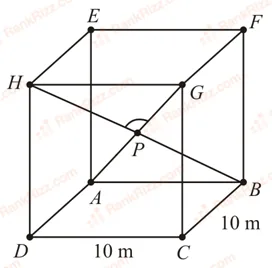
    1. (A)

      525\sqrt{2}

    2. (B)

      535\sqrt{3}

    3. (C)

      5105\sqrt{10}

    4. (D)

      5

    rr2.rankrizz.com/jee-main/maths/vector-algebra/q/26-aug-2021-s2-q78

  35. 155 · JEE MAIN 2021 · 26 AUG S2

    If the projection of the vector i^+2j^+k^\hat{i} + 2\hat{j} + \hat{k} on the sum of the two vectors 2i^+4j^−5k^2\hat{i} + 4\hat{j} - 5\hat{k} and −λi^+2j^+3k^-\lambda\hat{i} + 2\hat{j} + 3\hat{k} is 1, then λ\lambda is equal to _________

    Answer: ____________

    rr2.rankrizz.com/jee-main/maths/vector-algebra/q/26-aug-2021-s2-q89

  36. 156 · JEE MAIN 2021 · 25 JUL S2

    If a⃗\vec{a} and b⃗\vec{b} are unit vectors and (a⃗+3b⃗)\left(\vec{a} + 3\vec{b}\right) is perpendicular to (7a⃗−5b⃗)\left(7\vec{a} - 5\vec{b}\right) and (a⃗−4b⃗)\left(\vec{a} - 4\vec{b}\right) is perpendicular to (7a⃗−2b⃗)\left(7\vec{a} - 2\vec{b}\right), then the angle between a⃗\vec{a} and b⃗\vec{b} (in degrees) is _________.

    Answer: ____________

    rr2.rankrizz.com/jee-main/maths/vector-algebra/q/25-jul-2021-s2-q88

  37. 157 · JEE MAIN 2021 · 20 JUL S1

    Let a⃗,b⃗,c⃗\vec{a}, \vec{b}, \vec{c} be three mutually perpendicular vectors of the same magnitude and equally inclined at an angle θ\theta, with the vector a⃗+b⃗+c⃗\vec{a} + \vec{b} + \vec{c}. Then 36cos⁡22θ36\cos^2 2\theta is equal to ___.

    Answer: ____________

    rr2.rankrizz.com/jee-main/maths/vector-algebra/q/20-jul-2021-s1-q88

  38. 158 · JEE MAIN 2021 · 20 JUL S2

    In a triangle ABCABC, if ∣BC→∣=3|\overrightarrow{BC}| = 3, ∣CA→∣=5|\overrightarrow{CA}| = 5 and ∣BA→∣=7|\overrightarrow{BA}| = 7, then the projection of the vector BA→\overrightarrow{BA} on BC→\overrightarrow{BC} is equal to:

    1. (A)

      192\frac{19}{2}

    2. (B)

      132\frac{13}{2}

    3. (C)

      112\frac{11}{2}

    4. (D)

      152\frac{15}{2}

    rr2.rankrizz.com/jee-main/maths/vector-algebra/q/20-jul-2021-s2-q77

  39. 159 · JEE MAIN 2021 · 20 JUL S2

    For p>0p > 0, a vector v2⃗=2i^+(p+1)j^\vec{v_2} = 2\hat{i} + (p+1)\hat{j} is obtained by rotating the vector v1⃗=3pi^+j^\vec{v_1} = \sqrt{3}p\hat{i} + \hat{j} by an angle θ\theta about origin in counter clockwise direction. If tan⁡θ=(α3−2)(43+3)\tan\theta = \frac{(\alpha\sqrt{3}-2)}{(4\sqrt{3}+3)}, then the value of α\alpha is equal to ___.

    Answer: ____________

    rr2.rankrizz.com/jee-main/maths/vector-algebra/q/20-jul-2021-s2-q90

  40. 160 · JEE MAIN 2021 · 18 MAR S2

    In a triangle ABCABC, if ∣BC→∣=8|\overrightarrow{BC}| = 8, ∣CA→∣=7|\overrightarrow{CA}| = 7, ∣AB→∣=10|\overrightarrow{AB}| = 10, then the projection of the vector AB→\overrightarrow{AB} on AC→\overrightarrow{AC} is equal to :

    1. (A)

      254\frac{25}{4}

    2. (B)

      8514\frac{85}{14}

    3. (C)

      12720\frac{127}{20}

    4. (D)

      11516\frac{115}{16}

    rr2.rankrizz.com/jee-main/maths/vector-algebra/q/18-mar-2021-s2-q78

  41. 161 · JEE MAIN 2021 · 17 MAR S2

    Let x⃗\vec{x} be a vector in the plane containing vectors a⃗=2i^−j^+k^\vec{a} = 2\hat{i} - \hat{j} + \hat{k} and b⃗=i^+2j^−k^\vec{b} = \hat{i} + 2\hat{j} - \hat{k}. If the vector x⃗\vec{x} is perpendicular to (3i^+2j^−k^)(3\hat{i} + 2\hat{j} - \hat{k}) and its projection on a⃗\vec{a} is 1762\frac{17\sqrt{6}}{2}, then the value of ∣x⃗∣2|\vec{x}|^2 is equal to ________.

    Answer: ____________

    rr2.rankrizz.com/jee-main/maths/vector-algebra/q/17-mar-2021-s2-q89

  42. 162 · JEE MAIN 2020 · 06 SEP S2

    If x⃗\vec{x} and y⃗\vec{y} be two non-zero vectors such that ∣x⃗+y⃗∣=∣x⃗∣|\vec{x} + \vec{y}| = |\vec{x}| and 2x⃗+λy⃗2\vec{x} + \lambda\vec{y} is perpendicular to y⃗\vec{y}, then the value of λ\lambda is_____.

    Answer: ____________

    rr2.rankrizz.com/jee-main/maths/vector-algebra/q/6-sep-2020-s2-q75

  43. 163 · JEE MAIN 2020 · 05 SEP S2

    Let the vectors a⃗\vec{a}, b⃗\vec{b}, c⃗\vec{c} be such that ∣a⃗∣=2|\vec{a}| = 2, ∣b⃗∣=4|\vec{b}| = 4 and ∣c⃗∣=4|\vec{c}| = 4. If the projection of b⃗\vec{b} on a⃗\vec{a} is equal to the projection of c⃗\vec{c} on a⃗\vec{a} and b⃗\vec{b} is perpendicular to c⃗\vec{c}, then the value of ∣a⃗+b⃗−c⃗∣|\vec{a} + \vec{b} - \vec{c}| is...

    Answer: ____________

    rr2.rankrizz.com/jee-main/maths/vector-algebra/q/5-sep-2020-s2-q74

  44. 164 · JEE MAIN 2020 · 03 SEP S2

    Let a,b,c∈Ra, b, c \in R be such that a2+b2+c2=1a^2 + b^2 + c^2 = 1. If acos⁡θ=bcos⁡(θ+2π3)=ccos⁡(θ+4π3)a\cos\theta = b\cos\left(\theta + \frac{2\pi}{3}\right) = c\cos\left(\theta + \frac{4\pi}{3}\right), where θ=π9\theta = \frac{\pi}{9}, then the angle between the vectors ai^+bj^+ck^a\hat{i} + b\hat{j} + c\hat{k} and bi^+cj^+ak^b\hat{i} + c\hat{j} + a\hat{k} is:

    1. (A)

      0

    2. (B)

      2π3\frac{2\pi}{3}

    3. (C)

      π2\frac{\pi}{2}

    4. (D)

      π9\frac{\pi}{9}

    rr2.rankrizz.com/jee-main/maths/vector-algebra/q/3-sep-2020-s2-q68

  45. 165 · JEE MAIN 2020 · 02 SEP S1

    Let a⃗\vec{a}, b⃗\vec{b} and c⃗\vec{c} be three unit vectors such that ∣a⃗−b⃗∣2+∣a⃗−c⃗∣2=8|\vec{a} - \vec{b}|^2 + |\vec{a} - \vec{c}|^2 = 8. Then ∣a⃗+2b⃗∣2+∣a⃗+2c⃗∣2|\vec{a} + 2\vec{b}|^2 + |\vec{a} + 2\vec{c}|^2 is equal to ___________.

    Answer: ____________

    rr2.rankrizz.com/jee-main/maths/vector-algebra/q/2-sep-2020-s1-q75

  46. 166 · JEE MAIN 2020 · 07 JAN S1

    A vector a⃗=αi^+2j^+βk^\vec{a} = \alpha\hat{i} + 2\hat{j} + \beta\hat{k} (α,β∈R)(\alpha, \beta \in R) lies in the plane of the vectors, b⃗=i^+j^\vec{b} = \hat{i} + \hat{j} and c⃗=i^−j^+4k^\vec{c} = \hat{i} - \hat{j} + 4\hat{k}. If a⃗\vec{a} bisects the angle between b⃗\vec{b} and c⃗\vec{c}, then

    1. (A)

      a⃗⋅i^+3=0\vec{a} \cdot \hat{i} + 3 = 0

    2. (B)

      a⃗⋅i^+1=0\vec{a} \cdot \hat{i} + 1 = 0

    3. (C)

      a⃗⋅k^+2=0\vec{a} \cdot \hat{k} + 2 = 0

    4. (D)

      a⃗⋅k^+4=0\vec{a} \cdot \hat{k} + 4 = 0

    rr2.rankrizz.com/jee-main/maths/vector-algebra/q/7-jan-2020-s1-q68

  47. 167 · JEE MAIN 2019 · 10 APR S1

    Let A(3, 0, -1), B(2, 10, 6) and C(1, 2, 1) be the vertices of a triangle and M be the mid-point of AC. If G divides BM in the ratio, 2 : 1, then cos⁡(∠GOA)\cos(\angle GOA) (O being the origin) is equal to

    1. (A)

      130\frac{1}{\sqrt{30}}

    2. (B)

      1610\frac{1}{6\sqrt{10}}

    3. (C)

      115\frac{1}{\sqrt{15}}

    4. (D)

      1215\frac{1}{2\sqrt{15}}

    rr2.rankrizz.com/jee-main/maths/vector-algebra/q/10-apr-2019-s1-q87

  48. 168 · JEE MAIN 2019 · 09 APR S2

    If a unit vector a⃗\vec{a} makes angles π3\frac{\pi}{3} with i^\hat{i}, π4\frac{\pi}{4} with j^\hat{j} and θ∈(0,π)\theta \in (0, \pi) with k^\hat{k}, then a value of θ\theta is:

    1. (A)

      5π6\frac{5\pi}{6}

    2. (B)

      5π12\frac{5\pi}{12}

    3. (C)

      π4\frac{\pi}{4}

    4. (D)

      2π3\frac{2\pi}{3}

    rr2.rankrizz.com/jee-main/maths/vector-algebra/q/9-apr-2019-s2-q87

  49. 169 · JEE MAIN 2019 · 08 APR S1

    The magnitude of the projection of the vector 2i^+3j^+k^2\hat{i} + 3\hat{j} + \hat{k} on the vector perpendicular to the plane containing the vectors i^+j^+k^\hat{i} + \hat{j} + \hat{k} and i^+2j^+3k^\hat{i} + 2\hat{j} + 3\hat{k}, is:

    1. (A)

      363\sqrt{6}

    2. (B)

      32\sqrt{\frac{3}{2}}

    3. (C)

      6\sqrt{6}

    4. (D)

      32\frac{\sqrt{3}}{2}

    rr2.rankrizz.com/jee-main/maths/vector-algebra/q/8-apr-2019-s1-q87

  50. 170 · JEE MAIN 2019 · 11 JAN S2

    Let 3i^+j^\sqrt{3}\hat{i} + \hat{j}, i^+3j^\hat{i} + \sqrt{3}\hat{j} and βi^+(1−β)j^\beta\hat{i} + (1 - \beta)\hat{j} respectively be the position vectors of the points A, B and C with respect to the origin O. If the distance of C from the bisector of the acute angle between OA and OB is 32\frac{\sqrt{3}}{\sqrt{2}}, then the sum of all possible values of β\beta is:

    1. (A)

      4

    2. (B)

      3

    3. (C)

      2

    4. (D)

      1

    rr2.rankrizz.com/jee-main/maths/vector-algebra/q/11-jan-2019-s2-q86

  51. 171 · JEE MAIN 2019 · 10 JAN S1

    Let a⃗=2i^+λ1j^+3k^\vec{a} = 2\hat{i} + \lambda_1\hat{j} + 3\hat{k}, b⃗=4i^+(3−λ2)j^+6k^\vec{b} = 4\hat{i} + (3-\lambda_2)\hat{j} + 6\hat{k} and c⃗=3i^+6j^+(λ3−1)k^\vec{c} = 3\hat{i} + 6\hat{j} + (\lambda_3 - 1)\hat{k} be three vectors such that b⃗=2a⃗\vec{b} = 2\vec{a} and a⃗\vec{a} is perpendicular to c⃗\vec{c}. Then a possible value of (λ1,λ2,λ3)(\lambda_1, \lambda_2, \lambda_3) is:

    1. (A)

      (−12,4,0)\left(-\frac{1}{2}, 4, 0\right)

    2. (B)

      (1,5,1)(1, 5, 1)

    3. (C)

      (12,4,−2)\left(\frac{1}{2}, 4, -2\right)

    4. (D)

      (1,3,1)(1, 3, 1)

    rr2.rankrizz.com/jee-main/maths/vector-algebra/q/10-jan-2019-s1-q87

  52. 172 · JEE MAIN 2019 · 09 JAN S2

    Let a⃗=i^+j^+2k^\vec{a} = \hat{i} + \hat{j} + \sqrt{2}\hat{k}, b⃗=b1i^+b2j^+2k^\vec{b} = b_1\hat{i} + b_2\hat{j} + \sqrt{2}\hat{k} and c⃗=5i^+j^+2k^\vec{c} = 5\hat{i} + \hat{j} + \sqrt{2}\hat{k} be three vectors such that the projection vector of b⃗\vec{b} on a⃗\vec{a} is ∣a⃗∣|\vec{a}|. If a⃗+b⃗\vec{a} + \vec{b} is perpendicular to c⃗\vec{c}, then ∣b⃗∣|\vec{b}| is equal to:

    1. (A)

      22\sqrt{22}

    2. (B)

      32\sqrt{32}

    3. (C)

      6

    4. (D)

      4

    rr2.rankrizz.com/jee-main/maths/vector-algebra/q/9-jan-2019-s2-q87

  53. 173 · JEE MAIN 2018 · 08 APR OFFLINE

    Let u⃗\vec{u} be a vector coplanar with the vectors a⃗=2i^+3j^−k^\vec{a} = 2\hat{i} + 3\hat{j} - \hat{k} and b⃗=j^+k^\vec{b} = \hat{j} + \hat{k}. If u⃗\vec{u} is perpendicular to a⃗\vec{a} and u⃗⋅b⃗=24\vec{u} \cdot \vec{b} = 24, then ∣u⃗∣2|\vec{u}|^2 is equal to:

    1. (A)

      84

    2. (B)

      336

    3. (C)

      315

    4. (D)

      256

    rr2.rankrizz.com/jee-main/maths/vector-algebra/q/8-apr-2018-offline-q87

  54. 174 · JEE MAIN 2016 · 09 APR ONLINE

    In a triangle ABCABC, right angle at vertex AA, if the position vectors of AA, BB and CC are respectively 3i^+j^−k^3\hat{i} + \hat{j} - \hat{k}, −i^+3j^+pk^-\hat{i} + 3\hat{j} + p\hat{k} and 5i^+qj^−4k^5\hat{i} + q\hat{j} - 4\hat{k}, then the point (p,q)(p, q) lies on a line:

    1. (A)

      Making an obtuse angle with the positive direction of xx-axis

    2. (B)

      Parallel to xx-axis

    3. (C)

      Parallel to yy-axis

    4. (D)

      Making an acute angle with the positive direction of xx-axis

    rr2.rankrizz.com/jee-main/maths/vector-algebra/q/9-apr-2016-online-q87

  55. 175 · JEE MAIN 2015 · 11 APR ONLINE

    In a parallelogram ABCDABCD, ∣AB→∣=a\left|\overrightarrow{AB}\right| = a, ∣AD→∣=b\left|\overrightarrow{AD}\right| = b and ∣AC→∣=c\left|\overrightarrow{AC}\right| = c. DB→⋅AB→\overrightarrow{DB} \cdot \overrightarrow{AB} has the value:

    1. (A)

      12(a2+b2+c2)\frac{1}{2}(a^2 + b^2 + c^2)

    2. (B)

      14(a2+b2−c2)\frac{1}{4}(a^2 + b^2 - c^2)

    3. (C)

      13(b2+c2−a2)\frac{1}{3}(b^2 + c^2 - a^2)

    4. (D)

      12(3a2+b2−c2)\frac{1}{2}(3a^2 + b^2 - c^2)

    rr2.rankrizz.com/jee-main/maths/vector-algebra/q/11-apr-2015-online-q86

  56. 176 · JEE MAIN 2014 · 12 APR ONLINE

    If x^\hat{x}, y^\hat{y} and z^\hat{z} are three unit vectors in threedimensional space, then the minimum value of ∣x^+y^∣2+∣y^+z^∣2+∣z^+x^∣2|\hat{x} + \hat{y}|^2 + |\hat{y} + \hat{z}|^2 + |\hat{z} + \hat{x}|^2

    1. (A)

      32\frac{3}{2}

    2. (B)

      3

    3. (C)

      333\sqrt{3}

    4. (D)

      6

    rr2.rankrizz.com/jee-main/maths/vector-algebra/q/12-apr-2014-online-q87

  57. 177 · JEE MAIN 2014 · 09 APR ONLINE

    If ∣a⃗∣=2|\vec{a}| = 2, ∣b⃗∣=3|\vec{b}| = 3 and ∣2a⃗−b⃗∣=5|2\vec{a} - \vec{b}| = 5, then ∣2a⃗+b⃗∣|2\vec{a} + \vec{b}| equals:

    1. (A)

      5

    2. (B)

      7

    3. (C)

      17

    4. (D)

      1

    rr2.rankrizz.com/jee-main/maths/vector-algebra/q/9-apr-2014-online-q87

  58. 178 · JEE MAIN 2013 · 22 APR ONLINE

    If a^\hat{a}, b^\hat{b} and c^\hat{c} are unit vectors satisfying a^−3b^+c^=0⃗\hat{a} - \sqrt{3}\hat{b} + \hat{c} = \vec{0}, then the angle between the vectors a^\hat{a} and c^\hat{c} is :

    1. (A)

      π4\frac{\pi}{4}

    2. (B)

      π3\frac{\pi}{3}

    3. (C)

      π6\frac{\pi}{6}

    4. (D)

      π2\frac{\pi}{2}

    rr2.rankrizz.com/jee-main/maths/vector-algebra/q/22-apr-2013-online-q88

  59. 179 · JEE MAIN 2013 · 09 APR ONLINE

    Let a⃗=2i^−j^+k^\vec{a} = 2\hat{i} - \hat{j} + \hat{k}, b⃗=i^+2j^−k^\vec{b} = \hat{i} + 2\hat{j} - \hat{k} and c⃗=i^+j^−2k^\vec{c} = \hat{i} + \hat{j} - 2\hat{k} be three vectors. A vector of the type b⃗+λc⃗\vec{b} + \lambda\vec{c} for some scalar λ\lambda, whose projection on a⃗\vec{a} is of magnitude 23\sqrt{\frac{2}{3}} is :

    1. (A)

      2i^+j^+5k^2\hat{i} + \hat{j} + 5\hat{k}

    2. (B)

      2i^+3j^−3k^2\hat{i} + 3\hat{j} - 3\hat{k}

    3. (C)

      2i^−j^+5k^2\hat{i} - \hat{j} + 5\hat{k}

    4. (D)

      2i^+3j^+3k^2\hat{i} + 3\hat{j} + 3\hat{k}

    rr2.rankrizz.com/jee-main/maths/vector-algebra/q/9-apr-2013-online-q86

  60. 180 · JEE MAIN 2012

    Let a^\hat{a} and b^\hat{b} be two unit vectors. If the vectors c⃗=a^+2b^\vec{c} = \hat{a} + 2\hat{b} and d⃗=5a^−4b^\vec{d} = 5\hat{a} - 4\hat{b} are perpendicular to each other, then the angle between a^\hat{a} and b^\hat{b} is

    1. (A)

      π6\frac{\pi}{6}

    2. (B)

      π2\frac{\pi}{2}

    3. (C)

      π3\frac{\pi}{3}

    4. (D)

      π4\frac{\pi}{4}

    rr2.rankrizz.com/jee-main/maths/vector-algebra/q/2012-maths-499111

  61. 181 · JEE MAIN 2012

    If a⃗+b⃗+c⃗=0\vec{a} + \vec{b} + \vec{c} = 0, ∣a⃗∣=3|\vec{a}| = 3, ∣b⃗∣=5|\vec{b}| = 5 and ∣c⃗∣=7|\vec{c}| = 7, then the angle between a⃗\vec{a} and b⃗\vec{b} is

    1. (A)

      π3\frac{\pi}{3}

    2. (B)

      π4\frac{\pi}{4}

    3. (C)

      π6\frac{\pi}{6}

    4. (D)

      π2\frac{\pi}{2}

    rr2.rankrizz.com/jee-main/maths/vector-algebra/q/2012-maths-499374

  62. 182 · JEE MAIN 2010

    If the vectors a⃗=i^−j^+2k^\vec{a} = \hat{i} - \hat{j} + 2\hat{k}, b⃗=2i^+4j^+k^\vec{b} = 2\hat{i} + 4\hat{j} + \hat{k} and c⃗=λi^+j^+μk^\vec{c} = \lambda \hat{i} + \hat{j} + \mu \hat{k} are mutually orthogonal, then (λ,μ)=(\lambda, \mu) =

    1. (A)

      (2,−3)(2, -3)

    2. (B)

      (−2,3)(-2, 3)

    3. (C)

      (3,−2)(3, -2)

    4. (D)

      (−3,2)(-3, 2)

    rr2.rankrizz.com/jee-main/maths/vector-algebra/q/2010-maths-499735

  63. 183 · JEE MAIN 2006

    The values of aa, for which the points A,B,CA, B, C with position vectors 2i^−j^+k^,i^−3j^−5k^2\hat{i} - \hat{j} + \hat{k}, \hat{i} - 3\hat{j} - 5\hat{k} and ai^−3j^+k^a\hat{i} - 3\hat{j} + \hat{k} respectively are the vertices of a right-angled triangle with C=π2C = \dfrac{\pi}{2} are

    1. (A)

      2 and 1

    2. (B)

      −2-2 and −1-1

    3. (C)

      −2-2 and 1

    4. (D)

      2 and −1-1

    rr2.rankrizz.com/jee-main/maths/vector-algebra/q/2006-maths-500115

  64. 184 · JEE MAIN 2004

    A particle is acted upon by constant forces 4i^+j^−3k^4\hat{i} + \hat{j} - 3\hat{k} and 3i^+j^−k^3\hat{i} + \hat{j} - \hat{k} which displace it from a point i^+2j^+3k^\hat{i} + 2\hat{j} + 3\hat{k} to the point 5i^+4j^+k^5\hat{i} + 4\hat{j} + \hat{k}. The work done in standard units by the forces is given by

    1. (A)

      4040

    2. (B)

      3030

    3. (C)

      2525

    4. (D)

      1515

    rr2.rankrizz.com/jee-main/maths/vector-algebra/q/2004-maths-500541

Scalar triple product and coplanarity 61

  1. 185 · JEE MAIN 2026 · 06 APR S1

    If a⃗=i^+j^+k^\vec{a} = \hat{i} + \hat{j} + \hat{k}, b⃗=j^−k^\vec{b} = \hat{j} - \hat{k} and c⃗\vec{c} be three vectors such that a⃗×c⃗=b⃗\vec{a} \times \vec{c} = \vec{b} and a⃗⋅c⃗=3\vec{a} \cdot \vec{c} = 3, then c⃗⋅(a⃗−2b⃗)\vec{c} \cdot (\vec{a} - 2\vec{b}) is equal to _______.

    Answer: ____________

    rr2.rankrizz.com/jee-main/maths/vector-algebra/q/6-apr-2026-s1-q23

  2. 186 · JEE MAIN 2026

    The vectors 5i^+j^+k^,i^+5j^+k^5\hat{i}+\hat{j}+\hat{k}, \hat{i}+5\hat{j}+\hat{k} and i^+j^+5k^\hat{i}+\hat{j}+5\hat{k} are the three face diagonals of three faces having a common vertex in a parallelopiped. What is the volume of the parallelopiped?

    1. (A)

      2828

    2. (B)

      5656

    3. (C)

      112112

    4. (D)

      1414

    rr2.rankrizz.com/jee-main/maths/vector-algebra/q/2026-maths-516111

  3. 187 · JEE MAIN 2025 · 23 JAN S1

    Let the position vectors of the vertices A, B and C of a tetrahedron ABCD be i^+2j^+k^,i^+3j^−2k^\widehat{i}+2\widehat{j}+\widehat{k},\widehat{i}+3\widehat{j}-2\widehat{k} and 2i^+j^−k^2\widehat{i}+\widehat{j}-\widehat{k} respectively. The altitude from the vertex D to the opposite face ABC meets the median line segment through AA of the triangle ABC at the point . If the length of AD is 1103\frac{\sqrt{110}}{3} and the volume of the tetrahedron is 80562\frac{\sqrt{805}}{6\sqrt{2}}, then the position vector of is

    1. (A)

      112(7i^+4j^+3k^)\frac{1}{12}\left(7\widehat{i}+4\widehat{j}+3\widehat{k}\right)

    2. (B)

      12(i^+4j^+7k^)\frac{1}{2}\left(\widehat{i}+4\widehat{j}+7\widehat{k}\right)

    3. (C)

      16(12i^+12j^+k^)\frac{1}{6}\left(12\widehat{i}+12\widehat{j}+\widehat{k}\right)

    4. (D)

      16(7i^+12j^+k^)\frac{1}{6}\left(7\widehat{i}+12\widehat{j}+\widehat{k}\right)

    rr2.rankrizz.com/jee-main/maths/vector-algebra/q/23-jan-2025-s1-q3

  4. 188 · JEE MAIN 2024 · 04 APR S2

    Let a⃗=i^+j^+k^\vec{a} = \hat{i} + \hat{j} + \hat{k}, b⃗=2i^+4j^−5k^\vec{b} = 2\hat{i} + 4\hat{j} - 5\hat{k} and c⃗=xi^+2j^+3k^\vec{c} = x\hat{i} + 2\hat{j} + 3\hat{k}, x∈Rx \in \mathbb{R}. If d⃗\vec{d} is the unit vector in the direction of b⃗+c⃗\vec{b} + \vec{c} such that a⃗⋅d⃗=1\vec{a} \cdot \vec{d} = 1, then (a⃗×b⃗)⋅c⃗(\vec{a} \times \vec{b}) \cdot \vec{c} is equal to

    1. (A)

      11

    2. (B)

      3

    3. (C)

      9

    4. (D)

      6

    rr2.rankrizz.com/jee-main/maths/vector-algebra/q/04-apr-2024-s2-q78

  5. 189 · JEE MAIN 2024 · 27 JAN S1

    If a⃗=i^+2j^+k^\vec{a} = \hat{i} + 2\hat{j} + \hat{k}, b⃗=3(i^−j^+k^)\vec{b} = 3(\hat{i} - \hat{j} + \hat{k}) and c⃗\vec{c} be the vector such that a⃗×c⃗=b⃗\vec{a} \times \vec{c} = \vec{b} and a⃗⋅c⃗=3\vec{a} \cdot \vec{c} = 3, then a⃗⋅((c⃗×b⃗)−b⃗−c⃗)\vec{a} \cdot ((\vec{c} \times \vec{b}) - \vec{b} - \vec{c}) is equal to

    1. (A)

      32

    2. (B)

      24

    3. (C)

      20

    4. (D)

      36

    rr2.rankrizz.com/jee-main/maths/vector-algebra/q/27-jan-2024-s1-q78

  6. 190 · JEE MAIN 2023 · 15 APR S1

    Let SS be the set of all (λ,μ)(\lambda, \mu) for which the vectors λi^−j^+k^\lambda\hat{i} - \hat{j} + \hat{k}, i^+2j^+μk^\hat{i} + 2\hat{j} + \mu\hat{k} and 3i^−4j^+5k^3\hat{i} - 4\hat{j} + 5\hat{k}, where λ−μ=5\lambda - \mu = 5, are coplanar, then ∑(λ,μ)∈S80(λ2+μ2)\sum_{(\lambda,\mu) \in S} 80(\lambda^2 + \mu^2) is equal to

    1. (A)

      22102210

    2. (B)

      21302130

    3. (C)

      22902290

    4. (D)

      23702370

    rr2.rankrizz.com/jee-main/maths/vector-algebra/q/15-apr-2023-s1-q76

  7. 191 · JEE MAIN 2023 · 12 APR S1

    Let a, b, c be three distinct real numbers, none equal to one. If the vectors ai^+j^+k^a\hat{i} + \hat{j} + \hat{k}, i^+bj^+k^\hat{i} + b\hat{j} + \hat{k} and i^+j^+ck^\hat{i} + \hat{j} + c\hat{k} are coplanar, then 11−a+11−b+11−c\frac{1}{1-a} + \frac{1}{1-b} + \frac{1}{1-c} is equal to

    1. (A)

      22

    2. (B)

      −1-1

    3. (C)

      −2-2

    4. (D)

      11

    rr2.rankrizz.com/jee-main/maths/vector-algebra/q/12-apr-2023-s1-q76

  8. 192 · JEE MAIN 2023 · 12 APR S1

    Let λ∈Z\lambda \in \mathbb{Z}, a⃗=λi^+j^−k^\vec{a} = \lambda \hat{i} + \hat{j} - \hat{k} and b⃗=3i^−j^+2k^\vec{b} = 3\hat{i} - \hat{j} + 2\hat{k}. Let c⃗\vec{c} be a vector such that (a⃗+b⃗)×c⃗=0(\vec{a} + \vec{b}) \times \vec{c} = 0, a⃗⋅c⃗=−17\vec{a} \cdot \vec{c} = -17 and b⃗⋅c⃗=−20\vec{b} \cdot \vec{c} = -20. Then ∣c⃗×(λi^+j^+k^)∣2|\vec{c} \times (\lambda\hat{i} + \hat{j} + \hat{k})|^2 is equal to

    1. (A)

      4646

    2. (B)

      5353

    3. (C)

      6262

    4. (D)

      4949

    rr2.rankrizz.com/jee-main/maths/vector-algebra/q/12-apr-2023-s1-q77

  9. 193 · JEE MAIN 2023 · 11 APR S2

    If four distinct points with position vectors a⃗,b⃗,c⃗\vec{a}, \vec{b}, \vec{c} and d⃗\vec{d} are coplanar, then [a⃗b⃗c⃗][\vec{a}\vec{b}\vec{c}] is equal to

    1. (A)

      [d⃗b⃗a⃗]+[a⃗c⃗d⃗]+[d⃗b⃗c⃗][\vec{d}\vec{b}\vec{a}] + [\vec{a}\vec{c}\vec{d}] + [\vec{d}\vec{b}\vec{c}]

    2. (B)

      [a⃗d⃗b⃗]+[d⃗c⃗a⃗]+[d⃗b⃗c⃗][\vec{a}\vec{d}\vec{b}] + [\vec{d}\vec{c}\vec{a}] + [\vec{d}\vec{b}\vec{c}]

    3. (C)

      [d⃗c⃗a⃗]+[b⃗d⃗a⃗]+[c⃗d⃗b⃗][\vec{d}\vec{c}\vec{a}] + [\vec{b}\vec{d}\vec{a}] + [\vec{c}\vec{d}\vec{b}]

    4. (D)

      [b⃗c⃗d⃗]+[d⃗a⃗c⃗]+[d⃗b⃗a⃗][\vec{b}\vec{c}\vec{d}] + [\vec{d}\vec{a}\vec{c}] + [\vec{d}\vec{b}\vec{a}]

    rr2.rankrizz.com/jee-main/maths/vector-algebra/q/11-apr-2023-s2-q78

  10. 194 · JEE MAIN 2023 · 08 APR S2

    Let the vectors u⃗1=i^+j^+ak^\vec{u}_1 = \hat{i} + \hat{j} + a\hat{k}, u⃗2=i^+bj^+k^\vec{u}_2 = \hat{i} + b\hat{j} + \hat{k}, and u⃗3=ci^+j^+k^\vec{u}_3 = c\hat{i} + \hat{j} + \hat{k} be coplanar. If the vectors v⃗1=(a+b)i^+cj^+ck^\vec{v}_1 = (a+b)\hat{i} + c\hat{j} + c\hat{k}, v⃗2=ai^+(b+c)j^+ak^\vec{v}_2 = a\hat{i} + (b+c)\hat{j} + a\hat{k} and v⃗3=bi^+bj^+(c+a)k^\vec{v}_3 = b\hat{i} + b\hat{j} + (c+a)\hat{k} are also coplanar, then 6(a+b+c)6(a + b + c) is equal to

    1. (A)

      0

    2. (B)

      4

    3. (C)

      12

    4. (D)

      6

    rr2.rankrizz.com/jee-main/maths/vector-algebra/q/08-apr-2023-s2-q78

  11. 195 · JEE MAIN 2023 · 06 APR S1

    Let the position vectors of the points A, B, C and D be 5i^+5j^+2λk^5\hat{i} + 5\hat{j} + 2\lambda\hat{k}, i^+2j^+3k^\hat{i} + 2\hat{j} + 3\hat{k}, −2i^+λj^+4k^-2\hat{i} + \lambda\hat{j} + 4\hat{k} and −i^+5j^+6k^-\hat{i} + 5\hat{j} + 6\hat{k}. Let the set S={λ∈RS = \{\lambda \in \mathbb{R}: the points A, B, C and D are coplanar}\}. The ∑λ∈S(λ+2)2\sum_{\lambda \in S} (\lambda + 2)^2 is equal to

    1. (A)

      25

    2. (B)

      372\dfrac{37}{2}

    3. (C)

      14

    4. (D)

      41

    rr2.rankrizz.com/jee-main/maths/vector-algebra/q/6-apr-2023-s1-q76

  12. 196 · JEE MAIN 2023 · 06 APR S2

    Let the vectors a⃗,b⃗,c⃗\vec{a}, \vec{b}, \vec{c} represent three coterminous edges of a parallelopiped of volume VV. Then the volume of the parallelopiped, whose coterminous edges are represented by a⃗,b⃗+c⃗\vec{a}, \vec{b}+\vec{c} and a⃗+2b⃗+3c⃗\vec{a}+2\vec{b}+3\vec{c} is equal to

    1. (A)

      2V2V

    2. (B)

      6V6V

    3. (C)

      VV

    4. (D)

      3V3V

    rr2.rankrizz.com/jee-main/maths/vector-algebra/q/6-apr-2023-s2-q76

  13. 197 · JEE MAIN 2023 · 06 APR S2

    The sum of all values of α\alpha, for which the points whose position vectors are i^−2j^+3k^\hat{i} - 2\hat{j} + 3\hat{k}, 2i^−3j^+4k^2\hat{i} - 3\hat{j} + 4\hat{k}, (α+1)i^+2k^(\alpha+1)\hat{i} + 2\hat{k} and 9i^+(α−8)j^+6k^9\hat{i} + (\alpha-8)\hat{j} + 6\hat{k} are coplanar, is equal to

    1. (A)

      -2

    2. (B)

      2

    3. (C)

      6

    4. (D)

      4

    rr2.rankrizz.com/jee-main/maths/vector-algebra/q/6-apr-2023-s2-q77

  14. 198 · JEE MAIN 2023 · 01 FEB S1

    Let v⃗=αi^+2j^−3k^\vec{v} = \alpha\hat{i} + 2\hat{j} - 3\hat{k}, w⃗=2αi^+j^−k^\vec{w} = 2\alpha\hat{i} + \hat{j} - \hat{k}, and u⃗\vec{u} be a vector such that ∣u⃗∣=α>0|\vec{u}| = \alpha > 0. If the minimum value of the scalar triple product [u⃗ v⃗ w⃗][\vec{u}\ \vec{v}\ \vec{w}] is −α3401-\alpha\sqrt{3401}, and ∣u⃗⋅i^∣2=mn|\vec{u} \cdot \hat{i}|^2 = \frac{m}{n} where mm and nn are coprime natural numbers, then m+nm + n is equal to _____.

    Answer: ____________

    rr2.rankrizz.com/jee-main/maths/vector-algebra/q/01-feb-2023-s1-q89

  15. 199 · JEE MAIN 2023 · 30 JAN S1

    If a⃗\vec{a}, b⃗\vec{b}, c⃗\vec{c} are three non-zero vectors and n^\hat{n} is a unit vector perpendicular to c⃗\vec{c} such that a⃗=αb⃗−n^\vec{a} = \alpha\vec{b} - \hat{n}, α≠0\alpha \neq 0 and b⃗⋅c⃗=12\vec{b} \cdot \vec{c} = 12, then c⃗×(a⃗×b⃗)\vec{c} \times (\vec{a} \times \vec{b}) is equal to:

    1. (A)

      1515

    2. (B)

      99

    3. (C)

      1212

    4. (D)

      66

    rr2.rankrizz.com/jee-main/maths/vector-algebra/q/30-jan-2023-s1-q76

  16. 200 · JEE MAIN 2023 · 30 JAN S2

    Let λ∈R\lambda \in \mathbb{R}, a⃗=λi^+2j^−3k^\vec{a} = \lambda\hat{i} + 2\hat{j} - 3\hat{k}, b⃗=i^−λj^+2k^\vec{b} = \hat{i} - \lambda\hat{j} + 2\hat{k}. If ((a⃗+b⃗)×(a⃗×b⃗))×(a⃗−b⃗)=8i^−40j^−24k^\left((\vec{a}+\vec{b}) \times (\vec{a} \times \vec{b})\right) \times (\vec{a}-\vec{b}) = 8\hat{i} - 40\hat{j} - 24\hat{k} then ∣λ(a⃗+b⃗)×(a⃗−b⃗)∣2\left|\lambda(\vec{a}+\vec{b}) \times (\vec{a}-\vec{b})\right|^2 is equal to

    1. (A)

      140140

    2. (B)

      132132

    3. (C)

      144144

    4. (D)

      136136

    rr2.rankrizz.com/jee-main/maths/vector-algebra/q/30-jan-2023-s2-q77

  17. 201 · JEE MAIN 2023 · 29 JAN S1

    Let a⃗,b⃗\vec{a}, \vec{b} and c⃗\vec{c} be three non-zero non-coplanar vectors. Let the position vectors of four points AA, BB, CC and DD be a⃗−b⃗+c⃗\vec{a} - \vec{b} + \vec{c}, λa⃗−3b⃗+4c⃗\lambda\vec{a} - 3\vec{b} + 4\vec{c}, −a⃗+2b⃗−3c⃗-\vec{a} + 2\vec{b} - 3\vec{c} and 2a⃗−4b⃗+6c⃗2\vec{a} - 4\vec{b} + 6\vec{c} respectively. If AB⃗\vec{AB}, AC⃗\vec{AC} and AD⃗\vec{AD} are coplanar, then λ\lambda is:

    Answer: ____________

    rr2.rankrizz.com/jee-main/maths/vector-algebra/q/29-jan-2023-s1-q88

  18. 202 · JEE MAIN 2023 · 25 JAN S1

    Let a⃗,b⃗\vec{a}, \vec{b} and c⃗\vec{c} be three non zero vectors such that b⃗⋅c⃗=0\vec{b} \cdot \vec{c} = 0 and a⃗×(b⃗×c⃗)=b⃗−c⃗2\vec{a} \times (\vec{b} \times \vec{c}) = \frac{\vec{b} - \vec{c}}{2}. If d⃗\vec{d} be a vector such that b⃗⋅d⃗=a⃗⋅b⃗\vec{b} \cdot \vec{d} = \vec{a} \cdot \vec{b}, then (a⃗×b⃗)⋅(c⃗×d⃗)(\vec{a} \times \vec{b}) \cdot (\vec{c} \times \vec{d}) is equal to

    1. (A)

      32\frac{3}{2}

    2. (B)

      12\frac{1}{2}

    3. (C)

      -14\frac{1}{4}

    4. (D)

      14\frac{1}{4}

    rr2.rankrizz.com/jee-main/maths/vector-algebra/q/25-jan-2023-s1-q87

  19. 203 · JEE MAIN 2023 · 25 JAN S2

    If the four points, whose position vectors are 3i^−4j^+2k^3\hat{i} - 4\hat{j} + 2\hat{k}, i^+2j^−k^\hat{i} + 2\hat{j} - \hat{k}, −2i^−j^+3k^-2\hat{i} - \hat{j} + 3\hat{k} and 5i^−2αj^+4k^5\hat{i} - 2\alpha\hat{j} + 4\hat{k} are coplanar, then α\alpha is equal to

    1. (A)

      7317\frac{73}{17}

    2. (B)

      −10717-\frac{107}{17}

    3. (C)

      −7317-\frac{73}{17}

    4. (D)

      10717\frac{107}{17}

    rr2.rankrizz.com/jee-main/maths/vector-algebra/q/25-jan-2023-s2-q76

  20. 204 · JEE MAIN 2023 · 25 JAN S2

    Let a⃗=−i^−j^+k^\vec{a} = -\hat{i} - \hat{j} + \hat{k}, a⃗⋅b⃗=1\vec{a} \cdot \vec{b} = 1 and a⃗×b⃗=i^−j^\vec{a} \times \vec{b} = \hat{i} - \hat{j}. Then a⃗−6b⃗\vec{a} - 6\vec{b} is equal to

    1. (A)

      3(i^−j^−k^)3(\hat{i} - \hat{j} - \hat{k})

    2. (B)

      3(i^+j^+k^)3(\hat{i} + \hat{j} + \hat{k})

    3. (C)

      3(i^−j^+k^)3(\hat{i} - \hat{j} + \hat{k})

    4. (D)

      3(i^+j^−k^)3(\hat{i} + \hat{j} - \hat{k})

    rr2.rankrizz.com/jee-main/maths/vector-algebra/q/25-jan-2023-s2-q77

  21. 205 · JEE MAIN 2023 · 24 JAN S1

    Let u⃗=i^−j^−2k^\vec{u} = \hat{i} - \hat{j} - 2\hat{k}, v⃗=2i^+j^−k^\vec{v} = 2\hat{i} + \hat{j} - \hat{k}, v⃗⋅w⃗=2\vec{v} \cdot \vec{w} = 2 and v⃗×w⃗=u⃗+λv⃗\vec{v} \times \vec{w} = \vec{u} + \lambda\vec{v}, then u⃗⋅w⃗\vec{u} \cdot \vec{w} is equal to

    1. (A)

      1

    2. (B)

      32\frac{3}{2}

    3. (C)

      2

    4. (D)

      −23-\frac{2}{3}

    rr2.rankrizz.com/jee-main/maths/vector-algebra/q/24-jan-2023-s1-q76

  22. 206 · JEE MAIN 2023 · 24 JAN S1

    Let u⃗=i^−j^−2k^\vec{u} = \hat{i} - \hat{j} - 2\hat{k}, v⃗=2i^+j^−k^\vec{v} = 2\hat{i} + \hat{j} - \hat{k}, v⃗⋅w⃗=2\vec{v} \cdot \vec{w} = 2 and v⃗×w⃗=u⃗+λv⃗\vec{v} \times \vec{w} = \vec{u} + \lambda\vec{v}, then u⃗⋅w⃗\vec{u} \cdot \vec{w} is equal to

    1. (A)

      1

    2. (B)

      32\frac{3}{2}

    3. (C)

      2

    4. (D)

      −23-\frac{2}{3}

    rr2.rankrizz.com/jee-main/maths/vector-algebra/q/24-jan-2023-s1-q76-494109

  23. 207 · JEE MAIN 2022 · 29 JUL S1

    Let a⃗=3i^+j^\vec{a} = 3\hat{i} + \hat{j} and b⃗=i^+2j^+k^\vec{b} = \hat{i} + 2\hat{j} + \hat{k}. Let c⃗\vec{c} be a vector satisfying a⃗×(b⃗×c⃗)=b⃗+λc⃗\vec{a} \times (\vec{b} \times \vec{c}) = \vec{b} + \lambda\vec{c}. If b⃗\vec{b} and c⃗\vec{c} are non-parallel, then the value of λ\lambda is

    1. (A)

      -5

    2. (B)

      5

    3. (C)

      1

    4. (D)

      -1

    rr2.rankrizz.com/jee-main/maths/vector-algebra/q/29-jul-2022-s1-q77

  24. 208 · JEE MAIN 2022 · 27 JUL S1

    Let a⃗=2i^−j^+5k^\vec{a} = 2\hat{i} - \hat{j} + 5\hat{k} and b⃗=αi^+βj^+2k^\vec{b} = \alpha \hat{i} + \beta \hat{j} + 2\hat{k}. If ((a⃗×b⃗)×i^)⋅k^=232\left(\left(\vec{a} \times \vec{b}\right) \times \hat{i}\right) \cdot \hat{k} = \frac{23}{2}, then ∣b⃗×2j^∣\left|\vec{b} \times 2\hat{j}\right| is equal to

    1. (A)

      44

    2. (B)

      55

    3. (C)

      21\sqrt{21}

    4. (D)

      17\sqrt{17}

    rr2.rankrizz.com/jee-main/maths/vector-algebra/q/27-jul-2022-s1-q78

  25. 209 · JEE MAIN 2022 · 26 JUN S1

    If a⃗⋅b⃗=1,b⃗⋅c⃗=2\vec{a} \cdot \vec{b} = 1, \vec{b} \cdot \vec{c} = 2 and c⃗⋅a⃗=3\vec{c} \cdot \vec{a} = 3, then the value of [a⃗×(b⃗×c⃗),b⃗×(c⃗×a⃗),c⃗×(b⃗×a⃗)]\left[\vec{a} \times (\vec{b} \times \vec{c}), \vec{b} \times (\vec{c} \times \vec{a}), \vec{c} \times (\vec{b} \times \vec{a})\right] is

    1. (A)

      00

    2. (B)

      −6a⃗⋅(b⃗×c⃗)-6\vec{a} \cdot (\vec{b} \times \vec{c})

    3. (C)

      12c⃗⋅(a⃗×b⃗)12\vec{c} \cdot (\vec{a} \times \vec{b})

    4. (D)

      −12b⃗⋅(c⃗×a⃗)-12\vec{b} \cdot (\vec{c} \times \vec{a})

    rr2.rankrizz.com/jee-main/maths/vector-algebra/q/26-jun-2022-s1-q77

  26. 210 · JEE MAIN 2021 · 31 AUG S2

    Let a⃗\vec{a}, b⃗\vec{b}, c⃗\vec{c} be three vectors mutually perpendicular to each other and have same magnitude. If a vector r⃗\vec{r} satisfies a⃗×{(r⃗−b⃗)×a⃗}+b⃗×{(r⃗−c⃗)×b⃗}+c⃗×{(r⃗−a⃗)×c⃗}=0⃗\vec{a} \times \{(\vec{r} - \vec{b}) \times \vec{a}\} + \vec{b} \times \{(\vec{r} - \vec{c}) \times \vec{b}\} + \vec{c} \times \{(\vec{r} - \vec{a}) \times \vec{c}\} = \vec{0}, then r⃗\vec{r} is equal to:

    1. (A)

      13(a⃗+b⃗+c⃗)\frac{1}{3}(\vec{a} + \vec{b} + \vec{c})

    2. (B)

      13(2a⃗+b⃗−c⃗)\frac{1}{3}(2\vec{a} + \vec{b} - \vec{c})

    3. (C)

      12(a⃗+b⃗+c⃗)\frac{1}{2}(\vec{a} + \vec{b} + \vec{c})

    4. (D)

      12(a⃗+b⃗+2c⃗)\frac{1}{2}(\vec{a} + \vec{b} + 2\vec{c})

    rr2.rankrizz.com/jee-main/maths/vector-algebra/q/31-aug-2021-s2-q78

  27. 211 · JEE MAIN 2021 · 26 AUG S1

    Let a⃗=i^+j^+k^\vec{a} = \hat{i} + \hat{j} + \hat{k} and b⃗=j^−k^\vec{b} = \hat{j} - \hat{k}. If c⃗\vec{c} is a vector such that a⃗×c⃗=b⃗\vec{a} \times \vec{c} = \vec{b} and a⃗⋅c⃗=3\vec{a} \cdot \vec{c} = 3, then a⃗⋅(b⃗×c⃗)\vec{a} \cdot (\vec{b} \times \vec{c}) is equal to:

    1. (A)

      6

    2. (B)

      −2-2

    3. (C)

      2

    4. (D)

      −6-6

    rr2.rankrizz.com/jee-main/maths/vector-algebra/q/26-aug-2021-s1-q78

  28. 212 · JEE MAIN 2021 · 27 JUL S2

    Let a⃗,b⃗\vec{a}, \vec{b} and c⃗\vec{c} be three vectors such that a⃗=b⃗×(b⃗×c⃗)\vec{a} = \vec{b} \times (\vec{b} \times \vec{c}). If magnitudes of the vectors a⃗,b⃗\vec{a}, \vec{b} and c⃗\vec{c} are 2,1\sqrt{2}, 1 and 2 respectively and the angle between b⃗\vec{b} and c⃗\vec{c} is θ\theta (0<θ<π2)(0 < \theta < \frac{\pi}{2}), then the value of 1+tan⁡θ1 + \tan \theta is equal to:

    1. (A)

      3+1\sqrt{3} + 1

    2. (B)

      2

    3. (C)

      1

    4. (D)

      3+13\frac{\sqrt{3} + 1}{\sqrt{3}}

    rr2.rankrizz.com/jee-main/maths/vector-algebra/q/27-jul-2021-s2-q78

  29. 213 · JEE MAIN 2021 · 27 JUL S2

    Let a⃗=i^−αj^+βk^\vec{a} = \hat{i} - \alpha\hat{j} + \beta\hat{k}, b⃗=3i^+βj^−αk^\vec{b} = 3\hat{i} + \beta\hat{j} - \alpha\hat{k} and c⃗=−αi^−2j^+k^\vec{c} = -\alpha\hat{i} - 2\hat{j} + \hat{k}, where α\alpha and β\beta are integers. If a⃗⋅b⃗=−1\vec{a} \cdot \vec{b} = -1 and b⃗⋅c⃗=10\vec{b} \cdot \vec{c} = 10, then (a⃗×b⃗)⋅c⃗(\vec{a} \times \vec{b}) \cdot \vec{c} is equal to _________.

    Answer: ____________

    rr2.rankrizz.com/jee-main/maths/vector-algebra/q/27-jul-2021-s2-q89

  30. 214 · JEE MAIN 2021 · 25 JUL S1

    Let the vectors (2+a+b)i^+(a+2b+c)j^ −(b+c)k^(2 + a + b)\hat{i} + (a + 2b+c)\hat{j} - (b + c)\hat{k}, (1 +b)i^+2bj^−bk^(1 + b)\hat{i}+2b\hat{j}-b\hat{k} and (2+b)i^+2bj^+(1−b)k^(2 + b)\hat{i} + 2b\hat{j} + (1 - b)\hat{k}, a,b,c∈Ra, b, c \in R be co-planar. Then which of the following is true?

    1. (A)

      2b=a+c2b = a + c

    2. (B)

      3c=a+b3c = a + b

    3. (C)

      a=b+2ca = b + 2c

    4. (D)

      2a=b+c2a = b + c

    rr2.rankrizz.com/jee-main/maths/vector-algebra/q/25-jul-2021-s1-q78

  31. 215 · JEE MAIN 2021 · 22 JUL S1

    Let a vector a⃗\vec{a} be coplanar with vectors b⃗=2i^+j^+k^\vec{b} = 2\hat{i} + \hat{j} + \hat{k} and c⃗=i^−j^+k^\vec{c} = \hat{i} - \hat{j} + \hat{k}. If a⃗\vec{a} is perpendicular to d⃗=3i^+2j^+6k^\vec{d} = 3\hat{i} + 2\hat{j} + 6\hat{k}, and ∣a⃗∣=10|\vec{a}| = \sqrt{10}. Then a possible value of [a⃗ b⃗ c⃗]+[a⃗ b⃗ d⃗]+[a⃗ c⃗ d⃗][\vec{a} \ \vec{b} \ \vec{c}] + [\vec{a} \ \vec{b} \ \vec{d}] + [\vec{a} \ \vec{c} \ \vec{d}] is equal to:

    1. (A)

      -42

    2. (B)

      -40

    3. (C)

      -29

    4. (D)

      -38

    rr2.rankrizz.com/jee-main/maths/vector-algebra/q/22-jul-2021-s1-q76

  32. 216 · JEE MAIN 2021 · 22 JUL S1

    Let three vectors a⃗,b⃗\vec{a}, \vec{b} and c⃗\vec{c} be such that a⃗×b⃗=c⃗\vec{a} \times \vec{b} = \vec{c}, b⃗×c⃗=a⃗\vec{b} \times \vec{c} = \vec{a} and ∣a⃗∣=2|\vec{a}| = 2. Then which one of the following is not true?

    1. (A)

      a⃗×((b⃗+c⃗)×(b⃗−c⃗))=0⃗\vec{a} \times \left((\vec{b} + \vec{c}) \times (\vec{b} - \vec{c})\right) = \vec{0}

    2. (B)

      Projection of a⃗\vec{a} on (b⃗×c⃗)(\vec{b} \times \vec{c}) is 2

    3. (C)

      [a⃗ b⃗ c⃗]+[c⃗ a⃗ b⃗]=8[\vec{a} \ \vec{b} \ \vec{c}] + [\vec{c} \ \vec{a} \ \vec{b}] = 8

    4. (D)

      ∣3a⃗+b⃗−2c⃗∣2=51|3\vec{a} + \vec{b} - 2\vec{c}|^2 = 51

    rr2.rankrizz.com/jee-main/maths/vector-algebra/q/22-jul-2021-s1-q77

  33. 217 · JEE MAIN 2021 · 20 JUL S1

    Let a⃗=2i^+j^−2k^\vec{a} = 2\hat{i} + \hat{j} - 2\hat{k} and b⃗=i^+j^\vec{b} = \hat{i} + \hat{j}. If c⃗\vec{c} is a vector such that a⃗⋅c⃗=∣c⃗∣\vec{a} \cdot \vec{c} = |\vec{c}|, ∣c⃗−a⃗∣=22|\vec{c} - \vec{a}| = 2\sqrt{2} and the angle between (a⃗×b⃗)(\vec{a} \times \vec{b}) and c⃗\vec{c} is π6\frac{\pi}{6}, then the value of ∣(a⃗×b⃗)×c⃗∣|(\vec{a} \times \vec{b}) \times \vec{c}| is:

    1. (A)

      23\frac{2}{3}

    2. (B)

      4

    3. (C)

      3

    4. (D)

      32\frac{3}{2}

    rr2.rankrizz.com/jee-main/maths/vector-algebra/q/20-jul-2021-s1-q79

  34. 218 · JEE MAIN 2021 · 17 MAR S1

    Let a⃗=2i^−3j^+4k^\vec{a} = 2\hat{i} - 3\hat{j} + 4\hat{k} and b⃗=7i^+j^−6k^\vec{b} = 7\hat{i} + \hat{j} - 6\hat{k}. If r⃗×a⃗=r⃗×b⃗\vec{r} \times \vec{a} = \vec{r} \times \vec{b}, r⃗⋅(i^+2j^+k^)=−3\vec{r} \cdot (\hat{i} + 2\hat{j} + \hat{k}) = -3, then r⃗⋅(2i^−3j^+k^)\vec{r} \cdot (2\hat{i} - 3\hat{j} + \hat{k}) is equal to:

    1. (A)

      12

    2. (B)

      8

    3. (C)

      13

    4. (D)

      10

    rr2.rankrizz.com/jee-main/maths/vector-algebra/q/17-mar-2021-s1-q78

  35. 219 · JEE MAIN 2021 · 17 MAR S1

    If a⃗=αi^+βj^+3k^\vec{a} = \alpha\hat{i} + \beta\hat{j} + 3\hat{k}, b⃗=−βi^−αj^−k^\vec{b} = -\beta\hat{i} - \alpha\hat{j} - \hat{k} and c⃗=i^−2j^−k^\vec{c} = \hat{i} - 2\hat{j} - \hat{k} such that a⃗⋅b⃗=1\vec{a} \cdot \vec{b} = 1 and b⃗⋅c⃗=−3\vec{b} \cdot \vec{c} = -3, then 13((a⃗×b⃗)⋅c⃗)\frac{1}{3}\left((\vec{a} \times \vec{b}) \cdot \vec{c}\right) is equal to ________.

    Answer: ____________

    rr2.rankrizz.com/jee-main/maths/vector-algebra/q/17-mar-2021-s1-q88

  36. 220 · JEE MAIN 2021 · 17 MAR S2

    Let OO be the origin. Let OP⃗=xi^+yj^−k^\vec{OP} = x\hat{i} + y\hat{j} - \hat{k} and OQ⃗=−i^+2j^+3xk^\vec{OQ} = -\hat{i} + 2\hat{j} + 3x\hat{k}, x,y∈Rx, y \in R, x>0x > 0, be such that ∣PQ⃗∣=20|\vec{PQ}| = \sqrt{20} and the vector OP⃗\vec{OP} is perpendicular to OQ⃗\vec{OQ}. If OR⃗=3i^+zj^−7k^\vec{OR} = 3\hat{i} + z\hat{j} - 7\hat{k}, z∈Rz \in R, is coplanar with OP⃗\vec{OP} and OQ⃗\vec{OQ}, then the value of x2+y2+z2x^2 + y^2 + z^2 is equal to:

    1. (A)

      7

    2. (B)

      9

    3. (C)

      2

    4. (D)

      1

    rr2.rankrizz.com/jee-main/maths/vector-algebra/q/17-mar-2021-s2-q78

  37. 221 · JEE MAIN 2021 · 16 MAR S2

    Let c⃗\vec{c} be a vector perpendicular to the vectors a⃗=i^+j^−k^\vec{a} = \hat{i} + \hat{j} - \hat{k} and b⃗=i^+2j^+k^\vec{b} = \hat{i} + 2\hat{j} + \hat{k}. If c⃗⋅(i^+j^+3k^)=8\vec{c} \cdot (\hat{i} + \hat{j} + 3\hat{k}) = 8, then the value of c⃗⋅(a⃗×b⃗)\vec{c} \cdot (\vec{a} \times \vec{b}) is equal to ________.

    Answer: ____________

    rr2.rankrizz.com/jee-main/maths/vector-algebra/q/16-mar-2021-s2-q89

  38. 222 · JEE MAIN 2021 · 24 FEB S1

    Let three vectors a⃗\vec{a}, b⃗\vec{b} and c⃗\vec{c} be such that c⃗\vec{c} is coplanar with a⃗\vec{a} and b⃗\vec{b}, a⃗⋅c⃗=7\vec{a} \cdot \vec{c} = 7 and b⃗\vec{b} is perpendicular to c⃗\vec{c}, where a⃗=−i^+j^+k^\vec{a} = -\hat{i} + \hat{j} + \hat{k} and b⃗=2i^+k^\vec{b} = 2\hat{i} + \hat{k}, then the value of 2∣a⃗+b⃗+c⃗∣22|\vec{a} + \vec{b} + \vec{c}|^2 is ______

    Answer: ____________

    rr2.rankrizz.com/jee-main/maths/vector-algebra/q/24-feb-2021-s1-q89

  39. 223 · JEE MAIN 2020 · 05 SEP S1

    If the volume of a parallelepiped, whose coterminous edges are given by the vectors a⃗=i^+j^+nk^\vec{a} = \hat{i} + \hat{j} + n\hat{k}, b⃗=2i^+4j^−nk^\vec{b} = 2\hat{i} + 4\hat{j} - n\hat{k} and c⃗=i^+nj^+3k^\vec{c} = \hat{i} + n\hat{j} + 3\hat{k} (n≥0)(n \geq 0) is 158 cubic units, then:

    1. (A)

      a⃗⋅c⃗=17\vec{a} \cdot \vec{c} = 17

    2. (B)

      b⃗⋅c⃗=10\vec{b} \cdot \vec{c} = 10

    3. (C)

      n=7n = 7

    4. (D)

      n=9n = 9

    rr2.rankrizz.com/jee-main/maths/vector-algebra/q/5-sep-2020-s1-q69

  40. 224 · JEE MAIN 2020 · 04 SEP S1

    Let x0x_0 be the point of local maxima of f(x)=a⃗⋅(b⃗×c⃗)f(x) = \vec{a} \cdot (\vec{b} \times \vec{c}), where a⃗=xi^−2j^+3k^\vec{a} = x\hat{i} - 2\hat{j} + 3\hat{k}, b⃗=−2i^+xj^−k^\vec{b} = -2\hat{i} + x\hat{j} - \hat{k} and c⃗=7i^−2j^+xk^\vec{c} = 7\hat{i} - 2\hat{j} + x\hat{k}. Then the value of a⃗⋅b⃗+b⃗⋅c⃗+c⃗⋅a⃗\vec{a} \cdot \vec{b} + \vec{b} \cdot \vec{c} + \vec{c} \cdot \vec{a} at x=x0x = x_0 is:

    1. (A)

      -4

    2. (B)

      -30

    3. (C)

      14

    4. (D)

      -22

    rr2.rankrizz.com/jee-main/maths/vector-algebra/q/4-sep-2020-s1-q70

  41. 225 · JEE MAIN 2020 · 09 JAN S1

    If the vectors, p⃗=(a+1)i^+aj^+ak^\vec{p} = (a+1)\hat{i} + a\hat{j} + a\hat{k}, q⃗=ai^+(a+1)j^+ak^\vec{q} = a\hat{i} + (a+1)\hat{j} + a\hat{k} and r⃗=ai^+aj^+(a+1)k^\vec{r} = a\hat{i} + a\hat{j} + (a+1)\hat{k} (a∈R)(a \in R) are coplanar and 3(p⃗⋅q⃗)2−λ∣r⃗×q⃗∣2=03(\vec{p} \cdot \vec{q})^2 - \lambda|\vec{r} \times \vec{q}|^2 = 0, then the value of λ\lambda is ___________.

    Answer: ____________

    rr2.rankrizz.com/jee-main/maths/vector-algebra/q/9-jan-2020-s1-q74

  42. 226 · JEE MAIN 2020 · 08 JAN S1

    Let the volume of a parallelepiped whose coterminous edges are given by u⃗=i^+j^+λk^\vec{u} = \hat{i} + \hat{j} + \lambda\hat{k}, v⃗=i^+j^+3k^\vec{v} = \hat{i} + \hat{j} + 3\hat{k} and w⃗=2i^+j^+k^\vec{w} = 2\hat{i} + \hat{j} + \hat{k} be 1 cu. unit. If θ\theta be the angle between the edges u⃗\vec{u} and w⃗\vec{w}, then the value of cos⁡θ\cos\theta can be

    1. (A)

      766\frac{7}{6\sqrt{6}}

    2. (B)

      763\frac{7}{6\sqrt{3}}

    3. (C)

      57\frac{5}{7}

    4. (D)

      533\frac{5}{3\sqrt{3}}

    rr2.rankrizz.com/jee-main/maths/vector-algebra/q/8-jan-2020-s1-q68

  43. 227 · JEE MAIN 2019 · 12 APR S1

    If the volume of parallelepiped formed by the vectors i^+λj^+k^\hat{i} + \lambda\hat{j} + \hat{k}, j^+λk^\hat{j} + \lambda\hat{k} and λi^+k^\lambda\hat{i} + \hat{k} is minimum, then λ\lambda is

    1. (A)

      −13-\frac{1}{\sqrt{3}}

    2. (B)

      −3-\sqrt{3}

    3. (C)

      3\sqrt{3}

    4. (D)

      13\frac{1}{\sqrt{3}}

    rr2.rankrizz.com/jee-main/maths/vector-algebra/q/12-apr-2019-s1-q87

  44. 228 · JEE MAIN 2019 · 12 APR S2

    Let α∈R\alpha \in R and the three vectors a⃗=αi^+j^+3k^\vec{a} = \alpha\hat{i} + \hat{j} + 3\hat{k}, b⃗=2i^+j^−αk^\vec{b} = 2\hat{i} + \hat{j} - \alpha\hat{k} and c⃗=αi^−2j^+3k^\vec{c} = \alpha\hat{i} - 2\hat{j} + 3\hat{k}. Then the set S = {α\alpha: a⃗\vec{a}, b⃗\vec{b} and c⃗\vec{c} are coplanar}

    1. (A)

      is singleton

    2. (B)

      contains exactly two positive numbers

    3. (C)

      is empty

    4. (D)

      contains exactly two numbers only one of which is positive

    rr2.rankrizz.com/jee-main/maths/vector-algebra/q/12-apr-2019-s2-q86

  45. 229 · JEE MAIN 2019 · 12 JAN S1

    The sum of the distinct real values of μ\mu for which the vectors μi^+j^+k^\mu\hat{i} + \hat{j} + \hat{k}, i^+μj^+k^\hat{i} + \mu\hat{j} + \hat{k}, i^+j^+μk^\hat{i} + \hat{j} + \mu\hat{k} are co-planar, is

    1. (A)

      0

    2. (B)

      −1-1

    3. (C)

      1

    4. (D)

      2

    rr2.rankrizz.com/jee-main/maths/vector-algebra/q/12-jan-2019-s1-q87

  46. 230 · JEE MAIN 2019 · 12 JAN S2

    Let a⃗\vec{a}, b⃗\vec{b} and c⃗\vec{c} be three unit vectors, out of which vectors b⃗\vec{b} and c⃗\vec{c} are non-parallel. If α\alpha and β\beta are the angles which vector a⃗\vec{a} makes with vectors b⃗\vec{b} and c⃗\vec{c} respectively and a⃗×(b⃗×c⃗)=12b⃗\vec{a} \times (\vec{b} \times \vec{c}) = \frac{1}{2}\vec{b}, then ∣α−β∣|\alpha - \beta| is equal to:

    1. (A)

      90°

    2. (B)

      60°

    3. (C)

      45°

    4. (D)

      30°

    rr2.rankrizz.com/jee-main/maths/vector-algebra/q/12-jan-2019-s2-q86

  47. 231 · JEE MAIN 2019 · 09 JAN S1

    Let a⃗=i^−j^\vec{a} = \hat{i} - \hat{j}, b⃗=i^+j^+k^\vec{b} = \hat{i} + \hat{j} + \hat{k} and c⃗\vec{c} be a vector such that a⃗×c⃗+b⃗=0⃗\vec{a} \times \vec{c} + \vec{b} = \vec{0} and a⃗⋅c⃗=4\vec{a} \cdot \vec{c} = 4, then ∣c⃗∣2|\vec{c}|^2 is equal to:

    1. (A)

      192\frac{19}{2}

    2. (B)

      9

    3. (C)

      172\frac{17}{2}

    4. (D)

      8

    rr2.rankrizz.com/jee-main/maths/vector-algebra/q/9-jan-2019-s1-q87

  48. 232 · JEE MAIN 2016 · 03 APR OFFLINE

    Let a⃗\vec{a}, b⃗\vec{b} and c⃗\vec{c} be three unit vectors such that a⃗×(b⃗×c⃗)=32(b⃗+c⃗)\vec{a} \times (\vec{b} \times \vec{c}) = \frac{\sqrt{3}}{2}(\vec{b} + \vec{c}). If b⃗\vec{b} is not parallel to c⃗\vec{c}, then the angle between a⃗\vec{a} and b⃗\vec{b} is

    1. (A)

      2π3\frac{2\pi}{3}

    2. (B)

      5π6\frac{5\pi}{6}

    3. (C)

      3π4\frac{3\pi}{4}

    4. (D)

      π2\frac{\pi}{2}

    rr2.rankrizz.com/jee-main/maths/vector-algebra/q/3-apr-2016-offline-q87

  49. 233 · JEE MAIN 2015 · 04 APR OFFLINE

    Let a⃗\vec{a}, b⃗\vec{b} and c⃗\vec{c} be three non-zero vectors such that no two of them are collinear and (a⃗×b⃗)×c⃗=13∣b⃗∣∣c⃗∣a⃗(\vec{a} \times \vec{b}) \times \vec{c} = \frac{1}{3}|\vec{b}||\vec{c}|\vec{a}. If θ\theta is the angle between vectors b⃗\vec{b} and c⃗\vec{c}, then a value of sin⁡θ\sin \theta is

    1. (A)

      −233\frac{-2\sqrt{3}}{3}

    2. (B)

      223\frac{2\sqrt{2}}{3}

    3. (C)

      −23\frac{-\sqrt{2}}{3}

    4. (D)

      23\frac{2}{3}

    rr2.rankrizz.com/jee-main/maths/vector-algebra/q/4-apr-2015-offline-q87

  50. 234 · JEE MAIN 2014 · 06 APR OFFLINE

    If [a⃗×b⃗b⃗×c⃗c⃗×a⃗]=λ[a⃗b⃗c⃗]2\begin{bmatrix} \vec{a} \times \vec{b} & \vec{b} \times \vec{c} & \vec{c} \times \vec{a} \end{bmatrix} = \lambda \begin{bmatrix} \vec{a} & \vec{b} & \vec{c} \end{bmatrix}^2, then λ\lambda is equal to:

    1. (A)

      0

    2. (B)

      1

    3. (C)

      2

    4. (D)

      3

    rr2.rankrizz.com/jee-main/maths/vector-algebra/q/6-apr-2014-offline-q87

  51. 235 · JEE MAIN 2013 · 09 APR ONLINE

    The vector (i^×a⃗⋅b⃗)i^+(j^×a⃗⋅b⃗)j^+(k^×a⃗⋅b⃗)k^(\hat{i} \times \vec{a} \cdot \vec{b})\hat{i} + (\hat{j} \times \vec{a} \cdot \vec{b})\hat{j} + (\hat{k} \times \vec{a} \cdot \vec{b})\hat{k} is equal to:

    1. (A)

      b⃗×a⃗\vec{b} \times \vec{a}

    2. (B)

      a⃗\vec{a}

    3. (C)

      a⃗×b⃗\vec{a} \times \vec{b}

    4. (D)

      b⃗\vec{b}

    rr2.rankrizz.com/jee-main/maths/vector-algebra/q/9-apr-2013-online-q87

  52. 236 · JEE MAIN 2012

    If a⃗=i^−2j^+3k^,b⃗=2i^+3j^−k^\vec{a} = \hat{i} - 2\hat{j} + 3\hat{k}, \vec{b} = 2\hat{i} + 3\hat{j} - \hat{k} and c⃗=λi^+j^+(2λ−1)k^\vec{c} = \lambda\hat{i} + \hat{j} + (2\lambda - 1)\hat{k} are coplanar vectors, then λ\lambda is equal to

    1. (A)

      0

    2. (B)

      −1-1

    3. (C)

      2

    4. (D)

      1

    rr2.rankrizz.com/jee-main/maths/vector-algebra/q/2012-maths-499242

  53. 237 · JEE MAIN 2012

    Statement 1: The vectors a⃗,b⃗\vec{a}, \vec{b} and c⃗\vec{c} lie in the same plane if and only if a⃗⋅(b⃗×c⃗)=0\vec{a} \cdot (\vec{b} \times \vec{c}) = 0. Statement 2: The vectors u⃗\vec{u} and v⃗\vec{v} are perpendicular if and only if u⃗⋅v⃗=0\vec{u} \cdot \vec{v} = 0 where u⃗×v⃗\vec{u} \times \vec{v} is a vector perpendicular to the plane of u⃗\vec{u} and v⃗\vec{v}.

    1. (A)

      Statement 1 is false, Statement 2 is true.

    2. (B)

      Statement 1 is true, Statement 2 is true, Statement 2 is correct explanation for Statement 1.

    3. (C)

      Statement 1 is true, Statement 2 is false.

    4. (D)

      Statement 1 is true, Statement 2 is true, Statement 2 is not a correct explanation for Statement 1.

    rr2.rankrizz.com/jee-main/maths/vector-algebra/q/2012-maths-499314

  54. 238 · JEE MAIN 2012

    If a⃗=i^−2j^+3k^\vec{a} = \hat{i} - 2\hat{j} + 3\hat{k}, b⃗=2i^+3j^−k^\vec{b} = 2\hat{i} + 3\hat{j} - \hat{k} and c⃗=ri^+j^+(2r−1)k^\vec{c} = r\hat{i} + \hat{j} + (2r-1)\hat{k} are three vectors such that c⃗\vec{c} is parallel to the plane of a⃗\vec{a} and b⃗\vec{b}, then rr is equal to

    1. (A)

      11

    2. (B)

      −1-1

    3. (C)

      00

    4. (D)

      22

    rr2.rankrizz.com/jee-main/maths/vector-algebra/q/2012-maths-499377

  55. 239 · JEE MAIN 2012

    If u⃗=j^+4k^\vec{u} = \hat{j} + 4\hat{k}, v⃗=i^+3k^\vec{v} = \hat{i} + 3\hat{k} and w⃗=cos⁡θi^+sin⁡θj^\vec{w} = \cos\theta\hat{i} + \sin\theta\hat{j} are vectors in 3-dimensional space, then the maximum possible value of ∣u⃗×v⃗⋅w⃗∣|\vec{u} \times \vec{v} \cdot \vec{w}| is

    1. (A)

      3\sqrt{3}

    2. (B)

      55

    3. (C)

      14\sqrt{14}

    4. (D)

      77

    rr2.rankrizz.com/jee-main/maths/vector-algebra/q/2012-maths-499464

  56. 240 · JEE MAIN 2009

    If u⃗,v⃗,w⃗\vec{u}, \vec{v}, \vec{w} are non-coplanar vectors and p,qp, q are real numbers, then the equality [3u⃗    pv⃗    pw⃗]−[pv⃗    w⃗    qu⃗]−[2w⃗    qv⃗    qu⃗]=0[3\vec{u} \;\; p\vec{v} \;\; p\vec{w}] - [p\vec{v} \;\; \vec{w} \;\; q\vec{u}] - [2\vec{w} \;\; q\vec{v} \;\; q\vec{u}] = 0 holds for

    1. (A)

      exactly one value of (p,q)(p, q)

    2. (B)

      exactly two values of (p,q)(p, q)

    3. (C)

      more than two but not all values of (p,q)(p, q)

    4. (D)

      all values of (p,q)(p, q)

    rr2.rankrizz.com/jee-main/maths/vector-algebra/q/2009-maths-499690

  57. 241 · JEE MAIN 2007

    Let a⃗=i^+j^+k^,b⃗=i^−j^+2k^\vec{a} = \hat{i} + \hat{j} + \hat{k}, \vec{b} = \hat{i} - \hat{j} + 2\hat{k} and c⃗=xi^+(x−2)j^−k^\vec{c} = x\hat{i} + (x - 2)\hat{j} - \hat{k}. If the vector c⃗\vec{c} lies in the plane of a⃗\vec{a} and b⃗\vec{b}, then xx equals

    1. (A)

      0

    2. (B)

      1

    3. (C)

      −4-4

    4. (D)

      −2-2

    rr2.rankrizz.com/jee-main/maths/vector-algebra/q/2007-maths-499857

  58. 242 · JEE MAIN 2005

    If a⃗,b⃗,c⃗\vec{a}, \vec{b}, \vec{c} are non-coplanar vectors and λ\lambda is a real number then [λ(a⃗+b⃗) λ2b⃗ λc⃗]=[a⃗ b⃗+c⃗ b⃗][\lambda(\vec{a} + \vec{b}) \, \lambda^2 \vec{b} \, \lambda \vec{c}] = [\vec{a} \, \vec{b} + \vec{c} \, \vec{b}] for

    1. (A)

      exactly one value of λ\lambda

    2. (B)

      no value of λ\lambda

    3. (C)

      exactly three values of λ\lambda

    4. (D)

      exactly two values of λ\lambda

    rr2.rankrizz.com/jee-main/maths/vector-algebra/q/2005-maths-500542

  59. 243 · JEE MAIN 2005

    Let a⃗=i^−k^,b⃗=xi^+j^+(1−x)k^\vec{a} = \hat{i} - \hat{k}, \vec{b} = x\hat{i} + \hat{j} + (1 - x)\hat{k} and c⃗=yi^+xj^+(1+x−y)k^\vec{c} = y\hat{i} + x\hat{j} + (1 + x - y)\hat{k}. Then [a⃗,b⃗,c⃗][\vec{a}, \vec{b}, \vec{c}] depends on

    1. (A)

      only yy

    2. (B)

      only xx

    3. (C)

      both xx and yy

    4. (D)

      neither xx nor yy

    rr2.rankrizz.com/jee-main/maths/vector-algebra/q/2005-maths-500544

  60. 244 · JEE MAIN 2005

    Let a,ba, b and cc be distinct non-negative numbers. If the vectors ai^+aj^+ck^,i^+k^a\hat{i} + a\hat{j} + c\hat{k}, \hat{i} + \hat{k} and ci^+cj^+bk^c\hat{i} + c\hat{j} + b\hat{k} lie in a plane, then cc is

    1. (A)

      the Geometric Mean of aa and bb

    2. (B)

      the Arithmetic Mean of aa and bb

    3. (C)

      equal to zero

    4. (D)

      the Harmonic Mean of aa and bb

    rr2.rankrizz.com/jee-main/maths/vector-algebra/q/2005-maths-500558

  61. 245 · JEE MAIN 2004

    If a⃗,b⃗,c⃗\vec{a}, \vec{b}, \vec{c} are non-coplanar vectors and λ\lambda is a real number, then the vectors a⃗+2b⃗+3c⃗,λb⃗+4c⃗\vec{a} + 2\vec{b} + 3\vec{c}, \lambda \vec{b} + 4\vec{c} and (2λ−1)c⃗(2\lambda - 1)\vec{c} are non-coplanar for

    1. (A)

      all values of λ\lambda

    2. (B)

      all except one value of λ\lambda

    3. (C)

      all except two values of λ\lambda

    4. (D)

      no value of λ\lambda

    rr2.rankrizz.com/jee-main/maths/vector-algebra/q/2004-maths-500543

Vector algebra, components and section formula 38

  1. 246 · JEE MAIN 2026 · 05 APR S2

    Let OO be the origin, OP→=a⃗\overrightarrow{OP} = \vec{a} and OQ→=b⃗\overrightarrow{OQ} = \vec{b}.If RR is the point on OP→\overrightarrow{OP} such that OP→=5OR→\overrightarrow{OP} = 5\overrightarrow{OR}, and MM is the point such that OQ→=5RM→\overrightarrow{OQ} = 5\overrightarrow{RM}. Then PM→\overrightarrow{PM} is equal to :

    1. (A)

      15(a⃗−4b⃗)\frac{1}{5}(\vec{a} - 4\vec{b})

    2. (B)

      15(b⃗−4a⃗)\frac{1}{5}(\vec{b} - 4\vec{a})

    3. (C)

      15(−a⃗+4b⃗)\frac{1}{5}(-\vec{a} + 4\vec{b})

    4. (D)

      15(−b⃗+4a⃗)\frac{1}{5}(-\vec{b} + 4\vec{a})

    rr2.rankrizz.com/jee-main/maths/vector-algebra/q/5-apr-2026-s2-q16

  2. 247 · JEE MAIN 2026 · 28 JAN S1

    For three unit vectors a→,b→,c→\overrightarrow{a},\overrightarrow{b},\overrightarrow{c} satisfying ∣a→−b→∣2+∣b→−c→∣2+∣c→−a→∣2=9|\overrightarrow{a}-\overrightarrow{b}|^{2}+|\overrightarrow{b}-\overrightarrow{c}|^{2}+|\overrightarrow{c}-\overrightarrow{a}|^{2}=9 and ∣2a→+kb→+kc→∣=3|2\overrightarrow{a}+k\overrightarrow{b}+k\overrightarrow{c}|=3. the positive value of k is

    1. (A)

      6

    2. (B)

      4

    3. (C)

      5

    4. (D)

      3

    rr2.rankrizz.com/jee-main/maths/vector-algebra/q/28-jan-2026-s1-q12

  3. 248 · JEE MAIN 2025 · 04 APR S2

    Let the three sides of a triangle ABC be given by the vectors 2i^−j^+k^2\hat{i} - \hat{j} + \hat{k}, i^−3j^−5k^\hat{i} - 3\hat{j} - 5\hat{k} and 3i^−4j^−4k^3\hat{i} - 4\hat{j} - 4\hat{k}. Let G be the centroid of the triangle ABC. Then 6(∣AG⃗∣2+∣BG⃗∣2+∣CG⃗∣2)6\left(|\vec{AG}|^2 + |\vec{BG}|^2 + |\vec{CG}|^2\right) is equal to ______.

    Answer: ____________

    rr2.rankrizz.com/jee-main/maths/vector-algebra/q/2025-apr-4-s2-q25

  4. 249 · JEE MAIN 2025 · 28 JAN S2

    Let A, B, C be three points in xy−planexy-plane, whose position vector are given by 3i^+j^,i^+3j^\sqrt{3}\hat{i}+\hat{j}, \hat{i}+\sqrt{3}\hat{j} and ai^+(1−a)j^a\hat{i}+ (1-a)\hat{j} respectively with respect to the origin O . If the distance of the point C from the line bisecting the angle between the vectors OA→\overrightarrow{OA} and OB→\overrightarrow{OB} is 92\frac{9}{\sqrt{2}}, then the sum of all the possible values of aa is :

    1. (A)

      2

    2. (B)

      9/2

    3. (C)

      1

    4. (D)

      0

    rr2.rankrizz.com/jee-main/maths/vector-algebra/q/28-jan-2025-s2-q3

  5. 250 · JEE MAIN 2025 · 24 JAN S2

    Let the position vectors of three vertices of a triangle be 4p⃗+q⃗−3r⃗,  −5p⃗+q⃗+2r⃗4\vec p+\vec q-3\vec r,\;-5\vec p+\vec q+2\vec r and 2p⃗−q⃗+2r⃗.2\vec p-\vec q+2\vec r. If the position vectors of the orthocenter and the circumcenter  of the triangle are p⃗+q⃗+r⃗4\frac{\vec p+\vec q+\vec r}{4} and αp⃗+βq⃗+γr⃗\alpha\vec p+\beta\vec q+\gamma\vec r { respectively, then α+2β+5γ\alpha+2\beta+5\gamma  is equal to:

    1. (A)

      3

    2. (B)

      4

    3. (C)

      1

    4. (D)

      6

    rr2.rankrizz.com/jee-main/maths/vector-algebra/q/24-jan-2025-s2-q11

  6. 251 · JEE MAIN 2025 · 23 JAN S1

    Let the arc AC of a circle subtend a right angle at the centre O. If the point B on the arc AC, divides the arc AC such that lenght of arc ABlenght of arc BC=15\frac{\text{lenght of arc AB}}{\text{lenght of arc BC}}=\frac{1}{5},and OC→=αOA→+βOB→\overrightarrow{OC}=\alpha\overrightarrow{OA}+\beta\overrightarrow{OB}, then α+2(3−1)β\alpha +\sqrt{2}(\sqrt{3}-1)\beta is equal to

    1. (A)

      232\sqrt{3}

    2. (B)

      2−32-\sqrt{3}

    3. (C)

      535\sqrt{3}

    4. (D)

      2+32+\sqrt{3}

    rr2.rankrizz.com/jee-main/maths/vector-algebra/q/23-jan-2025-s1-q10

  7. 252 · JEE MAIN 2025 · 23 JAN S2

    Let the point A divide the line segment joining the points P(−1,−1, 2) and Q(5, 5, 10) internally in the ratio r:1(r>0)r : 1 (r > 0). If O is the origin and (OQ→.OA→)−15∣OP→.OA→∣2=10(\overrightarrow{OQ}.\overrightarrow{OA})-\frac{1}{5}|\overrightarrow{OP}.\overrightarrow{OA}|^{2}=10. then the value of r is :

    1. (A)

      7\sqrt{7}

    2. (B)

      14

    3. (C)

      3

    4. (D)

      7

    rr2.rankrizz.com/jee-main/maths/vector-algebra/q/23-jan-2025-s2-q8

  8. 253 · JEE MAIN 2024 · 29 JAN S1

    Let a⃗,b⃗\vec{a}, \vec{b} and c⃗\vec{c} be three non-zero vectors such that b⃗\vec{b} and c⃗\vec{c} are non-collinear. If a⃗+5b⃗\vec{a} + 5\vec{b} is collinear with c⃗\vec{c}, b⃗+6c⃗\vec{b} + 6\vec{c} is collinear with a⃗\vec{a} and a⃗+αb⃗+βc⃗=0⃗\vec{a} + \alpha\vec{b} + \beta\vec{c} = \vec{0}, then α+β\alpha + \beta is equal to

    1. (A)

      3535

    2. (B)

      3030

    3. (C)

      −30-30

    4. (D)

      −25-25

    rr2.rankrizz.com/jee-main/maths/vector-algebra/q/29-jan-2024-s1-q77

  9. 254 · JEE MAIN 2024 · 29 JAN S1

    Let OO be the origin and the position vector of AA and BB be 2i^+2j^+k^2\hat{i} + 2\hat{j} + \hat{k} and 2i^+4j^+4k^2\hat{i} + 4\hat{j} + 4\hat{k} respectively. If the internal bisector of ∠AOB\angle AOB meets the line ABAB at CC, then the length of OCOC is

    1. (A)

      2331\frac{2}{3}\sqrt{31}

    2. (B)

      2334\frac{2}{3}\sqrt{34}

    3. (C)

      3434\frac{3}{4}\sqrt{34}

    4. (D)

      3231\frac{3}{2}\sqrt{31}

    rr2.rankrizz.com/jee-main/maths/vector-algebra/q/29-jan-2024-s1-q78

  10. 255 · JEE MAIN 2024 · 27 JAN S2

    The position vectors of the vertices A, B and C of a triangle are 2i^−3j^+3k^2\hat{i} - 3\hat{j} + 3\hat{k}, 2i^+2j^+3k^2\hat{i} + 2\hat{j} + 3\hat{k} and −i^+j^+3k^-\hat{i} + \hat{j} + 3\hat{k} respectively. Let ll denotes the length of the angle bisector AD of ∠BAC\angle BAC where D is on the line segment BC, then 2l22l^2 equals :

    1. (A)

      49

    2. (B)

      42

    3. (C)

      50

    4. (D)

      45

    rr2.rankrizz.com/jee-main/maths/vector-algebra/q/27-jan-2024-s2-q77

  11. 256 · JEE MAIN 2023 · 15 APR S1

    Let ABCDABCD be a quadrilateral. If EE and FF are the mid points of the diagonals ACAC and BDBD respectively and (AB⃗−BC⃗)+(AD⃗−DC⃗)=kFE⃗\left(\vec{AB} - \vec{BC}\right) + \left(\vec{AD} - \vec{DC}\right) = k\vec{FE}, then kk is equal to

    1. (A)

      44

    2. (B)

      −2-2

    3. (C)

      22

    4. (D)

      −4-4

    rr2.rankrizz.com/jee-main/maths/vector-algebra/q/15-apr-2023-s1-q77

  12. 257 · JEE MAIN 2023 · 11 APR S1

    For any vector a⃗=a1i^+a2j^+a3k^\vec{a} = a_1\hat{i} + a_2\hat{j} + a_3\hat{k}, with 10∣ai∣<110|a_i| < 1, i=1,2,3i = 1, 2, 3, consider the following statements:
    A:max⁡(∣a1∣,∣a2∣,∣a3∣)≤∣a⃗∣A: \max(|a_1|, |a_2|, |a_3|) \leq |\vec{a}|
    B:∣a⃗∣≤3max⁡{∣a1∣,∣a2∣,∣a3∣}B: |\vec{a}| \leq 3\max \{|a_1|, |a_2|, |a_3|\}

    1. (A)

      Only B is true

    2. (B)

      Only A is true

    3. (C)

      Both A and B are true

    4. (D)

      Neither A nor B is true

    rr2.rankrizz.com/jee-main/maths/vector-algebra/q/11-apr-2023-s1-q76

  13. 258 · JEE MAIN 2023 · 10 APR S1

    An arc PQPQ of a circle subtends a right angle at its centre OO. The mid point of the arc PQPQ is RR. If OP→=u⃗\overrightarrow{OP} = \vec{u}, OR→=v⃗\overrightarrow{OR} = \vec{v} and OQ→=αu⃗+βv⃗\overrightarrow{OQ} = \alpha\vec{u} + \beta\vec{v}, then α\alpha, β2\beta^2, are the roots of the equation

    1. (A)

      x2+x−2=0x^2 + x - 2 = 0

    2. (B)

      x2−x−2=0x^2 - x - 2 = 0

    3. (C)

      3x2−2x−1=03x^2 - 2x - 1 = 0

    4. (D)

      3x2+2x−1=03x^2 + 2x - 1 = 0

    rr2.rankrizz.com/jee-main/maths/vector-algebra/q/10-apr-2023-s1-q75

  14. 259 · JEE MAIN 2023 · 10 APR S2

    If the points PP and QQ are respectively the circumcenter and the orthocentre of a △ABC\triangle ABC, then PA→+PB→+PC→\overrightarrow{PA} + \overrightarrow{PB} + \overrightarrow{PC} is equal to

    1. (A)

      2QP→2\overrightarrow{QP}

    2. (B)

      2PQ→2\overrightarrow{PQ}

    3. (C)

      PQ→\overrightarrow{PQ}

    4. (D)

      QP→\overrightarrow{QP}

    rr2.rankrizz.com/jee-main/maths/vector-algebra/q/10-apr-2023-s2-q77

  15. 260 · JEE MAIN 2023 · 08 APR S1

    If the points with position vectors αi^+10j^+13k^\alpha\hat{i} + 10\hat{j} + 13\hat{k}, 6i^+11j^+11k^6\hat{i} + 11\hat{j} + 11\hat{k}, 92i^+βj^−8k^\dfrac{9}{2}\hat{i} + \beta\hat{j} - 8\hat{k} are collinear, then (19α−6β)2(19\alpha - 6\beta)^2 is equal to

    1. (A)

      36

    2. (B)

      25

    3. (C)

      49

    4. (D)

      16

    rr2.rankrizz.com/jee-main/maths/vector-algebra/q/8-apr-2023-s1-q77

  16. 261 · JEE MAIN 2023 · 24 JAN S1

    Let PQRPQR be a triangle. The points A,BA, B and CC are on the sides QR,RPQR, RP and PQPQ respectively such that QAAR=RBBP=PCCQ=12\frac{QA}{AR} = \frac{RB}{BP} = \frac{PC}{CQ} = \frac{1}{2}. Then Area(△PQR)Area(△ABC)\frac{\text{Area}(\triangle PQR)}{\text{Area}(\triangle ABC)} is equal to

    1. (A)

      4

    2. (B)

      3

    3. (C)

      2

    4. (D)

      52\frac{5}{2}

    rr2.rankrizz.com/jee-main/maths/vector-algebra/q/24-jan-2023-s1-q77

  17. 262 · JEE MAIN 2023 · 24 JAN S1

    Let PQRPQR be a triangle. The points AA, BB and CC are on the sides QRQR, RPRP and PQPQ respectively such that QAAR=RBBP=PCCQ=12\frac{QA}{AR} = \frac{RB}{BP} = \frac{PC}{CQ} = \frac{1}{2}. Then Area△PQRArea△ABC\frac{\text{Area}\triangle PQR}{\text{Area}\triangle ABC} is equal to

    1. (A)

      4

    2. (B)

      3

    3. (C)

      2

    4. (D)

      52\frac{5}{2}

    rr2.rankrizz.com/jee-main/maths/vector-algebra/q/24-jan-2023-s1-q77-494111

  18. 263 · JEE MAIN 2022 · 28 JUL S1

    Let the vectors a⃗=(1+t)i^+(1−t)j^+k^\vec{a} = (1+t)\hat{i} + (1-t)\hat{j} + \hat{k}, b⃗=(1−t)i^+(1+t)j^+2k^\vec{b} = (1-t)\hat{i} + (1+t)\hat{j} + 2\hat{k} and c⃗=ti^−tj^+k^\vec{c} = t\hat{i} - t\hat{j} + \hat{k}, t∈Rt \in \mathbb{R} be such that for α,β,γ∈R\alpha, \beta, \gamma \in \mathbb{R}, αa⃗+βb⃗+γc⃗=0⃗⇒α=β=γ=0\alpha\vec{a} + \beta\vec{b} + \gamma\vec{c} = \vec{0} \Rightarrow \alpha = \beta = \gamma = 0. Then, the set of all values of tt is

    1. (A)

      a non-empty finite set

    2. (B)

      equal to N\mathbb{N}

    3. (C)

      equal to R−{0}\mathbb{R} - \{0\}

    4. (D)

      equal to R\mathbb{R}

    rr2.rankrizz.com/jee-main/maths/vector-algebra/q/28-jul-2022-s1-q77

  19. 264 · JEE MAIN 2022 · 29 JUN S2

    Let AA, BB, CC be three points whose position vectors respectively are:
    a⃗=i^+4j^+3k^\vec{a} = \hat{i} + 4\hat{j} + 3\hat{k}
    b⃗=2i^+αj^+4k^\vec{b} = 2\hat{i} + \alpha\hat{j} + 4\hat{k}, α∈R\alpha \in R
    c⃗=3i^−2j^+5k^\vec{c} = 3\hat{i} - 2\hat{j} + 5\hat{k}
    If α\alpha is the smallest positive integer for which a⃗\vec{a}, b⃗\vec{b}, c⃗\vec{c} are non-collinear, then the length of the median, through AA, of △ABC\triangle ABC is:

    1. (A)

      822\frac{\sqrt{82}}{2}

    2. (B)

      622\frac{\sqrt{62}}{2}

    3. (C)

      692\frac{\sqrt{69}}{2}

    4. (D)

      662\frac{\sqrt{66}}{2}

    rr2.rankrizz.com/jee-main/maths/vector-algebra/q/29-jun-2022-s2-q77

  20. 265 · JEE MAIN 2021 · 25 JUL S2

    Let a,ba, b and cc be distinct positive numbers. If the vectors ai^+aj^+ck^a\hat{i} + a\hat{j} + c\hat{k}, i^+k^\hat{i} + \hat{k} and ci^+cj^+bk^c\hat{i} + c\hat{j} + b\hat{k} are co-planar, then cc is equal to:

    1. (A)

      21a+1b\frac{2}{\frac{1}{a} + \frac{1}{b}}

    2. (B)

      a+b2\frac{a + b}{2}

    3. (C)

      1a+1b\frac{1}{a} + \frac{1}{b}

    4. (D)

      ab\sqrt{ab}

    rr2.rankrizz.com/jee-main/maths/vector-algebra/q/25-jul-2021-s2-q78

  21. 266 · JEE MAIN 2021 · 16 MAR S1

    Let a vector αi^+βj^\alpha\hat{i} + \beta\hat{j} be obtained by rotating the vector 3i^+j^\sqrt{3}\hat{i} + \hat{j} by an angle 45° about the origin in counterclockwise direction in the first quadrant. Then the area (in sq. units) of triangle having vertices (α,β)(\alpha, \beta), (0,β)(0, \beta) and (0,0)(0, 0) is equal to:

    1. (A)

      12\frac{1}{2}

    2. (B)

      1

    3. (C)

      12\frac{1}{\sqrt{2}}

    4. (D)

      222\sqrt{2}

    rr2.rankrizz.com/jee-main/maths/vector-algebra/q/16-mar-2021-s1-q76

  22. 267 · JEE MAIN 2021 · 26 FEB S2

    If vectors a1⃗=xi^−j^+k^\vec{a_1} = x\hat{i} - \hat{j} + \hat{k} and a2⃗=i^+yj^+zk^\vec{a_2} = \hat{i} + y\hat{j} + z\hat{k} are collinear, then a possible unit vector parallel to the vector xi^+yj^+zk^x\hat{i} + y\hat{j} + z\hat{k} is:

    1. (A)

      12(−j^+k^)\frac{1}{\sqrt{2}}(-\hat{j} + \hat{k})

    2. (B)

      13(i^+j^−k^)\frac{1}{\sqrt{3}}(\hat{i} + \hat{j} - \hat{k})

    3. (C)

      12(i^−j^)\frac{1}{\sqrt{2}}(\hat{i} - \hat{j})

    4. (D)

      13(i^−j^+k^)\frac{1}{\sqrt{3}}(\hat{i} - \hat{j} + \hat{k})

    rr2.rankrizz.com/jee-main/maths/vector-algebra/q/26-feb-2021-s2-q77

  23. 268 · JEE MAIN 2020 · 06 SEP S1

    If a⃗\vec{a} and b⃗\vec{b} are unit vectors, then the greatest value of 3∣a⃗+b⃗∣+∣a⃗−b⃗∣\sqrt{3}|\vec{a} + \vec{b}| + |\vec{a} - \vec{b}| is___.

    Answer: ____________

    rr2.rankrizz.com/jee-main/maths/vector-algebra/q/6-sep-2020-s1-q75

  24. 269 · JEE MAIN 2019 · 10 JAN S2

    Let α⃗=(λ−2)a⃗+b⃗\vec{\alpha} = (\lambda - 2)\vec{a} + \vec{b} and β⃗=(4λ−2)a⃗+3b⃗\vec{\beta} = (4\lambda - 2)\vec{a} + 3\vec{b}, be two given vectors where vectors a⃗\vec{a} and b⃗\vec{b} are non-collinear. The value of λ\lambda for which vectors α⃗\vec{\alpha} and β⃗\vec{\beta} are collinear, is:

    1. (A)

      −4-4

    2. (B)

      −3-3

    3. (C)

      4

    4. (D)

      3

    rr2.rankrizz.com/jee-main/maths/vector-algebra/q/10-jan-2019-s2-q87

  25. 270 · JEE MAIN 2018 · 15 APR S2

    If the position vectors of the vertices A, B and C of a △\triangleABC are respectively 4i^+7j^+8k^4\hat{i} + 7\hat{j} + 8\hat{k}, 2i^+3j^+4k^2\hat{i} + 3\hat{j} + 4\hat{k} and 2i^+5j^+7k^2\hat{i} + 5\hat{j} + 7\hat{k}, then the position vector of the point, where the bisector of ∠A\angle A meets BC is:

    1. (A)

      12(4i^+8j^+11k^)\frac{1}{2}(4\hat{i} + 8\hat{j} + 11\hat{k})

    2. (B)

      13(6i^+13j^+18k^)\frac{1}{3}(6\hat{i} + 13\hat{j} + 18\hat{k})

    3. (C)

      14(8i^+14j^+9k^)\frac{1}{4}(8\hat{i} + 14\hat{j} + 9\hat{k})

    4. (D)

      13(6i^+11j^+15k^)\frac{1}{3}(6\hat{i} + 11\hat{j} + 15\hat{k})

    rr2.rankrizz.com/jee-main/maths/vector-algebra/q/15-apr-2018-s2-q87

  26. 271 · JEE MAIN 2016 · 10 APR ONLINE

    Let ABCABC be a triangle whose circumcentre is at PP. If the position vectors of AA, BB, CC and PP are a⃗\vec{a}, b⃗\vec{b}, c⃗\vec{c} and a⃗+b⃗+c⃗4\frac{\vec{a}+\vec{b}+\vec{c}}{4} respectively, then the position vector of the orthocentre of this triangle, is:

    1. (A)

      −(a⃗+b⃗+c⃗2)-\left(\frac{\vec{a}+\vec{b}+\vec{c}}{2}\right)

    2. (B)

      a⃗+b⃗+c⃗\vec{a}+\vec{b}+\vec{c}

    3. (C)

      (a⃗+b⃗+c⃗)2\frac{(\vec{a}+\vec{b}+\vec{c})}{2}

    4. (D)

      0⃗\vec{0}

    rr2.rankrizz.com/jee-main/maths/vector-algebra/q/10-apr-2016-online-q89

  27. 272 · JEE MAIN 2013 · 23 APR ONLINE

    If a⃗\vec{a} and b⃗\vec{b} are non-collinear vectors, then the value of α\alpha for which the vectors u⃗=(α−2)a⃗+b⃗\vec{u} = (\alpha - 2)\vec{a} + \vec{b} and v⃗=(2+3α)a⃗−3b⃗\vec{v} = (2 + 3\alpha)\vec{a} - 3\vec{b} are collinear is :

    1. (A)

      32\frac{3}{2}

    2. (B)

      23\frac{2}{3}

    3. (C)

      −32-\frac{3}{2}

    4. (D)

      −23-\frac{2}{3}

    rr2.rankrizz.com/jee-main/maths/vector-algebra/q/23-apr-2013-online-q88

  28. 273 · JEE MAIN 2013 · 07 APR ONLINE

    If the vectors AB⃗=3i^+4k^\vec{AB} = 3\hat{i} + 4\hat{k} and AC⃗=5i^−2j^+4k^\vec{AC} = 5\hat{i} - 2\hat{j} + 4\hat{k} are the sides of a triangle ABCABC, then the length of the median through AA is:

    1. (A)

      33\sqrt{33}

    2. (B)

      45\sqrt{45}

    3. (C)

      18\sqrt{18}

    4. (D)

      72\sqrt{72}

    rr2.rankrizz.com/jee-main/maths/vector-algebra/q/7-apr-2013-offline-q87

  29. 274 · JEE MAIN 2009

    The projections of a vector on the three coordinate axis are 6,−3,26, -3, 2 respectively. The direction cosines of the vector are

    1. (A)

      6,−3,26, -3, 2

    2. (B)

      65,−35,25\frac{6}{5}, -\frac{3}{5}, \frac{2}{5}

    3. (C)

      67,−37,27\frac{6}{7}, -\frac{3}{7}, \frac{2}{7}

    4. (D)

      −67,−37,27-\frac{6}{7}, -\frac{3}{7}, \frac{2}{7}

    rr2.rankrizz.com/jee-main/maths/vector-algebra/q/2009-maths-499694

  30. 275 · JEE MAIN 2008

    The non-zero vectors a⃗,b⃗\vec{a}, \vec{b} and c⃗\vec{c} are related by a⃗=8b⃗\vec{a} = 8\vec{b} and c⃗=−7b⃗\vec{c} = -7\vec{b}. Then the angle between a⃗\vec{a} and c⃗\vec{c} is

    1. (A)

      0

    2. (B)

      π/4\pi/4

    3. (C)

      π/2\pi/2

    4. (D)

      π\pi

    rr2.rankrizz.com/jee-main/maths/vector-algebra/q/2008-maths-499962

  31. 276 · JEE MAIN 2008

    The vector a⃗=αi^+2j^+βk^\vec{a} = \alpha \hat{i} + 2\hat{j} + \beta \hat{k} lies in the plane of the vectors b⃗=i^+j^\vec{b} = \hat{i} + \hat{j} and c⃗=j^+k^\vec{c} = \hat{j} + \hat{k} and bisects the angle between b⃗\vec{b} and c⃗\vec{c}. Then which one of the following gives possible values of α\alpha and β\beta?

    1. (A)

      α=2, β=2\alpha = 2,\ \beta = 2

    2. (B)

      α=1, β=2\alpha = 1,\ \beta = 2

    3. (C)

      α=2, β=1\alpha = 2,\ \beta = 1

    4. (D)

      α=1, β=1\alpha = 1,\ \beta = 1

    rr2.rankrizz.com/jee-main/maths/vector-algebra/q/2008-maths-499963

  32. 277 · JEE MAIN 2007

    The resultant of two forces PP N and 3 N is a force of 7 N. If the direction of 3 N force were reversed, the resultant would be 19\sqrt{19} N. The value of PP is

    1. (A)

      5 N

    2. (B)

      6 N

    3. (C)

      3 N

    4. (D)

      4 N

    rr2.rankrizz.com/jee-main/maths/vector-algebra/q/2007-maths-499855

  33. 278 · JEE MAIN 2006

    A particle has two velocities of equal magnitude inclined to each other at an angle θ\theta. If one of them is halved, the angle between the other and the original resultant velocity is bisected by the new resultant. Then θ\theta is

    1. (A)

      90∘90^\circ

    2. (B)

      120∘120^\circ

    3. (C)

      45∘45^\circ

    4. (D)

      60∘60^\circ

    rr2.rankrizz.com/jee-main/maths/vector-algebra/q/2006-maths-500114

  34. 279 · JEE MAIN 2005

    If CC is the mid point of ABAB and PP is any point outside ABAB, then

    1. (A)

      PA→+PB→=2PC→\overrightarrow{PA} + \overrightarrow{PB} = 2\overrightarrow{PC}

    2. (B)

      PA→+PB→+2PC→=0\overrightarrow{PA} + \overrightarrow{PB} + 2\overrightarrow{PC} = 0

    3. (C)

      PA→+PB→+PC→=0\overrightarrow{PA} + \overrightarrow{PB} + \overrightarrow{PC} = 0

    4. (D)

      None of these

    rr2.rankrizz.com/jee-main/maths/vector-algebra/q/2005-maths-500539

  35. 280 · JEE MAIN 2005

    The resultant RR of two forces acting on a particle is at right angles to one of them and its magnitude is one third of the other force. The ratio of larger force to smaller one is

    1. (A)

      2:12 : 1

    2. (B)

      3:23 : \sqrt{2}

    3. (C)

      3:23 : 2

    4. (D)

      3:223 : 2\sqrt{2}

    rr2.rankrizz.com/jee-main/maths/vector-algebra/q/2005-maths-500546

  36. 281 · JEE MAIN 2004

    Let a⃗,b⃗\vec{a}, \vec{b} and c⃗\vec{c} be three non-zero vectors such that no two of these are collinear. If the vector a⃗+2b⃗\vec{a} + 2\vec{b} is collinear with c⃗\vec{c} and b⃗+3c⃗\vec{b} + 3\vec{c} is collinear with a⃗\vec{a} (λ\lambda being some non-zero scalar) then a⃗+2b⃗+6c⃗\vec{a} + 2\vec{b} + 6\vec{c} equals

    1. (A)

      λa⃗\lambda \vec{a}

    2. (B)

      λb⃗\lambda \vec{b}

    3. (C)

      λc⃗\lambda \vec{c}

    4. (D)

      0⃗\vec{0}

    rr2.rankrizz.com/jee-main/maths/vector-algebra/q/2004-maths-500538

  37. 282 · JEE MAIN 2004

    With two forces acting at a point, the maximum effect is obtained when their resultant is 44 N. If they act at right angles, then their resultant is 33 N. Then the forces are

    1. (A)

      (2+2)(2 + \sqrt{2}) N and (2−2)(2 - \sqrt{2}) N

    2. (B)

      (2+3)(2 + \sqrt{3}) N and (2−3)(2 - \sqrt{3}) N

    3. (C)

      (2+122)\left(2 + \frac{1}{2}\sqrt{2}\right) N and (2−122)\left(2 - \frac{1}{2}\sqrt{2}\right) N

    4. (D)

      (2+123)\left(2 + \frac{1}{2}\sqrt{3}\right) N and (2−123)\left(2 - \frac{1}{2}\sqrt{3}\right) N

    rr2.rankrizz.com/jee-main/maths/vector-algebra/q/2004-maths-500547

  38. 283 · JEE MAIN 2004

    A velocity 14\frac{1}{4} m/s is resolved into two components along OAOA and OBOB making angles 30∘30^\circ and 45∘45^\circ respectively with the given velocity. Then the component along OBOB is

    1. (A)

      18\frac{1}{8} m/s

    2. (B)

      14(3−1)\frac{1}{4}(\sqrt{3} - 1) m/s

    3. (C)

      14\frac{1}{4} m/s

    4. (D)

      18(6−2)\frac{1}{8}(\sqrt{6} - \sqrt{2}) m/s

    rr2.rankrizz.com/jee-main/maths/vector-algebra/q/2004-maths-500553

Vector triple product and vector equations 6

  1. 284 · JEE MAIN 2012

    A unit vector which is perpendicular to the vector 2i^−j^+2k^2\hat{i} - \hat{j} + 2\hat{k} and is coplanar with the vectors i^+j^−k^\hat{i} + \hat{j} - \hat{k} and 2i^+2j^−k^2\hat{i} + 2\hat{j} - \hat{k} is

    1. (A)

      2j^+k^5\dfrac{2\hat{j} + \hat{k}}{\sqrt{5}}

    2. (B)

      3i^+2j^−2k^17\dfrac{3\hat{i} + 2\hat{j} - 2\hat{k}}{\sqrt{17}}

    3. (C)

      3i^+2j^+2k^17\dfrac{3\hat{i} + 2\hat{j} + 2\hat{k}}{\sqrt{17}}

    4. (D)

      2i^+2j^−k^3\dfrac{2\hat{i} + 2\hat{j} - \hat{k}}{3}

    rr2.rankrizz.com/jee-main/maths/vector-algebra/q/2012-maths-499466

  2. 285 · JEE MAIN 2011

    If a⃗=110(3i^+k^)\vec{a} = \dfrac{1}{\sqrt{10}}(3\hat{i} + \hat{k}) and b⃗=17(2i^+3j^−6k^)\vec{b} = \dfrac{1}{7}(2\hat{i} + 3\hat{j} - 6\hat{k}), then the value of (2a⃗−b⃗)⋅[(a⃗×b⃗)×(a⃗+2b⃗)](2\vec{a} - \vec{b}) \cdot [(\vec{a} \times \vec{b}) \times (\vec{a} + 2\vec{b})] is:

    1. (A)

      −3-3

    2. (B)

      55

    3. (C)

      33

    4. (D)

      −5-5

    rr2.rankrizz.com/jee-main/maths/vector-algebra/q/2011-maths-499553

  3. 286 · JEE MAIN 2011

    The vectors a⃗\vec{a} and b⃗\vec{b} are not perpendicular and c⃗\vec{c} and d⃗\vec{d} are two vectors satisfying: b⃗×c⃗=b⃗×d⃗\vec{b} \times \vec{c} = \vec{b} \times \vec{d} and a⃗⋅d⃗=0\vec{a} \cdot \vec{d} = 0. Then the vector d⃗\vec{d} is equal to:

    1. (A)

      c⃗+(a⃗⋅c⃗a⃗⋅b⃗)b⃗\vec{c} + \left(\dfrac{\vec{a} \cdot \vec{c}}{\vec{a} \cdot \vec{b}}\right) \vec{b}

    2. (B)

      b⃗+(b⃗⋅c⃗a⃗⋅b⃗)c⃗\vec{b} + \left(\dfrac{\vec{b} \cdot \vec{c}}{\vec{a} \cdot \vec{b}}\right) \vec{c}

    3. (C)

      c⃗−(a⃗⋅c⃗a⃗⋅b⃗)b⃗\vec{c} - \left(\dfrac{\vec{a} \cdot \vec{c}}{\vec{a} \cdot \vec{b}}\right) \vec{b}

    4. (D)

      b⃗−(b⃗⋅c⃗a⃗⋅b⃗)c⃗\vec{b} - \left(\dfrac{\vec{b} \cdot \vec{c}}{\vec{a} \cdot \vec{b}}\right) \vec{c}

    rr2.rankrizz.com/jee-main/maths/vector-algebra/q/2011-maths-499554

  4. 287 · JEE MAIN 2010

    Let a⃗=j^−k^\vec{a} = \hat{j} - \hat{k} and c⃗=i^−j^−k^\vec{c} = \hat{i} - \hat{j} - \hat{k}. Then vector b⃗\vec{b} satisfying a⃗×b⃗+c⃗=0⃗\vec{a} \times \vec{b} + \vec{c} = \vec{0} and a⃗⋅b⃗=3\vec{a} \cdot \vec{b} = 3 is

    1. (A)

      2i^−j^+2k^2\hat{i} - \hat{j} + 2\hat{k}

    2. (B)

      i^−j^−2k^\hat{i} - \hat{j} - 2\hat{k}

    3. (C)

      i^+j^−2k^\hat{i} + \hat{j} - 2\hat{k}

    4. (D)

      −i^+j^−2k^-\hat{i} + \hat{j} - 2\hat{k}

    rr2.rankrizz.com/jee-main/maths/vector-algebra/q/2010-maths-499734

  5. 288 · JEE MAIN 2006

    If (a‾×b‾)×c‾=a‾×(b‾×c‾)(\overline{a} \times \overline{b}) \times \overline{c} = \overline{a} \times (\overline{b} \times \overline{c}), where a‾,b‾\overline{a}, \overline{b} and c‾\overline{c} are any three vectors such that a‾⋅b‾≠0,b‾⋅c‾≠0\overline{a} \cdot \overline{b} \ne 0, \overline{b} \cdot \overline{c} \ne 0, then a‾\overline{a} and c‾\overline{c} are

    1. (A)

      inclined at an angle of π/3\pi/3 between them

    2. (B)

      inclined at an angle of π/6\pi/6 between them

    3. (C)

      perpendicular

    4. (D)

      parallel

    rr2.rankrizz.com/jee-main/maths/vector-algebra/q/2006-maths-500113

  6. 289 · JEE MAIN 2004

    Let a⃗,b⃗\vec{a}, \vec{b} and c⃗\vec{c} be non-zero vectors such that (a⃗×b⃗)×c⃗=13∣b⃗∣∣c⃗∣a⃗(\vec{a} \times \vec{b}) \times \vec{c} = \frac{1}{3}|\vec{b}||\vec{c}|\vec{a}. If θ\theta is the acute angle between the vectors b⃗\vec{b} and c⃗\vec{c}, then sin⁡θ\sin\theta equals

    1. (A)

      13\frac{1}{3}

    2. (B)

      23\frac{\sqrt{2}}{3}

    3. (C)

      23\frac{2}{3}

    4. (D)

      223\frac{2\sqrt{2}}{3}

    rr2.rankrizz.com/jee-main/maths/vector-algebra/q/2004-maths-500545

Projection and resolution of vectors 3

  1. 290 · JEE MAIN 2012

    Let ABCDABCD be a parallelogram such that AB⃗=q⃗\vec{AB} = \vec{q}, AD⃗=p⃗\vec{AD} = \vec{p} and ∠BAD\angle BAD be an acute angle. If r⃗\vec{r} is the vector that coincides with the altitude directed from the vertex BB to the side ADAD, then r⃗\vec{r} is given by

    1. (A)

      r⃗=3q⃗−3(p⃗⋅q⃗)(p⃗⋅p⃗)p⃗\vec{r} = 3\vec{q} - \frac{3(\vec{p} \cdot \vec{q})}{(\vec{p} \cdot \vec{p})}\vec{p}

    2. (B)

      r⃗=−q⃗+(p⃗⋅q⃗p⃗⋅p⃗)p⃗\vec{r} = -\vec{q} + \left(\frac{\vec{p} \cdot \vec{q}}{\vec{p} \cdot \vec{p}}\right)\vec{p}

    3. (C)

      r⃗=q⃗−(p⃗⋅q⃗p⃗⋅p⃗)p⃗\vec{r} = \vec{q} - \left(\frac{\vec{p} \cdot \vec{q}}{\vec{p} \cdot \vec{p}}\right)\vec{p}

    4. (D)

      r⃗=−3q⃗+3(p⃗⋅q⃗)(p⃗⋅p⃗)p⃗\vec{r} = -3\vec{q} + \frac{3(\vec{p} \cdot \vec{q})}{(\vec{p} \cdot \vec{p})}\vec{p}

    rr2.rankrizz.com/jee-main/maths/vector-algebra/q/2012-maths-499114

  2. 291 · JEE MAIN 2012

    ABCDABCD is parallelogram. The position vectors of AA and CC are respectively, 3i^+3j^+5k^3\hat{i} + 3\hat{j} + 5\hat{k} and i^−5j^−5k^\hat{i} - 5\hat{j} - 5\hat{k}. If MM is the midpoint of the diagonal DBDB, then the magnitude of the projection of OM→\overrightarrow{OM} on OC→\overrightarrow{OC}, where OO is the origin, is

    1. (A)

      7517\sqrt{51}

    2. (B)

      750\dfrac{7}{\sqrt{50}}

    3. (C)

      7507\sqrt{50}

    4. (D)

      751\dfrac{7}{\sqrt{51}}

    rr2.rankrizz.com/jee-main/maths/vector-algebra/q/2012-maths-499240

  3. 292 · JEE MAIN 2004

    Let u⃗,v⃗,w⃗\vec{u}, \vec{v}, \vec{w} be such that ∣u⃗∣=1,∣v⃗∣=2,∣w⃗∣=3|\vec{u}| = 1, |\vec{v}| = 2, |\vec{w}| = 3. If the projection v⃗\vec{v} along u⃗\vec{u} is equal to that of w⃗\vec{w} along u⃗\vec{u} and v⃗,w⃗\vec{v}, \vec{w} are perpendicular to each other then ∣u⃗−v⃗+w⃗∣|\vec{u} - \vec{v} + \vec{w}| equals

    1. (A)

      22

    2. (B)

      7\sqrt{7}

    3. (C)

      14\sqrt{14}

    4. (D)

      1414

    rr2.rankrizz.com/jee-main/maths/vector-algebra/q/2004-maths-500561

Vectors in geometry 2

  1. 293 · JEE MAIN 2006

    ABCABC is a triangle, right angled at AA. The resultant of the forces acting along AB→,AC→\overrightarrow{AB}, \overrightarrow{AC} with magnitudes 1AB\dfrac{1}{AB} and 1AC\dfrac{1}{AC} respectively is the force along AD→\overrightarrow{AD}, where DD is the foot of the perpendicular from AA onto BCBC. The magnitude of the resultant is

    1. (A)

      AB2+AC2(AB)2(AC)2\dfrac{AB^2 + AC^2}{(AB)^2(AC)^2}

    2. (B)

      (AB)(AC)AB+AC\dfrac{(AB)(AC)}{AB + AC}

    3. (C)

      1AB+1AC\dfrac{1}{AB} + \dfrac{1}{AC}

    4. (D)

      1AD\dfrac{1}{AD}

    rr2.rankrizz.com/jee-main/maths/vector-algebra/q/2006-maths-500112

  2. 294 · JEE MAIN 2004

    Three forces P⃗,Q⃗\vec{P}, \vec{Q} and R⃗\vec{R} acting along IA,IBIA, IB and ICIC, where II is the incentre of a △ABC\triangle ABC, are in equilibrium. Then P⃗:Q⃗:R⃗\vec{P} : \vec{Q} : \vec{R} is

    1. (A)

      cos⁡A2:cos⁡B2:cos⁡C2\cos\frac{A}{2} : \cos\frac{B}{2} : \cos\frac{C}{2}

    2. (B)

      sin⁡A2:sin⁡B2:sin⁡C2\sin\frac{A}{2} : \sin\frac{B}{2} : \sin\frac{C}{2}

    3. (C)

      sec⁡A2:sec⁡B2:sec⁡C2\sec\frac{A}{2} : \sec\frac{B}{2} : \sec\frac{C}{2}

    4. (D)

      csc⁡A2:csc⁡B2:csc⁡C2\csc\frac{A}{2} : \csc\frac{B}{2} : \csc\frac{C}{2}

    rr2.rankrizz.com/jee-main/maths/vector-algebra/q/2004-maths-500551

Answer key

  1. 01 B
  2. 02 C
  3. 03 A
  4. 04 A
  5. 05 B
  6. 06 C
  7. 07 A
  8. 08 A
  9. 09 —
  10. 10 A
  11. 11 C
  12. 12 C
  13. 13 D
  14. 14 5
  15. 15 128
  16. 16 D
  17. 17 D
  18. 18 B
  19. 19 6
  20. 20 16
  21. 21 B
  22. 22 D
  23. 23 A
  24. 24 A
  25. 25 569
  26. 26 B
  27. 27 D
  28. 28 46
  29. 29 C
  30. 30 C
  31. 31 B
  32. 32 30
  33. 33 B
  34. 34 D
  35. 35 54
  36. 36 A
  37. 37 38
  38. 38 D
  39. 39 48
  40. 40 38
  41. 41 B
  42. 42 C
  43. 43 A
  44. 44 B
  45. 45 D
  46. 46 B
  47. 47 B
  48. 48 66
  49. 49 D
  50. 50 A
  51. 51 D
  52. 52 285
  53. 53 A
  54. 54 B
  55. 55 11
  56. 56 B
  57. 57 C
  58. 58 11
  59. 59 2.22
  60. 60 36
  61. 61 B
  62. 62 3
  63. 63 A
  64. 64 B
  65. 65 A
  66. 66 D
  67. 67 8
  68. 68 A
  69. 69 C
  70. 70 14
  71. 71 B
  72. 72 D
  73. 73 36
  74. 74 D
  75. 75 A
  76. 76 D
  77. 77 A
  78. 78 A
  79. 79 —
  80. 80 150
  81. 81 D
  82. 82 C
  83. 83 A
  84. 84 D
  85. 85 576
  86. 86 14
  87. 87 B
  88. 88 C
  89. 89 1494
  90. 90 90
  91. 91 B
  92. 92 2
  93. 93 3
  94. 94 A
  95. 95 B
  96. 96 B
  97. 97 12
  98. 98 2
  99. 99 18
  100. 100 0.8
  101. 101 30
  102. 102 C
  103. 103 D
  104. 104 B
  105. 105 A
  106. 106 B
  107. 107 D
  108. 108 C
  109. 109 B
  110. 110 A
  111. 111 B
  112. 112 B
  113. 113 D
  114. 114 A
  115. 115 D
  116. 116 D
  117. 117 D
  118. 118 C
  119. 119 A
  120. 120 C
  121. 121 A
  122. 122 C
  123. 123 B
  124. 124 B
  125. 125 37
  126. 126 D
  127. 127 D
  128. 128 5
  129. 129 D
  130. 130 C
  131. 131 C
  132. 132 B
  133. 133 C
  134. 134 A
  135. 135 A
  136. 136 A
  137. 137 C
  138. 138 C
  139. 139 C
  140. 140 A
  141. 141 C
  142. 142 A
  143. 143 B
  144. 144 5
  145. 145 A
  146. 146 C
  147. 147 C
  148. 148 —
  149. 149 C
  150. 150 B
  151. 151 D
  152. 152 B
  153. 153 D
  154. 154 A
  155. 155 5
  156. 156 60
  157. 157 4
  158. 158 C
  159. 159 6
  160. 160 B
  161. 161 486
  162. 162 1
  163. 163 6
  164. 164 C
  165. 165 2
  166. 166 C
  167. 167 C
  168. 168 D
  169. 169 B
  170. 170 D
  171. 171 A
  172. 172 C
  173. 173 B
  174. 174 D
  175. 175 D
  176. 176 B
  177. 177 A
  178. 178 B
  179. 179 B
  180. 180 C
  181. 181 A
  182. 182 D
  183. 183 A
  184. 184 A
  185. 185 3
  186. 186 B
  187. 187 D
  188. 188 A
  189. 189 B
  190. 190 C
  191. 191 D
  192. 192 A
  193. 193 D
  194. 194 C
  195. 195 D
  196. 196 C
  197. 197 B
  198. 198 3501
  199. 199 C
  200. 200 A
  201. 201 2
  202. 202 D
  203. 203 A
  204. 204 B
  205. 205 A
  206. 206 A
  207. 207 A
  208. 208 B
  209. 209 A
  210. 210 C
  211. 211 B
  212. 212 B
  213. 213 9
  214. 214 A
  215. 215 A
  216. 216 D
  217. 217 D
  218. 218 A
  219. 219 2
  220. 220 B
  221. 221 28
  222. 222 75
  223. 223 B
  224. 224 D
  225. 225 1
  226. 226 B
  227. 227 D
  228. 228 C
  229. 229 B
  230. 230 D
  231. 231 A
  232. 232 B
  233. 233 B
  234. 234 B
  235. 235 C
  236. 236 A
  237. 237 C
  238. 238 C
  239. 239 B
  240. 240 A
  241. 241 D
  242. 242 B
  243. 243 D
  244. 244 A
  245. 245 C
  246. 246 B
  247. 247 C
  248. 248 164
  249. 249 C
  250. 250 A
  251. 251 B
  252. 252 D
  253. 253 A
  254. 254 B
  255. 255 D
  256. 256 D
  257. 257 C
  258. 258 B
  259. 259 C
  260. 260 A
  261. 261 B
  262. 262 B
  263. 263 C
  264. 264 A
  265. 265 D
  266. 266 A
  267. 267 D
  268. 268 4
  269. 269 A
  270. 270 B
  271. 271 C
  272. 272 B
  273. 273 A
  274. 274 C
  275. 275 D
  276. 276 D
  277. 277 A
  278. 278 B
  279. 279 A
  280. 280 D
  281. 281 D
  282. 282 C
  283. 283 D
  284. 284 D
  285. 285 D
  286. 286 C
  287. 287 D
  288. 288 D
  289. 289 D
  290. 290 B
  291. 291 D
  292. 292 C
  293. 293 D
  294. 294 A

“—” marks a question whose key we have not checked yet; its page shows the latest on it.

Past questions are reproduced with their sitting. Not affiliated with NTA or the IITs. Every question, online and free: rr2.rankrizz.com/jee-main/maths/vector-algebra