Applications of Derivatives JEE Main PYQs with answer key
MATHS · 250 PAST QUESTIONS · 9 TOPICS · 2004–2026
HOW TO USE THIS SHEET
Every JEE Main Applications of Derivatives question we hold, grouped by topic, most-asked topic first and newest first inside each. The answer key is at the end (249 of 250 questions have a checked key); the worked solution is on each question’s page, printed beside it.
Local maxima and minima and concavity 82
Let be a differentiable function such that for all and . Then the minimum value of function is :
- (A)
- (B)
- (C)
- (D)
rr2.rankrizz.com/jee-main/maths/applications-of-derivatives/q/5-apr-2026-s1-q19
- (A)
The number of critical points of the function in the interval is equal to :
- (A)
- (B)
- (C)
- (D)
rr2.rankrizz.com/jee-main/maths/applications-of-derivatives/q/2-apr-2026-s1-q18
- (A)
Let be a polynomial of degree 5, and have extrema at and . If , then is equal to :
- (A)
- (B)
- (C)
- (D)
rr2.rankrizz.com/jee-main/maths/applications-of-derivatives/q/2-apr-2026-s2-q18
- (A)
Let \longrightarrow\ be . Let and denote the local maximum value and the local minimum value of respectively. What is the value of ?
Answer: ____________
rr2.rankrizz.com/jee-main/maths/applications-of-derivatives/q/2026-maths-516452
Let and be the critical points of the function . Let m and M respectively be the absolute minimum and the absolute maximum values of f in the interval . Then is equal to :
(Take )- (A)
21.1
- (B)
19.8
- (C)
22.1
- (D)
20.9
rr2.rankrizz.com/jee-main/maths/applications-of-derivatives/q/2025-apr-7-s1-q3
- (A)
Let be a polynomial function of degree four having extreme values at and . If , then is equal to :
- (A)
12
- (B)
10
- (C)
8
- (D)
14
rr2.rankrizz.com/jee-main/maths/applications-of-derivatives/q/2025-apr-7-s2-q8
- (A)
Let . If the function attains its local maximum and minimum values at the points and respectively such that , then is equal to :
- (A)
15
- (B)
18
- (C)
24
- (D)
13
rr2.rankrizz.com/jee-main/maths/applications-of-derivatives/q/2025-apr-4-s2-q1
- (A)
Let be a function defined by . If m is the number of points of local minima and n is the number of points of local maxima of f, then is
- (A)
5
- (B)
3
- (C)
2
- (D)
4
rr2.rankrizz.com/jee-main/maths/applications-of-derivatives/q/2025-apr-3-s2-q1
- (A)
If the function , where , attains its local maximum and local minimum values at and , respectively, such that , then is equal to:
- (A)
55
- (B)
10
- (C)
23
- (D)
37
rr2.rankrizz.com/jee-main/maths/applications-of-derivatives/q/2025-apr-02-s1-q9
- (A)
The sum of all local minimum values of the function
is- (A)
- (B)
- (C)
- (D)
rr2.rankrizz.com/jee-main/maths/applications-of-derivatives/q/28-jan-2025-s1-q4
- (A)
Consider the region The area of the largest rectangle of sides parallel to the coordinate axes and inscribed in is:
- (A)
- (B)
- (C)
- (D)
rr2.rankrizz.com/jee-main/maths/applications-of-derivatives/q/24-jan-2025-s1-q19
- (A)
Let . Then the numbers of local maximum and local minimum points of f(x) respectively, are :
- (A)
2 and 3
- (B)
2 and 2
- (C)
3 and 2
- (D)
1 and 3
rr2.rankrizz.com/jee-main/maths/applications-of-derivatives/q/22-jan-2025-s2-q8
- (A)
Let the set of all positive values of , for which the point of local minimum of the function satisfies , be . Then is equal to _________
Answer: ____________
rr2.rankrizz.com/jee-main/maths/applications-of-derivatives/q/9-apr-2024-s1-q89
The number of critical points of the function is
- (A)
1
- (B)
2
- (C)
0
- (D)
3
rr2.rankrizz.com/jee-main/maths/applications-of-derivatives/q/8-apr-2024-s1-q72
- (A)
If the function attains the maximum value at then :
- (A)
- (B)
- (C)
- (D)
rr2.rankrizz.com/jee-main/maths/applications-of-derivatives/q/6-apr-2024-s2-q73
- (A)
The maximum area of a triangle whose one vertex is at and the other two vertices lie on the curve at points and where is :
- (A)
- (B)
- (C)
- (D)
rr2.rankrizz.com/jee-main/maths/applications-of-derivatives/q/30-jan-2024-s1-q66
- (A)
Let , . If and are the maximum and minimum values of , respectively in , then the value of is:
- (A)
600
- (B)
392
- (C)
608
- (D)
108
rr2.rankrizz.com/jee-main/maths/applications-of-derivatives/q/30-jan-2024-s2-q74
- (A)
Let , . If and are respectively the number of points at which the curves and intersects the -axis, then the value of is _______
Answer: ____________
rr2.rankrizz.com/jee-main/maths/applications-of-derivatives/q/29-jan-2024-s1-q87
The function , has
- (A)
exactly one point of local minima and no point of local maxima
- (B)
exactly one point of local maxima and no point of local minima
- (C)
exactly one point of local maxima and exactly one point of local minima
- (D)
exactly two points of local maxima and exactly one point of local minima
rr2.rankrizz.com/jee-main/maths/applications-of-derivatives/q/29-jan-2024-s2-q73
- (A)
Let and for all . If g is decreasing in and increasing in , then is
- (A)
24
- (B)
0
- (C)
18
- (D)
20
rr2.rankrizz.com/jee-main/maths/applications-of-derivatives/q/27-jan-2024-s2-q73
- (A)
- (A)
- (B)
- (C)
- (D)
rr2.rankrizz.com/jee-main/maths/applications-of-derivatives/q/13-apr-2023-s1-q71
- (A)
If the total maximum value of the function , , is , then is equal to
- (A)
- (B)
- (C)
- (D)
rr2.rankrizz.com/jee-main/maths/applications-of-derivatives/q/12-apr-2023-s1-q73
- (A)
A square piece of tin of side 30 cm is to be made into a box without top by cutting a square from each corner and folding up the flaps to form a box. If the volume of the box is maximum, then its surface area (in cm) is equal to
- (A)
800
- (B)
675
- (C)
1025
- (D)
900
rr2.rankrizz.com/jee-main/maths/applications-of-derivatives/q/10-apr-2023-s1-q71
- (A)
The sum of the absolute maximum and minimum values of the function in the interval is equal to:
- (A)
- (B)
- (C)
- (D)
rr2.rankrizz.com/jee-main/maths/applications-of-derivatives/q/01-feb-2023-s2-q73
- (A)
A wire of length 20 m is to be cut into two pieces. A piece of length is bent to make a square of area and the other piece of length is made into a circle of area . If is minimum then is equal to:
- (A)
6 : 1
- (B)
3 : 1
- (C)
1 : 6
- (D)
4 : 1
rr2.rankrizz.com/jee-main/maths/applications-of-derivatives/q/31-jan-2023-s1-q74
- (A)
If the functions and , have a common extreme point, then is equal to
- (A)
- (B)
- (C)
- (D)
rr2.rankrizz.com/jee-main/maths/applications-of-derivatives/q/30-jan-2023-s2-q73
- (A)
Let be a local minima of the function , . If is local maximum value of the function in , then
- (A)
- (B)
- (C)
- (D)
rr2.rankrizz.com/jee-main/maths/applications-of-derivatives/q/25-jan-2023-s1-q72
- (A)
Let the function have a maxima for some value of and a minima for some value of . Then, the set of all values of is
- (A)
- (B)
- (C)
- (D)
rr2.rankrizz.com/jee-main/maths/applications-of-derivatives/q/25-jan-2023-s2-q72
- (A)
Let , . Then which of the following statements are true?
P: is a point of local minima of f
Q: is a point of inflection of f
R: is increasing for- (A)
Only P and Q
- (B)
Only P and R
- (C)
Only Q and R
- (D)
All P, Q and R
rr2.rankrizz.com/jee-main/maths/applications-of-derivatives/q/29-jul-2022-s1-q72
- (A)
If the minimum value of , is 14, then the value of is equal to
- (A)
32
- (B)
64
- (C)
128
- (D)
256
rr2.rankrizz.com/jee-main/maths/applications-of-derivatives/q/28-jul-2022-s1-q62
- (A)
Let . Then the set of all values of , for which has maximum value at , is:
- (A)
- (B)
- (C)
- (D)
rr2.rankrizz.com/jee-main/maths/applications-of-derivatives/q/26-jul-2022-s1-q73
- (A)
If the absolute maximum value of the function in the interval is , then
- (A)
- (B)
- (C)
- (D)
rr2.rankrizz.com/jee-main/maths/applications-of-derivatives/q/25-jul-2022-s1-q71
- (A)
The curve touches the -axis at the point and cuts the -axis at the point where is equal to . Then the local maximum value of is
- (A)
- (B)
- (C)
- (D)
rr2.rankrizz.com/jee-main/maths/applications-of-derivatives/q/25-jul-2022-s1-q72
- (A)
The sum of the maximum and minimum values of the function in the interval , where is the greatest integer , is ______.
Answer: ____________
rr2.rankrizz.com/jee-main/maths/applications-of-derivatives/q/25-jul-2022-s2-q86
A wire of length 22 m is to be cut into two pieces. One of the pieces is to be made into a square and the other into an equilateral triangle. Then, the length of the side of the equilateral triangle, so that the combined area of the square and the equilateral triangle is minimum, is
- (A)
- (B)
- (C)
- (D)
rr2.rankrizz.com/jee-main/maths/applications-of-derivatives/q/29-jun-2022-s1-q75
- (A)
Let be a function defined by , . The, which of the following is NOT true?
- (A)
For , , there exists where attains local maxima.
- (B)
For , , there exists where attains local maxima.
- (C)
For , , there exists where attains local maxima.
- (D)
For , , there exists where attains local maxima.
rr2.rankrizz.com/jee-main/maths/applications-of-derivatives/q/29-jun-2022-s2-q73
- (A)
The sum of the absolute minimum and the absolute maximum values of the function
in the interval is- (A)
- (B)
- (C)
- (D)
rr2.rankrizz.com/jee-main/maths/applications-of-derivatives/q/26-jun-2022-s1-q73
- (A)
Consider a cuboid of sides and and a closed hemisphere of radius . If the sum of their surface areas is constant , then the ratio , for which the sum of their volumes is maximum, is
- (A)
- (B)
- (C)
- (D)
rr2.rankrizz.com/jee-main/maths/applications-of-derivatives/q/26-jun-2022-s2-q73
- (A)
Let . If and are respectively the number of points of local minimum and local maximum of in the interval , then is equal to ______.
Answer: ____________
rr2.rankrizz.com/jee-main/maths/applications-of-derivatives/q/25-jun-2022-s2-q87
The sum of absolute maximum and absolute minimum values of the function in the interval is
- (A)
- (B)
- (C)
- (D)
rr2.rankrizz.com/jee-main/maths/applications-of-derivatives/q/24-jun-2022-s1-q75
- (A)
Let be a cubic polynomial with , , and has a local minima at , and has a local minima at . Then is equal to _________.
Answer: ____________
rr2.rankrizz.com/jee-main/maths/applications-of-derivatives/q/31-aug-2021-s2-q87
A wire of length 20 m is to be cut into two pieces. One of the pieces is to be made into a square and the other into a regular hexagon. Then the length of the side (in meters) of the hexagon, so that the combined area of the square and the hexagon is minimum, is
- (A)
- (B)
- (C)
- (D)
rr2.rankrizz.com/jee-main/maths/applications-of-derivatives/q/27-aug-2021-s1-q73
- (A)
The number of distinct real roots of the equation is _________.
Answer: ____________
rr2.rankrizz.com/jee-main/maths/applications-of-derivatives/q/27-aug-2021-s1-q88
A box open from top is made from a rectangular sheet of dimension by cutting squares each of side from each of the four corners and folding up the flaps. If the volume of the box is maximum, then is equal to:
- (A)
- (B)
- (C)
- (D)
rr2.rankrizz.com/jee-main/maths/applications-of-derivatives/q/27-aug-2021-s2-q72
- (A)
A wire of length 36 m is cut into two pieces, one of the pieces is bent to form a square and the other is bent to form a circle. If the sum of the areas of the two figures is minimum, and the circumference of the circle is (meter), then is equal to _________
Answer: ____________
rr2.rankrizz.com/jee-main/maths/applications-of-derivatives/q/26-aug-2021-s1-q88
The local maximum value of the function, , , is:
- (A)
1
- (B)
- (C)
- (D)
rr2.rankrizz.com/jee-main/maths/applications-of-derivatives/q/26-aug-2021-s2-q74
- (A)
Let be a real number such that the function , is increasing in and decreasing in . Then the function , has a
- (A)
local maximum at
- (B)
local minimum at
- (C)
local maximum at
- (D)
local minimum at
rr2.rankrizz.com/jee-main/maths/applications-of-derivatives/q/20-jul-2021-s1-q74
- (A)
The sum of all the local minimum values of the twice differentiable function defined by is:
- (A)
-22
- (B)
5
- (C)
-27
- (D)
0
rr2.rankrizz.com/jee-main/maths/applications-of-derivatives/q/20-jul-2021-s2-q72
- (A)
Let be defined as for all , where such that , and for the maximum value of is . If , , then the least value of is equal to ________.
Answer: ____________
rr2.rankrizz.com/jee-main/maths/applications-of-derivatives/q/17-mar-2021-s2-q86
Let be a polynomial of degree 6 in , in which the coefficient of is unity and it has extrema at and . If , then is equal to ______
Answer: ____________
rr2.rankrizz.com/jee-main/maths/applications-of-derivatives/q/25-feb-2021-s1-q88
The set of all real values of for which the function , , has exactly one maxima and exactly one minima, is:
- (A)
- (B)
- (C)
- (D)
rr2.rankrizz.com/jee-main/maths/applications-of-derivatives/q/6-sep-2020-s2-q63
- (A)
If is a critical point of the function , then:
- (A)
and are local minima of
- (B)
and is a local maxima of
- (C)
is a local maxima and is a local minima of
- (D)
is a local minima and are local maxima of
rr2.rankrizz.com/jee-main/maths/applications-of-derivatives/q/5-sep-2020-s2-q65
- (A)
The area (in sq. units) of the largest rectangle whose vertices and lie on the -axis and vertices and lie on the parabola, below the -axis, is:
- (A)
- (B)
- (C)
- (D)
rr2.rankrizz.com/jee-main/maths/applications-of-derivatives/q/4-sep-2020-s2-q66
- (A)
Suppose is a polynomial of degree four having critical points at -1, 0, 1. If , then the sum of squares of all the elements of is:
- (A)
4
- (B)
6
- (C)
2
- (D)
8
rr2.rankrizz.com/jee-main/maths/applications-of-derivatives/q/3-sep-2020-s2-q63
- (A)
If be a polynomial of degree three that has a local maximum value 8 at and a local minimum value 4 at then is equal to:
- (A)
6
- (B)
- (C)
24
- (D)
12
rr2.rankrizz.com/jee-main/maths/applications-of-derivatives/q/2-sep-2020-s1-q65
- (A)
Let , be a polynomial of degree 3, such that , , , has a critical point at and , has a critical point at . Then , has local minima at
Answer: ____________
rr2.rankrizz.com/jee-main/maths/applications-of-derivatives/q/8-jan-2020-s2-q75
Let be a polynomial of degree 5 such that are its critical points. If , then which one of the following is not true?
- (A)
is an odd function
- (B)
. is a point of maximum and
- (C)
is a point of local minimum and is a point of local maximum
- (D)
is a point of local maxima of
rr2.rankrizz.com/jee-main/maths/applications-of-derivatives/q/7-jan-2020-s2-q64
- (A)
If is a non-zero polynomial of degree four, having local extreme points at ; then the set contains exactly:
- (A)
Two irrational and two rational numbers
- (B)
Four rational numbers
- (C)
Two irrational and one rational number
- (D)
Four irrational numbers
rr2.rankrizz.com/jee-main/maths/applications-of-derivatives/q/9-apr-2019-s1-q80
- (A)
If and are respectively the sets of local minimum and local maximum points of the function, , , then:
- (A)
- (B)
- (C)
- (D)
rr2.rankrizz.com/jee-main/maths/applications-of-derivatives/q/8-apr-2019-s1-q81
- (A)
The height of a right circular cylinder of maximum volume inscribed in a sphere of radius 3 is:
- (A)
- (B)
- (C)
- (D)
rr2.rankrizz.com/jee-main/maths/applications-of-derivatives/q/8-apr-2019-s2-q82
- (A)
The maximum value of the function on the set is:
- (A)
-122
- (B)
-222
- (C)
122
- (D)
222
rr2.rankrizz.com/jee-main/maths/applications-of-derivatives/q/11-jan-2019-s1-q82
- (A)
The shortest distance between the point and the curve , , is:
- (A)
- (B)
- (C)
- (D)
rr2.rankrizz.com/jee-main/maths/applications-of-derivatives/q/10-jan-2019-s1-q82
- (A)
A helicopter is flying along the curve given by , . A soldier positioned at the point , who wants to shoot down the helicopter when it is nearest to him. Then this nearest distance is:
- (A)
- (B)
- (C)
- (D)
rr2.rankrizz.com/jee-main/maths/applications-of-derivatives/q/10-jan-2019-s2-q80
- (A)
The maximum volume in cu.m of the right circular cone having slant height 3 m is:
- (A)
- (B)
- (C)
- (D)
rr2.rankrizz.com/jee-main/maths/applications-of-derivatives/q/9-jan-2019-s1-q81
- (A)
Let M and m be respectively the absolute maximum and the absolute minimum values of the function, in the interval [0, 3]. Then M - m is equal to:
- (A)
9
- (B)
4
- (C)
1
- (D)
5
rr2.rankrizz.com/jee-main/maths/applications-of-derivatives/q/16-apr-2018-online-q81
- (A)
If a right circular cone having maximum volume, is inscribed in a sphere of radius 3 cm, then the curved surface area (in cm) of this cone is:
- (A)
- (B)
- (C)
- (D)
rr2.rankrizz.com/jee-main/maths/applications-of-derivatives/q/15-apr-2018-s1-q82
- (A)
Let and , . If , then the local minimum value of h(x) is:
- (A)
- (B)
3
- (C)
-3
- (D)
rr2.rankrizz.com/jee-main/maths/applications-of-derivatives/q/8-apr-2018-offline-q82
- (A)
Twenty meters of wire is available for fencing off a flower-bed in the form of a circular sector. Then the maximum area (in sq. m) of the flower-bed, is:
- (A)
12.5
- (B)
10
- (C)
25
- (D)
30
rr2.rankrizz.com/jee-main/maths/applications-of-derivatives/q/2-apr-2017-offline-q80
- (A)
The minimum distance of a point on the curve from the origin is
- (A)
units
- (B)
units
- (C)
units
- (D)
units
rr2.rankrizz.com/jee-main/maths/applications-of-derivatives/q/9-apr-2016-online-q82
- (A)
A wire of length 2 units is cut into two parts which are bent respectively to form a square of side = units and a circle of radius = units. If the sum of the areas of the square and the circle so formed is minimum, then
- (A)
- (B)
- (C)
- (D)
rr2.rankrizz.com/jee-main/maths/applications-of-derivatives/q/3-apr-2016-offline-q83
- (A)
Let and be the minimum and the maximum values of the function in , respectively, then the ordered pair is equal to:
- (A)
- (B)
- (C)
- (D)
rr2.rankrizz.com/jee-main/maths/applications-of-derivatives/q/11-apr-2015-online-q81
- (A)
Let be a polynomial of degree four and having its extreme values at and . If , then is equal to
- (A)
4
- (B)
- (C)
- (D)
0
rr2.rankrizz.com/jee-main/maths/applications-of-derivatives/q/4-apr-2015-offline-q82
- (A)
The volume of the largest possible right circular cylinder that can be inscribed in a sphere of radius = is:
- (A)
- (B)
- (C)
- (D)
rr2.rankrizz.com/jee-main/maths/applications-of-derivatives/q/11-apr-2014-online-q83
- (A)
If and are extreme points of , then:
- (A)
,
- (B)
,
- (C)
,
- (D)
,
rr2.rankrizz.com/jee-main/maths/applications-of-derivatives/q/6-apr-2014-offline-q81
- (A)
The cost of running a bus from A to B is Rs. where v km/h is the average speed of the bus. When the bus travels at 30 km/h, the cost comes out to be Rs. 75 while at 40 km/h, it is Rs. 65. Then the most economical speed (in km/h) of the bus is :
- (A)
45
- (B)
50
- (C)
60
- (D)
40
rr2.rankrizz.com/jee-main/maths/applications-of-derivatives/q/23-apr-2013-online-q83
- (A)
The maximum area of a right angled triangle with hypotenuse is :
- (A)
- (B)
- (C)
- (D)
rr2.rankrizz.com/jee-main/maths/applications-of-derivatives/q/22-apr-2013-online-q83
- (A)
Let be such that the function given by has extreme values at and . Statement 1: has local maximum at and at . Statement 2: and .
- (A)
Statement 1 is false, statement 2 is true
- (B)
Statement 1 is true, statement 2 is true; statement 2 is a correct explanation for statement 1
- (C)
Statement 1 is true, statement 2 is true; statement 2 is not a correct explanation for statement 1
- (D)
Statement 1 is true, statement 2 is false
rr2.rankrizz.com/jee-main/maths/applications-of-derivatives/q/2012-maths-499100
- (A)
Let be defined by . Statement 1: The function has a local extremum at . Statement 2: The function is continuous and differentiable on and .
- (A)
Statement 1 is true, Statement 2 is false.
- (B)
Statement 1 is true, Statement 2 is true, Statement 2 is a correct explanation for Statement 1.
- (C)
Statement 1 is true, Statement 2 is true, Statement 2 is not the correct explanation for Statement 1.
- (D)
Statement 1 is false, Statement 2 is true.
rr2.rankrizz.com/jee-main/maths/applications-of-derivatives/q/2012-maths-499302
- (A)
For , define . Then has:
- (A)
local minimum at and
- (B)
local minimum at and local maximum at
- (C)
local maximum at and local minimum at
- (D)
local maximum at and
rr2.rankrizz.com/jee-main/maths/applications-of-derivatives/q/2011-maths-499549
- (A)
Let be defined by . If has a local minimum at , then a possible value of is
- (A)
- (B)
- (C)
- (D)
rr2.rankrizz.com/jee-main/maths/applications-of-derivatives/q/2010-maths-499730
- (A)
Suppose the cube has three distinct real roots where and . Then which one of the following holds?
- (A)
The cubic has minima at and maxima at
- (B)
The cubic has minima at and maxima at
- (C)
The cubic has minima at both and
- (D)
The cubic has maxima at both and
rr2.rankrizz.com/jee-main/maths/applications-of-derivatives/q/2008-maths-499955
- (A)
The function has a local minimum at
- (A)
- (B)
- (C)
- (D)
rr2.rankrizz.com/jee-main/maths/applications-of-derivatives/q/2006-maths-500106
- (A)
Monotonicity and intervals of increase/decrease 48
Let be the largest interval in which the function , is strictly decreasing. Then the local maximum value of the function , is______.
Answer: ____________
rr2.rankrizz.com/jee-main/maths/applications-of-derivatives/q/24-jan-2026-s1-q25
Consider the following three statements for the function defined by
(I)f is differentiable at all x > 0.
(II)f is increasing in (0, 1).
(III)f is decreasing in (1, ).
Then.- (A)
Only (I) and (III) are TRUE.
- (B)
Only (II) and (III) are TRUE.
- (C)
All (I), (II) and (III) are TRUE.
- (D)
Only (I) is TRUE.
rr2.rankrizz.com/jee-main/maths/applications-of-derivatives/q/24-jan-2026-s2-q16
- (A)
Let be a twice differentiable function such that the quadratic equation in m, has two equal roots for every . If , and is the largest interval in which the function is increasing, then is equal to ________.
Answer: ____________
rr2.rankrizz.com/jee-main/maths/applications-of-derivatives/q/21-jan-2026-s1-q24
Let be a twice differentiable function such that for all and f'(a-1)=0, where a is a real number. Let g(x)= , .
Consider the following two statements :
(I)
(II)
Then,- (A)
Only (I) is True
- (B)
Neither (I) nor (II) is True
- (C)
Both (I) and (II) are T1ue
- (D)
Only (II) is True
rr2.rankrizz.com/jee-main/maths/applications-of-derivatives/q/21-jan-2026-s2-q5
- (A)
Let the function , be strictly increasing in and strictly decreasing in . Then is equal to :
- (A)
48
- (B)
28
- (C)
40
- (D)
36
rr2.rankrizz.com/jee-main/maths/applications-of-derivatives/q/2025-apr-8-s2-q3
- (A)
Let be the largest open interval in which the function is strictly increasing and be the largest open interval in which the function is strictly decreasing. Then is equal to:
- (A)
420
- (B)
360
- (C)
160
- (D)
280
rr2.rankrizz.com/jee-main/maths/applications-of-derivatives/q/24-jan-2025-s2-q17
- (A)
Let the set of all values of , for which does not have any critical point, be the interval . Then is equal to ________
Answer: ____________
rr2.rankrizz.com/jee-main/maths/applications-of-derivatives/q/9-apr-2024-s2-q89
For the function , between the following two statements (S1) for only one value of in . (S2) is decreasing in and increasing in .
- (A)
Both (S1) and (S2) are correct.
- (B)
Both (S1) and (S2) are incorrect.
- (C)
Only (S2) is correct.
- (D)
Only (S1) is correct.
rr2.rankrizz.com/jee-main/maths/applications-of-derivatives/q/8-apr-2024-s1-q70
- (A)
The interval in which the function , is strictly increasing is
- (A)
- (B)
- (C)
- (D)
rr2.rankrizz.com/jee-main/maths/applications-of-derivatives/q/6-apr-2024-s1-q74
- (A)
For the function , where , consider the following two statements : (I) is increasing in . (II) is decreasing in . Between the above two statements,
- (A)
only (II) is true.
- (B)
only (I) is true.
- (C)
neither (I) nor (II) is true.
- (D)
both (I) and (II) are true
rr2.rankrizz.com/jee-main/maths/applications-of-derivatives/q/5-apr-2024-s1-q74
- (A)
If , and , then is strictly increasing in:
- (A)
- (B)
- (C)
- (D)
rr2.rankrizz.com/jee-main/maths/applications-of-derivatives/q/01-feb-2024-s1-q74
- (A)
If the function defined by is one-one and onto, then the distance of the point from the line is:
- (A)
- (B)
- (C)
- (D)
rr2.rankrizz.com/jee-main/maths/applications-of-derivatives/q/31-jan-2024-s2-q73
- (A)
Consider the function defined by . Consider the statements
(I) The curve intersects the -axis exactly at one point
(II) The curve intersects the -axis at
Then- (A)
Only (II) is correct
- (B)
Both (I) and (II) are incorrect
- (C)
Only (I) is correct
- (D)
Both (I) and (II) are correct
rr2.rankrizz.com/jee-main/maths/applications-of-derivatives/q/29-jan-2024-s1-q72
- (A)
The function
- (A)
decreases in and increases in
- (B)
decreases in
- (C)
decreases in and increases in
- (D)
increases in
rr2.rankrizz.com/jee-main/maths/applications-of-derivatives/q/29-jan-2024-s2-q74
- (A)
Let be a differentiable function such that , with and .
Consider the following two statements:
(A) , for all
(B) , for all
Then,- (A)
Neither statement (A) nor statement (B) is true
- (B)
Only statement (B) is true
- (C)
Both the statements (A) and (B) are true
- (D)
Only statement (A) is true
rr2.rankrizz.com/jee-main/maths/applications-of-derivatives/q/11-apr-2023-s1-q72
- (A)
Let and , . If is decreasing in the interval and increasing in the interval , then is equal to
- (A)
- (B)
- (C)
- (D)
rr2.rankrizz.com/jee-main/maths/applications-of-derivatives/q/10-apr-2023-s2-q73
- (A)
Let be a function defined by , and . Consider two statements
(I) is an increasing function in
(II) is one-one in
Then,- (A)
Only (I) is true
- (B)
Only (II) is true
- (C)
Neither (I) nor (II) is true
- (D)
Both (I) and (II) are true
rr2.rankrizz.com/jee-main/maths/applications-of-derivatives/q/25-jan-2023-s1-q70
- (A)
The function , , is
- (A)
increasing in
- (B)
decreasing in
- (C)
increasing in
- (D)
decreasing in
rr2.rankrizz.com/jee-main/maths/applications-of-derivatives/q/28-jul-2022-s2-q71
- (A)
Let the function , , be decreasing in and increasing in . A tangent to the parabola at a point on it passes through the point but does not pass through the point . If the equation of the normal at is , then is equal to ______.
Answer: ____________
rr2.rankrizz.com/jee-main/maths/applications-of-derivatives/q/26-jul-2022-s1-q87
If the maximum value of , for which the function is non-decreasing in , is , then is equal to
- (A)
- (B)
- (C)
- (D)
rr2.rankrizz.com/jee-main/maths/applications-of-derivatives/q/26-jul-2022-s2-q74
- (A)
The number of real solutions of is equal to ______
- (A)
- (B)
- (C)
- (D)
rr2.rankrizz.com/jee-main/maths/applications-of-derivatives/q/28-jun-2022-s1-q72
- (A)
Let . If is the range of the function, then is equal to
- (A)
- (B)
- (C)
- (D)
rr2.rankrizz.com/jee-main/maths/applications-of-derivatives/q/26-jun-2022-s1-q75
- (A)
For the function , which one of the following is NOT correct?
- (A)
is increasing in and decreasing in
- (B)
has exactly two solutions
- (C)
- (D)
has a root in the interval
rr2.rankrizz.com/jee-main/maths/applications-of-derivatives/q/24-jun-2022-s1-q73
- (A)
Let be the largest value of for which the function is increasing for all . Then is equal to:
- (A)
36
- (B)
48
- (C)
64
- (D)
72
rr2.rankrizz.com/jee-main/maths/applications-of-derivatives/q/24-jun-2022-s2-q73
- (A)
The function is such that . Consider two statements:
: there exists , , such that and .
: there exists , , such that is decreasing in , increasing in and . Then- (A)
is true and is false
- (B)
both and are false
- (C)
both and are true
- (D)
is false and is true
rr2.rankrizz.com/jee-main/maths/applications-of-derivatives/q/1-sep-2021-s2-q72
- (A)
If is the least value of such that the function is increasing on and is the greatest value of such that the function is decreasing on , then the value of is _________.
Answer: ____________
rr2.rankrizz.com/jee-main/maths/applications-of-derivatives/q/31-aug-2021-s1-q86
Let , . Then, is:
- (A)
increasing in
- (B)
decreasing in
- (C)
increasing in
- (D)
decreasing in
rr2.rankrizz.com/jee-main/maths/applications-of-derivatives/q/25-jul-2021-s1-q73
- (A)
Let be defined as
Then is increasing function in the interval- (A)
- (B)
- (C)
- (D)
rr2.rankrizz.com/jee-main/maths/applications-of-derivatives/q/22-jul-2021-s1-q73
- (A)
Consider the function defined by . Then is:
- (A)
monotonic on
- (B)
not monotonic on and
- (C)
monotonic on only
- (D)
monotonic on only
rr2.rankrizz.com/jee-main/maths/applications-of-derivatives/q/17-mar-2021-s2-q73
- (A)
Let be a real valued function, defined on and given by . Then in which of the following intervals, function is increasing?
- (A)
- (B)
- (C)
- (D)
rr2.rankrizz.com/jee-main/maths/applications-of-derivatives/q/16-mar-2021-s2-q72
- (A)
The function :
- (A)
increases in
- (B)
decreases in
- (C)
decreases in
- (D)
increases in
rr2.rankrizz.com/jee-main/maths/applications-of-derivatives/q/24-feb-2021-s1-q72
- (A)
Let be defined as
Let . Then is equal to:- (A)
- (B)
- (C)
- (D)
rr2.rankrizz.com/jee-main/maths/applications-of-derivatives/q/24-feb-2021-s2-q71
- (A)
Let be a twice differentiable function on , If , , and , for all , then:
- (A)
- (B)
- (C)
- (D)
rr2.rankrizz.com/jee-main/maths/applications-of-derivatives/q/4-sep-2020-s1-q65
- (A)
The function, , , is increasing for all lying in:
- (A)
- (B)
- (C)
- (D)
rr2.rankrizz.com/jee-main/maths/applications-of-derivatives/q/3-sep-2020-s1-q64
- (A)
Let be defined by and , . Then the function :
- (A)
Decreases in and increases in
- (B)
Increases in
- (C)
Increases in and decreases in
- (D)
Decreases in
rr2.rankrizz.com/jee-main/maths/applications-of-derivatives/q/2-sep-2020-s2-q66
- (A)
Let , , then which of the following is true?
- (A)
is increasing in and decreasing in
- (B)
- (C)
is not differentiable at
- (D)
is decreasing in and increasing in
rr2.rankrizz.com/jee-main/maths/applications-of-derivatives/q/8-jan-2020-s1-q65
- (A)
If m is the minimum value of k for which the function is increasing in the interval [0, 3] and M is the maximum value of f in [0, 3] when k = m, then the ordered pair (m, M) is equal to:
- (A)
- (B)
- (C)
- (D)
rr2.rankrizz.com/jee-main/maths/applications-of-derivatives/q/12-apr-2019-s1-q81
- (A)
Let be a twice differentiable function such that , for all . If , then is:
- (A)
decreasing on (0, 2)
- (B)
increasing on (0, 2)
- (C)
increasing on (0, 1) and decreasing on (1, 2)
- (D)
decreasing on (0, 1) and increasing on (1, 2)
rr2.rankrizz.com/jee-main/maths/applications-of-derivatives/q/8-apr-2019-s1-q82
- (A)
If the function f given by , for some is increasing in (0, 1] and decreasing in [1, 5), then a root of the equation, , is:
- (A)
7
- (B)
-7
- (C)
6
- (D)
5
rr2.rankrizz.com/jee-main/maths/applications-of-derivatives/q/12-jan-2019-s2-q81
- (A)
Let , where a, b and d are non-zero real constants. Then:
- (A)
f is an increasing function of x
- (B)
f is a decreasing function of x
- (C)
f' is not a continuous function of x
- (D)
f is neither increasing nor decreasing function of x
rr2.rankrizz.com/jee-main/maths/applications-of-derivatives/q/11-jan-2019-s2-q80
- (A)
The function defined by is:
- (A)
Decreasing in
- (B)
Increasing in
- (C)
Increasing in and decreasing in
- (D)
Decreasing in and increasing in
rr2.rankrizz.com/jee-main/maths/applications-of-derivatives/q/9-apr-2017-online-q80
- (A)
Let . Then, is an increasing function in the interval:
- (A)
- (B)
- (C)
- (D)
rr2.rankrizz.com/jee-main/maths/applications-of-derivatives/q/10-apr-2016-online-q82
- (A)
Let and be two differentiable functions on R such that and for all . Then for all x:
- (A)
- (B)
- (C)
- (D)
rr2.rankrizz.com/jee-main/maths/applications-of-derivatives/q/12-apr-2014-online-q82
- (A)
Statement-1: The function is increasing for all .
Statement-2: The functions and are increasing for all and the sum of two increasing functions in any interval is an increasing function in .- (A)
Statement-1 is false; Statement-2 is true.
- (B)
Statement-1 is true; Statement-2 is true; Statement-2 is not a correct explanation for Statement-1.
- (C)
Statement-1 is true; Statement-2 is false.
- (D)
Statement-1 is true; Statement-2 is true; Statement-2 is a correct explanation for statement-1.
rr2.rankrizz.com/jee-main/maths/applications-of-derivatives/q/22-apr-2013-online-q82
- (A)
Statement-1: The equation is satisfied by at least one value of lying between 1 and 2.
Statement-2: The function is an increasing function in and is a decreasing function in and the graphs represented by these functions intersect at a point in .- (A)
Statement-1 is true; Statement-2 is true; Statement-2 is a correct explanation for Statement-1.
- (B)
Statement-1 is true; Statement-2 is true; Statement-2 is not correct explanation for Statement-1.
- (C)
Statement-1 is false, Statement-2 is true.
- (D)
Statement-1 is true, Statement-2 is false.
rr2.rankrizz.com/jee-main/maths/applications-of-derivatives/q/9-apr-2013-online-q81
- (A)
If , , then is
- (A)
decreasing on
- (B)
decreasing on
- (C)
increasing on
- (D)
increasing on
rr2.rankrizz.com/jee-main/maths/applications-of-derivatives/q/2012-maths-499458
- (A)
The function is an increasing function in
- (A)
- (B)
- (C)
- (D)
rr2.rankrizz.com/jee-main/maths/applications-of-derivatives/q/2007-maths-499849
- (A)
A function is matched below against an interval where it is supposed to be increasing. Which of the following pairs is incorrectly matched? Interval Function
- (A)
- (B)
- (C)
- (D)
rr2.rankrizz.com/jee-main/maths/applications-of-derivatives/q/2005-maths-500505
- (A)
Tangents and normals to curves 43
Let the quadratic curve passing through the point (-1, 0) and touching the line at (1, 1) be . Then the -intercept of the normal to the curve at the point in the first quadrant is _______.
Answer: ____________
rr2.rankrizz.com/jee-main/maths/applications-of-derivatives/q/10-apr-2023-s2-q87
The number of points on the curve at which the normal lines are parallel to is:
- (A)
- (B)
- (C)
- (D)
rr2.rankrizz.com/jee-main/maths/applications-of-derivatives/q/30-jan-2023-s1-q73
- (A)
If the equation of the normal to the curve at the point is then the value of is equal to ______.
Answer: ____________
rr2.rankrizz.com/jee-main/maths/applications-of-derivatives/q/29-jan-2023-s2-q90
If the tangent to the curve at the point (a, b) is also tangent to the curve at the point (2, -1), then is equal to _____
Answer: ____________
rr2.rankrizz.com/jee-main/maths/applications-of-derivatives/q/29-jul-2022-s2-q88
Let and be the number of points on the curve , where the tangents to the curve are parallel to -axis and -axis, respectively. Then the value of equals
Answer: ____________
rr2.rankrizz.com/jee-main/maths/applications-of-derivatives/q/27-jul-2022-s1-q88
Let be a line which is normal to the curve at a point on the curve. If the point lies on the line and is origin, then the area of the triangle is equal to ______
Answer: ____________
rr2.rankrizz.com/jee-main/maths/applications-of-derivatives/q/28-jun-2022-s1-q89
Let be the set of all the natural numbers, for which the line is a tangent to the curve at the point . Then
- (A)
- (B)
- (C)
- (D)
rr2.rankrizz.com/jee-main/maths/applications-of-derivatives/q/26-jun-2022-s1-q74
- (A)
If the angle made by the tangent at the point on the curve , with the positive -axis is , then is equal to
- (A)
- (B)
- (C)
- (D)
rr2.rankrizz.com/jee-main/maths/applications-of-derivatives/q/25-jun-2022-s2-q75
- (A)
If the tangent at the point on the curve passes through the origin, then does NOT lie on the curve
- (A)
- (B)
- (C)
- (D)
rr2.rankrizz.com/jee-main/maths/applications-of-derivatives/q/24-jun-2022-s1-q74
- (A)
If the curves and cut at right angles, then is equal to ______.
Answer: ____________
rr2.rankrizz.com/jee-main/maths/applications-of-derivatives/q/25-feb-2021-s2-q86
If the tangent to the curve at the point meets the curve again at , then the ordinate of the point which divides internally in the ratio 1 : 2 is:
- (A)
0
- (B)
- (C)
- (D)
rr2.rankrizz.com/jee-main/maths/applications-of-derivatives/q/24-feb-2021-s1-q73
- (A)
If the curve , , passes through the point (1, 2) and the tangent line to this curve at origin is , then the possible values of are:
- (A)
- (B)
- (C)
- (D)
rr2.rankrizz.com/jee-main/maths/applications-of-derivatives/q/24-feb-2021-s2-q72
- (A)
If the tangent to the curve , at a point is parallel to the line-segment joining the points and , then is equal to:
- (A)
- (B)
- (C)
- (D)
rr2.rankrizz.com/jee-main/maths/applications-of-derivatives/q/6-sep-2020-s2-q65
- (A)
Which of the following points lies on the tangent to the curve at the point ?
- (A)
- (B)
- (C)
- (D)
rr2.rankrizz.com/jee-main/maths/applications-of-derivatives/q/5-sep-2020-s2-q66
- (A)
If the lines and touch the curve at the points where the curve intersects the -axis, then is equal to...
Answer: ____________
rr2.rankrizz.com/jee-main/maths/applications-of-derivatives/q/5-sep-2020-s2-q73
If the tangent to the curve at a point and the normal to the parabola at the point (1, 2) intersect at the same point on the -axis, then the value of is .....
Answer: ____________
rr2.rankrizz.com/jee-main/maths/applications-of-derivatives/q/3-sep-2020-s2-q74
If the tangent to the curve at a point is parallel to the line joining and , then:
- (A)
- (B)
- (C)
- (D)
rr2.rankrizz.com/jee-main/maths/applications-of-derivatives/q/2-sep-2020-s1-q64
- (A)
Let be a point on the curve , nearest to the line, . Then the equation of the normal to the curve at is:
- (A)
- (B)
- (C)
- (D)
rr2.rankrizz.com/jee-main/maths/applications-of-derivatives/q/2-sep-2020-s1-q66
- (A)
The equation of the normal to the curve , at is:
- (A)
- (B)
- (C)
- (D)
rr2.rankrizz.com/jee-main/maths/applications-of-derivatives/q/2-sep-2020-s2-q65
- (A)
Let the normal at a point P on the curve intersect the y-axis at . If is the slope of the tangent at P to the curve, then is equal to
Answer: ____________
rr2.rankrizz.com/jee-main/maths/applications-of-derivatives/q/8-jan-2020-s1-q75
The length of the perpendicular from the origin, on normal to the curve, , at the point (2, 2), is.
- (A)
- (B)
- (C)
2
- (D)
rr2.rankrizz.com/jee-main/maths/applications-of-derivatives/q/8-jan-2020-s2-q63
- (A)
If the tangent to the curve , , , at a point on it is parallel to the line , then:
- (A)
- (B)
- (C)
- (D)
rr2.rankrizz.com/jee-main/maths/applications-of-derivatives/q/10-apr-2019-s2-q81
- (A)
If the tangent to the curve, at the point is perpendicular to the line, , then which one of the following points lies on the curve?
- (A)
- (B)
- (C)
- (D)
rr2.rankrizz.com/jee-main/maths/applications-of-derivatives/q/9-apr-2019-s1-q81
- (A)
Let be the set of all values of for which the tangent to the curve at is parallel to the line segment joining the points and , then is equal to:
- (A)
- (B)
- (C)
- (D)
rr2.rankrizz.com/jee-main/maths/applications-of-derivatives/q/9-apr-2019-s1-q82
- (A)
The tangent to the curve , parallel to the line , also passes through the point:
- (A)
- (B)
- (C)
- (D)
rr2.rankrizz.com/jee-main/maths/applications-of-derivatives/q/12-jan-2019-s2-q80
- (A)
The tangent to the curve, passing through the point also passes through the point:
- (A)
- (B)
- (C)
- (D)
rr2.rankrizz.com/jee-main/maths/applications-of-derivatives/q/10-jan-2019-s2-q81
- (A)
The tangent at the point to the curve, does not pass through the point:
- (A)
- (B)
- (C)
- (D)
rr2.rankrizz.com/jee-main/maths/applications-of-derivatives/q/8-apr-2017-online-q81
- (A)
The normal to the curve at the point where the curve intersects the -axis passes through the point:
- (A)
- (B)
- (C)
- (D)
rr2.rankrizz.com/jee-main/maths/applications-of-derivatives/q/2-apr-2017-offline-q81
- (A)
Let C be a curve given by , . If is a point on C, such that the tangent at has slope , then a point through which the normal at passes, is:
- (A)
- (B)
- (C)
(4, -3)
- (D)
rr2.rankrizz.com/jee-main/maths/applications-of-derivatives/q/10-apr-2016-online-q81
- (A)
If the tangent at a point P, with parameter , on the curve , , , meets the curve again at a point Q, then the coordinates of Q are:
- (A)
- (B)
- (C)
- (D)
rr2.rankrizz.com/jee-main/maths/applications-of-derivatives/q/9-apr-2016-online-q83
- (A)
Consider , . A normal to at also passes through the point
- (A)
- (B)
- (C)
- (D)
rr2.rankrizz.com/jee-main/maths/applications-of-derivatives/q/3-apr-2016-offline-q82
- (A)
The equation of a normal to the curve, at , is:
- (A)
- (B)
- (C)
- (D)
rr2.rankrizz.com/jee-main/maths/applications-of-derivatives/q/11-apr-2015-online-q80
- (A)
The distance from the origin, of the normal to the curve, , at , is:
- (A)
- (B)
- (C)
4
- (D)
2
rr2.rankrizz.com/jee-main/maths/applications-of-derivatives/q/10-apr-2015-online-q82
- (A)
The normal to the curve , at (1, 1)
- (A)
Meets the curve again in the fourth quadrant
- (B)
Does not meet the curve again
- (C)
Meets the curve again in the second quadrant
- (D)
Meets the curve again in the third quadrant
rr2.rankrizz.com/jee-main/maths/applications-of-derivatives/q/4-apr-2015-offline-q81
- (A)
For the curve , , , the tangent is parallel to x-axis when is:
- (A)
- (B)
- (C)
- (D)
rr2.rankrizz.com/jee-main/maths/applications-of-derivatives/q/11-apr-2014-online-q82
- (A)
If an equation of a tangent to the curve, , , is then is equal to :
- (A)
1
- (B)
2
- (C)
- (D)
rr2.rankrizz.com/jee-main/maths/applications-of-derivatives/q/25-apr-2013-online-q81
- (A)
If the curves and intersect at right angles, then a value of is :
- (A)
2
- (B)
- (C)
- (D)
rr2.rankrizz.com/jee-main/maths/applications-of-derivatives/q/23-apr-2013-online-q82
- (A)
The intercepts on the -axis made by tangents to the curve, , , which are parallel to the line , are equal to
- (A)
- (B)
- (C)
- (D)
rr2.rankrizz.com/jee-main/maths/applications-of-derivatives/q/7-apr-2013-offline-q82
- (A)
The equation of the tangent to the curve , that is parallel to the -axis, is
- (A)
- (B)
- (C)
- (D)
rr2.rankrizz.com/jee-main/maths/applications-of-derivatives/q/2010-maths-499729
- (A)
Angle between the tangents to the curve at the points and is
- (A)
- (B)
- (C)
- (D)
rr2.rankrizz.com/jee-main/maths/applications-of-derivatives/q/2006-maths-500096
- (A)
The normal to the curve at any point '' is such that
- (A)
it passes through the origin
- (B)
it makes angle with the -axis
- (C)
it passes through
- (D)
it is at a constant distance from the origin
rr2.rankrizz.com/jee-main/maths/applications-of-derivatives/q/2005-maths-500503
- (A)
A function has a second order derivative . If its graph passes through the point and at that point the tangent to the graph is , then the function is
- (A)
- (B)
- (C)
- (D)
rr2.rankrizz.com/jee-main/maths/applications-of-derivatives/q/2004-maths-500513
- (A)
The normal to the curve at '' always passes through the fixed point
- (A)
- (B)
- (C)
- (D)
rr2.rankrizz.com/jee-main/maths/applications-of-derivatives/q/2004-maths-500514
- (A)
Rate of change of quantities 21
A spherical chocolate ball has a layer of ice-cream of uniform thickness around it. When the thickness of the ice-cream layer is 1 cm , the ice-cream melts at the rate of and the thickness of the ice-cream layer decreases at the rate of . The surface area of the chocolate ball (without the ice-cream layer) is :
- (A)
196
- (B)
256
- (C)
225
- (D)
128
rr2.rankrizz.com/jee-main/maths/applications-of-derivatives/q/23-jan-2025-s2-q13
- (A)
The number of points, where the curve crosses the x-axis, is ______.
Answer: ____________
rr2.rankrizz.com/jee-main/maths/applications-of-derivatives/q/6-apr-2023-s2-q88
A water tank has the shape of a right circular cone with axis vertical and vertex downwards. Its semivertical angle is . Water is poured in it at a constant rate of 6 cubic meter per hour. The rate (in square meter per hour), at which the wet curved surface area of the tank is increasing, when the depth of water in the tank is 4 meters, is _______.
Answer: ____________
rr2.rankrizz.com/jee-main/maths/applications-of-derivatives/q/27-jul-2022-s2-q87
Water is being filled at the rate of cm sec in a right circular conical vessel (vertex downwards) of height cm and diameter cm. When the height of the water level is cm, the rate (in cm sec) at which the wet conical surface area of the vessel increases is
- (A)
- (B)
- (C)
- (D)
rr2.rankrizz.com/jee-main/maths/applications-of-derivatives/q/25-jun-2022-s2-q73
- (A)
The surface area of a balloon of spherical shape being inflated, increases at a constant rate. If initially, the radius of balloon is units and after seconds, it becomes units, then its radius after seconds is
- (A)
9
- (B)
7
- (C)
5
- (D)
3
rr2.rankrizz.com/jee-main/maths/applications-of-derivatives/q/24-jun-2022-s1-q76
- (A)
If the surface area of a cube is increasing at a rate of 3.6 cm/sec, retaining its shape; then the rate of change of its volume (in cm/sec), when the length of a side of the cube is 10 cm, is:
- (A)
20
- (B)
10
- (C)
18
- (D)
9
rr2.rankrizz.com/jee-main/maths/applications-of-derivatives/q/3-sep-2020-s2-q64
- (A)
A spherical iron ball of 10 cm radius is coated with a layer of ice of uniform thickness that melts at a rate of . When the thickness of ice is 5 cm, then the rate (in cm/min) at which the thickness of ice decreases, is:
- (A)
- (B)
- (C)
- (D)
rr2.rankrizz.com/jee-main/maths/applications-of-derivatives/q/9-jan-2020-s1-q64
- (A)
A 2m ladder leans against a vertical wall. If the top of the ladder begins to slide down the wall at the rate 25 cm/sec, then the rate (in cm/sec.) at which the bottom of the ladder slides away from the wall on the horizontal ground when the top of the ladder is 1 m above the ground is:
- (A)
25
- (B)
- (C)
- (D)
rr2.rankrizz.com/jee-main/maths/applications-of-derivatives/q/12-apr-2019-s1-q80
- (A)
A spherical iron ball of radius 10 cm is coated with a layer of ice of uniform thickness that melts at a rate of 50 cm/min. When the thickness of the ice is 5 cm, then the rate at which the thickness (in cm/min) of the ice decreases, is:
- (A)
- (B)
- (C)
- (D)
rr2.rankrizz.com/jee-main/maths/applications-of-derivatives/q/10-apr-2019-s2-q82
- (A)
A water tank has the shape of an inverted right circular cone, whose semi-vertical angle is . Water is poured into it at a constant rate of 5 cubic m/min. Then the rate (in m/min), at which the level of water is rising at the instant when the depth of water in the tank is 10 m; is:
- (A)
- (B)
- (C)
- (D)
rr2.rankrizz.com/jee-main/maths/applications-of-derivatives/q/9-apr-2019-s2-q81
- (A)
If the volume of a spherical ball is increasing at the rate of cc/sec then the rate of increase of its radius (in cm/sec), when the volume is cc is:
- (A)
- (B)
- (C)
- (D)
rr2.rankrizz.com/jee-main/maths/applications-of-derivatives/q/19-apr-2014-online-q81
- (A)
Two ships A and B are sailing straight away from a fixed point O along routes such that is always 120°. At a certain instance, OA = 8 km, OB = 6 km and the ship A is sailing at the rate of 20 km/hr while the ship B sailing at the rate of 30 km/hr. Then the distance between A and B is changing at the rate (in km/hr):
- (A)
- (B)
- (C)
- (D)
rr2.rankrizz.com/jee-main/maths/applications-of-derivatives/q/11-apr-2014-online-q75
- (A)
A spherical balloon is being inflated at the rate of 35cc/min. The rate of increase in the surface area (in cm/min.) of the balloon when its diameter is 14 cm, is :
- (A)
10
- (B)
- (C)
100
- (D)
rr2.rankrizz.com/jee-main/maths/applications-of-derivatives/q/25-apr-2013-online-q79
- (A)
If the surface area of a sphere of radius is increasing uniformly at the rate 8 cm/s, then the rate of change of its volume is:
- (A)
constant
- (B)
proportional to
- (C)
proportional to
- (D)
proportional to
rr2.rankrizz.com/jee-main/maths/applications-of-derivatives/q/9-apr-2013-online-q82
- (A)
A spherical balloon is filled with cubic meters of helium gas. If a leak in the balloon causes the gas to escape at the rate of cubic meters per minute, then the rate (in meters per minute) at which the radius of the balloon decreases minutes after the leakage began is
- (A)
- (B)
- (C)
- (D)
rr2.rankrizz.com/jee-main/maths/applications-of-derivatives/q/2012-maths-499099
- (A)
If a circular iron sheet of radius 30 cm is heated such that its area increases at the uniform rate of , then the rate (in mm/hr) at which the radius of the circular sheet increases is
- (A)
1.0
- (B)
0.1
- (C)
1.1
- (D)
2.0
rr2.rankrizz.com/jee-main/maths/applications-of-derivatives/q/2012-maths-499230
- (A)
If a metallic circular plate of radius 50 cm is heated so that its radius increases at the rate of 1 mm per hour, then the rate at which the area of the plate increases (in cm/hour) is
- (A)
- (B)
- (C)
- (D)
rr2.rankrizz.com/jee-main/maths/applications-of-derivatives/q/2012-maths-499304
- (A)
The weight of a certain stock of fish is given by , where is the size of stock and is the average weight of a fish. If and change with time as and , then the rate of change of with respect to at is
- (A)
- (B)
- (C)
- (D)
rr2.rankrizz.com/jee-main/maths/applications-of-derivatives/q/2012-maths-499369
- (A)
Consider a rectangle whose length is increasing at the uniform rate of m/sec, breadth is decreasing at the uniform rate of m/sec and the area is decreasing at the uniform rate of m/sec. If after some time the breadth of the rectangle is m then the length of the rectangle is
- (A)
m
- (B)
m
- (C)
m
- (D)
m
rr2.rankrizz.com/jee-main/maths/applications-of-derivatives/q/2012-maths-499457
- (A)
A spherical iron ball cm in radius is coated with a layer of ice of uniform thickness than melts at a rate of cm/min. When the thickness of ice is cm, then the rate at which the thickness of ice decreases, is
- (A)
cm/min
- (B)
cm/min
- (C)
cm/min
- (D)
cm/min
rr2.rankrizz.com/jee-main/maths/applications-of-derivatives/q/2005-maths-500515
- (A)
A point on the parabola at which the ordinate increases at twice the rate of the abscissa is
- (A)
- (B)
- (C)
- (D)
rr2.rankrizz.com/jee-main/maths/applications-of-derivatives/q/2004-maths-500511
- (A)
Rolle's theorem and Lagrange's mean value theorem 21
Let for a differentiable function , . Then is equal to _______.
Answer: ____________
rr2.rankrizz.com/jee-main/maths/applications-of-derivatives/q/27-jan-2024-s1-q86
Let be a twice differentiable function in (0, 1) such that and . If the line intersects the graph of at only two distinct points in (0, 1), then the least number of points , at which , is
Answer: ____________
rr2.rankrizz.com/jee-main/maths/applications-of-derivatives/q/28-jul-2022-s1-q88
Let and be twice differentiable even functions on such that , , and , . Then, the minimum number of solutions of in is equal to ______.
Answer: ____________
rr2.rankrizz.com/jee-main/maths/applications-of-derivatives/q/29-jun-2022-s2-q87
Let be any continuous function on and twice differentiable on . If , and , then:
- (A)
for all
- (B)
for some
- (C)
for some
- (D)
for all
rr2.rankrizz.com/jee-main/maths/applications-of-derivatives/q/31-aug-2021-s2-q74
- (A)
If Rolle's theorem holds for the function , with , then ordered pair is equal to:
- (A)
- (B)
- (C)
- (D)
rr2.rankrizz.com/jee-main/maths/applications-of-derivatives/q/25-feb-2021-s1-q73
- (A)
The position of a moving car at time is given by , , where , and are real numbers greater than 1. Then the average speed of the car over the time interval is attained at the point:
- (A)
- (B)
- (C)
- (D)
rr2.rankrizz.com/jee-main/maths/applications-of-derivatives/q/6-sep-2020-s1-q64
- (A)
Let be any function continuous on and twice differentiable on . If all , and , then for any , is:
- (A)
- (B)
1
- (C)
- (D)
rr2.rankrizz.com/jee-main/maths/applications-of-derivatives/q/9-jan-2020-s1-q63
- (A)
If is a point at which Rolle's theorem holds for the function, in the interval [3, 4], where , then is equal to
- (A)
- (B)
- (C)
- (D)
rr2.rankrizz.com/jee-main/maths/applications-of-derivatives/q/8-jan-2020-s1-q64
- (A)
Let , be the set of all functions , which are continuous on [0, 1], and differentiable on (0, 1). Then for every in , there exists , depending on , such that.
- (A)
- (B)
- (C)
- (D)
rr2.rankrizz.com/jee-main/maths/applications-of-derivatives/q/8-jan-2020-s2-q62
- (A)
Let the function be continuous on and differentiable on . If and for all , then for all such functions , lies in the interval
- (A)
- (B)
- (C)
- (D)
rr2.rankrizz.com/jee-main/maths/applications-of-derivatives/q/7-jan-2020-s1-q64
- (A)
The value of , in the Lagrange's mean value theorem for the function , when , is
- (A)
- (B)
- (C)
- (D)
rr2.rankrizz.com/jee-main/maths/applications-of-derivatives/q/7-jan-2020-s2-q63
- (A)
If Rolle's theorem holds for the function , at the point , then is equal to
- (A)
2
- (B)
1
- (C)
- (D)
rr2.rankrizz.com/jee-main/maths/applications-of-derivatives/q/10-apr-2015-online-q81
- (A)
If the Rolle's theorem holds for the function in the interval for the point , then the value of is:
- (A)
-1
- (B)
2
- (C)
1
- (D)
-2
rr2.rankrizz.com/jee-main/maths/applications-of-derivatives/q/9-apr-2014-online-q82
- (A)
If & are differentiable functions in satisfying , & , then for some :
- (A)
- (B)
- (C)
- (D)
rr2.rankrizz.com/jee-main/maths/applications-of-derivatives/q/6-apr-2014-offline-q80
- (A)
Let and for . The possible value of lies in the interval :
- (A)
[15, 19)
- (B)
- (C)
[12, 15)
- (D)
rr2.rankrizz.com/jee-main/maths/applications-of-derivatives/q/25-apr-2013-online-q80
- (A)
Consider the function . Statement 1: . Statement 2: is continuous in , differentiable in and .
- (A)
Statement 1 is false, statement 2 is true
- (B)
Statement 1 is true, statement 2 is true; statement 2 is a correct explanation for statement 1
- (C)
Statement 1 is true, statement 2 is true; statement 2 is not a correct explanation for statement 1
- (D)
Statement 1 is true, statement 2 is false
rr2.rankrizz.com/jee-main/maths/applications-of-derivatives/q/2012-maths-499097
- (A)
Consider a quadratic equation , where and let . Statement 1: The quadratic equation has at least one root in the interval . Statement 2: The Rolle's theorem is applicable to function on the interval .
- (A)
Statement 1 is false, Statement 2 is true.
- (B)
Statement 1 is true, Statement 2 is false.
- (C)
Statement 1 is true, Statement 2 is true, Statement 2 is not a correct explanation for Statement 1.
- (D)
Statement 1 is true, Statement 2 is true, Statement 2 is a correct explanation for Statement 1.
rr2.rankrizz.com/jee-main/maths/applications-of-derivatives/q/2012-maths-499350
- (A)
A value of for which the conclusion of Mean Value Theorem holds for the function on the interval is
- (A)
- (B)
- (C)
- (D)
rr2.rankrizz.com/jee-main/maths/applications-of-derivatives/q/2007-maths-499848
- (A)
Let be differentiable for all . If and for , then
- (A)
- (B)
- (C)
- (D)
rr2.rankrizz.com/jee-main/maths/applications-of-derivatives/q/2005-maths-500507
- (A)
If the equation , has a positive root , then the equation has a positive root, which is
- (A)
greater than
- (B)
smaller than
- (C)
greater than or equal to
- (D)
equal to
rr2.rankrizz.com/jee-main/maths/applications-of-derivatives/q/2005-maths-500517
- (A)
If , then at least one root of the equation lies in the interval
- (A)
- (B)
- (C)
- (D)
rr2.rankrizz.com/jee-main/maths/applications-of-derivatives/q/2004-maths-500516
- (A)
Angle between curves and shortest distance 10
Let and be any points on the curves and , respectively. The distance between and is minimum for some value of the abscissa of in the interval
- (A)
- (B)
- (C)
- (D)
rr2.rankrizz.com/jee-main/maths/applications-of-derivatives/q/26-jul-2022-s2-q73
- (A)
An angle of intersection of the curves, and , , is:
- (A)
- (B)
- (C)
- (D)
rr2.rankrizz.com/jee-main/maths/applications-of-derivatives/q/31-aug-2021-s2-q73
- (A)
If the curves, and intersect each other at an angle of 90°, then which of the following relations is TRUE?
- (A)
- (B)
- (C)
- (D)
rr2.rankrizz.com/jee-main/maths/applications-of-derivatives/q/25-feb-2021-s1-q68
- (A)
The shortest distance between the line and the curve is:
- (A)
- (B)
- (C)
- (D)
0
rr2.rankrizz.com/jee-main/maths/applications-of-derivatives/q/25-feb-2021-s2-q74
- (A)
For which of the following curves, the line is the tangent at the point ?
- (A)
- (B)
- (C)
- (D)
rr2.rankrizz.com/jee-main/maths/applications-of-derivatives/q/24-feb-2021-s2-q70
- (A)
The shortest distance between the line and the curve is:
- (A)
- (B)
- (C)
- (D)
2
rr2.rankrizz.com/jee-main/maths/applications-of-derivatives/q/8-apr-2019-s1-q80
- (A)
The maximum area (in sq. units) of a rectangle having its base on the x-axis and its other two vertices on the parabola, such that the rectangle lies inside the parabola, is:
- (A)
- (B)
32
- (C)
36
- (D)
rr2.rankrizz.com/jee-main/maths/applications-of-derivatives/q/12-jan-2019-s1-q82
- (A)
If denotes the acute angle between the curves, and at a point of their intersection, then is equal to:
- (A)
- (B)
- (C)
- (D)
rr2.rankrizz.com/jee-main/maths/applications-of-derivatives/q/9-jan-2019-s1-q82
- (A)
The shortest distance between line and curve is:
- (A)
- (B)
- (C)
- (D)
rr2.rankrizz.com/jee-main/maths/applications-of-derivatives/q/2011-maths-499547
- (A)
The shortest distance between the line and the curve is
- (A)
- (B)
- (C)
- (D)
rr2.rankrizz.com/jee-main/maths/applications-of-derivatives/q/2009-maths-499681
- (A)
Monotonicity for inequalities and number of roots 10
If the set of all values of a, for which the equation has three distinct real roots, is the interval , then is equal to ______
Answer: ____________
rr2.rankrizz.com/jee-main/maths/applications-of-derivatives/q/23-jan-2025-s1-q23
If the function , has a local maximum at and a local minimum at , then and are the roots of the equation :
- (A)
- (B)
- (C)
- (D)
rr2.rankrizz.com/jee-main/maths/applications-of-derivatives/q/8-apr-2024-s2-q73
- (A)
The number of distinct real roots of is
- (A)
- (B)
- (C)
- (D)
rr2.rankrizz.com/jee-main/maths/applications-of-derivatives/q/27-jun-2022-s1-q71
- (A)
The number of distinct real roots of the equation is
- (A)
5
- (B)
7
- (C)
1
- (D)
3
rr2.rankrizz.com/jee-main/maths/applications-of-derivatives/q/24-jun-2022-s2-q72
- (A)
The number of real roots of the equation is:
- (A)
0
- (B)
1
- (C)
4
- (D)
2
rr2.rankrizz.com/jee-main/maths/applications-of-derivatives/q/31-aug-2021-s1-q75
- (A)
Let be an integer such that all the real roots of the polynomial lie in the interval . Then, is equal to ______.
Answer: ____________
rr2.rankrizz.com/jee-main/maths/applications-of-derivatives/q/26-feb-2021-s2-q89
If , , then the equation has:
- (A)
No solution
- (B)
More than two solutions
- (C)
One solution
- (D)
Two solutions
rr2.rankrizz.com/jee-main/maths/applications-of-derivatives/q/9-apr-2014-online-q81
- (A)
The real number for which the equation, has two distinct real roots in belongs to
- (A)
lies between -1 and 0.
- (B)
does not exist.
- (C)
lies between 1 and 2.
- (D)
lies between 2 and 3.
rr2.rankrizz.com/jee-main/maths/applications-of-derivatives/q/7-apr-2013-offline-q61
- (A)
Let . Statement 1: for in Statement 2: for in but as .
- (A)
Statement 1 is true, Statement 2 is false.
- (B)
Statement 1 is true, Statement 2 is true, Statement 2 is a correct explanation for Statement 1.
- (C)
Statement 1 is true, Statement 2 is true, Statement 2 is not a correct explanation for Statement 1.
- (D)
Statement 1 is false, Statement 2 is true.
rr2.rankrizz.com/jee-main/maths/applications-of-derivatives/q/2012-maths-499226
- (A)
How many real solutions does the equation have?
- (A)
7
- (B)
1
- (C)
3
- (D)
5
rr2.rankrizz.com/jee-main/maths/applications-of-derivatives/q/2008-maths-499956
- (A)
Optimization word and geometry problems 8
Let , and be the vertices of a triangle ABC. Then the maximum area of the parallelogram AFDE, formed with vertices D, E and F on the sides BC, CA and AB of the triangle ABC respectively, is __________.
Answer: ____________
rr2.rankrizz.com/jee-main/maths/applications-of-derivatives/q/2025-apr-02-s2-q24
Let a rectangle of sides 2 and 4 be inscribed in another rectangle such that the vertices of the rectangle lie on the sides of the rectangle . Let and be the sides of the rectangle when its area is maximum. Then is equal to :
- (A)
72
- (B)
60
- (C)
64
- (D)
80
rr2.rankrizz.com/jee-main/maths/applications-of-derivatives/q/5-apr-2024-s1-q73
- (A)
Consider the triangles with vertices , and , . If the maximum and the minimum perimeters of such triangles are obtained at and respectively, then is equal to _____.
Answer: ____________
rr2.rankrizz.com/jee-main/maths/applications-of-derivatives/q/15-apr-2023-s1-q83
The lengths of the sides of a triangle are and . If for , the area of the triangle is maximum, then is equal to
- (A)
- (B)
- (C)
- (D)
rr2.rankrizz.com/jee-main/maths/applications-of-derivatives/q/27-jun-2022-s1-q72
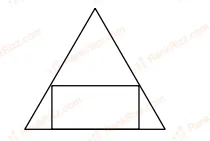
- (A)
If a rectangle is inscribed in an equilateral triangle of side length as shown in the figure, then the square of the largest area of such a rectangle is _________.
Answer: ____________
rr2.rankrizz.com/jee-main/maths/applications-of-derivatives/q/25-jul-2021-s2-q86
The triangle of maximum area that can be inscribed in a given circle of radius 'r' is:
- (A)
An equilateral triangle having each of its side of length .
- (B)
An isosceles triangle with base equal to .
- (C)
An equilateral triangle of height .
- (D)
A right angle triangle having two of its sides of length and .
rr2.rankrizz.com/jee-main/maths/applications-of-derivatives/q/26-feb-2021-s2-q72
- (A)
A triangular park is enclosed on two sides by a fence and on the third side by a straight river bank. The two sides having fence are of same length . The maximum area enclosed by the park is
- (A)
- (B)
- (C)
- (D)
rr2.rankrizz.com/jee-main/maths/applications-of-derivatives/q/2006-maths-500099
- (A)
Area of the greatest rectangle that can be inscribed in the ellipse is
- (A)
- (B)
- (C)
- (D)
rr2.rankrizz.com/jee-main/maths/applications-of-derivatives/q/2005-maths-500501
- (A)
Absolute maxima and minima 7
is equal to :
- (A)
- (B)
- (C)
- (D)
rr2.rankrizz.com/jee-main/maths/applications-of-derivatives/q/4-apr-2026-s2-q12
- (A)
Let and the minimmu value of the function in the interval [0, 1] be . Then n is equal to
- (A)
-80
- (B)
-41
- (C)
-40
- (D)
-81
rr2.rankrizz.com/jee-main/maths/applications-of-derivatives/q/22-jan-2026-s1-q20
- (A)
Let the maximum and minimum values of , be and , respectively. Then is equal to _________
Answer: ____________
rr2.rankrizz.com/jee-main/maths/applications-of-derivatives/q/05-apr-2024-s2-q87
If is the greatest term in the sequence , , then is equal to ______.
Answer: ____________
rr2.rankrizz.com/jee-main/maths/applications-of-derivatives/q/8-apr-2023-s1-q86
Let be a matrix, where
Let a function be defined as . Then the sum of maximum and minimum values of on is equal to:- (A)
- (B)
- (C)
- (D)
rr2.rankrizz.com/jee-main/maths/applications-of-derivatives/q/20-jul-2021-s1-q73
- (A)
The maximum value of in the following equation , where and for and is ________.
Answer: ____________
rr2.rankrizz.com/jee-main/maths/applications-of-derivatives/q/17-mar-2021-s1-q86
Given such that is the only real root of . If , then in the interval
- (A)
is the minimum and is the maximum of
- (B)
is not minimum but is the maximum of
- (C)
is the minimum and is not the maximum of
- (D)
neither is the minimum nor is the maximum of
rr2.rankrizz.com/jee-main/maths/applications-of-derivatives/q/2009-maths-499679
- (A)
Answer key
- 01 B
- 02 C
- 03 D
- 04 5
- 05 A
- 06 B
- 07 B
- 08 B
- 09 D
- 10 A
- 11 D
- 12 A
- 13 39
- 14 B
- 15 B
- 16 D
- 17 C
- 18 5
- 19 C
- 20 C
- 21 D
- 22 A
- 23 A
- 24 A
- 25 A
- 26 D
- 27 A
- 28 C
- 29 D
- 30 C
- 31 C
- 32 B
- 33 A
- 34 15
- 35 B
- 36 C
- 37 A
- 38 B
- 39 0
- 40 B
- 41 22
- 42 C
- 43 4
- 44 C
- 45 36
- 46 C
- 47 A
- 48 C
- 49 5
- 50 144
- 51 D
- 52 D
- 53 D
- 54 A
- 55 B
- 56 3
- 57 C
- 58 C
- 59 D
- 60 D
- 61 C
- 62 D
- 63 A
- 64 A
- 65 A
- 66 A
- 67 A
- 68 C
- 69 A
- 70 A
- 71 A
- 72 D
- 73 C
- 74 A
- 75 C
- 76 D
- 77 B
- 78 D
- 79 C
- 80 C
- 81 A
- 82 A
- 83 4
- 84 A
- 85 1
- 86 B
- 87 D
- 88 B
- 89 252
- 90 D
- 91 C
- 92 —
- 93 B
- 94 A
- 95 D
- 96 B
- 97 C
- 98 A
- 99 D
- 100 A
- 101 45
- 102 A
- 103 B
- 104 B
- 105 C
- 106 D
- 107 C
- 108 2
- 109 D
- 110 C
- 111 B
- 112 A
- 113 A
- 114 B
- 115 B
- 116 A
- 117 D
- 118 D
- 119 A
- 120 D
- 121 A
- 122 A
- 123 B
- 124 C
- 125 B
- 126 C
- 127 A
- 128 C
- 129 B
- 130 C
- 131 11
- 132 C
- 133 4
- 134 195
- 135 2
- 136 13
- 137 D
- 138 C
- 139 D
- 140 4
- 141 B
- 142 C
- 143 B
- 144 C
- 145 0.5
- 146 4
- 147 B
- 148 A
- 149 C
- 150 4
- 151 D
- 152 C
- 153 A
- 154 B
- 155 D
- 156 A
- 157 A
- 158 B
- 159 A
- 160 D
- 161 D
- 162 D
- 163 D
- 164 A
- 165 C
- 166 D
- 167 B
- 168 C
- 169 C
- 170 B
- 171 D
- 172 B
- 173 A
- 174 B
- 175 5
- 176 5
- 177 C
- 178 A
- 179 D
- 180 D
- 181 D
- 182 C
- 183 C
- 184 D
- 185 A
- 186 A
- 187 D
- 188 C
- 189 B
- 190 B
- 191 C
- 192 D
- 193 B
- 194 D
- 195 2890
- 196 2
- 197 4
- 198 C
- 199 C
- 200 C
- 201 D
- 202 B
- 203 B
- 204 A
- 205 B
- 206 C
- 207 A
- 208 B
- 209 D
- 210 B
- 211 D
- 212 A
- 213 A
- 214 B
- 215 A
- 216 C
- 217 C
- 218 B
- 219 C
- 220 C
- 221 A
- 222 B
- 223 D
- 224 A
- 225 A
- 226 30
- 227 A
- 228 C
- 229 D
- 230 B
- 231 2
- 232 C
- 233 B
- 234 C
- 235 B
- 236 3
- 237 A
- 238 48
- 239 C
- 240 3
- 241 A
- 242 C
- 243 A
- 244 B
- 245 D
- 246 1600
- 247 5
- 248 D
- 249 904
- 250 B
“—” marks a question whose key we have not checked yet; its page shows the latest on it.
Past questions are reproduced with their sitting. Not affiliated with NTA or the IITs. Every question, online and free: rr2.rankrizz.com/jee-main/maths/applications-of-derivatives