Work, Energy & Power JEE Advanced PYQs with answer key
PHYSICS · 17 PAST QUESTIONS · 3 TOPICS · 2007–2020
HOW TO USE THIS SHEET
Every JEE Advanced Work, Energy & Power question we hold, grouped by topic, most-asked topic first and newest first inside each. The answer key is at the end (15 of 17 questions have a checked key); the worked solution is on each question’s page, printed beside it.
Potential energy, conservative forces and energy curves 11
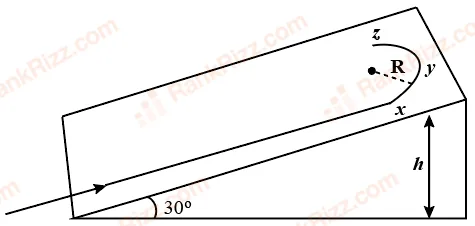
A student skates up a ramp that makes an angle with the horizontal. He/she starts (as shown in the figure) at the bottom of the ramp with speed and wants to turn around over a semicircular path xyz of radius 𝑅 during which he/she reaches a maximum height ℎ (at point y) from the ground as shown in the figure. Assume that the energy loss is negligible and the force required for this turn at the highest point is provided by his/her weight only. Then (g is the acceleration due to gravity)
- (A)
- (B)
- (C)
the centripetal force required at points x and z is zero
- (D)
the centripetal force required is maximum at points x and z
rr2.rankrizz.com/jee-advanced/physics/work-energy-and-power/q/2020-paper-2-q8
- (A)
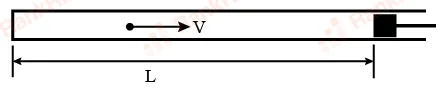
A small particle of mass m moving inside a heavy, hollow and straight tube along the tube axis undergoeselastic collision at two ends. The tube has no friction and it is closed at one end by a flat surface while the other endis fitted with a heavy movable flat piston as shown in figure. When the distance of the piston from closed end is the particle speed is . The piston is moved inward at a very low speed V such that where dL is the infinitesimal displacement of the piston. Which of the following statement(s) is/are correct?
- (A)
The rate at which the particle strikes the piston is
- (B)
After each collision with the piston, the particle speed increases by
- (C)
If the piston moves inward by dL, the particle speed increases by
- (D)
The particle’s kinetic energy increases by a factor of 4 when the piston is moved inward from to
rr2.rankrizz.com/jee-advanced/physics/work-energy-and-power/q/2019-paper-2-q3
- (A)
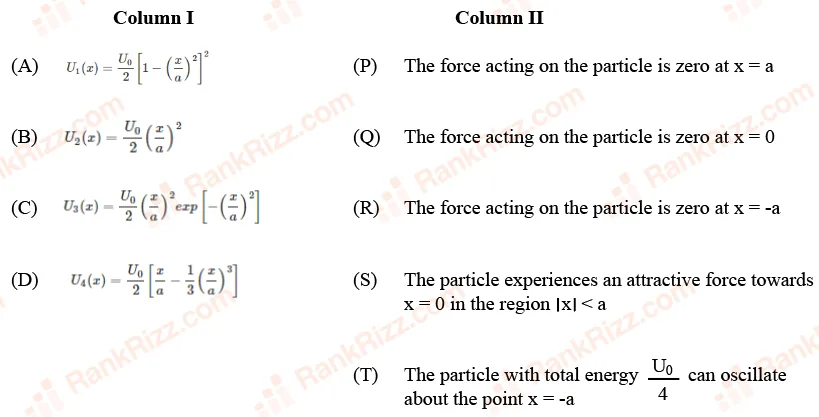
A particle of unit mass is moving along the x-axis under the influence of a force and its total energy is conserved. Four possible forms of the potential energy of the particle are given in column I (a and are constants). Match the potential energies in column I to the corresponding statement(s) in column II.
rr2.rankrizz.com/jee-advanced/physics/work-energy-and-power/q/2015-paper-1-q20
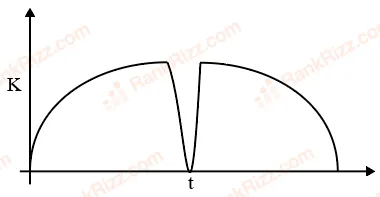
A tennis ball is dropped on a horizontal smooth surface. It bounces back to its original position after hitting the surface. The force on the ball during the collision is proportional to the length of compression of the ball. Which one of the following sketches describes the variation of its kinetic energy K with time t most appropriately? The figures are only illustrative and not to the scale.
- (A)
- (B)
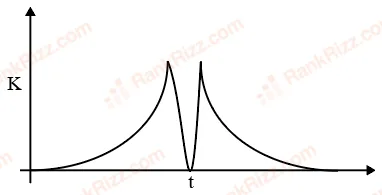
- (C)
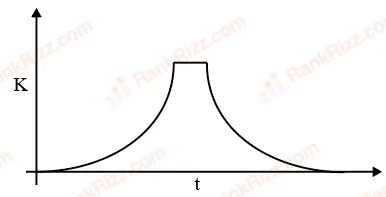
- (D)
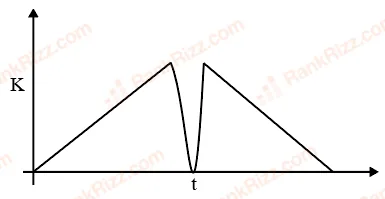
rr2.rankrizz.com/jee-advanced/physics/work-energy-and-power/q/2014-paper-2-q1
- (A)
Consider an elliptically shaped rail PQ in the vertical plane with OP = 3 m and OQ = 4 m. A block of mass 1 kg is pulled along the rail from P to Q with a force of 18 N, which is always parallel to line PQ (see the figure given). Assuming no frictional losses, the kinetic energy of the block when it reaches Q is Joules. The value of n is (take acceleration due to gravity = 10 )
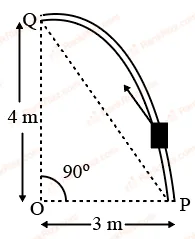
Answer: ____________
rr2.rankrizz.com/jee-advanced/physics/work-energy-and-power/q/2014-paper-1-q17
The speed of the block whenit reachesthe point Q is
- (A)
5
- (B)
10
- (C)
10
- (D)
20
rr2.rankrizz.com/jee-advanced/physics/work-energy-and-power/q/2013-paper-2-q13
- (A)
The magnitude of the normal reaction that acts on the block at the point Q is
- (A)
7.5 N
- (B)
8.6 N
- (C)
11.5 N
- (D)
22.5 N
rr2.rankrizz.com/jee-advanced/physics/work-energy-and-power/q/2013-paper-2-q14
- (A)
A bob of mass m, suspended by string of length , is given a minimum velocity required to completea full circle in the vertical plane. At the highestpoint,it collides elastically with another bob of mass m suspendedbya string of length , which is initially at rest. Both the strings are mass-less and inextensible. If the second bob, after collision acquires the minimum speed required to complete a full circle in the vertical plane, the ratio is
Answer: ____________
rr2.rankrizz.com/jee-advanced/physics/work-energy-and-power/q/2013-paper-1-q20
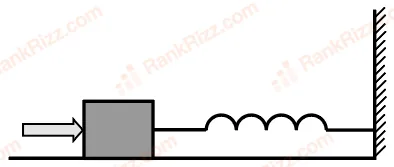
A block of mass 0.18 kg is attached to a spring of force-constant 2 N/m. The coefficient of friction between the block and the floor is 0.1. Initially the block is at rest and the spring is un-stretched. An impulse is given to the block as shown in the figure. The block slides a distance of 0.06 m and comes to rest for the first time. The initial velocity of the block in m/s is V = N/10. Then N is
Answer: ____________
rr2.rankrizz.com/jee-advanced/physics/work-energy-and-power/q/2011-paper-2-q34
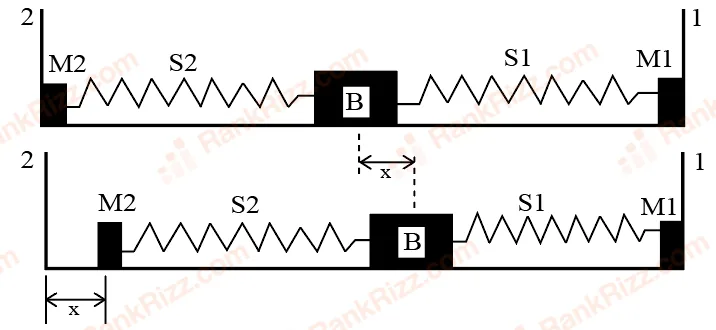
A block (B) is attached to two unstretched springs S1 and S2 with spring constants k and 4k, respectively (see figure I). The other ends are attached to identical supports M1 and M2 not attached to the walls. The springs and supports have negligible mass. There is no friction anywhere. The block B is displaced towards wall 1 by a small distance x (figure II) and released. The block returns and moves a maximum distance y towards wall 2. Displacements x and y are measured with respect to the equilibrium position of the block B. The ratio is
- (A)
4
- (B)
2
- (C)
- (D)
rr2.rankrizz.com/jee-advanced/physics/work-energy-and-power/q/2008-paper-2-q26
- (A)
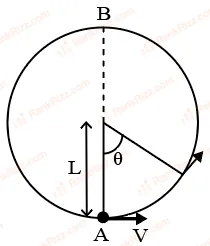
A bob of mass M is suspended by a massless string of length L. The horizontal velocity V at position A is just sufficient to make it reach the point B. The angle at which the speed of the bob is half of that at A, satisfies
- (A)
- (B)
- (C)
- (D)
rr2.rankrizz.com/jee-advanced/physics/work-energy-and-power/q/2008-paper-2-q27
- (A)
Work done by constant and variable forces 5
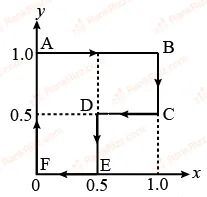
A particle is moved along a path AB-BC-CD-DE-EF-FA, as shownin figure, in presence of a force , where x and y are in meter and . The work done on the particle by this force will be ___ Joule.
Answer: ____________
rr2.rankrizz.com/jee-advanced/physics/work-energy-and-power/q/2019-paper-1-q13
The work done on a particle of mass m by a force, (K being a constant of appropriate dimensions), when the particle is taken from the point (a, 0) to the point (0, a) along a circular path of radius a about the origin in the x-y plane is
- (A)
- (B)
- (C)
- (D)
0
rr2.rankrizz.com/jee-advanced/physics/work-energy-and-power/q/2013-paper-1-q8
- (A)
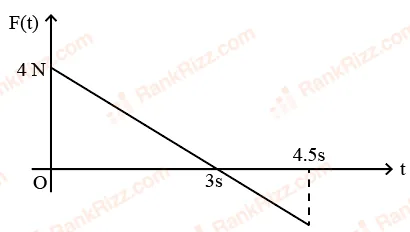
A block of mass 2 kg is free to move along the x-axis. It is at rest and from t = 0 onwards it is subjected to a time-dependent force Fit) in the x direction. The force F(t) varies with t as shown in the figure. The kinetic energy of the block after 4.5 seconds is
- (A)
4.50 J
- (B)
7.50 J
- (C)
5.06 J
- (D)
14.06 J
rr2.rankrizz.com/jee-advanced/physics/work-energy-and-power/q/2010-paper-2-q42
- (A)
A light inextensible string that goes over a smooth fixed pulley as shown in the figure connects two blocks of masses 0.36 kg and 0.72 kg. Taking g = 10 m/s, find the work
done (in joules) by the string on the block of mass 0.36 kg during the first second after the system is released from rest.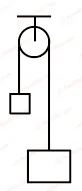
Answer: ____________
rr2.rankrizz.com/jee-advanced/physics/work-energy-and-power/q/2009-paper-2-q55
STATEMENT-1
A block of mass m starts moving on a rough horizontal surface with a velocity v. It stops due to friction between the block and the surface after moving through a certain distance. The surface is now tilted to an angle of with the horizontal and the same block is made to go up on the surface with the same initial velocity v. The decrease in the mechanical energy in the second situation is smaller than thatin thefirst situation.
because
STATEMENT-2
The coefficient of friction between the block and the surface decreases with the increase in the angle of inclination.- (A)
Statement-1 is True, Statement-2 is True; Statement-2 is a correct explanation for Statement-1
- (B)
Statement-1 is True, Statement-2 is True; Statement-2 is NOT a correct explanation for Statement-1
- (C)
Statement-1 is True, Statement-2 is False
- (D)
Statement-1 is False, Statement-2 is True
rr2.rankrizz.com/jee-advanced/physics/work-energy-and-power/q/2007-paper-1-q10
- (A)
Power 1
A particle of mass 0.2 kg is moving in one dimension under a force that delivers a constant power 0.5 W to the particle. If the initial speed (in of the particle is zero, the speed (in after 5 s is
Answer: ____________
rr2.rankrizz.com/jee-advanced/physics/work-energy-and-power/q/2013-paper-1-q18
Answer key
- 01 A, D
- 02 A, C
- 03 A-PQRT, B-QS, C-PQRS, D-PRT
- 04 B
- 05 5
- 06 B
- 07 A
- 08 5
- 09 4
- 10 C
- 11 D
- 12 —
- 13 D
- 14 C
- 15 —
- 16 C
- 17 5
“—” marks a question whose key we have not checked yet; its page shows the latest on it.
Past questions are reproduced with their sitting. Not affiliated with NTA or the IITs. Every question, online and free: rr2.rankrizz.com/jee-advanced/physics/work-energy-and-power