Waves JEE Advanced PYQs with answer key
PHYSICS · 36 PAST QUESTIONS · 4 TOPICS · 2007–2026
HOW TO USE THIS SHEET
Every JEE Advanced Waves question we hold, grouped by topic, most-asked topic first and newest first inside each. The answer key is at the end (31 of 36 questions have a checked key); the worked solution is on each question’s page, printed beside it.
Doppler effect in sound 16
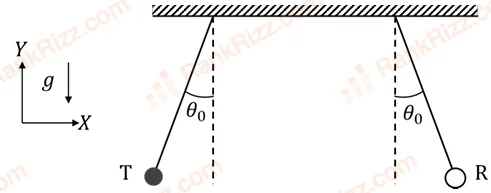
An audio transmitter (T) and a receiver (R) are hung vertically from two identical massless strings of length 8 m with their pivots well separated along the axis. They are pulled from the equilibrium position in opposite directions along the axis by a small angular amplitude and released simultaneously. If the natural frequency of the transmitter is 660 Hz and the speed of sound in air is 330 m/s, the maximum variation in the frequency (in Hz) as measured by the receiver is ______.
(Take the acceleration due to gravity m/s)
Answer: ____________
rr2.rankrizz.com/jee-advanced/physics/waves/q/2025-paper-2-q32
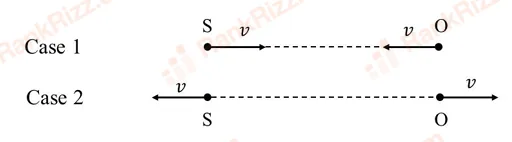
A source () of sound has frequency 240 Hz. When the observer () and the source move towards each other at a speed with respect to the ground (as shown in Case 1 in the figure), the observer measures the frequency of the sound to be 288 Hz. However, when the observer and the source move away from each other at the same speed with respect to the ground (as shown in Case 2 in the figure), the observer measures the frequency of sound to be Hz. The value of is ______.
Answer: ____________
rr2.rankrizz.com/jee-advanced/physics/waves/q/2024-paper-1-q28
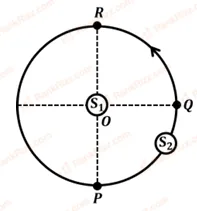
When only is emitting sound and it is , the frequency of sound measured by the detector in Hz is ____.
Answer: ____________
rr2.rankrizz.com/jee-advanced/physics/waves/q/2023-paper-2-q31
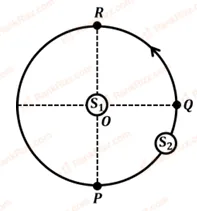
Consider both sources emitting sound. When is at R and approaches the detector with a speed 4 ms, the beat frequency measured by the detector is ____ Hz.
Answer: ____________
rr2.rankrizz.com/jee-advanced/physics/waves/q/2023-paper-2-q32
A source, approaching with speed 𝑢 towards the open end of a stationary pipe of length 𝐿, is emitting a sound of frequency . The farther end of the pipe is closed. The speed of sound in air is v and is the fundamental frequency of the pipe. For which of the following combination(s) of u and , will the sound reaching the pipe lead to a resonance?
- (A)
u = 0.8v and
- (B)
u = 0.8v and
- (C)
u = 0.8v and
- (D)
u = 0.8v and
rr2.rankrizz.com/jee-advanced/physics/waves/q/2021-paper-2-q21
- (A)
A stationary tuning fork is in resonance with an air column in a pipe. If the tuning fork is moved with a speed of in front of the open end of the pipe and parallel to it, the length of the pipe should be changed for the resonance to occur with the moving tuning fork. If the speed of sound in air is , the smallest value of the percentage change required in the length of the pipe is
____________.Answer: ____________
rr2.rankrizz.com/jee-advanced/physics/waves/q/2020-paper-1-q17
A tram S1, moving with a uniform velocity of 108 km/h, approaches another train S2 standing on a platform. An observer O moves with a uniform velocity of 36 km/h towards S2, as shown in figure. Both the trains are blowing whistles of same frequency 120 Hz. When O is 600 m away from S2 and distance between S1 and S2 is 800 m, the number of beats heard by O is __________.
[Speed of the sound = 330 m/s]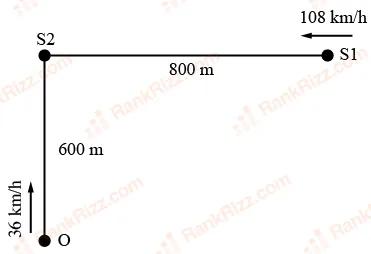
Answer: ____________
rr2.rankrizz.com/jee-advanced/physics/waves/q/2019-paper-1-q15
Two men are walking along a horizontal straight line in the same direction. The man in front walks at a speed 1.0 and the man behind walks at a speed 2.0 . A third man is standing at a height 12 𝑚 above the same horizontal line such that all three men are in a vertical plane. The two walking men are blowing identical whistles which emit a sound of frequency 1430 𝐻𝑧. The speed of sound in air is 330 . At the instant, when the moving men are 10 𝑚 apart, the stationary man is equidistant from them. The frequency of beats in 𝐻𝑧, heard by the stationary man at this instant, is __________.
Answer: ____________
rr2.rankrizz.com/jee-advanced/physics/waves/q/2018-paper-1-q8
A stationary source emits sound of frequency . The sound is reflected by a large car approaching the source with a speed of . The reflected signal is received by the source and superposed with the original. What will be the beat frequency of the resulting signal in Hz? (Given that the speed of sound in air is and the car reflects the sound at the frequency it has received).
Answer: ____________
rr2.rankrizz.com/jee-advanced/physics/waves/q/2017-paper-1-q11
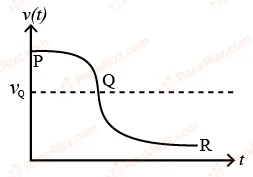
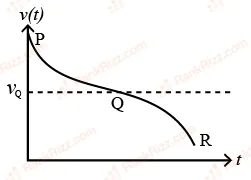
Two loudspeakers M and WN are located 20 m apart and emit sound at frequencies 118 Hz and 121 Hz, respectively. A caris initially at a point P , 1800 m away from the midpoint Q
of the line MN and moves towards @ constantly at 60 km/hr along the perpendicular bisector of MN. It crosses Q and eventually reaches a point R, 1800 m away from Q. Let v(t) represent the beat frequency measured by a person sitting in the car at time t. Let and be the beat frequencies measured at locations P, Q and R, respectively. The speed of sound in air is 330 ms Which of the following statement(s) is(are) true regarding the sound heard bythe person?- (A)
- (B)
The rate of change in beat frequency is maximum when thecar passes through Q
- (C)
The plot below represents schematically the variation of beat frequency with time
- (D)
The plot below represents schematically the variation of beat frequency with time t
rr2.rankrizz.com/jee-advanced/physics/waves/q/2016-paper-1-q7
- (A)
Two vehicles, each moving with speed u on the samehorizontal straight road, are approaching each other. Wind blows along the road with velocity w. One of these vehicles blows a whistle of frequency . An observerin the other vehicle hears the frequency of the whistle to be . The speed of soundin still air is V. The correct statement(s) is (are)
- (A)
If the wind blows from the observerto the source, .
- (B)
If the wind blows from the source to the observer, .
- (C)
If the wind blows from observerto the source, .
- (D)
If the wind blows from the source to the observer, .
rr2.rankrizz.com/jee-advanced/physics/waves/q/2013-paper-2-q8
- (A)
A police car with a siren of frequency 8 kHz is moving with uniform velocity 36 km/hr towards a tall building which reflects the sound waves. The speed of sound in air is 320 m/s. The frequency of the siren heard by the car driver is-
- (A)
8.50 kHz
- (B)
8.25 kHz
- (C)
7.75 kHz
- (D)
7.50 kHz
rr2.rankrizz.com/jee-advanced/physics/waves/q/2011-paper-1-q27
- (A)
A stationary source is emitting sound ata fixed frequency , which is reflected by two cars approaching the source. The difference between the frequencies of sound reflected from the cars is 1.2% of . What is the difference in the speeds of the cars (in km per hour) to the nearest integer ? The cars are moving at constant speeds much smaller than the speed of sound which is 330 .
Answer: ____________
rr2.rankrizz.com/jee-advanced/physics/waves/q/2010-paper-1-q84
The speed of sound of the whistle is
- (A)
340 m/s for passengers in A and 310 m/s for passengers in B
- (B)
360 m/s for passengers in A and 310 m/s for passengers in B
- (C)
310 m/s for passengers in A and 360 m/s for passengers in B
- (D)
340 m/s for passengersin both the trains
rr2.rankrizz.com/jee-advanced/physics/waves/q/2007-paper-2-q14
- (A)
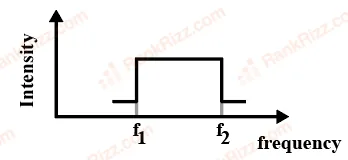
The distribution of the sound intensity of the whistle as observed by the passengers in train A is best represented by
- (A)
- (B)
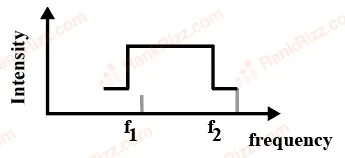
- (C)
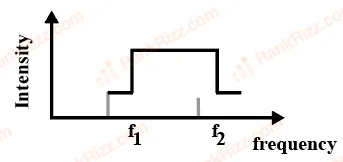
- (D)
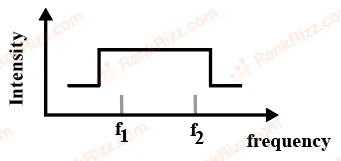
rr2.rankrizz.com/jee-advanced/physics/waves/q/2007-paper-2-q15
- (A)
The spread of frequency as observed by the passengersin train B is
- (A)
310 Hz
- (B)
330 Hz
- (C)
350 Hz
- (D)
290 Hz
rr2.rankrizz.com/jee-advanced/physics/waves/q/2007-paper-2-q16
- (A)
Superposition, interference and beats 12
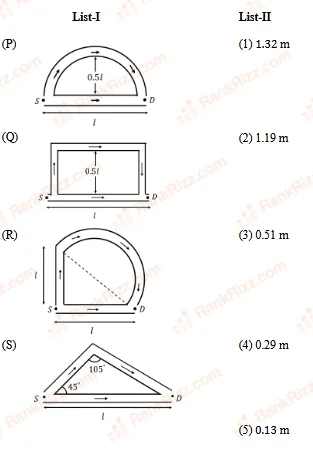
List-I shows four configurations made of straight and semi-circular narrow tubes containing air. A sound wave of wavelength enters these structures at the point and a sound detector is placed at . Between the points and , the sound travels only through the tubes. List-II contains the possible smallest values of (refer to the figures) for which the detector records maximum amplitude. Ignore effects of sharp corners. [Given ]
Choose the option that best describes the match between the entries in List-I to those in List-II.
- (A)
(P)(4), (Q)(3), (R)(5), (S)(1)
- (B)
(P)(4), (Q)(3), (R)(1), (S)(5)
- (C)
(P)(3), (Q)(4), (R)(1), (S)(2)
- (D)
(P)(3), (Q)(4), (R)(5), (S)(2)
rr2.rankrizz.com/jee-advanced/physics/waves/q/2026-paper-1-q13
- (A)
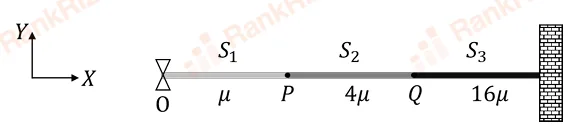
Consider a system of three connected strings, , and with uniform linear mass densities kg/m, kg/m and kg/m, respectively, as shown in the figure. and are connected at the point , whereas and are connected at the point , and the other end of is connected to a wall. A wave generator O is connected to the free end of . The wave from the generator is represented by cm, where , and are constants of appropriate dimensions. Which of the following statements is/are correct:
- (A)
When the wave reflects from for the first time, the reflected wave is represented by cm, where is a positive constant.
- (B)
When the wave transmits through for the first time, the transmitted wave is represented by cm, where is a positive constant.
- (C)
When the wave reflects from for the first time, the reflected wave is represented by cm, where is a positive constant.
- (D)
When the wave transmits through for the first time, the transmitted wave is represented by cm, where is a positive constant.
rr2.rankrizz.com/jee-advanced/physics/waves/q/2025-paper-1-q23
- (A)
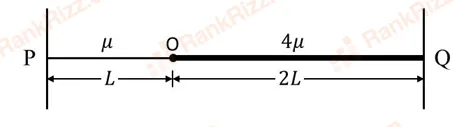
Two uniform strings of mass per unit length and , and length and , respectively, are joined at point , and tied at two fixed ends and , as shown in the figure. The strings are under a uniform tension . If we define the frequency , which of the following statement(s) is(are) correct?
- (A)
With a node at , the minimum frequency of vibration of the composite string is
- (B)
With an antinode at , the minimum frequency of vibration of the composite string is
- (C)
When the composite string vibrates at the minimum frequency with a node at , it has 6 nodes, including the end nodes
- (D)
No vibrational mode with an antinode at is possible for the composite string
rr2.rankrizz.com/jee-advanced/physics/waves/q/2024-paper-1-q23
- (A)
The length of the strings 1, 2, 3 and 4 are kept fixed at and , respectively. Strings 1, 2, 3, and 4 are vibrated at their and harmonics, respectively such that all the strings have same frequency. The correct match for the tension in the four strings in the units of will be,
- (A)
- (B)
- (C)
- (D)
rr2.rankrizz.com/jee-advanced/physics/waves/q/2019-paper-2-q16
- (A)
Four harmonic waves of equal frequencies and equalintensities have phase angles and . When they are superposed, the intensity of the resulting wave is The value of n is
Answer: ____________
rr2.rankrizz.com/jee-advanced/physics/waves/q/2015-paper-2-q4
A student is performing the experiment of Resonance Column. The diameter of the column tube is 4cm . The distance frequency of the tuning for k is 512 Hz. The air temperature is in which the speed of sound is 336 m/s. The zero of the meter scale coincides with the top and of the Resonance column. When first resonance occurs, the reading of the water level in the column is
- (A)
14.0
- (B)
15.2
- (C)
16.4
- (D)
17.6
rr2.rankrizz.com/jee-advanced/physics/waves/q/2012-paper-2-q5
- (A)
A person blowsinto open-end of a long pipe. As a result, a high-pressure pulseof air travels down the pipe. Whenthis pulse reachesthe other endof the pipe,
- (A)
a high-pressure pulsestarts traveling up the pipe, if the other end of the pipe is open.
- (B)
a low-pressure pulsestarts traveling up the pipe, if the other end ofthe pipe is open.
- (C)
alow-pressure pulsestarts traveling up the pipe, if the other end of the pipe is closed.
- (D)
a high-pressure pulse starts traveling up the pipe, if the other end of the pipe is closed.
rr2.rankrizz.com/jee-advanced/physics/waves/q/2012-paper-1-q15
- (A)
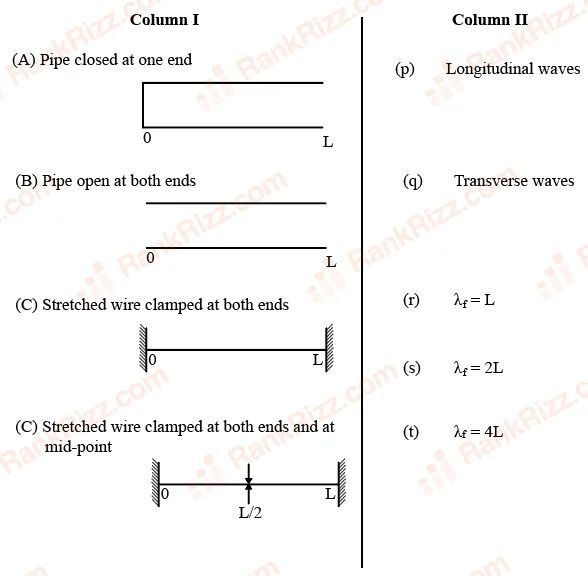
Column I shows four systems, each of the same length L, for producing standing waves. The lowest possible natural frequency of a system is called its fundamental frequency, whose wavelength is denoted as . Match each system with statements given in Column II describing the nature and wavelength of the standing waves.
rr2.rankrizz.com/jee-advanced/physics/waves/q/2011-paper-2-q40
A hollowpipe of length 0.8 mis closed at one end. At its open end a 0.5 mlong uniform string is vibrating in its second harmonic and it resonates with the fundamental frequencyof the pipe. If the tension in the wire is 50 N and the speed of sound is 320 ms, the massof thestring is
- (A)
5 grams
- (B)
10 grams
- (C)
20 grams
- (D)
40 grams
rr2.rankrizz.com/jee-advanced/physics/waves/q/2010-paper-2-q40
- (A)
When two progressive waves and are superimposed, the amplitude of the resultant wave is
Answer: ____________
rr2.rankrizz.com/jee-advanced/physics/waves/q/2010-paper-1-q79
A student performed the experiment to measure the speed of sound in air using resonance air-column method. Two resonances in the air-column were obtained by lowering the water level. The resonance with the shorter air-column is the first resonanceandthat with the longer air-column is the second resonance. Then,
- (A)
the intensity of the sound heard at the first resonance was more than that at the second resonance
- (B)
the prongs of the tuning fork were kept in a horizontal plane above the resonance tube
- (C)
the amplitude of vibration of the ends of the prongsis typically around 1 cm
- (D)
the length of the air-columnat the first resonance was somewhat shorter than of the wavelength of the sound in air
rr2.rankrizz.com/jee-advanced/physics/waves/q/2009-paper-2-q44
- (A)
A vibrating string of certain length l under a tension T resonates with a mode corresponding to the first overtone (third harmonic) of an air column of length 75 cm inside a tube closed at one end. The string also generates 4 beats per second when excited along with a tuning fork of frequency n. Now when the tension ofthe string is slightly increased the numberof beats reduces to 2 per second. Assuming the velocity of soundin air to be 340 m/s, the frequency n of the tuning fork in Hz is
- (A)
344
- (B)
336
- (C)
117.3
- (D)
109.3
rr2.rankrizz.com/jee-advanced/physics/waves/q/2008-paper-2-q29
- (A)
Progressive waves: wave equation, phase and intensity 7
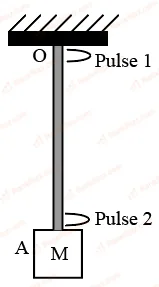
A block M hangs vertically at the bottom end of a uniform rope of constant mass per unit length. The top end of the rope is attached to a fixed rigid support at O. A transverse wave pulse (Pulse 1) of wavelength is produced at point O on the rope. The pulse takes time to reach point A. If the wave pulse of wavelength is produced at point A (Pulse 2) without disturbing the position of M it takes time to reach point O. Which of the following options is/are correct?
- (A)
The time
- (B)
The velocities of the two pulses (Pulse 1 and Pulse 2) are the same at the midpoint of rope
- (C)
The wavelength of Pulse 1 becomes longer when it reaches point A
- (D)
The velocity of any pulse along the rope is independent of its frequency and wavelength
rr2.rankrizz.com/jee-advanced/physics/waves/q/2017-paper-1-q3
- (A)
One end of a taut string of length 3m along the x axis is fixed at x = 0.The speed of the waves in the string is . The other end of the string is vibrating in the y direction so that stationary waves are set up in the string. The possible waveform(s) of these stationary waves is(are)
- (A)
- (B)
- (C)
- (D)
rr2.rankrizz.com/jee-advanced/physics/waves/q/2014-paper-1-q3
- (A)
A student is performing an experiment using a resonance column and a tuning fork of frequency . He is told that the air in the tube has been replaced by another gas (assume that the column remains filled with the gas). If the minimum height at which resonance occurs is the gas in the tube is
(Useful information: .The molar masses Min grams are given in the options. Take the values of for each gas as given there.)- (A)
Neon
- (B)
Nitrogen
- (C)
Oxygen
- (D)
Argon
rr2.rankrizz.com/jee-advanced/physics/waves/q/2014-paper-1-q6
- (A)
A horizontal stretched string, fixed at two ends, is vibrating in its fifth harmonic according to the equation, Assuming , the correct statement(s) is (are)
- (A)
The number of nodes is 5.
- (B)
The length of the string is 0.25 m.
- (C)
The maximum displacement of the midpoint of the string, from its equilibrium position is 0.01 m.
- (D)
The fundamental frequency is 100 Hz.
rr2.rankrizz.com/jee-advanced/physics/waves/q/2013-paper-1-q11
- (A)
A 20 cm long string, having a mass of 1.0 g, is fixed at both the ends. The tension in tne string is 0.5 N. The string is set into vibrations using an external vibrator of
frequency 100 Hz. Find the separation (in em) between the successive nodes on the string.Answer: ____________
rr2.rankrizz.com/jee-advanced/physics/waves/q/2009-paper-2-q57
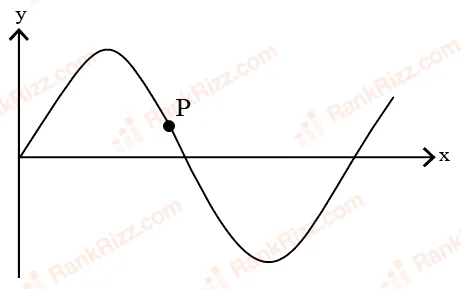
A transverse sinusoidal wave moves along a string in the positive x-direction at a speed of 10 cm/s. The wavelength of the waveis 0.5 m and its amplitude is 10 cm. At a particular time t, the snap-shot of the wave is shown in figure. The velocity of point P when its displacement is 5 cm is
- (A)
m/s
- (B)
m/s
- (C)
m/s
- (D)
m/s
rr2.rankrizz.com/jee-advanced/physics/waves/q/2008-paper-2-q25
- (A)
In the experiment to determine the speed of sound using a resonance column,
- (A)
prongs of the tuning fork are kept in a vertical plane
- (B)
prongs of the tuning fork are kept in a horizontal plane
- (C)
in one of the two resonances observed, the length of the resonating air columnis close to the wave length of sound in air
- (D)
in one of the two resonances observed, the length of the resonating air column is close to half of the wave length of sound in air
rr2.rankrizz.com/jee-advanced/physics/waves/q/2007-paper-2-q1
- (A)
Standing waves on strings and rods 1
A string of length 1 m and mass kg is under tension T. When the string vibrates, two successive harmonics are found to occur at frequencies 750 Hz and 1000 Hz. The value of tension T is ____ Newton.
Answer: ____________
rr2.rankrizz.com/jee-advanced/physics/waves/q/2023-paper-2-q27
Answer key
- 01 —
- 02 200
- 03 648
- 04 8.2
- 05 A
- 06 —
- 07 —
- 08 —
- 09 6
- 10 A, B, C
- 11 A, B
- 12 A
- 13 7
- 14 B
- 15 A
- 16 A
- 17 D
- 18 A, D
- 19 A, C, D
- 20 C
- 21 3
- 22 B
- 23 B, D
- 24 A-PT, B-PS, C-QS, D-QR
- 25 B
- 26 5
- 27 A
- 28 A
- 29 A, D
- 30 A, C, D
- 31 D
- 32 B, C
- 33 —
- 34 A
- 35 A
- 36 5
“—” marks a question whose key we have not checked yet; its page shows the latest on it.
Past questions are reproduced with their sitting. Not affiliated with NTA or the IITs. Every question, online and free: rr2.rankrizz.com/jee-advanced/physics/waves