Wave Optics JEE Advanced PYQs with answer key
PHYSICS · 21 PAST QUESTIONS · 3 TOPICS · 2007–2026
HOW TO USE THIS SHEET
Every JEE Advanced Wave Optics question we hold, grouped by topic, most-asked topic first and newest first inside each. The answer key is at the end (19 of 21 questions have a checked key); the worked solution is on each question’s page, printed beside it.
Young's double slit experiment: fringe width and intensity 17
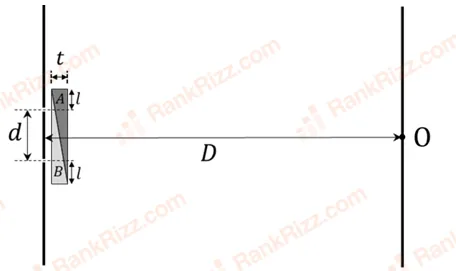
In a Young's double slit experiment, a combination of two glass wedges and , having refractive indices 1.7 and 1.5, respectively, are placed in front of the slits, as shown in the figure. The separation between the slits is mm and the shortest distance between the slits and the screen is m. Thickness of the combination of the wedges is m. The value of as shown in the figure is 1 mm. Neglect any refraction effect at the slanted interface of the wedges. Due to the combination of the wedges, the central maximum shifts (in mm) with respect to O by ______.
Answer: ____________
rr2.rankrizz.com/jee-advanced/physics/wave-optics/q/2025-paper-2-q30
The 8th bright fringe above the point oscillates with time between two extreme positions. The separation between these two extreme positions, in micrometer (m), is ________.
Answer: ____________
rr2.rankrizz.com/jee-advanced/physics/wave-optics/q/2024-paper-2-q31
The maximum speed in m/s at which the bright fringe will move is ________.
Answer: ____________
rr2.rankrizz.com/jee-advanced/physics/wave-optics/q/2024-paper-2-q32
A double slit setup is shown in the figure. One of the slits is in medium 2 of refractive index . The other slit is at the interface of this medium with another medium 1 of refractive index (). The line joining the slits is perpendicular to the interface and the distance between the slits is . The slit widths are much smaller than . A monochromatic parallel beam of light is incident on the slits from medium 1. A detector is placed in medium 2 at a large distance from the slits, and at an angle from the line joining them, so that equals the angle of refraction of the beam. Consider two approximately parallel rays from the slits received by the detector.
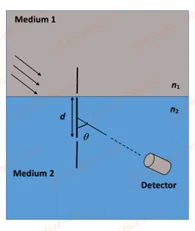
Which of the following statement(s) is (are) correct?
- (A)
The phase difference between the two rays is independent of .
- (B)
The two rays interfere constructively at the detector.
- (C)
The phase difference between the two rays depends on but is independent of .
- (D)
The phase difference between the two rays vanishes only for certain values of and the angle of incidence of the beam, with being the corresponding angle of refraction.
rr2.rankrizz.com/jee-advanced/physics/wave-optics/q/2022-paper-2-q31
- (A)
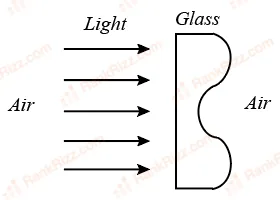
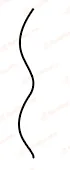
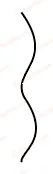
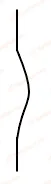
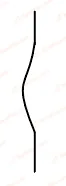
A parallel beam of light strikes a piece of transparent glass having cross section as shown in the figure below. Correct shape of the emergent wavefront will be (figures are schematic and not drawn to scale)
- (A)
- (B)
- (C)
- (D)
rr2.rankrizz.com/jee-advanced/physics/wave-optics/q/2020-paper-1-q5
- (A)
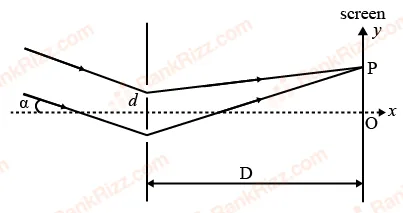
In a Young’s double slit experiment, the slit separation d is 0.3 mm and the screen distance D is 1 m. A parallel beam of light of wavelength 600 nm is incident on the slits at angle as shown in figure. On the screen, the point O is equidistant from the slits and distance PO is 11.0 mm. Which of the following statement(s) is/are correct?
- (A)
For degree, there will be destructive interference at point O.
- (B)
For there will be constructive interference at P point P.
- (C)
For degree, there will be destructive interference at P point P.
- (D)
Fringe spacing depends on .
rr2.rankrizz.com/jee-advanced/physics/wave-optics/q/2019-paper-2-q7
- (A)
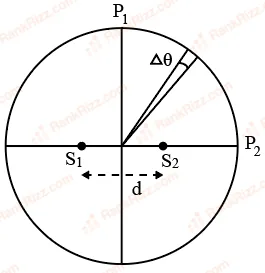
Two coherent monochromatic point sources and of wavelength nm are placed symmetrically on either side of the center of the circle as shown. The sources are separated by a distance mm. This arrangement produces interference fringes visible as alternate bright and dark spots on the circumference of the circle. The angular separation between two consecutive bright spots is . Which of the following options is/are correct?
- (A)
A dark spot will be formed at the point
- (B)
At the order of the fringe will be maximum
- (C)
The total number of fringes produced between and in the first quadrant is close to 3000
- (D)
The angular separation between two consecutive bright spots decreases as we move from to along the first quadrant
rr2.rankrizz.com/jee-advanced/physics/wave-optics/q/2017-paper-2-q11
- (A)
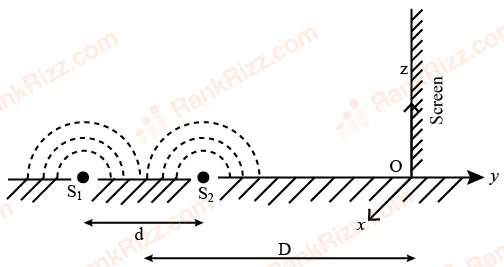
While conducting the Young’s double slit experiment, a student replaced the two slits with a large opaque plate in the x-y plane containing two small holes that act as two coherent point sources emitting light of wavelength 600 nm. The student mistakenly placed the screen parallel to the x-z plane (for z > 0) at a distance D = 3 m from the mid-point of S,S,, as shown schematically in the figure. The distance between the sources d = 0.6003 mm. The origin O is at the intersection of the screen and the line joining . Which of the following is(are) true of the intensity pattern on the screen?
- (A)
Straight bright and dark bands parallel to the x-axis
- (B)
The region very close to the point O will be dark
- (C)
Hyperbolic bright and dark bands with foci symmetrically placed about O in the x-direction
- (D)
Semi circular bright and dark bands centered at point O
rr2.rankrizz.com/jee-advanced/physics/wave-optics/q/2016-paper-2-q13
- (A)
A Young’s double slit interference arrangement with slits and is immersed in water (refractive index = ) as shown in the figure. The positions of maxima on the surface of water are given by , where is the wave length of light in air (refractive index = 1), 2d is the separation between theslits and m is an integer. The valueofp is
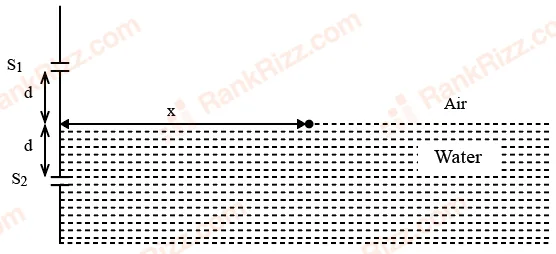
Answer: ____________
rr2.rankrizz.com/jee-advanced/physics/wave-optics/q/2015-paper-1-q7
A light source, which emits two wavelengths and , is used in a Young’s double slit experiment. If recorded fringe widths for and are and number of fringes for them within a distance yon one side of the central maximum are and , respectively, then
- (A)
- (B)
- (C)
From the central maximum, maximum of overlaps with minimum of
- (D)
The angular separation of fringes for is greater than
rr2.rankrizz.com/jee-advanced/physics/wave-optics/q/2014-paper-1-q2
- (A)
In the Young’s double slit experiment using a monochromatic light of wavelength , the path difference (in terms of an integer n) corresponding to any point having half the peak intensity is
- (A)
- (B)
- (C)
- (D)
rr2.rankrizz.com/jee-advanced/physics/wave-optics/q/2013-paper-1-q3
- (A)
Young's double slit experimentis carried out by using green, red and bluelight, one color at a time. The fringe widths recorded are , respectively. Then,
- (A)
- (B)
- (C)
- (D)
rr2.rankrizz.com/jee-advanced/physics/wave-optics/q/2012-paper-1-q6
- (A)
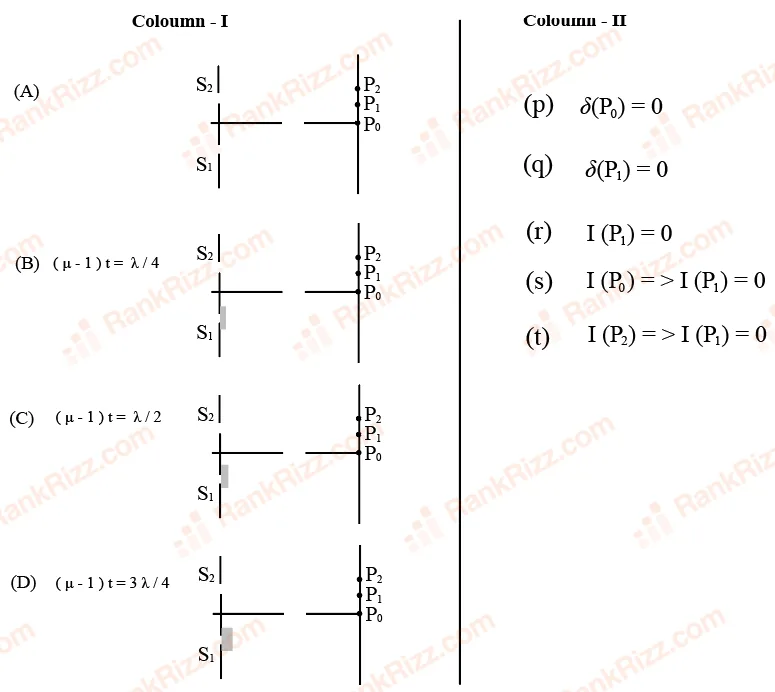
Column I shows four situations of standard Young’s double slit arrangement with the screen placed far away from the slits and . In each of these cases and , where is the wavelength of the light used. In the cases B, C and D, a transparent sheet of refractive index and thickness t is pasted on slit . The thicknesses of the sheets are different in different cases. The phase difference between thelight waves reaching a point P on the screen from the two slits is denoted by and the intensity by . Match each situation given in Column I with the statement(s) in Column II valid for that situation.
rr2.rankrizz.com/jee-advanced/physics/wave-optics/q/2009-paper-2-q49
In a Young’s double slit experiment, the separation between the two slits is d and the wavelength of the light is . The intensity of light falling on slit 1 is four times the
intensity of light falling on slit 2. Choose the correct choice(s).- (A)
If , the screen will contain only one maximum
- (B)
If , at least one more maximum (besides the central maximum) will be observed on the screen
- (C)
If the intensity of light falling on slit 1 is reduced so that it becomes equal to that of slit 2, the intensities of the observed dark and bright fringes will increase
- (D)
If the intensity of light falling on slit 2 is increased so that it becomes equal to that of slit 1, the intensities of the observed dark and bright fringes will increase
rr2.rankrizz.com/jee-advanced/physics/wave-optics/q/2008-paper-1-q33
- (A)
Light travels as a
- (A)
parallel beam in each medium
- (B)
convergent beam in each medium
- (C)
divergent beam in each medium
- (D)
divergent beam in one medium and convergent beam in the other medium
rr2.rankrizz.com/jee-advanced/physics/wave-optics/q/2007-paper-2-q17
- (A)
The phases of the light wave at c, d, e and f are and respectively. It is given that .
- (A)
cannot be equal to
- (B)
can be equal to
- (C)
is equal to
- (D)
is not equal to
rr2.rankrizz.com/jee-advanced/physics/wave-optics/q/2007-paper-2-q18
- (A)
Speed of light is
- (A)
the same in medium-1 and medium-2
- (B)
larger in medium-1 than in medium-2
- (C)
larger in medium-2 than in medium-1
- (D)
different at b and d
rr2.rankrizz.com/jee-advanced/physics/wave-optics/q/2007-paper-2-q19
- (A)
Polarisation: Malus's law and Brewster's law 3
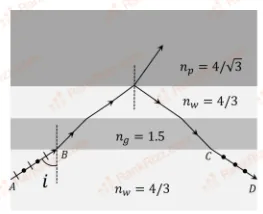
As shown in the figure, a ray of unpolarized light enters from water of refractive index into a medium of refractive index after passing through a glass plate of refractive index and a layer of water. At a particular incident angle the reflected ray is polarized in the direction as shown in the figure. The value of (in degrees) is:
Answer: ____________
rr2.rankrizz.com/jee-advanced/physics/wave-optics/q/2026-paper-2-q12
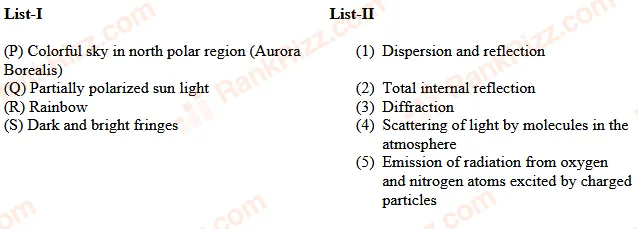
In the List-I, four optical effects are mentioned. The physical phenomena of light which are essential to describe these optical effects are given in List-II. Choose the option which describes the correct match between the entries in List-I to those in List-II.
- (A)
(P)(5), (Q)(4), (R)(1), (S)(3)
- (B)
(P)(4), (Q)(2), (R)(1), (S)(3)
- (C)
(P)(4), (Q)(1), (R)(2), (S)(3)
- (D)
(P)(5), (Q)(4), (R)(1), (S)(2)
rr2.rankrizz.com/jee-advanced/physics/wave-optics/q/2026-paper-1-q14
- (A)
A point source emits unpolarized light uniformly in all directions. At two points and , the ratio of the intensities of light is 2. If a set of two polaroids having 45° angle between their pass-axes is placed just before point , then the new value of will be ______.
Answer: ____________
rr2.rankrizz.com/jee-advanced/physics/wave-optics/q/2024-paper-1-q27
Wavefronts and Huygens' principle 1
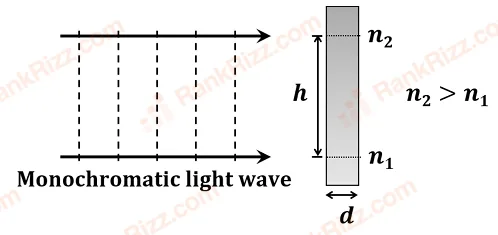
A monochromatic light wave is incident normally on a glass slab of thickness d, as shown in the figure. The refractive index of the slab increases linearly from to over the height h. Which of the following statement(s) is (are) true about the light wave emerging out of the slab?
- (A)
It will deflect up by an angle
- (B)
It will deflect up by an angle
- (C)
It will not deflect.
- (D)
The deflection angle depends only on and not on the individual values of and .
rr2.rankrizz.com/jee-advanced/physics/wave-optics/q/2023-paper-2-q22
- (A)
Answer key
- 01 1.2
- 02 601.50
- 03 —
- 04 A, B
- 05 D
- 06 B
- 07 B, C
- 08 B, D
- 09 3
- 10 A, B, C
- 11 B
- 12 D
- 13 —
- 14 A
- 15 A
- 16 C
- 17 B
- 18 60.00
- 19 A
- 20 8
- 21 B, D
“—” marks a question whose key we have not checked yet; its page shows the latest on it.
Past questions are reproduced with their sitting. Not affiliated with NTA or the IITs. Every question, online and free: rr2.rankrizz.com/jee-advanced/physics/wave-optics