Thermal Properties of Matter JEE Advanced PYQs with answer key
PHYSICS · 23 PAST QUESTIONS · 3 TOPICS · 2007–2024
HOW TO USE THIS SHEET
Every JEE Advanced Thermal Properties of Matter question we hold, grouped by topic, most-asked topic first and newest first inside each. The answer key is at the end (19 of 23 questions have a checked key); the worked solution is on each question’s page, printed beside it.
Thermal radiation: Stefan's law, Wien's law and Kirchhoff's law 13
Match the temperature of a black body given in List-I with an appropriate statement in List-II, and choose the correct option.
[Given: Wien's constant as m-K and V-m]
List-I List-II (P) 2000 K (1) The radiation at peak wavelength can lead to emission of photoelectrons from a metal of work function 4 eV (Q) 3000 K (2) The radiation at peak wavelength is visible to human eye. (R) 5000 K (3) The radiation at peak emission wavelength will result in the widest central maximum of a single slit diffraction. (S) 10000 K (4) The power emitted per unit area is 1/16 of that emitted by a blackbody at temperature 6000 K. (5) The radiation at peak emission wavelength can be used to image human bones. - (A)
P 3, Q 5, R 2, S 3
- (B)
P 3, Q 2, R 4, S 1
- (C)
P 3, Q 4, R 2, S 1
- (D)
P 1, Q 2, R 5, S 3
rr2.rankrizz.com/jee-advanced/physics/thermal-properties-of-matter/q/2023-paper-1-q32
- (A)
A small object is placed at the center of a large evacuated hollow spherical container. Assume that the container is maintained at 0 K. At time 𝑡=0, the temperature of the object is 200 K. The temperature of the object becomes 100 K at and 50 K at . Assume the object and the container to be ideal black bodies. The heat capacity of the object does not depend on temperature. The ratio is ___.
Answer: ____________
rr2.rankrizz.com/jee-advanced/physics/thermal-properties-of-matter/q/2021-paper-1-q38
The filament of a light bulb has surface area . The filament can be considered as a black
body at temperature 2500 K emitting radiation like a point source when viewed from far. At night the light bulb is observed from a distance of 100 m. Assume the pupil of the eyes of the observer to be circular with radius 3 mm. Then
(Take Stefan-Boltzmann constant = , Wien’s displacement constant = , Planck’s constant = Js, speed of light in vacuum = )- (A)
power radiated by the filament is in the range 642 W to 645 W
- (B)
radiated power entering into one eye of the observer is in the range
- (C)
the wavelength corresponding to the maximum intensity of light is 1160 nm
- (D)
taking the average wavelength of emitted radiation to be 1740 nm, the total number of photons entering per second into one eye of the observer is in the range to
rr2.rankrizz.com/jee-advanced/physics/thermal-properties-of-matter/q/2020-paper-1-q8
- (A)
A container with 1 kg of water in it is kept in sunlight, which causes the water to get warmer than the surroundings. The average energy per unit time per unit area received due to the sunlight is 700 Wm and it is absorbed by the water over an effective area of 0.05 m. Assuming that the heat loss from the water to the surroundings is governed by Newton’s law of cooling, the difference (in ) in the temperature of water and the surroundings after a long time will be _____________. (Ignore effect of the container, and take constant for Newton’s law of cooling = 0.001 s, Heat capacity of water = 4200 J kg K)
Answer: ____________
rr2.rankrizz.com/jee-advanced/physics/thermal-properties-of-matter/q/2020-paper-2-q18
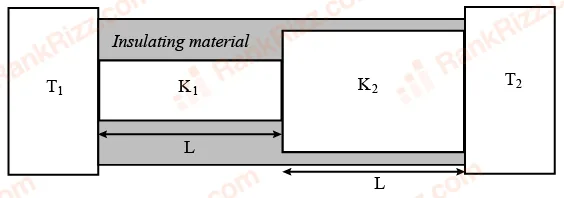
Two conducting cylinders of equal length but different radii are connected in series between two heat baths kept at temperatures = 100 𝐾, as shown in the figure. The radius of the bigger cylinder is twice that of the smaller one and the thermal conductivities of the materials of the smaller and the larger cylinders are respectively. If the temperature at the junction of the two cylinders in the steady state is 200 𝐾, then =__________.
Answer: ____________
rr2.rankrizz.com/jee-advanced/physics/thermal-properties-of-matter/q/2018-paper-1-q14
A human body has a surface area of approximately 1 . The normal body temperature is 10 K above the surrounding room temperature . Take the room temperature to be . For , the value of (where is the Stefan-Boltzmann constant). Which of the following options is/are correct?
- (A)
The amount of energy radiated by the body in 1 second is close to 60 Joules
- (B)
If the surrounding temperature reduces by a small amount , then to maintain the same body temperature the same (living) human being needs to radiate more energy per unit time
- (C)
Reducing the exposed surface area of the body (e.g. by curling up) allows humans to maintain the same body temperature while reducing the energy lost by radiation
- (D)
If the body temperature rises significantly then the peak in the spectrum of electromagnetic radiation emitted by the body would shift to longer wavelengths
rr2.rankrizz.com/jee-advanced/physics/thermal-properties-of-matter/q/2017-paper-1-q4
- (A)
A metal is heated in a furnace where a sensor is kept above the metal surface to read the power radiated (P) by the metal. The sensor hasa scale that displays log, , where is a constant. When the metal surface is at a temperature of , the sensor shows a value 1. Assume that the emissivity of the metallic surface remains constant. What is the value displayed by the sensor when the temperature of the metal surface is raised to ?
Answer: ____________
rr2.rankrizz.com/jee-advanced/physics/thermal-properties-of-matter/q/2016-paper-1-q14
Two spherical stars A and B emit blackbody radiation. The radius of A is 400 times that of B and A emits times the power emitted from B. The ratio of their wavelengths and at which the peaks occurin their respective radiation curves is
Answer: ____________
rr2.rankrizz.com/jee-advanced/physics/thermal-properties-of-matter/q/2015-paper-1-q5
Parallel rays of light of intensity are incident on a spherical black body kept in surroundings of temperature 300 K. Take Stefan-Boltzmann constant and assume that the energy exchange with the surroundingsis only through radiation. The final steady state temperature of the black body is close to
- (A)
330 K
- (B)
660 K
- (C)
990 K
- (D)
1550 K
rr2.rankrizz.com/jee-advanced/physics/thermal-properties-of-matter/q/2014-paper-2-q6
- (A)
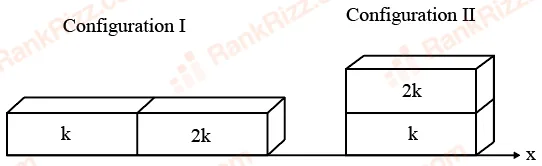
Two rectangular blocks, having identical dimensions, can be arranged either in configuration I or in configuration II as shown in the figure. One of the blocks has thermal conductivity K and the other 2K. The temperature difference between the ends along the x-axis is the same in both the configurations. It takes 9 s to transport a certain amount of heat from the hot end to the cold end in the configuration I. The time to transport the same amount of heat in the configuration II is
- (A)
2.0 s
- (B)
3.0 s
- (C)
4.5 s
- (D)
6.0 s
rr2.rankrizz.com/jee-advanced/physics/thermal-properties-of-matter/q/2013-paper-1-q5
- (A)
Three very large plates of same area are kept parallel and close to each other. They are considered as ideal black surfaces and have very high thermal conductivity. Thefirst and
third plates are maintained at temperatures 27 and 37 respectively. The temperature of the middle (i.e. second) plate under steady state condition is- (A)
- (B)
- (C)
- (D)
rr2.rankrizz.com/jee-advanced/physics/thermal-properties-of-matter/q/2012-paper-1-q2
- (A)
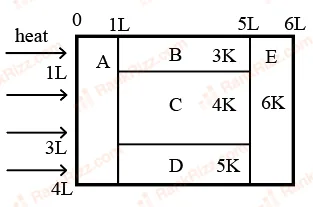
A composite book is made of slabs A, B, C, D and E of different thermal conductivities (given in terms of a constant K) and sizes (given in terms of length, L) as shown in the figure. All slabs are of same width. Heat 'Q' flow only from left to right through the blocks. Then in steady state-
- (A)
heat flow through A and E slabs are same
- (B)
heat flow through slab E is maximum
- (C)
temperature difference across slab E is smallest
- (D)
heat flow through C = heat flow through B + heat flow through D
rr2.rankrizz.com/jee-advanced/physics/thermal-properties-of-matter/q/2011-paper-1-q34
- (A)
Two spherical bodies A (radius 6 cm) and B (radius 18 cm) are at temperatures and , respectively. The maximum intensity in the emission spectrum of A is at 500 nm and in that of B is at 1500 nm. Considering themto be black bodies, what will be the ratio of the rate of total energy radiated by A to that of B ?
Answer: ____________
rr2.rankrizz.com/jee-advanced/physics/thermal-properties-of-matter/q/2010-paper-1-q78
Calorimetry and specific heat capacity 7
The specific heat capacity of a substance is temperature dependent and is given by the formula , where is a constant of suitable dimensions in SI units, and is the absolute temperature. If the heat required to raise the temperature of 1 kg of the substance from C to C is , the value of is ______.
[Given: K C.]
Answer: ____________
rr2.rankrizz.com/jee-advanced/physics/thermal-properties-of-matter/q/2024-paper-1-q25
A current carrying wire heats a metal rod. The wire provides a constant power (P) to the rod. The metal rod is enclosed in an insulated container. It is observed that the temperature (T) inthe metal rod changes with time (t) as
where is a constant with appropriate dimension while is a constant with dimension of temperature. The heat capacity of the metal is,- (A)
- (B)
- (C)
- (D)
rr2.rankrizz.com/jee-advanced/physics/thermal-properties-of-matter/q/2019-paper-1-q3
- (A)
A liquid at is poured very slowly into a Calorimeter that is at temperature of . The boiling temperature of the liquid is . It is found that the first 5 gm of the liquid completely evaporates. After pouring another 80 gm of the liquid the equilibrium temperature is found to be . The ratio of the Latent heat of the liquid to its specific heat will be
[Neglect the heat exchange with surrounding]Answer: ____________
rr2.rankrizz.com/jee-advanced/physics/thermal-properties-of-matter/q/2019-paper-1-q17
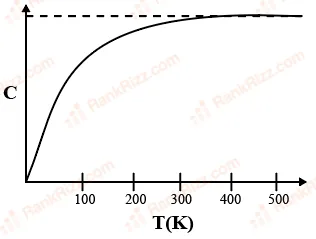
The figure below shows the variation of specific heat capacity (C) of a solid as a function of temperature (T). The temperature is increased continuously from 0 to 500 K at a constant rate. Ignoring any volume change, the following statement(s)is (are) correct to a reasonable approximation.
- (A)
the rate at which heat is absorbed in the range 0-100 K varies linearly with temperature T.
- (B)
heat absorbed in increasing the temperature from 0-100 K is less than the heat required for increasing the temperature from 400-500 K.
- (C)
there is no changein the rate of heat absorption in the range 400-500 K.
- (D)
the rate of heat absorption increases in the range 200-300 K.
rr2.rankrizz.com/jee-advanced/physics/thermal-properties-of-matter/q/2013-paper-2-q3
- (A)
Two moles of ideal helium gas are in a rubber balloon at .The balloon is fully expandable and can be assumed to require no energy in its expansion. The temperature of the gas in the balloon is slowly changed to .The amount of heat required in raising the temperature is nearly (take R = 8.31 J/mol.K)
- (A)
62 J
- (B)
104 J
- (C)
124 J
- (D)
208 J
rr2.rankrizz.com/jee-advanced/physics/thermal-properties-of-matter/q/2012-paper-2-q8
- (A)
A piece of ice (heat capacity = 2100 J andlatent heat = ) of mass m grams is at at atmospheric pressure. It is given 420 J of heat so that the ice starts melting. Finally when the ice-water mixture is in equilibrium, it is found that 1 gmof ice has melted. Assuming there is no other heat exchange in the process, the value of m is
Answer: ____________
rr2.rankrizz.com/jee-advanced/physics/thermal-properties-of-matter/q/2010-paper-1-q83
A metal rod AB of length 10x has its one end A in ice at and the other end B in water at . If a point P on the rod is maintained at , then it is found that equal amounts of water andice evaporate and melt per unit time. The latent heat of evaporation of water is 540 cal/g and latent heat of melting of ice is 80 cal/g. If the point P is at a distance of from the ice end A, find the value of . [Neglect any heat loss to the surrounding.]
Answer: ____________
rr2.rankrizz.com/jee-advanced/physics/thermal-properties-of-matter/q/2009-paper-2-q50
Temperature scales and thermal expansion 3
The ends Q and of two thin wires, PQ and RS, are soldered (joined) together. Initially each of the wires has a length of 1 m at . Now the end P is maintained at , while the end S is heated and maintained at . The system is thermally insulated from its surroundings. If the thermal conductivity of wire PQ is twice that of the wire RS and the coefficient of linear thermal expansion of PQ is the change in length of the wire PQ is
- (A)
0.78 mm
- (B)
0.90 mm
- (C)
1.56 mm
- (D)
2.34 mm
rr2.rankrizz.com/jee-advanced/physics/thermal-properties-of-matter/q/2016-paper-2-q4
- (A)
Steel wire of length 'L' at is suspended from the ceiling and then a mass 'm' is hung from its free end. The wire is cooled down from to to region its original length 'L'. The coefficient of linear thermal expansion of the steel is , Young's modulus of steel is and radius of the wire is 1 mm. Assume that L >> diameter of the wire. Then the value of 'm' in kg is nearly.
Answer: ____________
rr2.rankrizz.com/jee-advanced/physics/thermal-properties-of-matter/q/2011-paper-1-q46
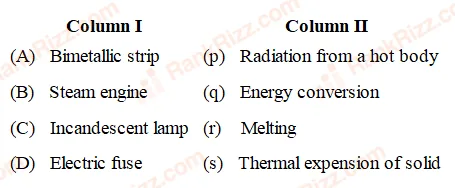
Column I gives some devices and Column II gives some processes on which the functioning of these devices depend. Match the devices in Column I with the processes in Column II and indicate your answer by darkening appropriate bubbles in the matrix given in the ORS.
rr2.rankrizz.com/jee-advanced/physics/thermal-properties-of-matter/q/2007-paper-2-q22
Answer key
- 01 C
- 02 9
- 03 B, C, D
- 04 —
- 05 —
- 06 C
- 07 9
- 08 2
- 09 A
- 10 A
- 11 C
- 12 A, C, D
- 13 9
- 14 25000
- 15 B
- 16 —
- 17 A, B, C, D
- 18 D
- 19 8
- 20 —
- 21 A
- 22 3
- 23 A-QS, B-Q, C-PQ, D-QR
“—” marks a question whose key we have not checked yet; its page shows the latest on it.
Past questions are reproduced with their sitting. Not affiliated with NTA or the IITs. Every question, online and free: rr2.rankrizz.com/jee-advanced/physics/thermal-properties-of-matter