Rotational Motion JEE Advanced PYQs with answer key
PHYSICS · 64 PAST QUESTIONS · 5 TOPICS · 2007–2026
HOW TO USE THIS SHEET
Every JEE Advanced Rotational Motion question we hold, grouped by topic, most-asked topic first and newest first inside each. The answer key is at the end (57 of 64 questions have a checked key); the worked solution is on each question’s page, printed beside it.
Rolling with friction, slipping and impulsive forces 32
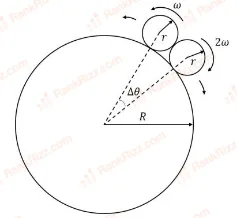
Consider a large disk of radius and two smaller disks, each of radius , lying on its circumference, as shown in the figure. The smaller disks are initially in contact with each other, with an angular separation between their centers. They are made to roll without slipping in opposite directions, with constant angular velocities and while the large disk is held stationary. The time at which the smaller disks are again in contact is:
[Use and ignore gravity.]
- (A)
- (B)
- (C)
- (D)
rr2.rankrizz.com/jee-advanced/physics/rotational-motion/q/2026-paper-1-q1
- (A)
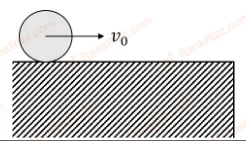
A solid cylinder of radius rolls without slipping with a center of mass speed on a horizontal surface with a vertical edge, as shown in the figure. Here, is the acceleration due to the gravity. At the moment when the cylinder loses contact with the surface due to rotation around the corner, the speed of its center of mass is:
- (A)
- (B)
- (C)
- (D)
rr2.rankrizz.com/jee-advanced/physics/rotational-motion/q/2026-paper-1-q3
- (A)
Question Stem for Question Nos. 17 and 18
A uniform circular disk of radius and mass is pivoted at its top point such that it can rotate freely around in the plane, as shown in the figure. Initially, when the disk is at rest, a particle of mass , travelling along negative direction in the plane with speed , hits the circumference of the disk at a point . After collision the particle moves along negative direction at a speed of .
[Given: the acceleration due to gravity ]
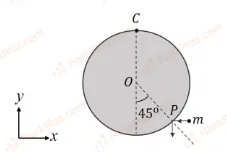
After the collision the disk starts to rotate around point in the plane. The maximum change in the height (in m) of its center is:
Answer: ____________
rr2.rankrizz.com/jee-advanced/physics/rotational-motion/q/2026-paper-2-q17
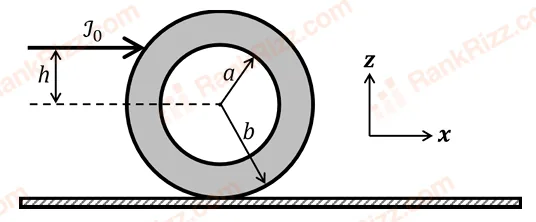
An annular disk of mass , inner radius and outer radius is placed on a horizontal surface with coefficient of friction , as shown in the figure. At some time, an impulse is applied at a height h above the center of the disk. If then the disk rolls without slipping along the x-axis. Which of the following statement(s) is(are) correct?
- (A)
For and ,
- (B)
For and ,
- (C)
For , the initial angular velocity does not depend on the inner radius .
- (D)
For and , the wheel always slides without rolling.
rr2.rankrizz.com/jee-advanced/physics/rotational-motion/q/2023-paper-2-q23
- (A)
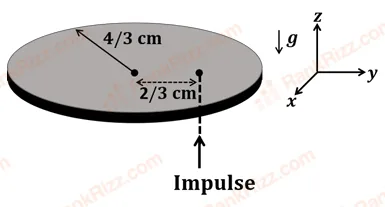
A thin circular coin of mass 5 gm and radius 4/3 cm is initially in a horizontal -plane. The coin is tossed vertically up (+z direction) by applying an impulse of N-s at a distance 2/3 cm from its center. The coin spins about its diameter and moves along the +z direction. By the time the coin reaches back to its initial position, it completes rotations. The value of is ____.
[Given: The acceleration due to gravity ms]
Answer: ____________
rr2.rankrizz.com/jee-advanced/physics/rotational-motion/q/2023-paper-2-q25
At time , a disk of radius 1 m starts to roll without slipping on a horizontal plane with an angular acceleration of rad s. A small stone is stuck to the disk. At , it is at the contact point of the disk and the plane. Later, at time s, the stone detaches itself and flies off tangentially from the disk. The maximum height (in m) reached by the stone measured from the plane is . The value of is ______. [Take m s.]
Answer: ____________
rr2.rankrizz.com/jee-advanced/physics/rotational-motion/q/2022-paper-1-q23
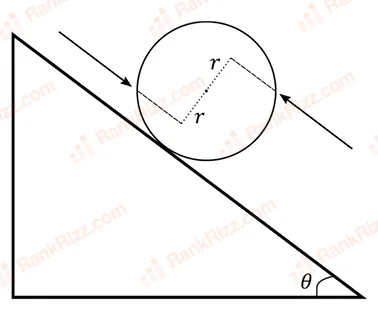
A solid sphere of mass 1 kg and radius 1 m rolls without slipping on a fixed inclined plane with an angle of inclination from the horizontal. Two forces of magnitude 1 N each, parallel to the incline, act on the sphere, both at distance m from the center of the sphere, as shown in the figure. The acceleration of the sphere down the plane is ______ ms. (Take m s.)
Answer: ____________
rr2.rankrizz.com/jee-advanced/physics/rotational-motion/q/2022-paper-1-q24
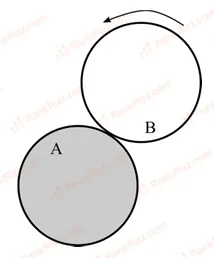
A flat surface of a thin uniform disk A of radius R is glued to a horizontal table. Another thin uniform disk B of mass M and with the same radius R rolls without slipping on the circumference of A, as shown in the figure. A flat surface of B also lies on the plane of the table. The center of mass of B has fixed angular speed about the vertical axis passing through the center of A. The angular momentum of B is with respect to the center of A. Which of the following is the value of ?
- (A)
2
- (B)
5
- (C)
- (D)
rr2.rankrizz.com/jee-advanced/physics/rotational-motion/q/2022-paper-2-q33
- (A)
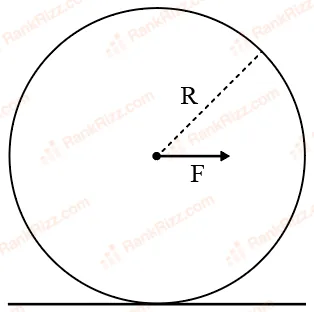
A horizontal force 𝐹 is applied at the center of mass of a cylindrical object of mass 𝑚 and radius 𝑅, perpendicular to its axis as shown in the figure. The coefficient of friction between the object and the ground is . The center of mass of the object has an acceleration 𝑎. The acceleration due to gravity is 𝑔. Given that the object rolls without slipping, which of the following statement(s) is(are) correct?
- (A)
For the same F, the value of 𝑎 does not depend on whether the cylinder is solid or hollow
- (B)
For a solid cylinder,the maximum possible value of 𝑎 is
- (C)
The magnitude of the frictional force on the object due to the ground is always
- (D)
For a thin-walled hollow cylinder,
rr2.rankrizz.com/jee-advanced/physics/rotational-motion/q/2021-paper-1-q30
- (A)
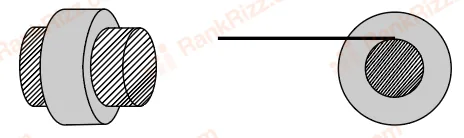
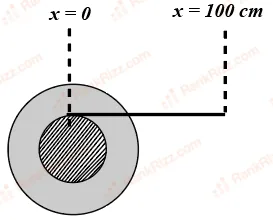
A small roller of diameter 20 cm has an axle of diameter 10 cm (see figure below on the left). It is on a horizontal floor and a meter scale is positioned horizontally on its axle with one edge of the scale on top of the axle (see figure on the right). The scale is now pushed slowly on the axle so that it moves without slipping on the axle, and the roller starts rolling without slipping. After the roller has moved 50 cm, the position of the scale will look like (figures are schematic and not drawn to scale)
- (A)
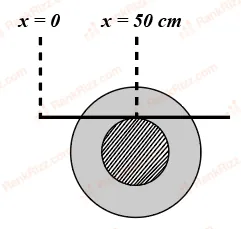
- (B)
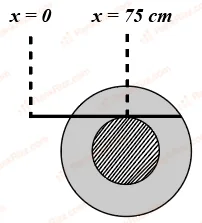
- (C)
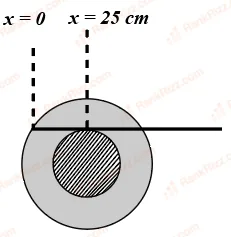
- (D)
rr2.rankrizz.com/jee-advanced/physics/rotational-motion/q/2020-paper-1-q3
- (A)
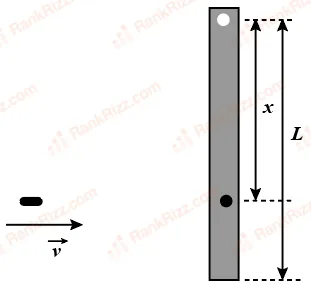
A rod of mass 𝑚 and length 𝐿, pivoted at one of its ends, is hanging vertically. A bullet of the same mass moving at speed 𝑣 strikes the rod horizontally at a distance 𝑥 from its pivoted end and gets embedded in it. The combined system now rotates with angular speed about the pivot. The maximum angular speed is achieved for . Then
- (A)
- (B)
- (C)
- (D)
rr2.rankrizz.com/jee-advanced/physics/rotational-motion/q/2020-paper-2-q9
- (A)
A thin and uniform rod of mass M and length L is held vertical on a floor with large friction. The rod is released from rest so that it falls by rotating about its contact-point with the floor without slipping. Which of the following statement(s) is/are correct, when the rod makes an angle with vertical?
[g is the acceleration due to gravity]- (A)
The angular speed of the rod will be
- (B)
The angular acceleration of the rod will be
- (C)
The radial acceleration ofthe rod’s center of mass will be
- (D)
The normal reaction force from the floor on the rod will be
rr2.rankrizz.com/jee-advanced/physics/rotational-motion/q/2019-paper-2-q1
- (A)
Two vectors are defined as =a and , where a is a constant and .If = at time t = for the first time,
the value of , in Seconds, is .................Answer: ____________
rr2.rankrizz.com/jee-advanced/physics/rotational-motion/q/2018-paper-1-q7
A ring and a disc are initially at rest, side by side, at the top of an inclined plane which makes an angle with the horizontal. They start to roll without slipping at the same instant of time along the shortest path. If the time difference between their reaching the ground is S then the height of the top of the inclined plane, in meters, is __________. Take
Answer: ____________
rr2.rankrizz.com/jee-advanced/physics/rotational-motion/q/2018-paper-1-q9
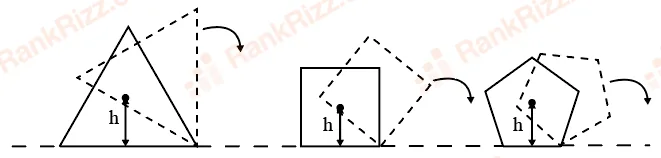
Consider regular polygons with number of sides n=3,4,5.....as shown in the figure. The center of mass of all the polygons is at height h from the ground. They roll on a horizontal surface about the leading vertex without slipping and sliding as depicted. The maximum increase in height of the locus of the center of mass for each polygon is . Then depends on n and has
- (A)
- (B)
- (C)
- (D)
rr2.rankrizz.com/jee-advanced/physics/rotational-motion/q/2017-paper-2-q2
- (A)
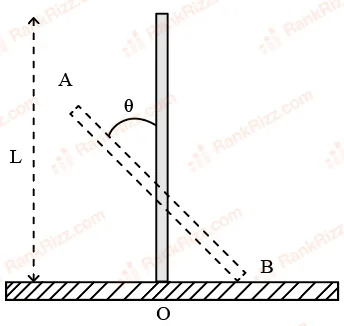
A rigid uniform bar AB of length L is slipping from its vertical position on a frictionless floor (as shown in the figure). At some instant of time, the angle made by the bar with the vertical is Which of the following statements about its motion is/are correct?
- (A)
The midpoint of the bar will fall vertically downward
- (B)
The trajectory of the point A is a parabola
- (C)
Instantaneous torque about the point in contact with the floor is proportional to
- (D)
When the bar makes an angle with the vertical, the displacement of its midpoint from the initial position is proportional to
rr2.rankrizz.com/jee-advanced/physics/rotational-motion/q/2017-paper-2-q13
- (A)
The minimum value of below which the ring will drop down is
- (A)
- (B)
- (C)
- (D)
rr2.rankrizz.com/jee-advanced/physics/rotational-motion/q/2017-paper-2-q18
- (A)
Two identical uniform discs roll without slipping on two different surfaces AB and CD (see figure) starting at A and C with linear speeds and , respectively, and always remain in contact with the surfaces. If they reach B and D with the samelinear speed and , the in m/s is ()
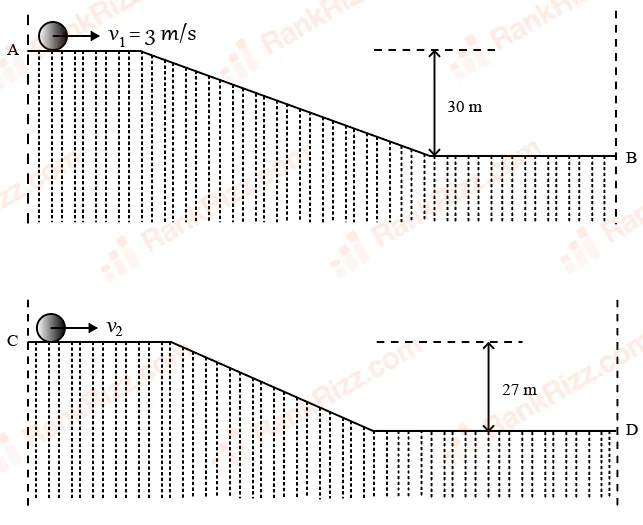
Answer: ____________
rr2.rankrizz.com/jee-advanced/physics/rotational-motion/q/2015-paper-1-q4
Consider a disc rotating in the horizontal plane with a constant angular speed about its centre O. The disc has a shaded region on one side of the diameter and an unshaded region on the other side as shown in the figure. When the disc is in the orientation as shown, two pebbles P and Q are simultaneously projected at an angle towards R. The velocity of projection is in the y-z plane and is same for both pebbles with respect to the disc. Assume that (i) they land back on the disc before the disc completed rotation. (ii) their range is less than half disc radius, and (iii) remains constant throughout . Then
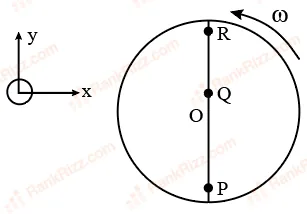
- (A)
P lands in the shaded region and Q in the unshaded region
- (B)
P lands in the unshaded region and Q in the shaded region
- (C)
Both P and Q land in the unshaded region
- (D)
Both P and Q land in the shaded region
rr2.rankrizz.com/jee-advanced/physics/rotational-motion/q/2012-paper-2-q4
- (A)
Two identical discs of same radius R are rotating about their axes in opposite directions with the same constant angular speed . The disc are in the same horizontal plane. At time t = 0 , the points P and Q are facing each other as shown in the figure. The relative speed between the two points P and Q is . as function of times best represented by
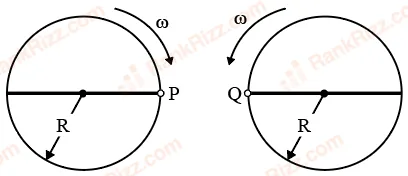
- (A)
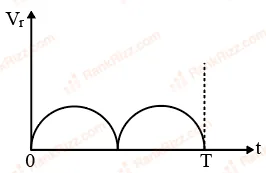
- (B)
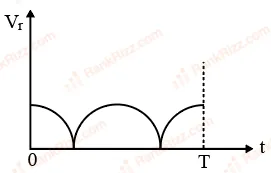
- (C)
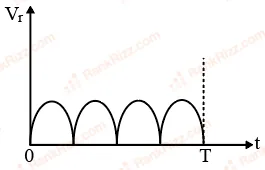
- (D)
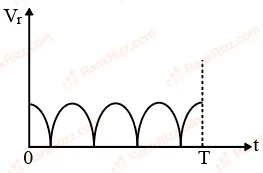
rr2.rankrizz.com/jee-advanced/physics/rotational-motion/q/2012-paper-2-q7
- (A)
Which of the following statement regarding the angular speed about the istantaneous axis (passing through the centre of mass) is correct?
- (A)
It is for both the cases
- (B)
It is for case (a); and for case (b).
- (C)
It is for case (a); and for case (b).
- (D)
It is for both the cases
rr2.rankrizz.com/jee-advanced/physics/rotational-motion/q/2012-paper-2-q13
- (A)
Which of the following statements about the instantaneous axis (passing through the centre of mass) is correct?
- (A)
It is vertical for both the cases (a) and (b).
- (B)
It is verticle for case (a); and is at to the x-z plane and lies in the plane of the disc for case (b)
- (C)
It is horizontal ofr case (a); and is at to the x - z plane and is normal to the plane of the disc for case (b).
- (D)
It is vertical of case (a); and is at to the x - z plane and is normal to the plane of the disc for case (b).
rr2.rankrizz.com/jee-advanced/physics/rotational-motion/q/2012-paper-2-q14
- (A)
Two solid cylinders P andQ of same mass and same radius start rolling down a fixed inclined plane form the same height at the same time. Cylinder P has most of its mass concentrated near its surface, while Q has most of its mass concentrated near the axis. Which statement (s) is (are) correct?
- (A)
Both cylinders P and Q reach the ground at the same time
- (B)
Cylinder P has larger linear acceleration than cylinder Q.
- (C)
Both cylinder Q reaches the ground with same translational kinetic energy.
- (D)
Cylinder Q reaches the ground with larger angular speed.
rr2.rankrizz.com/jee-advanced/physics/rotational-motion/q/2012-paper-2-q15
- (A)
The figure shows a system consisting of (i) a ring of outer radius 3R rolling clockwise without slipping on a horizontal surface with angular speed and (ii) an inner disc of radius 2R rotating anti-clockwisewith angular speed . The ring and disc are separated b frictionaless ball bearings. The system is in the x-z plane. The
point P on the inner disc is at distance R from the origin, where OP makes an angle of with the horizontal. Then with respect to the horizontal surface,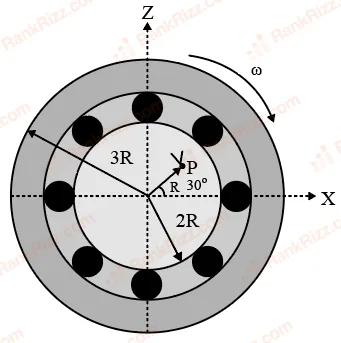
- (A)
the point O has linear velocity .
- (B)
the point P has a linear velocity
- (C)
the point P has a linear velocity
- (D)
the point P has a linear velocity
rr2.rankrizz.com/jee-advanced/physics/rotational-motion/q/2012-paper-2-q20
- (A)
A boy is pushing a ring of mass 2 kg and radius 0.5 m with a stick as shown in the figure. The stick applies a force of 2 N on the ring and rolls it without slipping with an acceleration of 0.3 . The coefficient of friction between the ground and the ring is large enough that rolling always occurs and the coefficient of friction between the stick and the ring is (P/10). The value of P is.
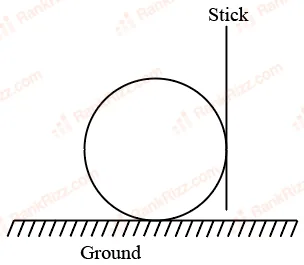
Answer: ____________
rr2.rankrizz.com/jee-advanced/physics/rotational-motion/q/2011-paper-1-q41
A sphere is rolling without slipping on a fixed horizontal plane surface. In the figure, A is the point of contact, B is the centre of the sphere and C is its topmost point. Then,
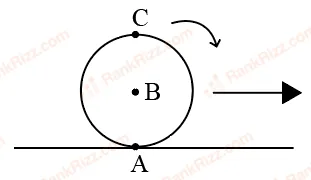
- (A)
- (B)
- (C)
- (D)
rr2.rankrizz.com/jee-advanced/physics/rotational-motion/q/2009-paper-2-q47
- (A)
STATEMENT-1
Twocylinders, one hollow (metal) and the other solid (wood) with the same mass and identical dimensions are simultaneously allowed to roll without slipping down an inclined plane from the sameheight. The hollow cylinder will reach the bottom of the inclined plane first.
and
STATEMENT-2
By the principle of conservation of energy, the total kinetic energies of both the cylinders are identical when they reach the bottom of the incline.- (A)
STATEMENT-1 is True, STATEMENT-2 is True; STATEMENT-2 is a correct explanation for STATEMENT-1
- (B)
STATEMENT-1 is True, STATEMENT-2 is True; STATEMENT-2 is NOT a correct explanation for STATEMENT-1
- (C)
STATEMENT-1 is True, STATEMENT-2 is False
- (D)
STATEMENT-1 is False, STATEMENT-2 is True
rr2.rankrizz.com/jee-advanced/physics/rotational-motion/q/2008-paper-1-q36
- (A)
The net external force acting on the disk whenits centre of mass is at displacement x with respect to its equilibrium position is
- (A)
-kx
- (B)
-2kx
- (C)
- (D)
rr2.rankrizz.com/jee-advanced/physics/rotational-motion/q/2008-paper-2-q39
- (A)
The centre of mass of the disk undergoes simple harmonic motion with angular frequency equal to
- (A)
- (B)
- (C)
- (D)
rr2.rankrizz.com/jee-advanced/physics/rotational-motion/q/2008-paper-2-q40
- (A)
The maximum value of for which the disk will roll without slipping is
- (A)
- (B)
- (C)
- (D)
rr2.rankrizz.com/jee-advanced/physics/rotational-motion/q/2008-paper-2-q41
- (A)
A small object of uniform density rolls up a curved surface with an initial velocity v. It reaches up to a maximum height of with respect to the initial position. The object is
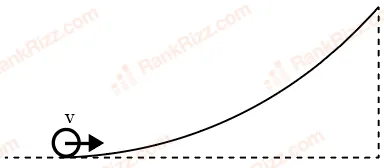
- (A)
ring
- (B)
solid sphere
- (C)
hollow sphere
- (D)
disc
rr2.rankrizz.com/jee-advanced/physics/rotational-motion/q/2007-paper-2-q4
- (A)
The ratio is
- (A)
2
- (B)
- (C)
- (D)
rr2.rankrizz.com/jee-advanced/physics/rotational-motion/q/2007-paper-1-q14
- (A)
Angular momentum of particles and rigid bodies 16
Question Stem for Question Nos. 17 and 18
A uniform circular disk of radius and mass is pivoted at its top point such that it can rotate freely around in the plane, as shown in the figure. Initially, when the disk is at rest, a particle of mass , travelling along negative direction in the plane with speed , hits the circumference of the disk at a point . After collision the particle moves along negative direction at a speed of .
[Given: the acceleration due to gravity ]
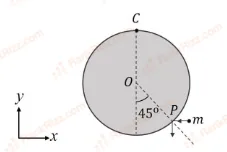
Amount of energy loss (in J) in the collision is:
Answer: ____________
rr2.rankrizz.com/jee-advanced/physics/rotational-motion/q/2026-paper-2-q18
A disc of mass and radius is free to rotate about its vertical axis as shown in the figure. A battery operated motor of negligible mass is fixed to this disc at a point on its circumference. Another disc of the same mass and radius is fixed to the motor's thin shaft. Initially, both the discs are at rest. The motor is switched on so that the smaller disc rotates at a uniform angular speed . If the angular speed at which the large disc rotates is , then the value of is ______.
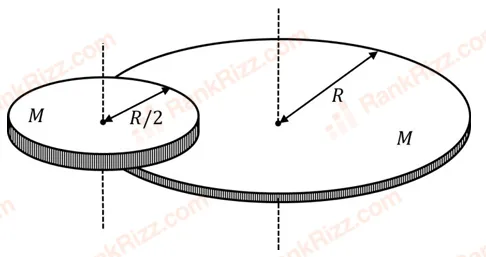
Answer: ____________
rr2.rankrizz.com/jee-advanced/physics/rotational-motion/q/2024-paper-1-q26
A thin uniform rod of length and certain mass is kept on a frictionless horizontal table with a massless string of length fixed to one end (top view is shown in the figure). The other end of the string is pivoted to a point . If a horizontal impulse is imparted to the rod at a distance from the mid-point of the rod (see figure), then the rod and string revolve together around the point , with the rod remaining aligned with the string. In such a case, the value of is ______.
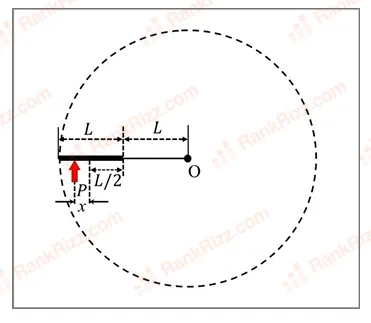
Answer: ____________
rr2.rankrizz.com/jee-advanced/physics/rotational-motion/q/2024-paper-1-q30
A particle of mass M = 0.2 kg is initially at rest in the xy-plane at a point (x = −l, y = −h), where l = 10 m and h = 1 m. The particle is accelerated at time t = 0 with a constant acceleration 𝑎 = 10 m/s along the positive x-direction. Its angular momentum and torque with respect to the origin, in SI units, are represented by and , respectively. and are unit vectors along the positive x, y and z-directions, respectively. If then which of the following statement(s) is(are) correct?
- (A)
The particle arrives at the point (x = l, y = −h) at time t = 2 s
- (B)
when the particle passes through the point (x = l, y = −h)
- (C)
when the particle passes through the point (x = l, y = −h)
- (D)
when the particle passes through the point (x = 0, y = −h)
rr2.rankrizz.com/jee-advanced/physics/rotational-motion/q/2021-paper-1-q32
- (A)
A thin rod of mass M and length 𝑎 is free to rotate in horizontal plane about a fixed vertical axis passing through point O. A thin circular disc of mass M and of radius 𝑎/4 is pivoted on this rod with its center at a distance 𝑎/4 from the free end so that it can rotate freely about its vertical axis, as shown in the figure. Assume that both the rod and the disc have uniform density and they remain horizontal during the motion. An outside stationary observer finds the rod rotating with an angular velocity Ω and the disc rotating about its vertical axis with angular velocity 4Ω. The total angular momentum of the system about the point O is .
The value of n is .........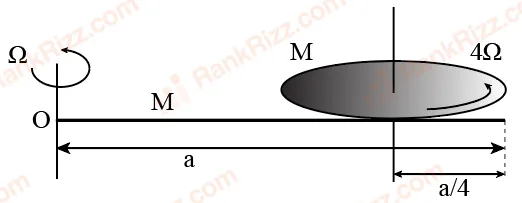
Answer: ____________
rr2.rankrizz.com/jee-advanced/physics/rotational-motion/q/2021-paper-1-q37
The potential energy of a particle of mass 𝑚 at a distance 𝑟 from a fixed point 𝑂 is given by where 𝑘 is a positive constant of appropriate dimensions. This particle is moving in a circular orbit of radius 𝑅 about the point 𝑂. If 𝑣 is the speed of the particle and 𝐿 is the magnitude of its angular momentum about 𝑂, which of the following statements is (are) true?where 𝑘 is a positive constant of appropriate dimensions. This particle is moving in a circular orbit of radius 𝑅 about the point 𝑂. If 𝑣 is the speed of the particle and 𝐿 is the magnitude of its angular momentum about 𝑂, which of the following statements is (are) true?
- (A)
R
- (B)
R
- (C)
- (D)
rr2.rankrizz.com/jee-advanced/physics/rotational-motion/q/2018-paper-1-q1
- (A)
Two thin circular discs of mass m and 4m, having radii of a and 2a, respectively, are rigidly fixed by a mass less, rigid rod of length through their centers. This assembly is laid on a firm and flat surface, and set rolling without slipping on the surface so that the angular speed about the axis of the rod is . The angular momentum of the entire assembly about the point ‘O’ is (see the figure). Which of the following statement(s) is(are) true?
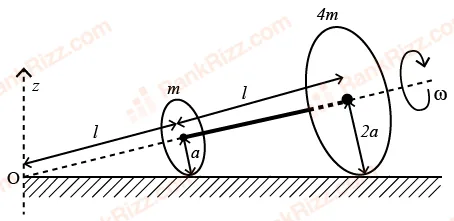
- (A)
The center of mass of the assembly rotates aboutthe z-axis with an angularspeed of
- (B)
The magnitude of angular momentum of center of mass of the assembly about the point O is
- (C)
The magnitude of angular momentumofthe assembly aboutits center of mass is
- (D)
The magnitude of the z-component of is
rr2.rankrizz.com/jee-advanced/physics/rotational-motion/q/2016-paper-2-q7
- (A)
The position vector of a particle of mass m is given by the following equation
where and m=0.1 kg. At t=1 s, which of the following statement(s) is(are) true about the particle?- (A)
The velocity is given by
- (B)
The angular momentum with respect to the origin is given by
- (C)
The force is given by
- (D)
The torque with respect to the origin is given by
rr2.rankrizz.com/jee-advanced/physics/rotational-motion/q/2016-paper-1-q12
- (A)
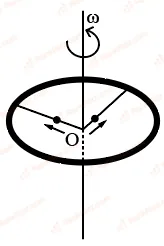
A ring of mass M and radius R is rotating with angular speed about a fixed vertical axis passing through its centre O with two point masses each of mass at rest at O. These masses can move radially outwards along two massless rods fixed on the ring as shown in the figure. At some instant the angular speed of the system is and one of the masses is at a distance of from O. At this instant the distance of the other mass from O is
- (A)
- (B)
- (C)
- (D)
rr2.rankrizz.com/jee-advanced/physics/rotational-motion/q/2015-paper-1-q12
- (A)
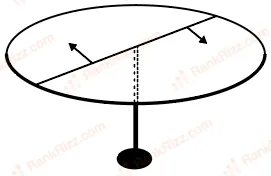
A horizontal circular platform of radius 0.5 m and mass 0.45 kg is free to rotate about its axis. Two massless spring toy-guns, each carrying a steel ball of mass 0.05 kg are attached to the platform at a distance 0.25 m from the centre on its either sides along its diameter (see figure). Each gun simultaneously fires the balls horizontally and perpendicular to the diameter in opposite directions. After leaving the platform, the balls have horizontal speed of with respect to the ground. The rotational speed of the platform in after the balls leave the platform is
Answer: ____________
rr2.rankrizz.com/jee-advanced/physics/rotational-motion/q/2014-paper-1-q19
A uniform circular disc of mass 50 kg and radius 0.4 m is rotating with an angular velocity of 10 rad aboutits own axis, which is vertical. Two uniform circular rings, each of mass 6.25 kg and radius 0.2 m, are gently placed symmetrically on the disc in such a manner that they are touching each other along the axis of the disc and are horizontal. Assume that the friction is large enough such that the rings are at rest relative to the disc and the system rotates about the original axis. The new angular velocity (in rad ) of the system is
Answer: ____________
rr2.rankrizz.com/jee-advanced/physics/rotational-motion/q/2013-paper-1-q19
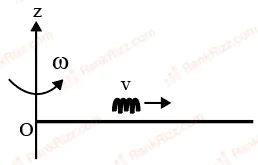
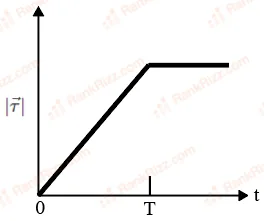
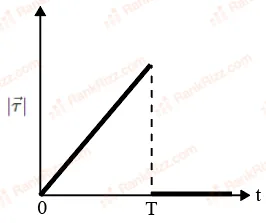
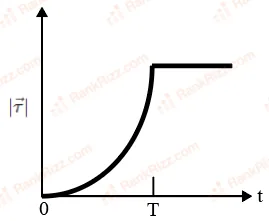
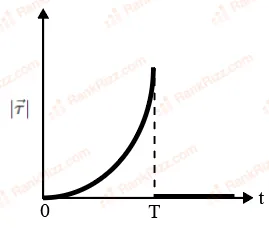
Athin uniform rod, pivoted at O,is rotating in the horizontal plane with constant angular speed , as shownin the figure. At time t = 0, a small insect starts from O and moves with constant speedv with respect to the rod towardsthe other end. It reaches the end of the rod at t = T and stops. The angular speed of the system remains throughout. The magnitude of the torque on the system about O, as a function of time is best represented by which plot ?
- (A)
- (B)
- (C)
- (D)
rr2.rankrizz.com/jee-advanced/physics/rotational-motion/q/2012-paper-1-q1
- (A)
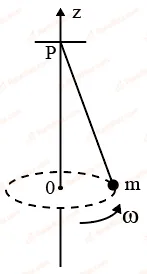
A small mass m is attached to a massless string whose other end is fixed at P as shown in the figure. The mass is undergoing circular motion in the x-y plane with centre at O and constant angular speed If the angular momentum of the system, calculated about O and P are denoted by and respectively, then
- (A)
and do not vary with time
- (B)
varies with time while remains constant.
- (C)
remains constant while varies with time.
- (D)
and both vary with time.
rr2.rankrizz.com/jee-advanced/physics/rotational-motion/q/2012-paper-1-q7
- (A)
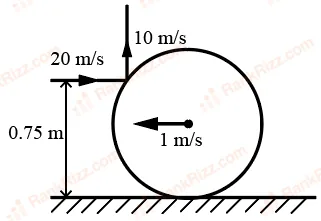
A thin ring of mass 2 kg and radius 0.5 m is rolling without slipping on a horizontal plane with velocity 1 m/s. A small ball of mass 0.1 kg, moving with velocity 20 m/s in the opposite direction, hits the ring at a height of 0.75 m and goes vertically up with velocity 10 m/s. Immediately after the collision
- (A)
the ring has pure rotation aboutits stationary CM.
- (B)
the ring comes to a complete stop.
- (C)
friction between the ring and the ground is to the left.
- (D)
there is no friction between the ring and the ground.
rr2.rankrizz.com/jee-advanced/physics/rotational-motion/q/2011-paper-2-q32
- (A)
If the resultant of all the external forces acting on a system of particles is zero, then from an inertial frame, one can surely say that
- (A)
linear momentum of the system does not change in time
- (B)
kinetic energy of the system does not change in time
- (C)
angular momentum of the system does not change in time
- (D)
potential energy of the system does not change in time
rr2.rankrizz.com/jee-advanced/physics/rotational-motion/q/2009-paper-1-q50
- (A)
When disc B is brought in contact with disc A, they acquire a common angular velocity in time t. The averagefrictional torque on one disc by the other during this period is
- (A)
- (B)
- (C)
- (D)
rr2.rankrizz.com/jee-advanced/physics/rotational-motion/q/2007-paper-1-q15
- (A)
Equilibrium of rigid bodies and toppling 9
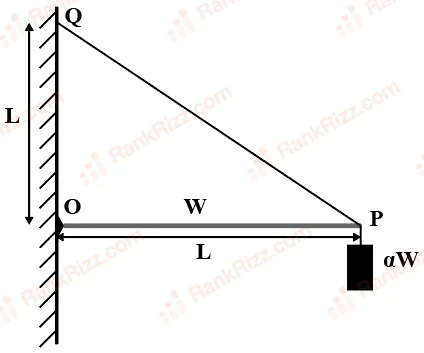
One end of a horizontal uniform beam of weight 𝑊 and length 𝐿 is hinged on a vertical wall at point O and its other end is supported by a light inextensible rope. The other end of the rope is fixed at point Q, at a height 𝐿 above the hinge at point O. A block of weight is attached at the point P of the beam, as shown in the figure (not to scale). The rope can sustain a maximum tension of ()W. Which of the following statement(s) is(are) correct?
- (A)
The vertical component of reaction force at O does not depend on
- (B)
The horizontal component of reaction force at O is equal to 𝑊 for
- (C)
The tension in the rope is 2𝑊 for
- (D)
The rope breaks if
rr2.rankrizz.com/jee-advanced/physics/rotational-motion/q/2021-paper-2-q20
- (A)
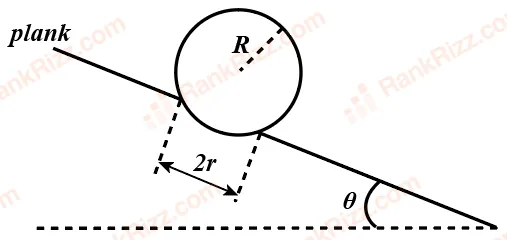
A football of radius R is kept on a hole of radius r (𝑟 < 𝑅) made on a plank kept horizontally. One end of the plank is now lifted so that it gets tilted making an angle 𝜃 from the horizontal as shown in the figure below. The maximum value of so that the football does not start rolling down the plank satisfies (figure is schematic and not drawn to scale)
- (A)
- (B)
- (C)
- (D)
rr2.rankrizz.com/jee-advanced/physics/rotational-motion/q/2020-paper-1-q1
- (A)
Consider a body of mass 1.0 𝑘𝑔 at rest at the origin at time 𝑡 = 0. A force is applied on the body, where and N The torque acting on the body about the origin at time 𝑡 = 1.0 𝑠 is 𝜏⃗. Which of the following statements is (are) true?
- (A)
Nm
- (B)
The torque is in the direction of the unit vector
- (C)
The velocity of the body at is
- (D)
The magnitude of displacement of the body at is m
rr2.rankrizz.com/jee-advanced/physics/rotational-motion/q/2018-paper-1-q2
- (A)
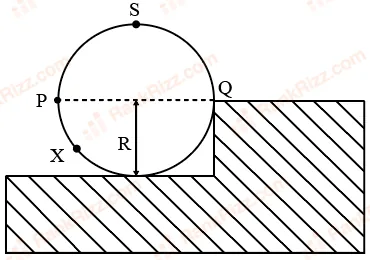
A wheel of radius R and mass M is placed at the bottom of a fixed step of height R as shown in the figure. A constant force is continuously applied on the surface of the wheel so that it just climbs the step without slipping. Consider the torque about an axis normal to the plane of the paper passing through the point Q. Which of the following options is/are correct?
- (A)
If the force is applied at point P tangentially then decreases continuously as the wheel climbs
- (B)
If the force is applied normal to the circumference at point X then is constant
- (C)
If the force is applied normal to the circumference at point P then is zero
- (D)
If the force is applied tangentially at point S then but the wheel never climbs the step
rr2.rankrizz.com/jee-advanced/physics/rotational-motion/q/2017-paper-2-q14
- (A)
A uniform wooden stick of mass 1.6 kg and length / rests in an inclined manneron a smooth, vertical wall of height A(</) such that a small portion of the stick extends beyond the wall. The reaction force of the wall on the stick is perpendicular to the stick. The stick makes an angle of with the wall and the bottom of the stick is on a roughfloor. The reaction of the wall on the stick is equal in magnitudeto the reaction of the floor on the stick. The ratio h/l and thefrictional force f at the bottom of the stick are (g = 10 ms)
- (A)
- (B)
- (C)
- (D)
rr2.rankrizz.com/jee-advanced/physics/rotational-motion/q/2016-paper-1-q2
- (A)
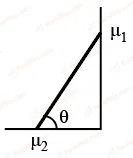
In the figure, a ladder of mass m is shown leaning against a wall. It is in static equilibrium making an angle with the horizontal floor. The coefficient of friction between the wall and the ladder is and that between the floor and the ladder is . The normal reaction of the wall on the ladder is and that of the floor is . If the ladder is about to slip, then
- (A)
and
- (B)
and
- (C)
and
- (D)
and
rr2.rankrizz.com/jee-advanced/physics/rotational-motion/q/2014-paper-1-q8
- (A)
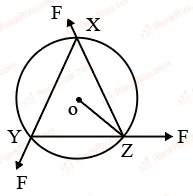
A uniform circular disc of mass 1.5 kg and radius 0.5 m is initially at rest on a horizontal frictionless surface. Three forces of equal magnitude F = 0.5 N are applied simultaneously along the three sides of an equilateral triangle XYZ with its vertices on the perimeter of the disc (see figure). One second after applying the forces, the angular speed of the disc in is
Answer: ____________
rr2.rankrizz.com/jee-advanced/physics/rotational-motion/q/2014-paper-1-q13
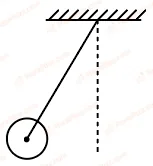
A metal rod of length 'L' and mass 'm' is pivoted at one end. A thin disk of mass 'M' and radius 'R' (< L) is attached at its centre to the free end of the rod. Consider two ways the disc is attached :(case A) The disc is not free to rotate about its center and (case B) the disc is free to rotate about its center. The rod-disc system performs SHM in vertical plane after being released from the same displaced position. Which of the following statement(s) is (are) true ?
- (A)
Restoring torque in case A = Restoring torque in case B
- (B)
Restoring torque in case A < Restoring torque in case B
- (C)
Angular frequency for case A > Angular frequency for case B
- (D)
Angular frequency for case A < Angular frequency for case B
rr2.rankrizz.com/jee-advanced/physics/rotational-motion/q/2011-paper-1-q32
- (A)
STATEMENT-1
If there is no external torque on a body aboutits center of mass, then the velocity of the center of mass remains constant.
because
STATEMENT-2
The linear momentum of an isolated system remains constant.- (A)
Statement-1 is True, Statement-2 is True; Statement-2 is a correct explanation for Statement-1
- (B)
Statement-1 is True, Statement-2 is True; Statement-2 is NOT a correct explanation for Statement-1
- (C)
Statement-1 is True, Statement-2 is False
- (D)
Statement-1 is False, Statement-2 is True
rr2.rankrizz.com/jee-advanced/physics/rotational-motion/q/2007-paper-2-q10
- (A)
Moment of inertia of standard bodies and composite systems 6
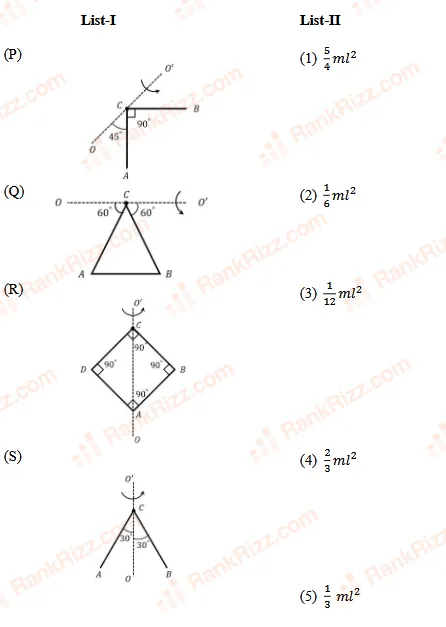
List-I shows four planar structures made of uniform solid rods each of mass and length . In the List-II the possible moment of inertia of these structures about an axis , which lies in the plane of the structures, are given. Choose the option that describes the correct match between the entries in List-I to those in List-II.
- (A)
(P)(5), (Q)(1), (R)(4), (S)(2)
- (B)
(P)(1), (Q)(3), (R)(4), (S)(2)
- (C)
(P)(5), (Q)(3), (R)(2), (S)(1)
- (D)
(P)(5), (Q)(4), (R)(2), (S)(1)
rr2.rankrizz.com/jee-advanced/physics/rotational-motion/q/2026-paper-1-q16
- (A)
A bar of mass kg and length m is lying on a horizontal frictionless surface. One end of the bar is pivoted at a point about which it is free to rotate. A small mass kg is moving on the same horizontal surface with 5.00 m s speed on a path perpendicular to the bar. It hits the bar at a distance from the pivoted end and returns back on the same path with speed v. After this elastic collision, the bar rotates with an angular velocity . Which of the following statement is correct?
- (A)
rad s and v = 4.30 m s
- (B)
rad s and v = 4.30 m s
- (C)
rad s and v = 10.0 m s
- (D)
rad s and v = 4.10 m s
rr2.rankrizz.com/jee-advanced/physics/rotational-motion/q/2023-paper-1-q21
- (A)
The total kinetic energy of the ring is
- (A)
- (B)
- (C)
- (D)
rr2.rankrizz.com/jee-advanced/physics/rotational-motion/q/2017-paper-2-q17
- (A)
The densities of two solid spheres A and B of the same radii R vary with radial distance r as and respectively, where k is a constant. The moments of inertia of the individual spheres about axes passing through their centres are and respectively. If the value of n is
Answer: ____________
rr2.rankrizz.com/jee-advanced/physics/rotational-motion/q/2015-paper-2-q3
A lamina is made by removing a small disc of diameter 2R from a bigger disc of uniform mass density and radius 2R, as shown in the figure. The moment of inertia of this lamina about axes passing through O and is and , respectively. Both these axes are perpendicular to the plane of the lamina. The ratio to the nearest integer is
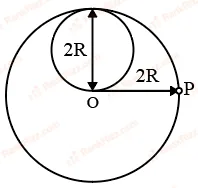
Answer: ____________
rr2.rankrizz.com/jee-advanced/physics/rotational-motion/q/2012-paper-1-q18
Four solid spheres each of diameter cm and mass 0.5 kg are placed with their centers at the corners of a square of side 4 cm. The momentum of inertia of the system about the diagonal of the square is , then N is.
Answer: ____________
rr2.rankrizz.com/jee-advanced/physics/rotational-motion/q/2011-paper-1-q43
Torque and the rotational form of Newton's second law 1
Two point-like objects of masses 20 gm and 30 gm are fixed at the two ends of a rigid massless rod of length 10 cm. This system is suspended vertically from a rigid ceiling using a thin wire attached to its center of mass, as shown in the figure. The resulting torsional pendulum undergoes small oscillations. The torsional constant of the wire is N m rad. The angular frequency of the oscillations in rad s. The value of is ______.
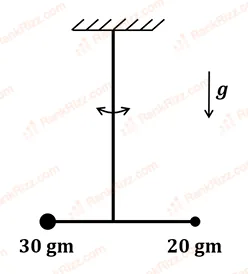
Answer: ____________
rr2.rankrizz.com/jee-advanced/physics/rotational-motion/q/2023-paper-1-q30
Answer key
- 01 C
- 02 B
- 03 —
- 04 A, B, C, D
- 05 30
- 06 —
- 07 —
- 08 B
- 09 B
- 10 D
- 11 A, C, D
- 12 B, C, D
- 13 —
- 14 —
- 15 B
- 16 A, C, D
- 17 A
- 18 7
- 19 C
- 20 A
- 21 D
- 22 A
- 23 D
- 24 A, B
- 25 4
- 26 B
- 27 D
- 28 D
- 29 D
- 30 C
- 31 D
- 32 C
- 33 —
- 34 12
- 35 18
- 36 A, B, C
- 37 49
- 38 B, C
- 39 A
- 40 A, B, D
- 41 C, D
- 42 4
- 43 8
- 44 B
- 45 C
- 46 A
- 47 A
- 48 A
- 49 A
- 50 A
- 51 A, C
- 52 C
- 53 D
- 54 C, D
- 55 2
- 56 A, D
- 57 D
- 58 A
- 59 A
- 60 —
- 61 6
- 62 3
- 63 9
- 64 10
“—” marks a question whose key we have not checked yet; its page shows the latest on it.
Past questions are reproduced with their sitting. Not affiliated with NTA or the IITs. Every question, online and free: rr2.rankrizz.com/jee-advanced/physics/rotational-motion