Mechanical Properties of Fluids JEE Advanced PYQs with answer key
PHYSICS · 33 PAST QUESTIONS · 5 TOPICS · 2007–2026
HOW TO USE THIS SHEET
Every JEE Advanced Mechanical Properties of Fluids question we hold, grouped by topic, most-asked topic first and newest first inside each. The answer key is at the end (27 of 33 questions have a checked key); the worked solution is on each question’s page, printed beside it.
Equation of continuity and Bernoulli's theorem 12
Question Stem for Question Nos. 15 and 16
A container of height , length and breadth is made of insulating vertical walls and two large area horizontal metal plates ( and ) which extend far beyond the vertical walls in all directions. The container is partitioned into two equal chambers with a thin insulating vertical wall. The partition wall contains a small hole of cross-sectional area near its bottom edge. Initially the hole is closed and the left chamber of the container is completely filled with a liquid of dielectric constant and the right chamber is empty (). At time , the hole is opened and the liquid flows from the left chamber to the right chamber. In both the chambers, the space above the liquid has and is maintained at atmospheric pressure. The schematic of the container at a time is shown in the figure.
[Given: acceleration due to gravity is .]
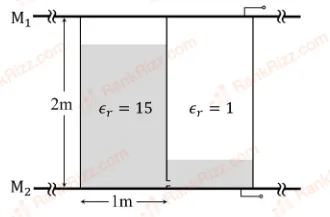
The height (in m) of the liquid in left chamber at is:
Answer: ____________
rr2.rankrizz.com/jee-advanced/physics/mechanical-properties-of-fluids/q/2026-paper-2-q15
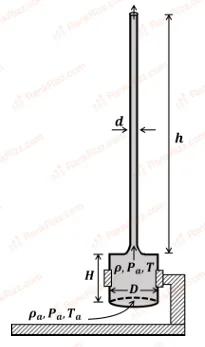
Two large, identical water tanks, 1 and 2, kept on the top of a building of height , are filled with water up to height in each tank. Both the tanks contain an identical hole of small radius on their sides, close to their bottom. A pipe of the same internal radius as that of the hole is connected to tank 2, and the pipe ends at the ground level. When the water flows the tanks 1 and 2 through the holes, the times taken to empty the tanks are and , respectively. If , then the ratio is ______.
Answer: ____________
rr2.rankrizz.com/jee-advanced/physics/mechanical-properties-of-fluids/q/2024-paper-1-q29
Considering the air flow to be streamline, the steady mass flow rate of air exiting the chimney is ____ gm s.
Answer: ____________
rr2.rankrizz.com/jee-advanced/physics/mechanical-properties-of-fluids/q/2023-paper-2-q33
An ideal gas of density kg m enters a chimney of height h at the rate of kg s from its lower end, and escapes through the upper end as shown in the figure. The cross-sectional area of the lower end is m and the upper end is m. The pressure and the temperature of the gas at the lower end are 600 Pa and 300 K, respectively, while its temperature at the upper end is 150 K. The chimney is heat insulated so that the gas undergoes adiabatic expansion. Take ms and the ratio of specific heats of the gas . Ignore atmospheric pressure.
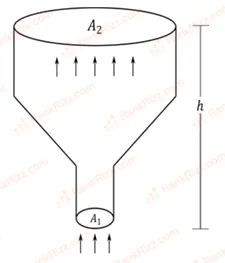
Which of the following statement(s) is(are) correct?
- (A)
The pressure of the gas at the upper end of the chimney is 300 Pa.
- (B)
The velocity of the gas at the lower end of the chimney is 40 ms and at the upper end is 20 ms.
- (C)
The height of the chimney is 590 m.
- (D)
The density of the gas at the upper end is 0.05 kg m.
rr2.rankrizz.com/jee-advanced/physics/mechanical-properties-of-fluids/q/2022-paper-1-q29
- (A)
A train with cross-sectional area is moving with speed inside a long tunnel of cross-sectional area . Assume that almost all the air (density )in front of the train flows back between its sides and the walls of the tunnel. Also, the air flow with respect to the train is steady and laminar. Take the ambient pressure and that inside the train to be . If the pressure in the region between the sides of the train and the tunnel walls is 𝑝, then . The value of N is _____________.
Answer: ____________
rr2.rankrizz.com/jee-advanced/physics/mechanical-properties-of-fluids/q/2020-paper-2-q2
Consider two solid spheres P and Q each of density 8 gm cm and diameters 1 cm and 0.5 cm, respectively. Sphere P is dropped into a liquid of density 0.8 gm cm and viscosity poiseulles. Sphere Q is dropped into a liquid of density 1.6 gm cm and viscosity poiseulles. The ratio of the terminal velocities of P and Q is
Answer: ____________
rr2.rankrizz.com/jee-advanced/physics/mechanical-properties-of-fluids/q/2016-paper-1-q17
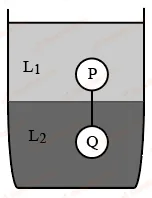
Two spheres P and Q of equal radii have densities and respectively. The spheres are connected by a massless string and placed in liquids and of densities and and viscosities and respectively. They float in equilibrium with the sphere P in and sphere Q in and the string being taut (see figure). If sphere P alone in has terminal velocity and Q alone in has terminal velocity , then
- (A)
- (B)
- (C)
- (D)
rr2.rankrizz.com/jee-advanced/physics/mechanical-properties-of-fluids/q/2015-paper-2-q9
- (A)
If the piston is pushed at a speed of , the air comes out of the nozzle with a speed of
- (A)
- (B)
- (C)
- (D)
rr2.rankrizz.com/jee-advanced/physics/mechanical-properties-of-fluids/q/2014-paper-2-q13
- (A)
If the density of air is and that of the liquid , then for a given piston speed the rate (volume per unit time) at which the liquid is sprayed will be proportional to
- (A)
- (B)
- (C)
- (D)
rr2.rankrizz.com/jee-advanced/physics/mechanical-properties-of-fluids/q/2014-paper-2-q14
- (A)
A cylindrical vessel of height 500 mm has an orifice (small hole) at its bottom. The orifice is initially closed and wateris filled in it up to height H. Now the top is completely sealed with a cap and theorifice at the bottom is opened. Some water comes out from the orifice and the water level in the vessel becomes steady with height of water column being 200 mm. Find the fall in height (in mm) of water level due to opening ofthe orifice.
[Take atmospheric pressure , density of water and . Neglect any affect of surface tension.]Answer: ____________
rr2.rankrizz.com/jee-advanced/physics/mechanical-properties-of-fluids/q/2009-paper-2-q51
STATEMENT-1
The stream of water flowing at high speed from a garden hose pipe tends to spread like a fountain when held vertically up, but tends to narrow down when held vertically down.
and
STATEMENT-2
In any steady flow of an incompressible fluid, the volume flow rate of the fluid remains constant.- (A)
STATEMENT-1 is True, STATEMENT-2 is True; STATEMENT-2 is a correct explanation for STATEMENT-1
- (B)
STATEMENT-1 is True, STATEMENT-2 is True; STATEMENT-2 is NOT a correct explanation for STATEMENT-1
- (C)
STATEMENT-1 is True, STATEMENT-2 is False
- (D)
STATEMENT-1 is False, STATEMENT-2 is True
rr2.rankrizz.com/jee-advanced/physics/mechanical-properties-of-fluids/q/2008-paper-1-q37
- (A)
The buoyancy force acting on the gas bubble is (Assume R is the universal gas constant)
- (A)
- (B)
- (C)
- (D)
rr2.rankrizz.com/jee-advanced/physics/mechanical-properties-of-fluids/q/2008-paper-1-q40
- (A)
Surface tension and surface energy 10
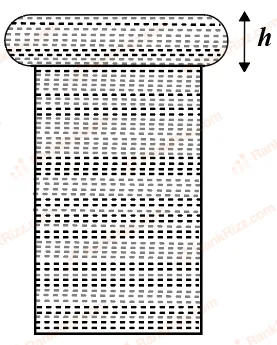
When water is filled carefully in a glass, one can fill it to a height h above the rim of the glass due to the surface tension of water. To calculate h just before water starts flowing, model the shape of the water above the rim as a disc of thickness h having semicircular edges, as shown schematically in the figure. When the pressure of water at the bottom of this disc exceeds what can be withstood due to the surface tension, the water surface breaks near the rim and water starts flowing from there. If the density of water, its surface tension and the acceleration due to gravity are and , respectively, the value of h (in mm) is _________.
Answer: ____________
rr2.rankrizz.com/jee-advanced/physics/mechanical-properties-of-fluids/q/2020-paper-1-q14
A cylindrical capillary tube of 0.2 mm radius is made by joining two capillaries T1 and T2 of different materials having water contact angles of and , respectively. The capillary tube is dipped vertically in water in two different configurations, case I and II as shown in figure. Which of the following option(s) is(are) correct?
[Surface tension of water = 0.075 N/m, density of water = , take ]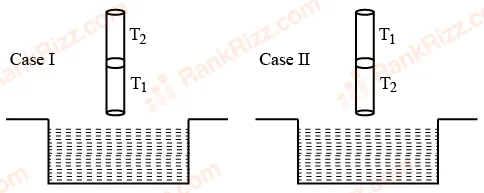
- (A)
The correction in the height of water column raised in the tube, due to weight of water contained in the meniscus, will be different for both cases.
- (B)
For case II, if the capillary joint is 5 cm above the water surface, the height of water column raised in the tube will be 3.75 cm. (Neglect the weight of the water in the meniscus)
- (C)
For case I, if the joint is kept at 8 cm above the water surface, the height of water column in the tube will be 7.5 cm. (Neglect the weight of the water in the meniscus)
- (D)
For case I, if the capillary joint is 5 cm above the water surface, the height of water column raised in the tube will be more than 8.75 cm. (Neglect the weight of the water in the meniscus)
rr2.rankrizz.com/jee-advanced/physics/mechanical-properties-of-fluids/q/2019-paper-1-q5
- (A)
A uniform capillary tube of inner radius 𝑟 is dipped vertically into a beaker filled with water. The water rises to a height ℎ in the capillary tube above the water surface in the beaker. The surface tension of water is The angle of contact between water and the wall of the capillary tube is . Ignore the mass of water in the meniscus. Which of the following statements is (are) true?
- (A)
For a given material of the capillary tube, ℎ decreases with increase in r
- (B)
For a given material of the capillary tube, ℎ is independent of
- (C)
If this experiment is performed in a lift going up with a constant acceleration, then ℎ decreases
- (D)
ℎ is proportional to contact angle
rr2.rankrizz.com/jee-advanced/physics/mechanical-properties-of-fluids/q/2018-paper-1-q3
- (A)
A drop of liquid of radius having surface tension divides itself into 𝐾 identical drops. In this process the total change in the surface energy . If then the value of is
Answer: ____________
rr2.rankrizz.com/jee-advanced/physics/mechanical-properties-of-fluids/q/2017-paper-1-q8
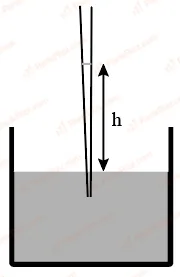
A glass capillary tube is of the shape of a truncated cone with an apex angle so that its two ends have cross sections of different radii. When dipped in water vertically, water rises in it to a height h, where the radius of its cross section is b. If the surface tension of water is S, its density is , and its contact angle with glass is , the value of h will be (g is the acceleration due to gravity)
- (A)
- (B)
- (C)
- (D)
rr2.rankrizz.com/jee-advanced/physics/mechanical-properties-of-fluids/q/2014-paper-2-q10
- (A)
If , the radius of the drop when it detaches from the dropper is approximately
- (A)
m
- (B)
m
- (C)
m
- (D)
m
rr2.rankrizz.com/jee-advanced/physics/mechanical-properties-of-fluids/q/2010-paper-2-q51
- (A)
Two soap bubbles A and B are kept in a closed chamber where the air is maintained at pressure 8 N/m. The radii of bubbles A and B are 2 cm and 4 cm, respectively. Surface tension of the soap-water used to make bubbles is 0.04 N/m. Find the ratio . Where and are the number of moles of air in bubbles A and B, respectively. [Neglect the effect of gravity.]
Answer: ____________
rr2.rankrizz.com/jee-advanced/physics/mechanical-properties-of-fluids/q/2009-paper-2-q52
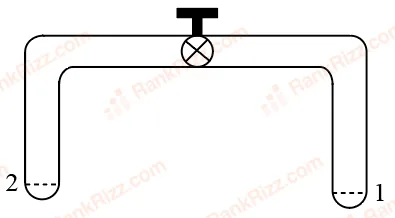
A glass tube of uniform internal radius (r) has a valve separating the two identical ends. Initially, the valve is in a tightly closed position. End 1 has a hemispherical soap bubble of radius r. End 2 has sub-hemispherical soap bubble as shown in figure. Just after opening the valve,
- (A)
air from end 1 flows towards end 2. No change in the volumeof the soap bubbles
- (B)
air from end 1 flows towards end 2. Volumeof the soap bubble at end 1 decreases
- (C)
no change occurs
- (D)
air from end 2 flows towards end 1. Volume of the soap bubble at end 1 increases
rr2.rankrizz.com/jee-advanced/physics/mechanical-properties-of-fluids/q/2008-paper-2-q28
- (A)
As the bubble moves upwards, besides the buoyancy force the following forces are acting on it
- (A)
Only the force of gravity
- (B)
The force due to gravity and the force due to the pressure of the liquid
- (C)
The force due to gravity, the force due to the pressure of the liquid and the force due to viscosity of the liquid
- (D)
The force due to gravity and the force due to viscosity of the liquid
rr2.rankrizz.com/jee-advanced/physics/mechanical-properties-of-fluids/q/2008-paper-1-q38
- (A)
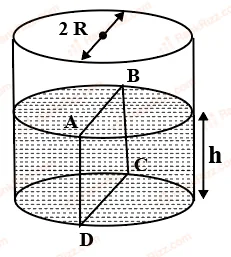
Water is filled up to a height h in a beaker of radius R as shown in the figure. The density of water is , the surface tension of water is T and the atmospheric pressure is . Consider a vertical section ABCD of the water column through a diameter of the beaker. The force on water on one side of this section by water on the other side of this section has magnitude.
- (A)
- (B)
- (C)
- (D)
rr2.rankrizz.com/jee-advanced/physics/mechanical-properties-of-fluids/q/2007-paper-2-q5
- (A)
Fluid pressure, Pascal's law and accelerated/rotating liquids 8
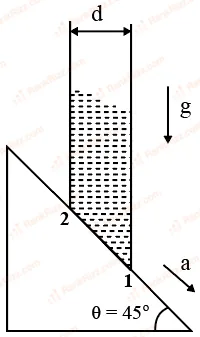
A cylindrical tube, with its base as shown in the figure, is filled with water. It is moving down with a constant acceleration 𝑎 along a fixed inclined plane with angle and are pressures at points 1 and 2, respectively, located at the base of the tube. Let , where is density of water, 𝑑 is the inner diameter of the tube and 𝑔 is the acceleration due to gravity. Which of the following statement(s) is(are) correct?
- (A)
when
- (B)
when
- (C)
when
- (D)
when
rr2.rankrizz.com/jee-advanced/physics/mechanical-properties-of-fluids/q/2021-paper-1-q35
- (A)
A hot air balloon is carrying some passengers, and a few sandbags of mass 1 kg each so that its total mass is 480 kg. Its effective volume giving the balloon its buoyancy is 𝑉. The balloon is floating at an equilibrium height of 100 m. When 𝑁 number of sandbags are thrown out, the balloon rises to a new equilibrium height close to 150 m with its volume 𝑉 remaining unchanged. If the variation of the density of air with height ℎ from the ground is , where kg m and m, the value of N is ________________.
Answer: ____________
rr2.rankrizz.com/jee-advanced/physics/mechanical-properties-of-fluids/q/2020-paper-2-q4
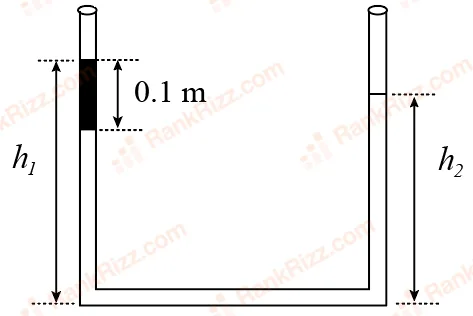
An open-ended U-tube of uniform cross-sectional area contains water (density ). Initially the water level stands at 0.29 m from the bottom in each arm. Kerosene oil (a water-immiscible liquid) of density 800 kg is added to the left arm until its length is 0.1 m, as shown in the schematic figure below. The ratio of the heights of the liquid in the two arms is
- (A)
- (B)
- (C)
- (D)
rr2.rankrizz.com/jee-advanced/physics/mechanical-properties-of-fluids/q/2020-paper-1-q6
- (A)
A spherical body of radius R consists of a fluid of constant density and is in equilibrium under its own gravity. If P(r) is the pressure at r(r < R), then the correct option(s) is(are)
- (A)
- (B)
- (C)
- (D)
rr2.rankrizz.com/jee-advanced/physics/mechanical-properties-of-fluids/q/2015-paper-2-q13
- (A)
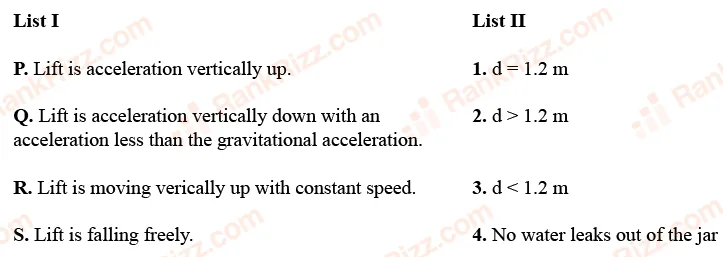
A person in a lift is holding a water jar, which has a small hole at the lower end of its side. When the lift is at rest, the water jet coming out of the hole hits the floor of the lift at a distance of 1.2 m from the person. In the following, state of the lift’s motion is given in List I and the distance where the water jet hits the floor of the lift is given in List II. Match the statements from List I with those in List II and select the correct answer using the code given below the list.
- (A)
P-2, Q-3, R-2, S-4
- (B)
P-2, Q-3, R-1, S-4
- (C)
P-1, Q-1, R-1, S-4
- (D)
P-2, Q-3, R-1, S-1
rr2.rankrizz.com/jee-advanced/physics/mechanical-properties-of-fluids/q/2014-paper-2-q20
- (A)
A solid sphere of radius R and density is attached to one end of a mass-less spring of force constant k. The other end of the spring is connected to another solid sphere of radius R and density . The complete arrangement is placed in a liquid of density and is allowed to reach equilibrium. The correct statement(s) is (are)
- (A)
the net elongation of the spring is
- (B)
the net elongation of the spring is
- (C)
the light sphere is partially submerged.
- (D)
the light sphere is completely submerged.
rr2.rankrizz.com/jee-advanced/physics/mechanical-properties-of-fluids/q/2013-paper-1-q12
- (A)
A thin uniform cylindrical shell, closed at both ends, is partially filled with water. It is floating vertically in water in half-submerged state. If is the relative density of the material of the shell with respect to water, then the correct statement is that the shell is
- (A)
more than half filled if is less than 0.5
- (B)
more than half filled if is less than 1.0
- (C)
half filled if is less than 0.5
- (D)
less than half filled if is less than 0.5
rr2.rankrizz.com/jee-advanced/physics/mechanical-properties-of-fluids/q/2012-paper-2-q2
- (A)
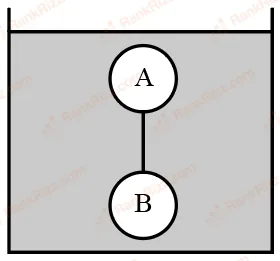
Two solid spheres A and B of equal volumes but of different densities and are connected by a string. They are fully immersed in a fluid of density . They get arranged into an equilibrium state as shown in the figure with a tension in the string. The arrangement is possible only if
- (A)
- (B)
- (C)
- (D)
rr2.rankrizz.com/jee-advanced/physics/mechanical-properties-of-fluids/q/2011-paper-2-q29
- (A)
Angle of contact and capillary rise 2
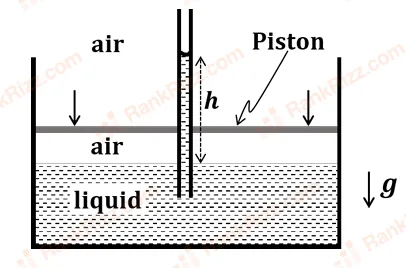
An incompressible liquid is kept in a container having a weightless piston with a hole. A capillary tube of inner radius 0.1 mm is dipped vertically into the liquid through the airtight piston hole, as shown in the figure. The air in the container is isothermally compressed from its original volume to with the movable piston. Considering air as an ideal gas, the height () of the liquid column in the capillary above the liquid level in cm is ____.
[Given: Surface tension of the liquid is 0.075 Nm, atmospheric pressure is N m, acceleration due to gravity (g) is 10 m s, density of the liquid is kg m and contact angle of capillary surface with the liquid is zero]
Answer: ____________
rr2.rankrizz.com/jee-advanced/physics/mechanical-properties-of-fluids/q/2023-paper-2-q28
A bubble has surface tension . The ideal gas inside the bubble has ratio of specific heats . The bubble is exposed to the atmosphere and it always retains its spherical shape. When the atmospheric pressure is , the radius of the bubble is found to be and the temperature of the enclosed gas is . When the atmospheric pressure is , the radius of the bubble and the temperature of the enclosed gas are and , respectively.
Which of the following statement(s) is(are) correct?
- (A)
If the surface of the bubble is a perfect heat insulator, then .
- (B)
If the surface of the bubble is a perfect heat insulator, then the total internal energy of the bubble including its surface energy does not change with the external atmospheric pressure.
- (C)
If the surface of the bubble is a perfect heat conductor and the change in atmospheric temperature is negligible, then .
- (D)
If the surface of the bubble is a perfect heat insulator, then .
rr2.rankrizz.com/jee-advanced/physics/mechanical-properties-of-fluids/q/2022-paper-2-q29
- (A)
Archimedes' principle and floatation 1
A table tennis ball has radius m and mass kg. It is slowly pushed down into a swimming pool to a depth of m below the water surface and then released from rest. It emerges from the water surface at speed , without getting wet, and rises up to a height . Which of the following option(s) is (are) correct?
[Given: , ms, density of water kg m, viscosity of water Pa·s.]
- (A)
The work done in pushing the ball to the depth is 0.077 J.
- (B)
If we neglect the viscous force in water, then the speed m/s.
- (C)
If we neglect the viscous force in water, then the height m.
- (D)
The ratio of the magnitudes of the net force excluding the viscous force to the maximum viscous force in water is 500/9.
rr2.rankrizz.com/jee-advanced/physics/mechanical-properties-of-fluids/q/2024-paper-2-q23
- (A)
Answer key
- 01 1.25
- 02 3
- 03 —
- 04 B
- 05 —
- 06 3
- 07 A, D
- 08 C
- 09 A
- 10 —
- 11 A
- 12 B
- 13 —
- 14 A, C, D
- 15 A, C
- 16 6
- 17 D
- 18 A
- 19 —
- 20 B
- 21 D
- 22 B
- 23 A, C
- 24 —
- 25 B
- 26 B, C
- 27 C
- 28 A, D
- 29 A
- 30 A, B, D
- 31 25
- 32 C, D
- 33 A, B, D
“—” marks a question whose key we have not checked yet; its page shows the latest on it.
Past questions are reproduced with their sitting. Not affiliated with NTA or the IITs. Every question, online and free: rr2.rankrizz.com/jee-advanced/physics/mechanical-properties-of-fluids