Gravitation JEE Advanced PYQs with answer key
PHYSICS · 21 PAST QUESTIONS · 4 TOPICS · 2007–2026
HOW TO USE THIS SHEET
Every JEE Advanced Gravitation question we hold, grouped by topic, most-asked topic first and newest first inside each. The answer key is at the end (18 of 21 questions have a checked key); the worked solution is on each question’s page, printed beside it.
Escape speed 8
A geostationary satellite above the equator is orbiting around the earth at a fixed distance from the center of the earth. A second satellite is orbiting in the equatorial plane in the opposite direction to the earth's rotation, at a distance from the center of the earth, such that . The time period of the second satellite as measured from the geostationary satellite is hours. The value of is ______.
Answer: ____________
rr2.rankrizz.com/jee-advanced/physics/gravitation/q/2025-paper-2-q28
A particle of mass is under the influence of the gravitational field of a body of mass (). The particle is moving in a circular orbit of radius with time period around the mass . Then, the particle is subjected to an additional central force, corresponding to the potential energy , where is a positive constant of suitable dimensions and is the distance from the center of the orbit. If the particle moves in the same circular orbit of radius in the combined gravitational potential due to and , but with a new time period , then is given by
[ is the gravitational constant.]
- (A)
- (B)
- (C)
- (D)
rr2.rankrizz.com/jee-advanced/physics/gravitation/q/2024-paper-2-q19
- (A)
Two spherical stars and have densities and , respectively. and have the same radius, and their masses and are related by . Due to an interaction process, star loses some of its mass, so that its radius is halved, while its spherical shape is retained, and its density remains . The entire mass lost by is deposited as a thick spherical shell on with the density of the shell being . If and are the escape velocities from and after the interaction process, the ratio . The value of is ______.
Answer: ____________
rr2.rankrizz.com/jee-advanced/physics/gravitation/q/2022-paper-1-q19
A rocket is launched normal to the surface of the Earth, away from the Sun, along the line joining the Sun and the Earth. The Sun is times heavier than the Earth and is at a distance times larger than the radius of the Earth. The escape velocity from Earth’s gravitational field is
. The minimum initial velocity required for the rocket to be able to leave the Sun-Earth system is closest to(Ignore the rotation and revolution of the Earth and the presence of any other planet)
- (A)
- (B)
- (C)
- (D)
rr2.rankrizz.com/jee-advanced/physics/gravitation/q/2017-paper-2-q6
- (A)
A bullet is fired vertically upwards with velocity v from the surface of a spherical planet. Whenit reaches its maximum height, its acceleration due to the planet’s gravity is of its value at the surface of the planet. If the escape velocity from the planet is , then the value of N is (ignore energy loss due to atmosphere)
Answer: ____________
rr2.rankrizz.com/jee-advanced/physics/gravitation/q/2015-paper-1-q3
Two bodies, each of mass M, are kept fixed with a separation 2L. A particle of mass m is projected from the midpoint of the line joining their centres, perpendicular to the line. The gravitational constant is G. The correct statement(s) is (are)
- (A)
The minimum initial velocity of the mass m to escape the gravitational field of the two bodiesis
- (B)
The minimum initial velocity of the mass m to escape the gravitational field of the two bodiesis
- (C)
The minimum initial velocity of the mass m to escape the gravitational field of the two bodiesis
- (D)
The energy of the mass m remains constant.
rr2.rankrizz.com/jee-advanced/physics/gravitation/q/2013-paper-2-q5
- (A)
Two spherical planets P andQ have the same unfirom density , masses and , an surface areas A and 4A, respectively. A spherical planet R also has unfirom density and its mass is . The escape velocities from the planets P, Q and R, are and respectively. Then
- (A)
- (B)
- (C)
- (D)
rr2.rankrizz.com/jee-advanced/physics/gravitation/q/2012-paper-2-q19
- (A)
A satellite is moving with a constant speed ‘V’ in a circular orbit about the earth. An object of mass ‘m’ is ejected from the satellite such that it just escapes from the gravitational pull
of the earth. At the time of its ejection, the kinetic energy of the object is- (A)
- (B)
- (C)
- (D)
rr2.rankrizz.com/jee-advanced/physics/gravitation/q/2011-paper-2-q22
- (A)
Kepler's laws and planetary motion 8
A particle of mass , and angular momentum is moving in a circular orbit of radius under the influence of an attractive force . Keeping its angular momentum unchanged, the particle is displaced radially by a small distance , due to which its radial distance varies periodically. The corresponding time period is:
- (A)
- (B)
- (C)
- (D)
rr2.rankrizz.com/jee-advanced/physics/gravitation/q/2026-paper-2-q4
- (A)
Consider a star of mass kg revolving in a circular orbit around another star of mass kg with . The heavier star slowly acquires mass from the lighter star at a constant rate of kg/s. In this transfer process, there is no other loss of mass. If the separation between the centers of the stars is , then its relative rate of change (in s) is given by:
- (A)
- (B)
- (C)
- (D)
rr2.rankrizz.com/jee-advanced/physics/gravitation/q/2025-paper-2-q20
- (A)
The distance between two stars of masses and is 9𝑅. Here 𝑅 is the mean distance between the centers of the Earth and the Sun, and is the mass of the Sun. The two stars orbit around their common center of mass in circular orbits with period 𝑛𝑇, where 𝑇 is the period of Earth’s revolution around the Sun.
The value of n is ___.Answer: ____________
rr2.rankrizz.com/jee-advanced/physics/gravitation/q/2021-paper-2-q37
Consider a spherical gaseous cloud of mass density (r) in free space where r is the radial distance from its center. The gaseous cloud is made ofparticles of equal mass m moving in circular orbits about the common center with the same kinetic energy K. The force acting on the particles is their mutual gravitational force. If (r) is constant in time, the particle numberdensity n(r) = (r)/m is
[G is universal gravitational constant]- (A)
- (B)
- (C)
- (D)
rr2.rankrizz.com/jee-advanced/physics/gravitation/q/2019-paper-1-q1
- (A)
A large spherical mass M is fixed at one position and two identical point masses m are kept on a line passing through the centre of M (see figure). The point masses are connected by a rigid massless rod of length / and this assembly is free to move along the line connecting them. All three masses interact only through their mutual gravitational interaction. When the point mass nearer to M is at a distance r = 3l from M, the tension in the rod is zero for . The value of k is
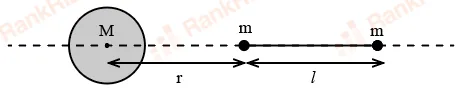
Answer: ____________
rr2.rankrizz.com/jee-advanced/physics/gravitation/q/2015-paper-2-q1
A binarystar consists of two stars A (mass 2.2 ) and B (mass 11 ). where is the mass of the sun. They are separated by distance d and are rotating about their centre of mass, which is stationary. The ratio of the total angular momentum of the binarystar to the angular momentumof star B about the centre of mass is
Answer: ____________
rr2.rankrizz.com/jee-advanced/physics/gravitation/q/2010-paper-1-q81
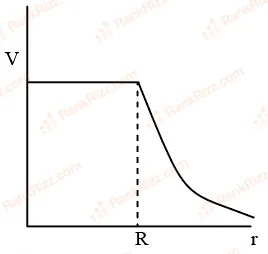
A spherically symmetric gravitational system of particles has a mass density where is a constant. A test mass can undergo circular motion underthe influence of the gravitational field of particles. Its speed V as a function of distance from the center of the system is represented by
- (A)
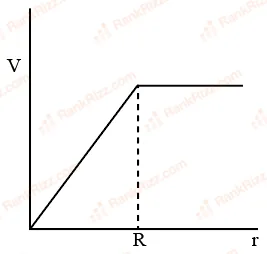
- (B)
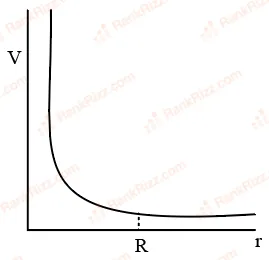
- (C)
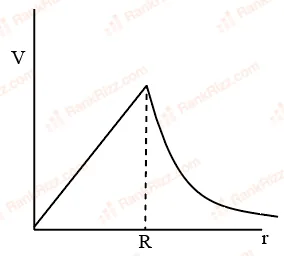
- (D)
rr2.rankrizz.com/jee-advanced/physics/gravitation/q/2008-paper-1-q29
- (A)
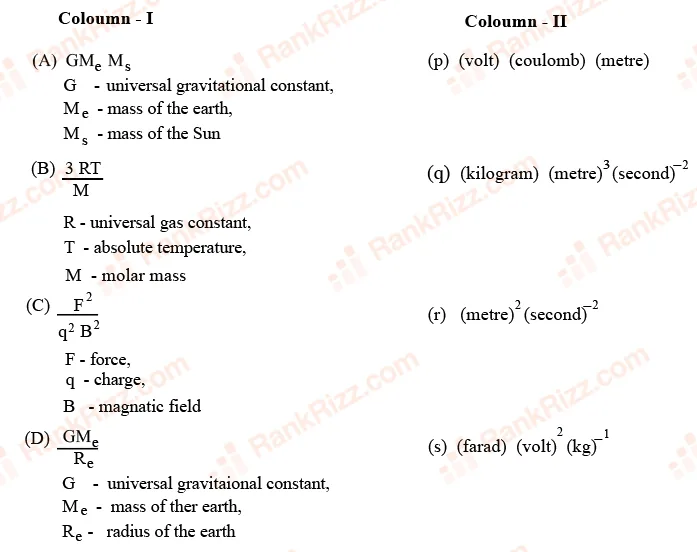
Some physical quantities are given in Column I and some possible SI units in which these quantities may be expressed are given in Column II. Match the physical quantities in Column I with the units in Column II and indicate your answer by darkening appropriate bubbles in the matrix given in the ORS.
rr2.rankrizz.com/jee-advanced/physics/gravitation/q/2007-paper-1-q20
Acceleration due to gravity and its variation 4
Two satellites P and Q are moving in different circular orbits around the Earth (radius ). The heights of P and Q from the Earth surface are and , respectively, where . The accelerations of P and Q due to Earth's gravity are and , respectively. If , what is the value of ?
- (A)
- (B)
- (C)
- (D)
rr2.rankrizz.com/jee-advanced/physics/gravitation/q/2023-paper-1-q24
- (A)
A planet of radius (radius of Earth) has the same mass density as Earth. Scientists dig a well of depth on it and lower a wire of the same length and of linear mass density into it. If the wire is not touching anywhere, the force applied at the top of the wire by a person holding it in place is (take the radius of Earth and the acceleration due to gravity on Earth is )
- (A)
96 N
- (B)
108 N
- (C)
120 N
- (D)
150 N
rr2.rankrizz.com/jee-advanced/physics/gravitation/q/2014-paper-2-q9
- (A)
Gravitational acceleration on the surface of a planet is , where g is the gravitational acceleration on the surface of the earth. The average mass density of the planet is times that of the earth. If the escape speed on the surface of the earth is taken to be 11 , the escape speed on the surface of the planet in will be
Answer: ____________
rr2.rankrizz.com/jee-advanced/physics/gravitation/q/2010-paper-1-q82
STATEMENT-1
Anastronaut in an orbiting space station above the Earth experiences weightlessness.
and
STATEMENT-2
An object moving around the Earth underthe influence of Earth’s gravitational force is in a state of ‘free-fall’.- (A)
STATEMENT-1 is True, STATEMENT-2 is True; STATEMENT-2 is a correct explanation for STATEMENT-1
- (B)
STATEMENT-1 is True, STATEMENT-2 is True; STATEMENT-2 is NOT a correct explanation for STATEMENT-1
- (C)
STATEMENT-1 is True, STATEMENT-2 is False
- (D)
STATEMENT-1 is False, STATEMENT-2 is True
rr2.rankrizz.com/jee-advanced/physics/gravitation/q/2008-paper-1-q35
- (A)
Gravitational potential energy of systems 1
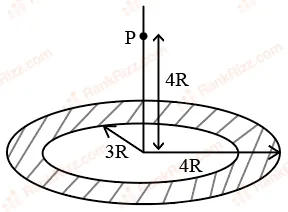
A thin uniform annular disc (see figure) of mass M has outer radius 4R and inner radius 3R. The work required to take a unit mass from point P on its axis to infinity is
- (A)
- (B)
- (C)
- (D)
rr2.rankrizz.com/jee-advanced/physics/gravitation/q/2010-paper-1-q64
- (A)
Answer key
- 01 —
- 02 A
- 03 —
- 04 B
- 05 2
- 06 B, D
- 07 B, D
- 08 B
- 09 A
- 10 —
- 11 9
- 12 D
- 13 7
- 14 6
- 15 C
- 16 A-PQ, B-RS, C-RS, D-RS
- 17 A
- 18 B
- 19 3
- 20 A
- 21 A
“—” marks a question whose key we have not checked yet; its page shows the latest on it.
Past questions are reproduced with their sitting. Not affiliated with NTA or the IITs. Every question, online and free: rr2.rankrizz.com/jee-advanced/physics/gravitation