Dual Nature of Radiation & Matter JEE Advanced PYQs with answer key
PHYSICS · 25 PAST QUESTIONS · 3 TOPICS · 2007–2025
HOW TO USE THIS SHEET
Every JEE Advanced Dual Nature of Radiation & Matter question we hold, grouped by topic, most-asked topic first and newest first inside each. The answer key is at the end (23 of 25 questions have a checked key); the worked solution is on each question’s page, printed beside it.
Photoelectric effect and Einstein's equation 13
A Hydrogen-like atom has atomic number . Photons emitted in the electronic transitions from level to level in these atoms are used to perform photoelectric effect experiment on a target metal. The maximum kinetic energy of the photoelectrons generated is 1.95 eV. If the photoelectric threshold wavelength for the target metal is 310 nm, the value of is ______.
[Given: eV-nm and eV, where is the Rydberg constant, is the Planck's constant and is the speed of light in vacuum]
Answer: ____________
rr2.rankrizz.com/jee-advanced/physics/dual-nature-of-radiation-and-matter/q/2023-paper-1-q25
When light of a given wavelength is incident on a metallic surface, the minimum potential needed to stop the emitted photoelectrons is 6.0 V. This potential drops to 0.6 V if another source with wavelength four times that of the first one and intensity half of the first one is used. What are the wavelength of the first source and the work function of the metal, respectively?
[Take J m C.]
- (A)
1.72 10 m, 1.20 eV
- (B)
1.72 10 m, 5.60 eV
- (C)
3.78 10 m, 5.60 eV
- (D)
3.78 10 m, 1.20 eV
rr2.rankrizz.com/jee-advanced/physics/dual-nature-of-radiation-and-matter/q/2022-paper-2-q34
- (A)
In a photoemission experiment, the maximum kinetic energies of photoelectrons from metals 𝑃, 𝑄 and 𝑅 are and , respectively, and they are related by . In this experiment, the same source of monochromatic light is used for metals 𝑃 and 𝑄 while a different source of monochromatic light is used for the metal 𝑅. The work functions for metals 𝑃, 𝑄 and 𝑅 are 4.0 eV, 4.5 eV and 5.5 eV, respectively. The energy of the incident photon used for metal 𝑅, in eV, is ___.
Answer: ____________
rr2.rankrizz.com/jee-advanced/physics/dual-nature-of-radiation-and-matter/q/2021-paper-2-q38
A photoelectric material having work-function is illuminated with light of wavelength . The fastest photoelectron has a de Broglie wavelength . A change in wavelength of the incident light by results in a change in . Then the ratio is proportional to
- (A)
- (B)
- (C)
- (D)
rr2.rankrizz.com/jee-advanced/physics/dual-nature-of-radiation-and-matter/q/2017-paper-2-q3
- (A)
In a historical experiment to determine Planck’s constant, a metal surface was irradiated with light of different wavelengths. The emitted photo electron energies were measured by applying a stopping potential. The relevant data for the wavelength () of incident light and the corresponding stopping potential () are given below :
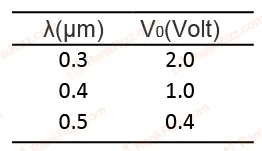
Given that and , Planck’s constant (in units of J s) found from such an experiment is
- (A)
- (B)
- (C)
- (D)
rr2.rankrizz.com/jee-advanced/physics/dual-nature-of-radiation-and-matter/q/2016-paper-1-q1
- (A)
Light of wave length falls on a cathode plate inside a vacuumtube as shown in the figure. The work function of the cathode surface is and the anode is a wire mesh of conducting material kept at a distance d from the cathode. A potential difference V is maintained between the electrodes. If the minimum de Broglie wavelength of the electrons passing through the anode is , which of the following statement(s) is(are) true?
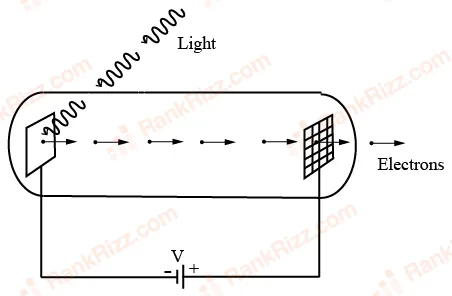
- (A)
decreases with increase in and
- (B)
is approximately halved, if d is doubled
- (C)
For large potential difference is approximately halved if V is made four times
- (D)
increases at the same rate as for
rr2.rankrizz.com/jee-advanced/physics/dual-nature-of-radiation-and-matter/q/2016-paper-2-q8
- (A)
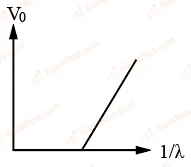
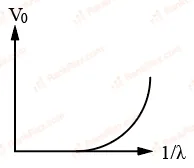
For photo-electric effect with incident photon wavelength , the stopping potential is . Identify the correct variation(s) of with and .
- (A)
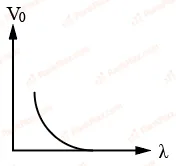
- (B)
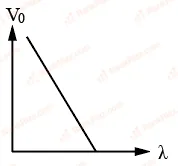
- (C)
- (D)
rr2.rankrizz.com/jee-advanced/physics/dual-nature-of-radiation-and-matter/q/2015-paper-1-q18
- (A)
A metal surface is illuminated by light of two different wavelengths 248 nm and 310 nm. The maximum speeds of the photoelectrons corresponding to these wavelengths are and ,respectively. If the ratio and hc = 1240 eV nm, the work function of the metal is nearly
- (A)
3.7 eV
- (B)
3.2 eV
- (C)
2.8 eV
- (D)
2.5 eV
rr2.rankrizz.com/jee-advanced/physics/dual-nature-of-radiation-and-matter/q/2014-paper-2-q7
- (A)
The work functions of Silver and Sodium are 4.6 and 2.3 eV, respectively. The ratio of the slope of the stopping potential versus frequencyplot for Silver to that of Sodium is
Answer: ____________
rr2.rankrizz.com/jee-advanced/physics/dual-nature-of-radiation-and-matter/q/2013-paper-1-q16
A silver sphere of radius 1 cm and work function 4.7 eV is suspended from an insulating thread in free-space. It is under continuous illumination of 200 nm wavelength light. As photoelectrons are emitted, the sphere gets charged and acquires a potential. The maximum number of photoelectrons emitted from the sphere is (where 1 < A < 10). The value of ‘Z’ is
Answer: ____________
rr2.rankrizz.com/jee-advanced/physics/dual-nature-of-radiation-and-matter/q/2011-paper-2-q38
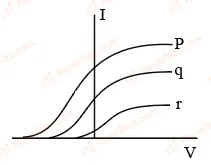
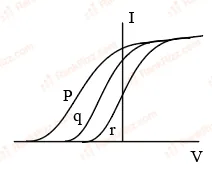
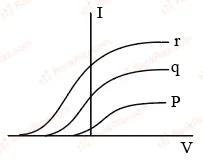
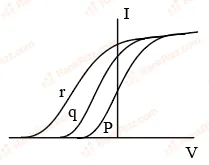
Photoelectric effect experiments are performed using three different metal plates p, q and r having work functions eV, eV and eV, respectively. A light beam containing wavelengths of 550 nm, 450 nm and 350 nm with equal intensities illuminates each of the plates. The correct I-V graph for the experiment is [Take hc = 1240 eV nm]
- (A)
- (B)
- (C)
- (D)
rr2.rankrizz.com/jee-advanced/physics/dual-nature-of-radiation-and-matter/q/2009-paper-2-q41
- (A)
STATEMENT-1
If the accelerating potential in an X-ray tube is increased, the wavelengths of the characteristic X-rays do not change.
because
STATEMENT-2
Whenanelectron beam strikes the target in an X-ray tube, part of the kinetic energy is converted into X-ray energy.- (A)
Statement-1 is True, Statement-2 is True; Statement-2 is a correct explanation for Statement-1
- (B)
Statement-1 is True, Statement-2 is True; Statement-2 is NOT a correct explanation for Statement-1
- (C)
Statement-1 is True, Statement-2 is False
- (D)
Statement-1 is False, Statement-2 is True
rr2.rankrizz.com/jee-advanced/physics/dual-nature-of-radiation-and-matter/q/2007-paper-1-q13
- (A)
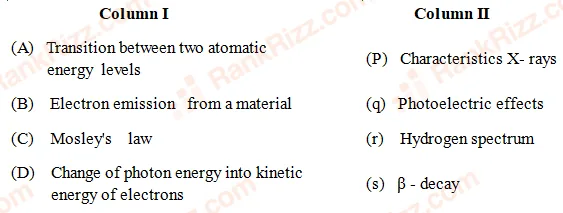
Some laws / processes are given in Column I. Match these with the physical phenomena given in Column II and indicate your answer by darkening appropriate bubbles in the matrix given in the ORS.
rr2.rankrizz.com/jee-advanced/physics/dual-nature-of-radiation-and-matter/q/2007-paper-1-q22
de Broglie wavelength of matter waves 8
Consider an electron in the orbit of a hydrogen-like atom with atomic number . At absolute temperature , a neutron having thermal energy has the same de Broglie wavelength as that of this electron. If this temperature is given by , (where is the Planck's constant, is the Boltzmann constant, is the mass of the neutron and is the first Bohr radius of hydrogen atom) then the value of is ________.
Answer: ____________
rr2.rankrizz.com/jee-advanced/physics/dual-nature-of-radiation-and-matter/q/2025-paper-1-q29
An electron in an excited state of ion has angular momentum The de Broglie wavelength of the electron in this state is (where is the Bohr radius). The value of p is
Answer: ____________
rr2.rankrizz.com/jee-advanced/physics/dual-nature-of-radiation-and-matter/q/2015-paper-2-q8
A proton is fired from very far away towards a nucleus with charge Q = 120 e, where e is the electronic charge. It makes a closest approach of 10 fm to the nucleus. The de Broglie wavelength (in units of fm) of the protonatits start is: (take the proton mass, kg; J.s/C; m/f; 1 fm = m)
Answer: ____________
rr2.rankrizz.com/jee-advanced/physics/dual-nature-of-radiation-and-matter/q/2012-paper-1-q20
An -particle and a proton are accelerated from rest by a potential difference of 100V. After this, their de Broglie wavelengths are and respectively. The ratio \frac{\lambda_p}{\lambda_{\alpha}, to the nearest integer, is
Answer: ____________
rr2.rankrizz.com/jee-advanced/physics/dual-nature-of-radiation-and-matter/q/2010-paper-1-q76
The allowed energy for the particle for a particular value of n is proportional to -
- (A)
- (B)
- (C)
- (D)
rr2.rankrizz.com/jee-advanced/physics/dual-nature-of-radiation-and-matter/q/2009-paper-1-q56
- (A)
If the mass of the particle is kg and a = 6.6 nm, the energy of the particle in its ground state is closest to -
- (A)
0.8 meV
- (B)
8 meV
- (C)
80 meV
- (D)
800 meV
rr2.rankrizz.com/jee-advanced/physics/dual-nature-of-radiation-and-matter/q/2009-paper-1-q57
- (A)
The speed of the particle, that can take discrete values, is proportional to -
- (A)
- (B)
- (C)
- (D)
n
rr2.rankrizz.com/jee-advanced/physics/dual-nature-of-radiation-and-matter/q/2009-paper-1-q58
- (A)
Electrons with de-Broglie wave length fall on the target in an X-ray tube. The cut-off wavelength of the emitted X-rays is
- (A)
- (B)
- (C)
- (D)
rr2.rankrizz.com/jee-advanced/physics/dual-nature-of-radiation-and-matter/q/2007-paper-2-q9
- (A)
Photons: energy, momentum and radiation pressure 4
A hydrogen atom, initially at rest in its ground state, absorbs a photon of frequency and ejects the electron with a kinetic energy of 10 eV. The electron then combines with a positron at rest to form a positronium atom in its ground state and simultaneously emits a photon of frequency . The center of mass of the resulting positronium atom moves with a kinetic energy of 5 eV. It is given that positron has the same mass as that of electron and the positronium atom can be considered as a Bohr atom, in which the electron and the positron orbit around their center of mass. Considering no other energy loss during the whole process, the difference between the two photon energies (in eV) is ______.
Answer: ____________
rr2.rankrizz.com/jee-advanced/physics/dual-nature-of-radiation-and-matter/q/2025-paper-2-q26
A metal target with atomic number is bombarded with a high energy electron beam. The emission of X-rays from the target is analyzed. The ratio of the wavelengths of the -line and the cut-off is found to be . If the same electron beam bombards another metal target with , the value of will be
- (A)
2.53
- (B)
1.27
- (C)
2.24
- (D)
1.58
rr2.rankrizz.com/jee-advanced/physics/dual-nature-of-radiation-and-matter/q/2024-paper-2-q20
- (A)
A perfectly reflecting mirror of mass M mounted on a spring constitutes a spring-mass system of angular frequency such that with h as Planck’s constant. N photons of wavelength strike the mirror simultaneously at normal incidence such that the mirror gets displaced by If the value of N is then the value of x is ________ .
[Consider the spring as mass less]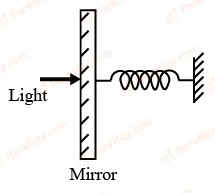
Answer: ____________
rr2.rankrizz.com/jee-advanced/physics/dual-nature-of-radiation-and-matter/q/2019-paper-2-q12
Which one of the following statements is WRONG in the context of X-rays generated from a X-ray tube?
- (A)
Wave length of characteristic X-rays decreases when the atomic number of the target increases
- (B)
Cut-off wavelength of the continuous X-rays depends on the atomic number of the target
- (C)
Intensity of the characteristic X-rays depends on the electrical power given to the X-ray tube
- (D)
Cut-off wavelength of the continuous X-rays depends on the energy of the electrons in the X-ray tube
rr2.rankrizz.com/jee-advanced/physics/dual-nature-of-radiation-and-matter/q/2008-paper-1-q26
- (A)
Answer key
- 01 3
- 02 A
- 03 6
- 04 D
- 05 B
- 06 C
- 07 A, C
- 08 A
- 09 1
- 10 7
- 11 A
- 12 B
- 13 A-PR, B-QS, C-P, D-Q
- 14 72
- 15 2
- 16 7
- 17 3
- 18 A
- 19 B
- 20 D
- 21 A
- 22 —
- 23 A
- 24 —
- 25 B
“—” marks a question whose key we have not checked yet; its page shows the latest on it.
Past questions are reproduced with their sitting. Not affiliated with NTA or the IITs. Every question, online and free: rr2.rankrizz.com/jee-advanced/physics/dual-nature-of-radiation-and-matter