Centre of Mass, Momentum & Collisions JEE Advanced PYQs with answer key
PHYSICS · 12 PAST QUESTIONS · 4 TOPICS · 2007–2025
HOW TO USE THIS SHEET
Every JEE Advanced Centre of Mass, Momentum & Collisions question we hold, grouped by topic, most-asked topic first and newest first inside each. The answer key is at the end (11 of 12 questions have a checked key); the worked solution is on each question’s page, printed beside it.
Motion of centre of mass, momentum conservation and explosions 8
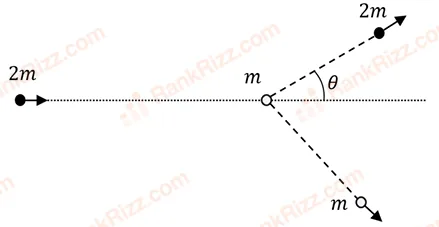
In a scattering experiment, a particle of mass collides with another particle of mass , which is initially at rest. Assuming the collision to be perfectly elastic, the maximum angular deviation of the heavier particle, as shown in the figure, in radians is:
- (A)
- (B)
- (C)
- (D)
rr2.rankrizz.com/jee-advanced/physics/centre-of-mass-momentum-and-collisions/q/2025-paper-1-q18
- (A)
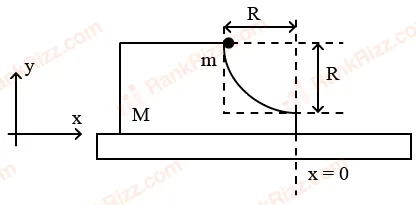
A block of mass M has a circular cut with a frictionless surface as shown. The block rests on the horizontal frictionless surface of a fixed table. Initially the right edge of the block is at x = 0, in a co-ordinate system fixed to the table. A point mass m is released from rest at the topmost point of the path as shown and it slides down. When the mass loses contact with the block, its position is x and the velocity is v. At that instant, which of the following options is/are correct?
- (A)
The position of the point mass m is:
- (B)
The velocity of the point mass m is
- (C)
The x component of displacement of the center of mass of the block M is:
- (D)
The velocity of the block M is:
rr2.rankrizz.com/jee-advanced/physics/centre-of-mass-momentum-and-collisions/q/2017-paper-1-q2
- (A)
A particle of mass m is projected from the ground with an initial speed , at an angle with the horizontal. At the highest point of its trajectory, it makes a completely inelastic collision with another identical particle, which was thrown vertically upward from the ground with the same initial speed The angle that the composite system makes with the horizontal immediately after the collision is
- (A)
- (B)
- (C)
- (D)
rr2.rankrizz.com/jee-advanced/physics/centre-of-mass-momentum-and-collisions/q/2013-paper-1-q7
- (A)
A point mass of 1 kg collides elastically with a stationary point mass of 5 kg. After their collision, the 1 kg mass reverses its direction and moves with a speed of 2 .
Which of the following statement(s) is (are) correct for the system of these two masses ?- (A)
Total momentumof the system is 3 kg
- (B)
Momentum of 5 kg massaftercollision is 4 kg
- (C)
Kinetic energy of the centre of mass is 0.75 J
- (D)
Total kinetic energy of the system is 4 J
rr2.rankrizz.com/jee-advanced/physics/centre-of-mass-momentum-and-collisions/q/2010-paper-1-q67
- (A)
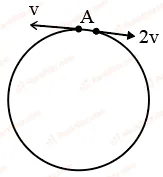
Two small particles of equal masses start moving in opposite directions from a point A in a horizontal circular orbit. Their tangential velocities are v and 2v, respectively, as shown in the figure. Between collisions, the particles move with constant speeds. After making how many collisions, other than that at A, these two particles will again reach the point A ?
- (A)
4
- (B)
3
- (C)
2
- (D)
1
rr2.rankrizz.com/jee-advanced/physics/centre-of-mass-momentum-and-collisions/q/2009-paper-1-q48
- (A)
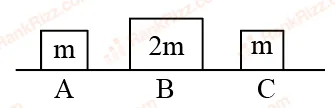
Three objects A. B and C are kept in a straight line on a frictionless horizontal surface. These have:masses m, 2m and m, respectively. The object A moves towards B with a speed 9 m/s and makes an elastic collision with it. Thereafter, B makes completely inelastic collision with C. All motions occur on the same straight line. Find the final speed (in m/s) of the object C.
Answer: ____________
rr2.rankrizz.com/jee-advanced/physics/centre-of-mass-momentum-and-collisions/q/2009-paper-2-q53
If collision between the block and theincline is completely elastic, then the vertical (upward) component of the velocity of the block at point B, immediately after it strikes the second incline is
- (A)
m/s
- (B)
m/s
- (C)
0
- (D)
m/s
rr2.rankrizz.com/jee-advanced/physics/centre-of-mass-momentum-and-collisions/q/2008-paper-1-q46
- (A)
STATEMENT-1
In an elastic collision between two bodies, the relative speed of the bodies after collision is equal to the relative speed before the collision.
because
STATEMENT-2
In anelastic collision, the linear momentum of the system is conserved.- (A)
Statement-1 is True, Statement-2 is True; Statement-2 is a correct explanation for Statement-1
- (B)
Statement-1 is True, Statement-2 is True; Statement-2 is NOT a correct explanation for Statement-1
- (C)
Statement-1 is True, Statement-2 is False
- (D)
Statement-1 is False, Statement-2 is True
rr2.rankrizz.com/jee-advanced/physics/centre-of-mass-momentum-and-collisions/q/2007-paper-1-q11
- (A)
Impulse and impulse-momentum theorem 2
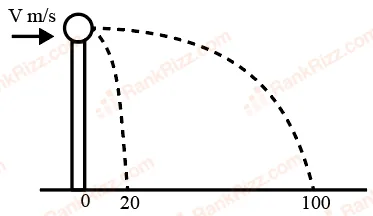
A ball of mass 0.2 kg rests on a vertical post of height 5 m. A bullet of mass 0.01 kg, traveling with a velocity V m/s in a horizontal direction, hits the centre of the ball. After the collision, the ball and bullet travel independently. The ball hits the ground at a distance of 20 m and the bullet at a distance of 100 m from the foot of the post. The initial velocity V of the bullet is
- (A)
250 m/s
- (B)
m/s
- (C)
400 m/s
- (D)
500 m/s
rr2.rankrizz.com/jee-advanced/physics/centre-of-mass-momentum-and-collisions/q/2011-paper-2-q26
- (A)
Two balls, having linear momenta and , undergo a collision in free space. There is no external force acting on the balls. Let and be their final momenta. The following option(s) is(are) NOT ALLOWED for any non-zero value of and .
- (A)
- (B)
- (C)
- (D)
rr2.rankrizz.com/jee-advanced/physics/centre-of-mass-momentum-and-collisions/q/2008-paper-1-q30
- (A)
Centre of mass of continuous bodies and cavities 1
Look at the drawing given in the figure which has been drawn with ink of uniform linethickness. The mass of ink used to draw each of the two inner circles, and each of the two lines segments is m. The mass of the ink used to draw the outer circle is 6m. The coordinates of the centres of the different parts are : outer circle (0, 0), left inner circle (-a, a), right inner circle (a, a), vertical line (0, 0) and horizontal line (0, -a). The y-coordinate of the centre of mass of the ink in this drawing is-

- (A)
- (B)
- (C)
- (D)
rr2.rankrizz.com/jee-advanced/physics/centre-of-mass-momentum-and-collisions/q/2009-paper-1-q45
- (A)
Head-on collisions and coefficient of restitution 1
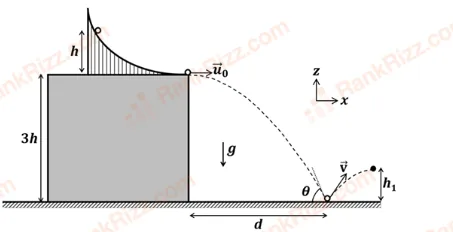
A slide with a frictionless curved surface, which becomes horizontal at its lower end, is fixed on the terrace of a building of height from the ground, as shown in the figure. A spherical ball of mass m is released on the slide from rest at a height from the top of the terrace. The ball leaves the slide with a velocity and falls on the ground at a distance from the building making an angle with the horizontal. It bounces off with a velocity and reaches a maximum height . The acceleration due to gravity is and the coefficient of restitution of the ground is . Which of the following statement(s) is(are) INCORRECT?
- (A)
- (B)
- (C)
- (D)
rr2.rankrizz.com/jee-advanced/physics/centre-of-mass-momentum-and-collisions/q/2023-paper-1-q18
- (A)
Answer key
- 01 D
- 02 B, C
- 03 A
- 04 A, C
- 05 C
- 06 —
- 07 C
- 08 B
- 09 D
- 10 A
- 11 A
- 12 A, C, D
“—” marks a question whose key we have not checked yet; its page shows the latest on it.
Past questions are reproduced with their sitting. Not affiliated with NTA or the IITs. Every question, online and free: rr2.rankrizz.com/jee-advanced/physics/centre-of-mass-momentum-and-collisions