Atoms & Nuclei JEE Advanced PYQs with answer key
PHYSICS · 53 PAST QUESTIONS · 6 TOPICS · 2007–2026
HOW TO USE THIS SHEET
Every JEE Advanced Atoms & Nuclei question we hold, grouped by topic, most-asked topic first and newest first inside each. The answer key is at the end (50 of 53 questions have a checked key); the worked solution is on each question’s page, printed beside it.
Radioactivity: decay law, half-life and decay modes 20
A nuclear reactor starts producing a radioactive nuclide from , at a constant rate of per second. Each decay of produces energy , which is utilized to heat a liquid of mass and specific heat . Assuming no heat loss from the liquid and taking as the decay constant of , the rate of increase in the temperature of the liquid is:
- (A)
- (B)
- (C)
- (D)
rr2.rankrizz.com/jee-advanced/physics/atoms-and-nuclei/q/2026-paper-2-q2
- (A)
In a radioactive decay process, the activity is defined as , where is the number of radioactive nuclei at time . Two radioactive sources, and have same activity at time . At a later time, the activities of and are and , respectively. When and have just completed their 3rd and 7th half-lives, respectively, the ratio is ____.
Answer: ____________
rr2.rankrizz.com/jee-advanced/physics/atoms-and-nuclei/q/2023-paper-2-q29
List-I shows different radioactive decay processes and List-II provides possible emitted particles. Match each entry in List-I with an appropriate entry from List-II, and choose the correct option.
List-I List-II (P) (1) one particle and one particle (Q) (2) three particles and one particle (R) (3) two particles and one particle (S) (4) one particle and one particle (5) one particle and two particles - (A)
P 4, Q 3, R 2, S 1
- (B)
P 4, Q 1, R 2, S 5
- (C)
P 5, Q 3, R 1, S 4
- (D)
P 5, Q 1, R 3, S 2
rr2.rankrizz.com/jee-advanced/physics/atoms-and-nuclei/q/2023-paper-1-q31
- (A)
In a radioactive decay chain reaction, Th nucleus decays into Po nucleus. The ratio of the number of to number of particles emitted in this process is _______.
Answer: ____________
rr2.rankrizz.com/jee-advanced/physics/atoms-and-nuclei/q/2022-paper-2-q20
The binding energy of nucleons in a nucleus can be affected by the pairwise Coulomb repulsion. Assume that all nucleons are uniformly distributed inside the nucleus. Let the binding energy of a proton be and the binding energy of a neutron be in the nucleus.
Which of the following statement(s) is(are) correct?
- (A)
is proportional to where is the atomic number of the nucleus.
- (B)
is proportional to where is the mass number of the nucleus.
- (C)
is positive.
- (D)
increases if the nucleus undergoes a beta decay emitting a positron.
rr2.rankrizz.com/jee-advanced/physics/atoms-and-nuclei/q/2022-paper-1-q32
- (A)
A heavy nucleus Q of half-life 20 minutes undergoes alpha-decay with probability of 60% and beta-decay with probability of 40%. Initially, the number of Q nuclei is 1000. The number of alpha-decays of Q in the first one hour is
- (A)
50
- (B)
75
- (C)
350
- (D)
525
rr2.rankrizz.com/jee-advanced/physics/atoms-and-nuclei/q/2021-paper-1-q23
- (A)
In a radioactive sample, nuclei either decay into stable nuclei with decay constant per year or into stable nuclei with decay constant per year. Given that in this sample all the stable and nuclei are produced by the nuclei only. In time years, if the ratio of the sum of stable and nuclei to the radioactive nuclei is 99, the value of t will be,
[Given: ]- (A)
1.15
- (B)
9.2
- (C)
2.3
- (D)
4.6
rr2.rankrizz.com/jee-advanced/physics/atoms-and-nuclei/q/2019-paper-1-q4
- (A)
A free hydrogen atom after absorbing a photon of wavelength gets excited from the state n = 1 to the state n = 4. Immediately after that the electron jumps to n = m state by emitting a photon of wavelength . Let the change in momentum of atom due to the absorption and the emission are and respectively. If which of the option(s) is/are correct?
[Use hc = 1242 eV nm ; 1 nm = m, h and c are Planck’s constant and speed of light, respectively]- (A)
m = 2
- (B)
- (C)
- (D)
The ratio of kinetic energy of the electron in the state n = m to the state n = 1 is
rr2.rankrizz.com/jee-advanced/physics/atoms-and-nuclei/q/2019-paper-2-q8
- (A)
Suppose a nucleus at rest and in ground state undergoes decay to a nucleus in its excited state. The kinetic energy of the emitted particle is found to be 4.44 MeV. nucleus then goes to its ground state by decay. The energy of the emitted photon is ________ ke V.
[Given: atomic mass of atomic mass of atomic mass of particle = 4.000 u, c is speed of the light]Answer: ____________
rr2.rankrizz.com/jee-advanced/physics/atoms-and-nuclei/q/2019-paper-2-q13
is an isotope of Iodine that decays to an isotope of Xenon with a half-life of 8 days. A small amount of a serum labelled with is injected into the blood of a person. The activity of the amount of injected was Becquerel (Bq). It is known that the
injected serum will get distributed uniformly in the blood stream in less than half an hour. After 11.5 hours, 2.5 ml of blood is drawn from the person’s body, and gives an activity of 115 Bq. The total volume of blood in the person’s body, in liters is approximately (you may use for and ).Answer: ____________
rr2.rankrizz.com/jee-advanced/physics/atoms-and-nuclei/q/2017-paper-1-q12
An accident in a nuclear laboratory resulted in deposition of a certain amount of radioactive material of half-life 18 days inside the laboratory. Tests revealed that the radiation was 64 times more than the permissible level required for safe operation of the laboratory. What is the minimum number of days after which the laboratory can be considered safe for use?
- (A)
64
- (B)
90
- (C)
108
- (D)
120
rr2.rankrizz.com/jee-advanced/physics/atoms-and-nuclei/q/2016-paper-2-q2
- (A)
For a radioactive material, its activity A and rate of change of its activity R are defined as and where N(t) is the number of nuclei at time t. Two radioactive sources P (mean life ) and Q (mean life ) have the same activity at t = 0. Their rates of change of activities at are and , respectively. If then the value of n is
Answer: ____________
rr2.rankrizz.com/jee-advanced/physics/atoms-and-nuclei/q/2015-paper-2-q5
A nuclear power plant supplying electrical power to a village uses a radioactive material of half life 7’ years as the fuel. The amountof fuel at the beginningis such that the total power requirement of the village is 12.5% of the electrical power available from the plant at that time. If the plant is able to meet the total power needsof the village for a maximum period of nT years, then the valueof n is
Answer: ____________
rr2.rankrizz.com/jee-advanced/physics/atoms-and-nuclei/q/2015-paper-1-q6
The kinetic energy (in keV) of the alpha particle, when the nucleus at rest undergoes alpha decay, is
- (A)
5319
- (B)
5422
- (C)
5707
- (D)
5818
rr2.rankrizz.com/jee-advanced/physics/atoms-and-nuclei/q/2013-paper-2-q12
- (A)
A freshly prepared sample of a radioisotope of half-life 1386 s has activity disintegrations per second. Given that ln 2 = 0.693, the fraction of the initial number of nuclei (expressed in nearest integer percentage) that will decay in the first 80 s after preparation of the sample is
Answer: ____________
rr2.rankrizz.com/jee-advanced/physics/atoms-and-nuclei/q/2013-paper-1-q17
Match List I of the nuclear processes with List II containing parent nucleus and one of the end products of each process and then select the correct answer using the codes given below the lists :
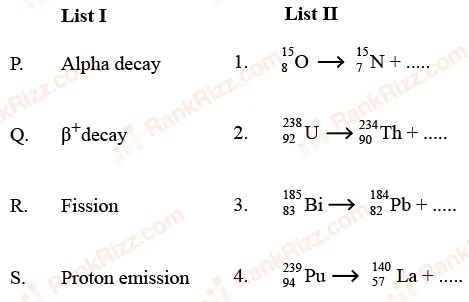
- (A)
P-4, Q-2, R-1, S-3
- (B)
P-1, Q-3, R-2, S-4
- (C)
P-2, Q-1, R-4, S-3
- (D)
P-4, Q-3, R-2, S-1
rr2.rankrizz.com/jee-advanced/physics/atoms-and-nuclei/q/2013-paper-2-q19
- (A)
What is the maximum energy of the anti-neutrino ?
- (A)
Zero
- (B)
Much less than eV
- (C)
Nearly eV
- (D)
Much larger than eV
rr2.rankrizz.com/jee-advanced/physics/atoms-and-nuclei/q/2012-paper-2-q9
- (A)
The activity of a freshly prepared radioactive sample is disintegrations per second, whose mean life is s. The mass of an atom of this radioisotope is kg. The mass (in mg) of the radioactive sample is.
Answer: ____________
rr2.rankrizz.com/jee-advanced/physics/atoms-and-nuclei/q/2011-paper-1-q44
To determine the half life of a radioactive element, a student plots a graph of versus t. Here is the rate of radioactive decay at time t If the number of radioactive nuclei of this element decreases by a factor of p after 4.16 years, the value of p is
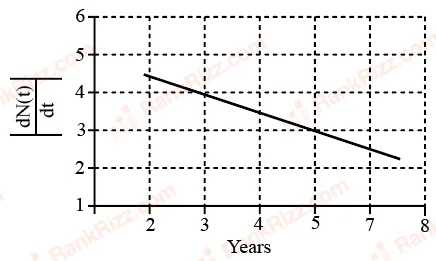
Answer: ____________
rr2.rankrizz.com/jee-advanced/physics/atoms-and-nuclei/q/2010-paper-2-q49
A radioactive sample S1 having an activity of has twice the number of nuclei as another sample S2 which has anactivity of . The half lives of S1 and S2
can be- (A)
20 years and 5 years, respectively
- (B)
20 years and 10 years, respectively
- (C)
10 years each
- (D)
5 years each
rr2.rankrizz.com/jee-advanced/physics/atoms-and-nuclei/q/2008-paper-2-q24
- (A)
Hydrogen spectrum and spectral series 17
Consider a hydrogen atom with , , and denoting the velocity, orbital radius and kinetic energy of the electron in the orbit, respectively. The electron undergoes a transition from the orbit, emitting radiation corresponding to the Lyman series. Considering to be the Planck's constant and the permittivity of the free space, the correct statement(s) is(are):
- (A)
Magnitude of change in kinetic energy of electron can be expressed as .
- (B)
Magnitude of change in de Broglie wavelength of the electron can be expressed as .
- (C)
Frequency of the radiation emitted can be expressed as .
- (D)
Magnitude of change in total energy of the electron can be expressed as .
rr2.rankrizz.com/jee-advanced/physics/atoms-and-nuclei/q/2026-paper-1-q5
- (A)
List-I shows various functional dependencies of energy () on the atomic number (). Energies associated with certain phenomena are given in List-II.
Choose the option that describes the correct match between the entries in List-I to those in List-II.
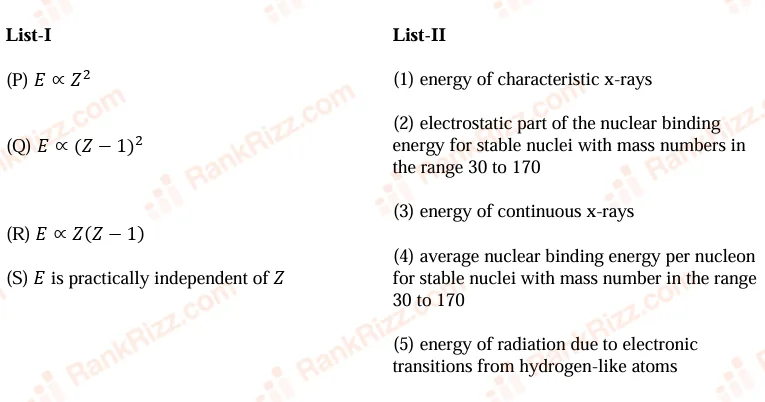
- (A)
P4, Q3, R1, S2
- (B)
P5, Q2, R1, S4
- (C)
P5, Q1, R2, S4
- (D)
P3, Q2, R1, S5
rr2.rankrizz.com/jee-advanced/physics/atoms-and-nuclei/q/2025-paper-1-q32
- (A)
Which of the following statement(s) is(are) correct about the spectrum of hydrogen atom?
- (A)
The ratio of the longest wavelength to the shortest wavelength in Balmer series is
- (B)
There is an overlap between the wavelength ranges of Balmer and Paschen series
- (C)
The wavelengths of Lyman series are given by , where is the shortest wavelength of Lyman series and m is an integer
- (D)
The wavelength ranges of Lyman and Balmer series do not overlap
rr2.rankrizz.com/jee-advanced/physics/atoms-and-nuclei/q/2021-paper-1-q33
- (A)
A particle of mass m moves in circular orbits with potential energy 𝑉(𝑟) = 𝐹𝑟, where F is a positive constant and r is its distance from the origin. Its energies are calculated using the Bohr model. If the radius of the particle’s orbit is denoted by R and its speed and energy are denoted by v and E, respectively, then for the orbit (here h is the Planck’s constant)
- (A)
and
- (B)
and
- (C)
- (D)
rr2.rankrizz.com/jee-advanced/physics/atoms-and-nuclei/q/2020-paper-1-q7
- (A)
An electron in a hydrogen atom undergoes a transition from an orbit with quantum number to another with quantum number . and are respectively the initial and final potential energies of the electron. If , then the smallest possible is
Answer: ____________
rr2.rankrizz.com/jee-advanced/physics/atoms-and-nuclei/q/2017-paper-1-q9
Highly excited states for hydrogen-like atoms (also called Rydberg states) with nuclear charge Ze are defined by their principal quantum number n, where n >> 1. Which of the
following statement(s) is(are) true?- (A)
Relative change in the radii of two consecutive orbitals does not depend on Z
- (B)
Relative change in the radii of two consecutive orbitals varies as
- (C)
Relative change in the energy of two consecutive orbitals varies as
- (D)
Relative change in the angular momenta of two consecutive orbitals varies as
rr2.rankrizz.com/jee-advanced/physics/atoms-and-nuclei/q/2016-paper-1-q6
- (A)
A hydrogen atom in its ground state is irradiated by light of wavelength 970 A. Taking m and the ground state energy of hydrogen atom as —13.6 eV, the numberof lines present in the emission spectrum is
Answer: ____________
rr2.rankrizz.com/jee-advanced/physics/atoms-and-nuclei/q/2016-paper-1-q16
Consider a hydrogen atom with its electron in the orbital. An electromagnetic radiation of wavelength 90 nm is used to ionize the atom. If the kinetic energy of the ejected electron is 10.4 eV, then the value of n is (hc = 1242 eV nm)
Answer: ____________
rr2.rankrizz.com/jee-advanced/physics/atoms-and-nuclei/q/2015-paper-1-q2
The radius of the orbit of an electron in a Hydrogen-like atom is 4.5 , where is the bohr radius. Its orbital angular momentum is . It is given that h is Planck constant and R is Rydberg constant. The possible wavelength(s), when the atom de-excites, is (are)
- (A)
- (B)
- (C)
- (D)
rr2.rankrizz.com/jee-advanced/physics/atoms-and-nuclei/q/2013-paper-2-q4
- (A)
The wavelength of the first spectral line in the Balmer series of hydrogen atom is 6561 Å. The wave length of the second spectral line in the Balmer series of singly-ionized helium atom is-
- (A)
1215 Å
- (B)
1640 Å
- (C)
2430 Å
- (D)
4687 Å
rr2.rankrizz.com/jee-advanced/physics/atoms-and-nuclei/q/2011-paper-1-q30
- (A)
A diatomic molecule has momentof inertia I By Bohr's quantization condition its rotational energy in the level (n = O is not allowed) is
- (A)
- (B)
- (C)
- (D)
rr2.rankrizz.com/jee-advanced/physics/atoms-and-nuclei/q/2010-paper-2-q53
- (A)
It is found that the excitation frequency from ground to thefirst excited state of rotation for the CO molecule is close to Hz. Then the moment of inertia of
CO molecule about its center of massis close to (Take J s)- (A)
- (B)
- (C)
- (D)
rr2.rankrizz.com/jee-advanced/physics/atoms-and-nuclei/q/2010-paper-2-q54
- (A)
In a CO molecule, the distance between C (mass = 12 a.m.u.) and O (mass = 16 a.m.u.), where 1 a.m.u. kg, is close to
- (A)
m
- (B)
m
- (C)
m
- (D)
m
rr2.rankrizz.com/jee-advanced/physics/atoms-and-nuclei/q/2010-paper-2-q55
- (A)
The quantum number n ofthe state finally populated in ions is
- (A)
2
- (B)
3
- (C)
4
- (D)
5
rr2.rankrizz.com/jee-advanced/physics/atoms-and-nuclei/q/2008-paper-1-q41
- (A)
The wave length of light emitted in the visible region by ions after collisions with H atoms is
- (A)
m
- (B)
m
- (C)
m
- (D)
m
rr2.rankrizz.com/jee-advanced/physics/atoms-and-nuclei/q/2008-paper-1-q42
- (A)
The ratio of the kinetic energy of the n = 2 electron for the H atom to that of ion is
- (A)
- (B)
- (C)
- (D)
rr2.rankrizz.com/jee-advanced/physics/atoms-and-nuclei/q/2008-paper-1-q43
- (A)
The largest wavelength in the ultraviolet region of the hydrogen spectrum is 122 nm. The smallest wavelength in the infrared region of the hydrogen spectrum (to the nearest integer) is
- (A)
802 nm
- (B)
823 nm
- (C)
1882 nm
- (D)
1648 nm
rr2.rankrizz.com/jee-advanced/physics/atoms-and-nuclei/q/2007-paper-1-q9
- (A)
Nuclear fission, fusion and Q-value 12
A heavy nucleus N, at rest, undergoes fission , where P and Q are two lighter nuclei. Let , where , and are the masses of P, Q and N, respectively. EP and EQ are the kinetic energies of P and Q, respectively. The speeds of P and Q are and , respectively. If c is the speed of light, which of the following statement(s) is(are) correct?
- (A)
- (B)
- (C)
- (D)
The magnitude of momentum for P as well as Q is , where
rr2.rankrizz.com/jee-advanced/physics/atoms-and-nuclei/q/2021-paper-2-q24
- (A)
The electrostatic energy of Z protons uniformly distributed throughout a spherical nucleus of radius R is given by
The measured masses of the neutron, and are 1.008665 u, 1.007825 u, 15.000109 u and 15.003065 u,respectively. Given that the radii of both the and nuclei are same, (c is the speed oflight) and . Assumingthat the difference between the binding energies of and is purely due to the electrostatic energy, the radius of either of the nuclei is- (A)
2.85 fm
- (B)
3.03 fm
- (C)
3.42 fm
- (D)
3.80 fm
rr2.rankrizz.com/jee-advanced/physics/atoms-and-nuclei/q/2016-paper-2-q1
- (A)
The isotope having a mass 12.014 u undergoes - decay to , has an excited state of the nucleus () at 4.041 MeV above its ground state. If decays to , the maximumkinetic energy of the - particle in units of MeV is
(1 u = 931.5 MeV/c, where c is the speed of light in vacuum).Answer: ____________
rr2.rankrizz.com/jee-advanced/physics/atoms-and-nuclei/q/2016-paper-1-q15
A fission reaction is given by where x and y are two particles. Considering to be at rest, the kinetic energies of the products are denoted by and respectively. Let the binding energies per nucleon of and be 7.5 MeV, 8.5 MeV and 8.5 MeV,respectively. Considering different conservation laws, the correct option(s) is(are)
- (A)
- (B)
- (C)
- (D)
rr2.rankrizz.com/jee-advanced/physics/atoms-and-nuclei/q/2015-paper-2-q16
- (A)
Match the nuclear processes given in column I with the appropriate option(s) in column II.
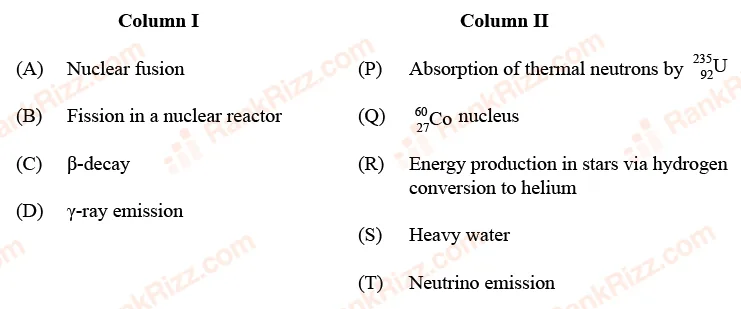
rr2.rankrizz.com/jee-advanced/physics/atoms-and-nuclei/q/2015-paper-1-q19
The correct statement is
- (A)
The nucleus can emit an alpha particle.
- (B)
The nucleus can emit a proton.
- (C)
Deuteron and alpha particle can undergo complete fusion.
- (D)
The nuclei and can undergo complete fusion
rr2.rankrizz.com/jee-advanced/physics/atoms-and-nuclei/q/2013-paper-2-q11
- (A)
If the anti-neutrino had amass of 3 eV/c (where c is the speed of light) instead of zeromass, what should be the range of the kinetic energy, K, of the electron ?
- (A)
eV
- (B)
3.0 eV eV
- (C)
3.0 eV eV
- (D)
eV
rr2.rankrizz.com/jee-advanced/physics/atoms-and-nuclei/q/2012-paper-2-q10
- (A)
In the core of nuclear fusion reactor, the gas becomes plasma because of -
- (A)
Strong nuclear force acting between the deuterons
- (B)
Coulomb force acting between the deuterons
- (C)
Coulomb force acting between deuteron-electron pairs
- (D)
the high temperature maintained inside the reactor core
rr2.rankrizz.com/jee-advanced/physics/atoms-and-nuclei/q/2009-paper-1-q53
- (A)
Assume that two deuteron nuclei in the core of fusion reactor at temperature T are moving towards each other, each with kinetic energy 1.5 kT, when the separation between them is large enough to neglect Coulomb potential energy. Also neglect any interaction from other particles in the core. The minimum temperature T required for them to reach a separation of m is in the range-
- (A)
- (B)
- (C)
- (D)
rr2.rankrizz.com/jee-advanced/physics/atoms-and-nuclei/q/2009-paper-1-q54
- (A)
Results of calculations for four different designs of a fusion reactor using D-D reaction are given below. Which of these is most promising based on Lawson criterion ?
- (A)
deuteron density = , confinement time = s
- (B)
deuteron density = , confinement time = s
- (C)
deuteron density = , confinement time = s
- (D)
deuteron density = , confinement time = s
rr2.rankrizz.com/jee-advanced/physics/atoms-and-nuclei/q/2009-paper-1-q55
- (A)
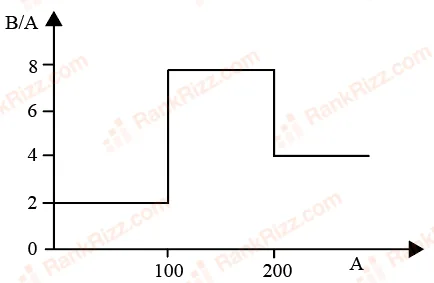
Assume that the nuclear binding energy per nucleon (B/A) versus mass number (A) is as shown in the figure. Use this plot to choose the correct choice(s) given below.
- (A)
Fusion of two nuclei with mass numbers lying in the range of 1 < A < 50 will release energy
- (B)
Fusion of two nuclei with mass numbers lying in the range of 51 < A < 100 will release energy
- (C)
Fission of a nucleus lying in the mass range of 100 < A < 200 will release energy when broken into two equal fragments
- (D)
Fission of a nucleus lying in the mass range of 200 < A < 260 will release energy when broken into two equal fragments
rr2.rankrizz.com/jee-advanced/physics/atoms-and-nuclei/q/2008-paper-1-q31
- (A)
In the options given below, let E denote the rest mass energy of a nucleus and n aneutron. The correct option is
- (A)
- (B)
- (C)
- (D)
rr2.rankrizz.com/jee-advanced/physics/atoms-and-nuclei/q/2007-paper-1-q8
- (A)
X-rays: continuous and characteristic spectra, Moseley's law 2
In an X-ray tube, electrons emitted from a filament (cathode) carrying current I hit a target (anode) at a distance 𝑑 from the cathode. The target is kept at a potential 𝑉 higher than the cathode resulting in emission of continuous and characteristic X-rays. If the filament current 𝐼 is decreased to , the potential difference 𝑉 is increased to 2𝑉, and the separation distance 𝑑 is reduced to , then
- (A)
the cut-off wavelength will reduce to half, and the wavelengths of the characteristic X-rays will remain the same
- (B)
the cut-off wavelength as well as the wavelengths of the characteristic X-rays will remain the same
- (C)
the cut-off wavelength will reduce to half, and the intensities of all the X-rays will decrease
- (D)
the cut-off wavelength will become two times larger, and the intensity of all the X-rays will decrease
rr2.rankrizz.com/jee-advanced/physics/atoms-and-nuclei/q/2020-paper-2-q10
- (A)
If is the wavelength of X-ray line of copper (atomic number 29) and is the wavelength of the X-ray line of molybdenum (atomic number 42), then the ratio is close to
- (A)
1.99
- (B)
2.14
- (C)
0.50
- (D)
0.48
rr2.rankrizz.com/jee-advanced/physics/atoms-and-nuclei/q/2014-paper-2-q8
- (A)
Bohr model of hydrogen-like atoms 1
A particle of mass is moving in a circular orbit under the influence of the central force , corresponding to the potential energy , where is a positive force constant and is the radial distance from the origin. According to the Bohr's quantization rule, the angular momentum of the particle is given by , where , is the Planck's constant, and a positive integer. If and are the speed and total energy of the particle, respectively, then which of the following expression(s) is(are) correct?
- (A)
- (B)
- (C)
- (D)
rr2.rankrizz.com/jee-advanced/physics/atoms-and-nuclei/q/2024-paper-1-q22
- (A)
Nuclear size, mass defect and binding energy 1
The minimum kinetic energy needed by an alpha particle to cause the nuclear reaction in a laboratory frame is (in MeV). Assume that is at rest in the laboratory frame. The masses of , , and can be taken to be 16.006 , 4.003 , 1.008 and 19.003 , respectively, where 1 = 930 MeV. The value of is ______.
Answer: ____________
rr2.rankrizz.com/jee-advanced/physics/atoms-and-nuclei/q/2022-paper-1-q20
Answer key
- 01 A
- 02 16
- 03 A
- 04 2
- 05 A, B, D
- 06 D
- 07 B
- 08 A, B
- 09 —
- 10 5
- 11 C
- 12 2
- 13 3
- 14 A
- 15 4
- 16 C
- 17 C
- 18 1
- 19 8
- 20 A
- 21 A, C
- 22 C
- 23 A, D
- 24 B, C
- 25 5
- 26 A, B, D
- 27 6
- 28 2
- 29 A, C
- 30 A
- 31 D
- 32 B
- 33 C
- 34 C
- 35 C
- 36 A
- 37 B
- 38 A
- 39 C
- 40 8
- 41 A
- 42 A-RT, B-PS, C-QT, D-R
- 43 C
- 44 D
- 45 D
- 46 A
- 47 B
- 48 —
- 49 A
- 50 A, C
- 51 B
- 52 A, B, C
- 53 —
“—” marks a question whose key we have not checked yet; its page shows the latest on it.
Past questions are reproduced with their sitting. Not affiliated with NTA or the IITs. Every question, online and free: rr2.rankrizz.com/jee-advanced/physics/atoms-and-nuclei