Three Dimensional Geometry JEE Advanced PYQs with answer key
MATHS · 38 PAST QUESTIONS · 5 TOPICS · 2007–2026
HOW TO USE THIS SHEET
Every JEE Advanced Three Dimensional Geometry question we hold, grouped by topic, most-asked topic first and newest first inside each. The answer key is at the end (37 of 38 questions have a checked key); the worked solution is on each question’s page, printed beside it.
Line and plane: intersection, coplanarity and projection 19
Let be the line of intersection of the planes given by the equations
Let be the line passing through the point and parallel to . Let denote the plane given by the equation
Suppose that the line meets the plane at the point . Let be the foot of the perpendicular drawn from to the plane .
Then which of the following statements is (are) TRUE?
- (A)
The length of the line segment is
- (B)
The length of the line segment is
- (C)
The area of is
- (D)
The acute angle between the line segments and is
rr2.rankrizz.com/jee-advanced/maths/three-dimensional-geometry/q/2025-paper-1-q5
- (A)
A straight line drawn from the point , parallel to the line , intersects the plane at the point . Another straight line which passes through and is perpendicular to the plane intersects the plane at the point . Then which of the following statements is(are) TRUE?
- (A)
The length of the line segment is
- (B)
The coordinates of are
- (C)
The centroid of the triangle is
- (D)
The perimeter of the triangle is
rr2.rankrizz.com/jee-advanced/maths/three-dimensional-geometry/q/2024-paper-2-q6
- (A)
Let be such that the lines and intersect. Let be the point of intersection of and . Let , and denote a unit normal vector to the plane containing both the lines and .
Match each entry in List-I to the correct entry in List-II.
List-I List-II (P) equals (1) (Q) A possible choice for is (2) (R) equals (3) 1 (S) A possible value of is (4) (5) - (A)
(P) (3), (Q) (4), (R) (1), (S) (2)
- (B)
(P) (5), (Q) (4), (R) (2), (S) (3)
- (C)
(P) (3), (Q) (4), (R) (1), (S) (5)
- (D)
(P) (3), (Q) (1), (R) (4), (S) (5)
rr2.rankrizz.com/jee-advanced/maths/three-dimensional-geometry/q/2024-paper-1-q16
- (A)
Let and be the lines and , respectively. Let X be the set of all the planes H that contain the line . For a plane H, let d(H) denote the smallest possible distance between the points of and H. Let be the plane in X for which d() is the maximum value of d(H) as H varies over all planes in X.
Match each entry in List-I to the correct entries in List-II.
List-I List-II (P) The value of d() is (1) (Q) The distance of the point (0, 1, 2) from is (2) (R) The distance of origin from is (3) 0 (S) The distance of origin from the point of intersection of planes , and is (4) (5) The correct option is:
- (A)
(P) (2) (Q) (4) (R) (5) (S) (1)
- (B)
(P) (5) (Q) (4) (R) (3) (S) (1)
- (C)
(P) (2) (Q) (1) (R) (3) (S) (2)
- (D)
(P) (5) (Q) (1) (R) (4) (S) (2)
rr2.rankrizz.com/jee-advanced/maths/three-dimensional-geometry/q/2023-paper-1-q16
- (A)
Let and be two planes given by
Which of the following straight lines can be an edge of some tetrahedron whose two faces lie on and ?
- (A)
- (B)
- (C)
- (D)
rr2.rankrizz.com/jee-advanced/maths/three-dimensional-geometry/q/2022-paper-1-q11
- (A)
Let and be the following straight lines.
and .
Suppose the straight line
lies in the plane containing and , and passes through the point of intersection of and . If the line 𝐿 bisects the acute angle between the lines and , then which of the following statements is/are TRUE?
- (A)
- (B)
l + m = 2
- (C)
- (D)
l + m = 0
rr2.rankrizz.com/jee-advanced/maths/three-dimensional-geometry/q/2020-paper-1-q47
- (A)
Three lines are given by
and
.
Let the lines cut the plane x + y + z = 1 at the points A, B and C respectively. If the area of the triangle ABC is then the value of equals__________ .Answer: ____________
rr2.rankrizz.com/jee-advanced/maths/three-dimensional-geometry/q/2019-paper-1-q54
Consider a pyramid OPQRS located in the first octant with O as origin, and OP and ORalongthe x-axis and the y-axis, respectively. The base OPQR of the pyramid is a square with OP =3. Thepoint S is directly above the mid-point T of diagonal OQ such that TS = 3. Then
- (A)
the acute angle between OQ and OS is
- (B)
the equation of the plane containing the triangle OQS is x - y = 0
- (C)
the length of the perpendicular from P to the plane containing the triangle OQS is
- (D)
the perpendicular distance from O to the straight line containing RS is
rr2.rankrizz.com/jee-advanced/maths/three-dimensional-geometry/q/2016-paper-1-q42
- (A)
Let P be the image of the point (3,1,7) with respect to the plane . Then the equation of the plane passing through P and containing the straight line is
- (A)
- (B)
- (C)
- (D)
rr2.rankrizz.com/jee-advanced/maths/three-dimensional-geometry/q/2016-paper-2-q42
- (A)
In let L be a straight line passing through the origin. Suppose that all the points on L are at a constant distance from the two planes and Let M be the locus of the feet of the perpendiculars drawn from the points on L to the plane . Which of the following points lie(s) on M ?
- (A)
- (B)
- (C)
- (D)
rr2.rankrizz.com/jee-advanced/maths/three-dimensional-geometry/q/2015-paper-1-q52
- (A)
From a point perpendiculars PQ and PR are drawn respectively on the lines y = x, z = 1 and y = -x, z = -1. If P is such that is a right angle, then the possible value(s) of is(are)
- (A)
- (B)
- (C)
- (D)
rr2.rankrizz.com/jee-advanced/maths/three-dimensional-geometry/q/2014-paper-1-q47
- (A)
Perpendiculars are drawn from points on the line to the plane x + y + z = 3. The feet of perpendiculars lie on the line
- (A)
- (B)
- (C)
- (D)
rr2.rankrizz.com/jee-advanced/maths/three-dimensional-geometry/q/2013-paper-1-q49
- (A)
Consider the lines and the planes . Let ax + by + cz = d be the equation of the plane pasing through the point of intersection of lines and , and perpendicular to planes and .
Match List — I with List — II and select the correct answer using the code given below the lists :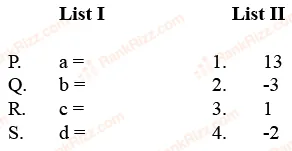
- (A)
P-3, Q-2, R-4, S-1
- (B)
P-1, Q-3, R-4, S-2
- (C)
P-3, Q-2, R-1, S-4
- (D)
P-2, Q-4, R-1, S-3
rr2.rankrizz.com/jee-advanced/maths/three-dimensional-geometry/q/2013-paper-2-q59
- (A)
The equation of a plane passing through the line of intersection of the planes and and at a distance from the point (3, 1, -1) is
- (A)
5x - 11y + z = 17
- (B)
- (C)
- (D)
rr2.rankrizz.com/jee-advanced/maths/three-dimensional-geometry/q/2012-paper-2-q41
- (A)
The point P is the intersection of the straight line joining the points Q(2,3,5) and R(1, -1, 4) with the plane 5x - 4y - z = 1. If S is the foot of the perpendicular drawn from the point 7(2, 1, 4) to QR, then the length of the line segment PS is
- (A)
- (B)
- (C)
2
- (D)
rr2.rankrizz.com/jee-advanced/maths/three-dimensional-geometry/q/2012-paper-1-q49
- (A)
If the straight lines and are coplanar, then the plane(s) containing these two lines is(are)
- (A)
- (B)
- (C)
- (D)
rr2.rankrizz.com/jee-advanced/maths/three-dimensional-geometry/q/2012-paper-2-q58
- (A)
Let P(3, 2, 6) be a point in space and Q be a point on the line Then the value of for which the vector is parallel to the plane is
- (A)
- (B)
- (C)
- (D)
rr2.rankrizz.com/jee-advanced/maths/three-dimensional-geometry/q/2009-paper-1-q23
- (A)
The distance of the point (1,1, 1) from the plane passing through the point (-1, -2, -1) and whose normalis perpendicularto both the lines and is
- (A)
- (B)
- (C)
- (D)
rr2.rankrizz.com/jee-advanced/maths/three-dimensional-geometry/q/2008-paper-2-q19
- (A)
Consider the planes and .
STATEMENT-1: The parametric equations of the line of intersection of the given planes are 14\hat{i} + 2 \hat{j} + 15 \hat{k}$$ is parallel to the line ofintersection of given planes.- (A)
Statement-1 is True, Statement-2 is True; Statement-2 is a correct explanation for Statement-1
- (B)
Statement-1 is True, Statement-2 is True; Statement-2 is NOT a correct explanation for Statement-1
- (C)
Statement-1 is True, Statement-2 is False
- (D)
Statement-1 is False, Statement-2 is True
rr2.rankrizz.com/jee-advanced/maths/three-dimensional-geometry/q/2007-paper-2-q54
- (A)
Equation of a plane 8
Let be real numbers such that and Suppose the point (3,2,−1) is the mirror image of the point (1,0,−1) with respect to the plane . Then which of the following statements is/are TRUE?
- (A)
- (B)
- (C)
- (D)
rr2.rankrizz.com/jee-advanced/maths/three-dimensional-geometry/q/2020-paper-2-q46
- (A)
Let and be two planes. Then, which of the following statement(s) is (are) TRUE?
- (A)
The line of intersection of has direction ratios 1, 2, −1
- (B)
The line is perpendicular to the line of intersection of
- (C)
The acute angle between is
- (D)
If is the plane passing through the point (4, 2, −2) and perpendicular to the line of intersection of , then the distance of the point (2, 1, 1) from the plane is
rr2.rankrizz.com/jee-advanced/maths/three-dimensional-geometry/q/2018-paper-1-q39
- (A)
The equation of the plane passing through the point (1, 1, 1) and perpendicular to the planes and , is
- (A)
- (B)
- (C)
- (D)
rr2.rankrizz.com/jee-advanced/maths/three-dimensional-geometry/q/2017-paper-2-q37
- (A)
In , consider the planes and . Let be a plane, different from and , which passes through the intersection of and . If the distance of the point (0,1,0) from is 1 and the distance of a point from is 2, then which of the following relationsis (are) true?
- (A)
- (B)
- (C)
- (D)
rr2.rankrizz.com/jee-advanced/maths/three-dimensional-geometry/q/2015-paper-1-q51
- (A)
If the distance of the point P(1, -2, 1) from the plane , where , is 5, then the foot of the perpendicular from P to the plane is
- (A)
- (B)
- (C)
- (D)
rr2.rankrizz.com/jee-advanced/maths/three-dimensional-geometry/q/2010-paper-2-q23
- (A)
Equation of the plane containing the straight line and perpendicular to the plane containing the straight lines and is
- (A)
- (B)
- (C)
- (D)
rr2.rankrizz.com/jee-advanced/maths/three-dimensional-geometry/q/2010-paper-1-q30
- (A)
If the distance between the plane and the plane containing the lines and is , then is
Answer: ____________
rr2.rankrizz.com/jee-advanced/maths/three-dimensional-geometry/q/2010-paper-1-q51
Consider three planes
.
Let be the lines of interaction of the planes and and and and , respectively.
STATEMENT-1: At least two of the lines , and are non-parallel.
and
STATEMENT-2: The three planes do not have a common point.- (A)
STATEMENT-1 is True, STATEMENT-2 is True; STATEMENT-2 is a correct explanation for STATEMENT-1
- (B)
STATEMENT-1 is True, STATEMENT-2 is True; STATEMENT-2 is NOT a correct explanation for STATEMENT-1
- (C)
STATEMENT-1 is True, STATEMENT-2 is False
- (D)
STATEMENT-1 is False, STATEMENT-2 is True
rr2.rankrizz.com/jee-advanced/maths/three-dimensional-geometry/q/2008-paper-1-q12
- (A)
Foot of perpendicular, image and distance from a line 7
Let be the straight line joining the points and . Let be the foot of the perpendicular drawn from the point to the line . Another line passing through intersects at a point such that the point divides the line segment internally in the ratio , where and are the lengths of the line segments and , respectively.
Then which of the following statements is (are) TRUE?
- (A)
The orthocentre of the triangle is
- (B)
The orthocentre of the triangle is
- (C)
The area of the triangle is
- (D)
The area of the triangle is
rr2.rankrizz.com/jee-advanced/maths/three-dimensional-geometry/q/2026-paper-2-q43
- (A)
Let Q be the cube with the set of vertices . Let F be the set of all twelve lines containing the diagonals of the six faces of the cube Q. Let S be the set of all four lines containing the main diagonals of the cube Q; for instance, the line passing through the vertices (0, 0, 0) and (1, 1, 1) is in S. For lines and , let denote the shortest distance between them. Then the maximum value of , as varies over F and varies over S, is
- (A)
- (B)
- (C)
- (D)
rr2.rankrizz.com/jee-advanced/maths/three-dimensional-geometry/q/2023-paper-1-q5
- (A)
Three lines
and
are given. For which point(s) Q on can wefind a point P on and a point R on so that P,Q and R are collinear?- (A)
- (B)
- (C)
- (D)
rr2.rankrizz.com/jee-advanced/maths/three-dimensional-geometry/q/2019-paper-2-q44
- (A)
Let and denote the lines
and
respectively. If is a line which is perpendicular to both and and cuts both of them, then which of the following options describe(s) ?- (A)
- (B)
- (C)
- (D)
rr2.rankrizz.com/jee-advanced/maths/three-dimensional-geometry/q/2019-paper-1-q48
- (A)
Two lines and are coplanar. Then can take value(s)
- (A)
1
- (B)
2
- (C)
3
- (D)
4
rr2.rankrizz.com/jee-advanced/maths/three-dimensional-geometry/q/2013-paper-2-q47
- (A)
A line l passing through the origin is perpendicular to the lines
Then, the coordinate(s) of the point(s) on at a distance of from the point of intersection of and is (are)- (A)
- (B)
- (C)
- (D)
rr2.rankrizz.com/jee-advanced/maths/three-dimensional-geometry/q/2013-paper-1-q55
- (A)
The shortest distance between and is
- (A)
0
- (B)
- (C)
- (D)
rr2.rankrizz.com/jee-advanced/maths/three-dimensional-geometry/q/2008-paper-2-q18
- (A)
Distance, foot and image with respect to a plane 3
Let be the plane such that it contains the straight line and is perpendicular to the plane . Let be the plane which passes through the point and is parallel to .
Then which of the following statements is (are) TRUE?
- (A)
The equation of the plane is
- (B)
The distance between the planes and is
- (C)
The distance of the plane from the origin is
- (D)
The acute angle between the plane and the plane is
rr2.rankrizz.com/jee-advanced/maths/three-dimensional-geometry/q/2026-paper-1-q38
- (A)
Let denote the three-dimensional space. Take two points and . Let denote the distance between two points and in . Let and . Then which of the following statements is (are) TRUE?
- (A)
There is a triangle whose area is 1 and all of whose vertices are from .
- (B)
There are two distinct points and in such that each point on the line segment is also in .
- (C)
There are infinitely many rectangles of perimeter 48, two of whose vertices are from and the other two vertices are from .
- (D)
There is a square of perimeter 48, two of whose vertices are from and the other two vertices are from .
rr2.rankrizz.com/jee-advanced/maths/three-dimensional-geometry/q/2024-paper-1-q7
- (A)
Let be the reflection of a point with respect to the plane given by
where , are real parameters and , , are the unit vectors along the three positive coordinate axes. If the position vectors of and are and respectively, then which of the following is/are TRUE?
- (A)
- (B)
- (C)
- (D)
rr2.rankrizz.com/jee-advanced/maths/three-dimensional-geometry/q/2022-paper-1-q12
- (A)
Coordinates, direction cosines and direction ratios 1
A line with positive direction cosines passes through the point P(2,-1, 2) and makes equal angles with the coordinate axes. The line meets the plane at point Q. The length of the line segment PQ equals
- (A)
1
- (B)
- (C)
- (D)
2
rr2.rankrizz.com/jee-advanced/maths/three-dimensional-geometry/q/2009-paper-2-q21
- (A)
Answer key
- 01 A, C
- 02 A, C
- 03 C
- 04 B
- 05 A, B, D
- 06 A, B
- 07 —
- 08 B, C, D
- 09 C
- 10 A, B
- 11 C
- 12 D
- 13 A
- 14 A
- 15 A
- 16 B, C
- 17 A
- 18 C
- 19 D
- 20 A, B, C
- 21 C, D
- 22 C
- 23 B, D
- 24 A
- 25 C
- 26 6
- 27 D
- 28 A, D
- 29 A
- 30 C, D
- 31 A, B, C
- 32 A, D
- 33 B, D
- 34 D
- 35 A, D
- 36 A, B, C
- 37 A, B, C
- 38 C
“—” marks a question whose key we have not checked yet; its page shows the latest on it.
Past questions are reproduced with their sitting. Not affiliated with NTA or the IITs. Every question, online and free: rr2.rankrizz.com/jee-advanced/maths/three-dimensional-geometry