In the print dialog choose “Save as PDF”. Turn off the browser’s own headers and footers; the chapter has its own.

RankRizzFREE PDF

Matrices and Determinants JEE Advanced PYQs with answer key

MATHS · 57 PAST QUESTIONS · 8 TOPICS · 2007–2026

HOW TO USE THIS SHEET

Every JEE Advanced Matrices and Determinants question we hold, grouped by topic, most-asked topic first and newest first inside each. The answer key is at the end (54 of 57 questions have a checked key); the worked solution is on each question’s page, printed beside it.

Systems of linear equations 15

  1. 01 · JEE ADVANCED 2024 · PAPER 1

    Let R2\mathbb{R}^2 denote R×R\mathbb{R} \times \mathbb{R}. Let S={(a,b,c):a,b,c∈RS = \{(a, b, c) : a, b, c \in \mathbb{R} and ax2+2bxy+cy2>0ax^2 + 2bxy + cy^2 \gt 0 for all (x,y)∈R2−{(0,0)}}(x, y) \in \mathbb{R}^2 - \{(0, 0)\}\}. Then which of the following statements is (are) TRUE?

    1. (A)

      (2,72,6)∈S\left(2, \frac{7}{2}, 6\right) \in S

    2. (B)

      If (3,b,112)∈S\left(3, b, \frac{1}{12}\right) \in S, then ∣2b∣<1|2b| \lt 1

    3. (C)

      For any given (a,b,c)∈S(a, b, c) \in S, the system of linear equations ax+by=1ax + by = 1, bx+cy=−1bx + cy = -1 has a unique solution.

    4. (D)

      For any given (a,b,c)∈S(a, b, c) \in S, the system of linear equations (a+1)x+by=0(a+1)x + by = 0, bx+(c+1)y=0bx + (c+1)y = 0 has a unique solution.

    rr2.rankrizz.com/jee-advanced/maths/matrices-and-determinants/q/2024-paper-1-q6

  2. 02 · JEE ADVANCED 2023 · PAPER 2

    Let M=(aij)M = (a_{ij}), i,j∈{1,2,3}i, j \in \{1, 2, 3\}, be the 3×33 \times 3 matrix such that aij=1a_{ij} = 1 if j+1j + 1 is divisible by ii, otherwise aij=0a_{ij} = 0. Then which of the following statements is (are) true?

    1. (A)

      M is invertible

    2. (B)

      There exists a nonzero column matrix (a1a2a3)\begin{pmatrix} a_1 \\ a_2 \\ a_3 \end{pmatrix} such that M(a1a2a3)=(−a1−a2−a3)M\begin{pmatrix} a_1 \\ a_2 \\ a_3 \end{pmatrix} = \begin{pmatrix} -a_1 \\ -a_2 \\ -a_3 \end{pmatrix}

    3. (C)

      The set {X∈R3:MX=0}≠{0}\{X \in \mathbb{R}^3 : MX = \mathbf{0}\} \neq \{\mathbf{0}\}, where 0=(000)\mathbf{0} = \begin{pmatrix} 0 \\ 0 \\ 0 \end{pmatrix}

    4. (D)

      The matrix (M−2I)(M - 2I) is invertible, where II is the 3×33 \times 3 identity matrix

    rr2.rankrizz.com/jee-advanced/maths/matrices-and-determinants/q/2023-paper-2-q5

  3. 03 · JEE ADVANCED 2023 · PAPER 1

    Let α\alpha, β\beta and γ\gamma be real numbers. Consider the following system of linear equations

    x+2y+z=7x + 2y + z = 7

    x+αz=11x + \alpha z = 11

    2x−3y+βz=γ2x - 3y + \beta z = \gamma

    Match each entry in List-I to the correct entries in List-II.

    List-IList-II
    (P)If β=12(7α−3)\beta = \frac{1}{2}(7\alpha - 3) and γ=28\gamma = 28, then the system has(1)a unique solution
    (Q)If β=12(7α−3)\beta = \frac{1}{2}(7\alpha - 3) and γ≠28\gamma \neq 28, then the system has(2)no solution
    (R)If β≠12(7α−3)\beta \neq \frac{1}{2}(7\alpha - 3) where α=1\alpha = 1 and γ≠28\gamma \neq 28, then the system has(3)infinitely many solutions
    (S)If β≠12(7α−3)\beta \neq \frac{1}{2}(7\alpha - 3) where α=1\alpha = 1 and γ=28\gamma = 28, then the system has(4)x=11,y=−2x = 11, y = -2 and z=0z = 0 as a solution
    (5)x=−15,y=4x = -15, y = 4 and z=0z = 0 as a solution
    1. (A)

      (P) →\to (3) (Q) →\to (2) (R) →\to (1) (S) →\to (4)

    2. (B)

      (P) →\to (3) (Q) →\to (2) (R) →\to (5) (S) →\to (4)

    3. (C)

      (P) →\to (2) (Q) →\to (1) (R) →\to (4) (S) →\to (5)

    4. (D)

      (P) →\to (2) (Q) →\to (1) (R) →\to (1) (S) →\to (3)

    rr2.rankrizz.com/jee-advanced/maths/matrices-and-determinants/q/2023-paper-1-q14

  4. 04 · JEE ADVANCED 2022 · PAPER 1

    Let pp, qq, rr be nonzero real numbers that are, respectively, the 10th10^{th}, 100th100^{th} and 1000th1000^{th} terms of a harmonic progression. Consider the system of linear equations

    x+y+z=1x + y + z = 1

    10x+100y+1000z=010x + 100y + 1000z = 0

    qr x+pr y+pq z=0.qr \, x + pr \, y + pq \, z = 0.

    List-IList-II
    (I) If qr=10\frac{q}{r} = 10, then the system of linear equations has(P) x=0,y=109,z=−19x = 0, y = \frac{10}{9}, z = -\frac{1}{9} as a solution
    (II) If pr≠100\frac{p}{r} \neq 100, then the system of linear equations has(Q) x=109,y=−19,z=0x = \frac{10}{9}, y = -\frac{1}{9}, z = 0 as a solution
    (III) If pq≠10\frac{p}{q} \neq 10, then the system of linear equations has(R) infinitely many solutions
    (IV) If pq=10\frac{p}{q} = 10, then the system of linear equations has(S) no solution
    (T) at least one solution

    The correct option is:

    1. (A)

      (I) →\to (T); (II) →\to (R); (III) →\to (S); (IV) →\to (T)

    2. (B)

      (I) →\to (Q); (II) →\to (S); (III) →\to (S); (IV) →\to (R)

    3. (C)

      (I) →\to (Q); (II) →\to (R); (III) →\to (P); (IV) →\to (R)

    4. (D)

      (I) →\to (T); (II) →\to (S); (III) →\to (P); (IV) →\to (T)

    rr2.rankrizz.com/jee-advanced/maths/matrices-and-determinants/q/2022-paper-1-q17

  5. 05 · JEE ADVANCED 2017 · PAPER 1

    For a real number α\alpha, if the system [1αα2α1αα2α1][xyz]=[1−11]\begin{bmatrix}1 & \alpha & \alpha^2 \\\alpha & 1 & \alpha\\\alpha^2 & \alpha & 1 \end{bmatrix}\begin{bmatrix}x\\y\\z \end{bmatrix} = \begin{bmatrix}1\\-1\\1 \end{bmatrix} of linear equations, has infinitely many solutions, then 1+α+α2=1+ \alpha + \alpha^2 =

    Answer: ____________

    rr2.rankrizz.com/jee-advanced/maths/matrices-and-determinants/q/2017-paper-1-q46

  6. 06 · JEE ADVANCED 2016 · PAPER 2

    Let a,λ,μϵRa, \lambda, \mu \epsilon R. Consider the system of linear equations
    ax+2y=λax + 2y = \lambda
    3x−2y=μ3x - 2y = \mu
    Which of the following statement(s) is(are) correct?

    1. (A)

      If a = -3, then the system has infinitely many solutionsforall values of λ\lambda and μ\mu

    2. (B)

      If a≠−3a \neq -3, then the system has a unique solution for all values of λ\lambda and μ\mu

    3. (C)

      If λ+μ=0\lambda + \mu = 0, then the systemhasinfinitely many solutions for a = -3

    4. (D)

      If λ+μ≠0\lambda + \mu \neq 0, then the systemhasinfinitely many solutions for a = -3

    rr2.rankrizz.com/jee-advanced/maths/matrices-and-determinants/q/2016-paper-2-q49

  7. 07 · JEE ADVANCED 2011 · PAPER 1

    If the point P(a, b, c), with reference to (E), lies on the plane 2x + y + z = 1, then the value of 7a + b + c is

    1. (A)

      0

    2. (B)

      12

    3. (C)

      7

    4. (D)

      6

    rr2.rankrizz.com/jee-advanced/maths/matrices-and-determinants/q/2011-paper-1-q58

  8. 08 · JEE ADVANCED 2011 · PAPER 1

    Let ω\omega be a solution of x3−1=0x^3 - 1 = 0 with Im(ω)>0Im(\omega) > 0. If a = 2 with b and c satisfying (E), then the value of 3ωa+1ωb+3ωc\frac{3}{\omega^a} + \frac{1}{\omega^b} + \frac{3}{\omega^c} is equal to

    1. (A)

      -2

    2. (B)

      2

    3. (C)

      3

    4. (D)

      -3

    rr2.rankrizz.com/jee-advanced/maths/matrices-and-determinants/q/2011-paper-1-q59

  9. 09 · JEE ADVANCED 2011 · PAPER 1

    Let b = 6, with a and c satisfying (E). If α\alpha and β\beta are the roots of the quadratic equation ax2+bx+c=0ax^2 + bx + c = 0, then ∑n=0∞(1α+1β)n\sum_{n=0}^{\infty}\left(\frac{1}{\alpha} + \frac{1}{\beta}\right)^n is

    1. (A)

      6

    2. (B)

      7

    3. (C)

      67\frac{6}{7}

    4. (D)

      ∞\infty

    rr2.rankrizz.com/jee-advanced/maths/matrices-and-determinants/q/2011-paper-1-q60

  10. 10 · JEE ADVANCED 2010 · PAPER 1

    The number of 3×33\times3 matrices A whose entries are either O or 1 and for which the system A[xyz]=[100]A\begin{bmatrix}x\\y\\z\end{bmatrix}=\begin{bmatrix}1\\0\\0\end{bmatrix} has exactly two distinct solutions, is

    1. (A)

      00

    2. (B)

      29−12^{9}-1

    3. (C)

      168168

    4. (D)

      22

    rr2.rankrizz.com/jee-advanced/maths/matrices-and-determinants/q/2010-paper-1-q33

  11. 11 · JEE ADVANCED 2009 · PAPER 2

    Let (x, y, z) be points with integer coordinates satisfying the system of homogeneous equations:
    3x−y−z=03x - y - z = 0
    −3x+z=0-3x + z = 0
    −3x+2y+z=0-3x + 2y + z = 0.
    Then the number of such points for which x2+y2+z2≤100x^2 + y^2 + z^2 \leq 100 is

    Answer: ____________

    rr2.rankrizz.com/jee-advanced/maths/matrices-and-determinants/q/2009-paper-2-q32

  12. 12 · JEE ADVANCED 2009 · PAPER 1

    The number of matrices A in A for which the system of linear equations
    A[xyz]=[100]A\begin{bmatrix}x\\y\\z \end{bmatrix} = \begin{bmatrix}1\\0\\0 \end{bmatrix}
    has a unique solution, is

    1. (A)

      less than 4

    2. (B)

      at least 4 but less than 7

    3. (C)

      at least 7 but less than 10

    4. (D)

      at least 10

    rr2.rankrizz.com/jee-advanced/maths/matrices-and-determinants/q/2009-paper-1-q34

  13. 13 · JEE ADVANCED 2009 · PAPER 1

    The number of matrices A in A for which the system of linear equations
    A[xyz]=[100]A\begin{bmatrix}x\\y\\z \end{bmatrix} = \begin{bmatrix}1\\0\\0 \end{bmatrix}
    is inconsistent, is

    1. (A)

      0

    2. (B)

      More than 2

    3. (C)

      2

    4. (D)

      1

    rr2.rankrizz.com/jee-advanced/maths/matrices-and-determinants/q/2009-paper-1-q35

  14. 14 · JEE ADVANCED 2008 · PAPER 1

    Consider the system of equations
    x−2y+3z=−1x - 2y + 3z = -1
    −x+y−2z=k-x + y - 2z = k
    x−3y+4z=1x - 3y + 4z = 1.
    STATEMENT-1: The system of equations has no solution for k≠3k \neq 3.
    and
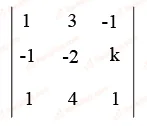
    STATEMENT-2: The determinant

    ≠0\neq 0, for k≠3k \neq 3.

    1. (A)

      STATEMENT-1 is True, STATEMENT-2 is True; STATEMENT-2 is a correct explanation for STATEMENT-1

    2. (B)

      STATEMENT-1 is True, STATEMENT-2 is True; STATEMENT-2 is NOT a correct explanation for STATEMENT-1

    3. (C)

      STATEMENT-1 is True, STATEMENT-2 is False

    4. (D)

      STATEMENT-1 is False, STATEMENT-2 is True

    rr2.rankrizz.com/jee-advanced/maths/matrices-and-determinants/q/2008-paper-1-q13

  15. 15 · JEE ADVANCED 2007 · PAPER 1

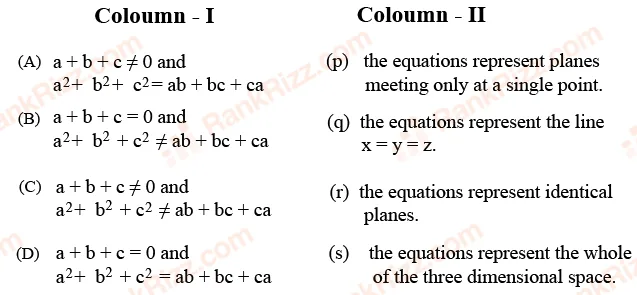
    Consider the following linear equations
    ax+by+cz=0ax + by + cz = 0
    bx+cy+az=0bx + cy + az = 0
    cx+ay+bz=0cx + ay + bz = 0
    Match the conditions/expressions in Column I with statements in Column II and indicate your answer by darkening the appropriate bubbles in the 4×44 \times 4 matrix given in the ORS.

    rr2.rankrizz.com/jee-advanced/maths/matrices-and-determinants/q/2007-paper-1-q64

Adjoint and inverse of a matrix 10

  1. 16 · JEE ADVANCED 2026 · PAPER 1

    Consider the matrix M=[2−110].M=\begin{bmatrix}2&-1\\1&0\end{bmatrix}.

    Let p,q,r,s,a,b,cp,q,r,s,a,b,c and dd be integers such that M26=[pqrs]M^{26}=\begin{bmatrix}p&q\\r&s\end{bmatrix} and ∑k=126Mk=[abcd].\displaystyle\sum_{k=1}^{26}M^k=\begin{bmatrix}a&b\\c&d\end{bmatrix}.

    Then which of the following statements is (are) TRUE?

    1. (A)

      There exists a 2×22\times 2 invertible matrix NN with real entries such that MN=N[1101]MN=N\begin{bmatrix}1&1\\0&1\end{bmatrix}

    2. (B)

      The value of aa is 378378

    3. (C)

      For any two given integers mm and nn, there exist unique integers xx and yy such that px+qy=mpx+qy=m and rx+sy=nrx+sy=n

    4. (D)

      For each positive real number tt, the system of linear equations (a+t)x+by=1,  cx+(d+t)y=−1(a+t)x+by=1,\;cx+(d+t)y=-1 has a unique solution

    rr2.rankrizz.com/jee-advanced/maths/matrices-and-determinants/q/2026-paper-1-q40

  2. 17 · JEE ADVANCED 2025 · PAPER 1

    Consider the matrix

    P=(200020003).P = \begin{pmatrix} 2 & 0 & 0 \\ 0 & 2 & 0 \\ 0 & 0 & 3 \end{pmatrix}.

    Let the transpose of a matrix XX be denoted by XTX^T. Then the number of 3×33 \times 3 invertible matrices QQ with integer entries, such that

    Q−1=QTandPQ=QP,Q^{-1} = Q^T \quad \text{and} \quad PQ = QP,

    is

    1. (A)

      3232

    2. (B)

      88

    3. (C)

      1616

    4. (D)

      2424

    rr2.rankrizz.com/jee-advanced/maths/matrices-and-determinants/q/2025-paper-1-q4

  3. 18 · JEE ADVANCED 2023 · PAPER 2

    Let R={(a3bc2d050):a,b,c,d∈{0,3,5,7,11,13,17,19}}R = \left\{\begin{pmatrix} a & 3 & b \\ c & 2 & d \\ 0 & 5 & 0 \end{pmatrix} : a, b, c, d \in \{0, 3, 5, 7, 11, 13, 17, 19\}\right\}. Then the number of invertible matrices in R is

    Answer: ____________

    rr2.rankrizz.com/jee-advanced/maths/matrices-and-determinants/q/2023-paper-2-q12

  4. 19 · JEE ADVANCED 2021 · PAPER 1

    For any 3×33 \times 3 matrix M, let ∣M∣\mid M \mid denote the determinant of M. Let I be the 3×33 \times 3 identity matrix. Let E and F be two 3×33 \times 3 matrices such that (I−EF)(I − EF) is invertible. If G=(I−EF)−1G = (I − EF) − 1, then which of the following statements is (are) TRUE ?

    1. (A)

      ∣FE∣=∣I−FE∣∣FGE∣\mid FE \mid = \mid I - FE \mid \mid FGE \mid

    2. (B)

      (I−FE)(I+FGE)=I(I - FE)(I + FGE) = I

    3. (C)

      EFG=GEFEFG = GEF

    4. (D)

      (I−FE)(I−FGE)=I(I - FE)(I - FGE) = I

    rr2.rankrizz.com/jee-advanced/maths/matrices-and-determinants/q/2021-paper-1-q14

  5. 20 · JEE ADVANCED 2020 · PAPER 1

    Let 𝑀 be a 3×33 \times 3 invertible matrix with real entries and let I denote the 3×33 \times 3 identity matrix. If 𝑀−1=adj(adj𝑀)𝑀^{−1} = adj (adj 𝑀), then which of the following statements is/are ALWAYS TRUE?

    1. (A)

      M = I

    2. (B)

      bet M = 1

    3. (C)

      M2=IM^{2} = I

    4. (D)

      (adj𝑀)2=I(adj 𝑀)^{2} = I

    rr2.rankrizz.com/jee-advanced/maths/matrices-and-determinants/q/2020-paper-1-q44

  6. 21 · JEE ADVANCED 2019 · PAPER 1

    Let
    M=[sin⁡4θ−1−sin⁡2θ1+cos⁡2θcos⁡4θ]=αI+βM−1M = \begin{bmatrix}\sin^4\theta & -1-\sin^2\theta \\1 + \cos^2\theta & \cos^4\theta \end{bmatrix} = \alpha I + \beta M^{-1}
    where α=α(θ)andβ=β(θ)\alpha = \alpha (\theta) and \beta = \beta (\theta) are real numbers, and I is the 2×22 \times 2 identity matrix. If
    α∗\alpha^* is the minimum of the set {α(θ):θ∈[0,2π)}\left\{\alpha (\theta): \theta \in [0, 2\pi)\right\} and
    β∗\beta^* is the minimum of the set {β(θ):θ∈[0,2π)}\left\{\beta (\theta): \theta \in [0, 2\pi)\right\},
    then the value of α∗+β∗\alpha^* + \beta^* is

    1. (A)

      −3716-\frac{37}{16}

    2. (B)

      −3116-\frac{31}{16}

    3. (C)

      −2916-\frac{29}{16}

    4. (D)

      −1716-\frac{17}{16}

    rr2.rankrizz.com/jee-advanced/maths/matrices-and-determinants/q/2019-paper-1-q38

  7. 22 · JEE ADVANCED 2019 · PAPER 1

    Let
    M=[01a1233b1]M = \begin{bmatrix}0 & 1 & a \\1 & 2 & 3 \\3 & b & 1 \end{bmatrix} and adjM=[−11−18−62−53−1]adj M = \begin{bmatrix}-1 & 1 & -1 \\8 & -6 & 2 \\-5 & 3 & -1 \end{bmatrix}
    where a and b are real numbers. Which of the following options is/are correct?

    1. (A)

      a + b = 3

    2. (B)

      (adjM)−1+adjM−1=−M(adj M)^{-1} + adj M^{-1} = -M

    3. (C)

      det(adjM2)=81det(adj M^2) = 81

    4. (D)

      If M [αβγ]=[123],\begin{bmatrix}\alpha \\ \beta \\ \gamma \end{bmatrix} = \begin{bmatrix}1 \\2 \\3 \end{bmatrix}, then α−β+γ=3\alpha - \beta + \gamma = 3

    rr2.rankrizz.com/jee-advanced/maths/matrices-and-determinants/q/2019-paper-1-q42

  8. 23 · JEE ADVANCED 2016 · PAPER 1

    Let P=[3−1−220α3−50]P = \begin{bmatrix}3 & -1 & -2 \\2 & 0 & \alpha \\3 & -5 & 0 \end{bmatrix} where α∈R\alpha \in R. Suppose Q=[qij]Q = [q_{ij}] is a matrix such that PQ=kIPQ = kI, where k∈R,k≠0k \in R, k \neq 0 and II is the identity matrix of order 3. If q23=−k8q_{23} = -\frac{k}{8} and det(Q)=k22det(Q) = \frac{k^2}{2}, then

    1. (A)

      α=0,k=8\alpha = 0, k = 8

    2. (B)

      4α−k+8=04 \alpha - k + 8 = 0

    3. (C)

      det(Padj(Q))=29det(P adj(Q)) = 2^9

    4. (D)

      det(Qadj(P))=213det(Q adj(P)) = 2^{13}

    rr2.rankrizz.com/jee-advanced/maths/matrices-and-determinants/q/2016-paper-1-q44

  9. 24 · JEE ADVANCED 2012 · PAPER 2

    If the adjoint of a 3×33 \times 3 matrix P is [144217113]\begin{bmatrix}1 & 4 & 4 \\2 & 1 & 7\\1 & 1 & 3 \end{bmatrix}, then the possible value(s) of the determinant of P is (are)

    1. (A)

      -2

    2. (B)

      -1

    3. (C)

      1

    4. (D)

      2

    rr2.rankrizz.com/jee-advanced/maths/matrices-and-determinants/q/2012-paper-2-q59

  10. 25 · JEE ADVANCED 2010 · PAPER 2

    Let k be a positive real number and let
    A=[2k−12k2k2k1−2k−2k2k−1]A = \begin{bmatrix}2k-1 & 2\sqrt{k} & 2\sqrt{k} \\2\sqrt{k} & 1 & -2k \\-2\sqrt{k} & 2k & -1 \end{bmatrix} and B=[02k−1k1−2k02k−k−2k0]B = \begin{bmatrix}0 & 2k-1 & \sqrt{k} \\1-2k & 0 & 2\sqrt{k} \\-\sqrt{k} & -2\sqrt{k} & 0 \end{bmatrix}.If det(adjA)+det(adjB)=106det(adj A) + det(adj B) = 10^6, then [k] is equal to
    [Note : adj M denotes the adjoint of a square matrix M and [k] denotes the largest integer less than or equal to k].

    Answer: ____________

    rr2.rankrizz.com/jee-advanced/maths/matrices-and-determinants/q/2010-paper-2-q30

Properties of determinants 9

  1. 26 · JEE ADVANCED 2025 · PAPER 2

    Let I=(1001)I = \begin{pmatrix} 1 & 0 \\ 0 & 1 \end{pmatrix} and P=(2003)P = \begin{pmatrix} 2 & 0 \\ 0 & 3 \end{pmatrix}. Let Q=(xyz4)Q = \begin{pmatrix} x & y \\ z & 4 \end{pmatrix} for some non-zero real numbers xx, yy, and zz, for which there is a 2×22 \times 2 matrix RR with all entries being non-zero real numbers, such that QR=RPQR = RP.

    Then which of the following statements is (are) TRUE?

    1. (A)

      The determinant of Q−2IQ - 2I is zero

    2. (B)

      The determinant of Q−6IQ - 6I is 12

    3. (C)

      The determinant of Q−3IQ - 3I is 15

    4. (D)

      yz=2yz = 2

    rr2.rankrizz.com/jee-advanced/maths/matrices-and-determinants/q/2025-paper-2-q5

  2. 27 · JEE ADVANCED 2022 · PAPER 2

    Let β\beta be a real number. Consider the matrix A=(β0121−231−2)A = \begin{pmatrix} \beta & 0 & 1 \\ 2 & 1 & -2 \\ 3 & 1 & -2 \end{pmatrix}. If A7−(β−1)A6−βA5A^7 - (\beta - 1)A^6 - \beta A^5 is a singular matrix, then the value of 9β9\beta is _______.

    Answer: ____________

    rr2.rankrizz.com/jee-advanced/maths/matrices-and-determinants/q/2022-paper-2-q6

  3. 28 · JEE ADVANCED 2014 · PAPER 1

    Let M and N be two 3×33 \times 3 matrices such that MN = NM. Further, if M≠N2M \neq N^2 and M2=N4M^2 = N^4, then

    1. (A)

      determinant of (M2+MN2)(M^2 + MN^2) is 0

    2. (B)

      there is a 3×33 \times 3 non-zero matrix UU such that (M2+MN2)(M^2 + MN^2) U is the zero matrix

    3. (C)

      determinant of (M2+MN2)≥1(M^2 + MN^2) \geq 1

    4. (D)

      for a 3×33 \times 3 matrix UU, if (M2+MN2)(M^2 + MN^2)U equals the zero matrix then U is the zero matrix

    rr2.rankrizz.com/jee-advanced/maths/matrices-and-determinants/q/2014-paper-1-q41

  4. 29 · JEE ADVANCED 2012 · PAPER 1

    Let P=[aij]P = [a_{ij}] be a 3×33 \times 3 matrix and let Q=[bij]Q = [b_{ij}], where bij=2i+jaijb_{ij} = 2^{i + j}a_{ij} for 1≤i,j≤31 \leq i, j \leq 3. If the determinant of P, is 2, then the determinant of the matrix Q is

    1. (A)

      2102^{10}

    2. (B)

      2112^{11}

    3. (C)

      2122^{12}

    4. (D)

      2132^{13}

    rr2.rankrizz.com/jee-advanced/maths/matrices-and-determinants/q/2012-paper-1-q47

  5. 30 · JEE ADVANCED 2011 · PAPER 2

    Let ω≠1\omega \neq 1 be a cube root of unity and S bethe set of all non-singular matrices of the form
    [1abω1cω2ω1]\begin{bmatrix}1 & a & b\\\omega & 1 & c\\\omega^2 & \omega & 1\end{bmatrix},
    where each of a, b, and c is either ω\omega or ω2\omega^2. Then the number of distinct matrices in the set S is

    1. (A)

      2

    2. (B)

      6

    3. (C)

      4

    4. (D)

      8

    rr2.rankrizz.com/jee-advanced/maths/matrices-and-determinants/q/2011-paper-2-q43

  6. 31 · JEE ADVANCED 2010 · PAPER 1

    The number of A in TpT_p, such that A is either symmetric or skew-symmetric or both, and det (A) divisible by p is

    1. (A)

      (p−1)2(p-1)^2

    2. (B)

      2(p−1)2(p-1)

    3. (C)

      (p−1)2+1(p-1)^2 + 1

    4. (D)

      2p−12p-1

    rr2.rankrizz.com/jee-advanced/maths/matrices-and-determinants/q/2010-paper-1-q42

  7. 32 · JEE ADVANCED 2010 · PAPER 1

    The number of A in TpT_p, suchthat the trace of A is not divisible by p but det (A) is divisible by p is
    [Note : The trace of a matrix is the sumofits diagonal entries.]

    1. (A)

      (p−1)(p2−p+1)(p-1)(p^2 - p + 1)

    2. (B)

      p3−(p−1)2p^3 - (p - 1)^2

    3. (C)

      (p−1)2(p-1)^2

    4. (D)

      (p−1)(p2−2)(p-1)(p^2 - 2)

    rr2.rankrizz.com/jee-advanced/maths/matrices-and-determinants/q/2010-paper-1-q43

  8. 33 · JEE ADVANCED 2010 · PAPER 1

    The number of A in TpT_p, such that det (A) is not divisible byp is

    1. (A)

      2p22p^2

    2. (B)

      p3−5pp^3 - 5p

    3. (C)

      p3−3pp^3 - 3p

    4. (D)

      p3−p2p^3 - p^2

    rr2.rankrizz.com/jee-advanced/maths/matrices-and-determinants/q/2010-paper-1-q44

  9. 34 · JEE ADVANCED 2010 · PAPER 1

    Let ω\omega be the complex number cos⁡2π3+isin⁡2π3\cos \frac{2 \pi}{3} + i \sin \frac{2 \pi}{3}. Then the number of distinct complex numbers z satisfying
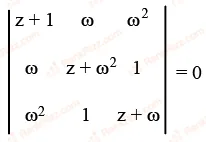
    Answer: ____________

    rr2.rankrizz.com/jee-advanced/maths/matrices-and-determinants/q/2010-paper-1-q53

Transpose, symmetric and skew-symmetric matrices 8

  1. 35 · JEE ADVANCED 2024 · PAPER 1

    Let α\alpha and β\beta be the distinct roots of the equation x2+x−1=0x^2 + x - 1 = 0. Consider the set T={1,α,β}T = \{1, \alpha, \beta\}. For a 3×33 \times 3 matrix M=(aij)3×3M = (a_{ij})_{3 \times 3}, define Ri=ai1+ai2+ai3R_i = a_{i1} + a_{i2} + a_{i3} and Cj=a1j+a2j+a3jC_j = a_{1j} + a_{2j} + a_{3j} for i=1,2,3i = 1, 2, 3 and j=1,2,3j = 1, 2, 3.

    Match each entry in List-I to the correct entry in List-II.

    List-IList-II
    (P)The number of matrices M=(aij)3×3M = (a_{ij})_{3 \times 3} with all entries in TT such that Ri=Cj=0R_i = C_j = 0 for all i,ji, j is(1)1
    (Q)The number of symmetric matrices M=(aij)3×3M = (a_{ij})_{3 \times 3} with all entries in TT such that Cj=0C_j = 0 for all jj is(2)12
    (R)Let M=(aij)3×3M = (a_{ij})_{3 \times 3} be a skew symmetric matrix such that aij∈Ta_{ij} \in T for i>ji \gt j. Then the number of elements in the set {(xyz):x,y,z∈R,M(xyz)=(a120−a23)}\left\{\begin{pmatrix} x \\ y \\ z \end{pmatrix} : x, y, z \in R, M\begin{pmatrix} x \\ y \\ z \end{pmatrix} = \begin{pmatrix} a_{12} \\ 0 \\ -a_{23} \end{pmatrix}\right\} is(3)Infinite
    (S)Let M=(aij)3×3M = (a_{ij})_{3 \times 3} be a matrix with all entries in TT such that Ri=0R_i = 0 for all ii. Then the absolute value of the determinant of MM is(4)6
    (5)0
    1. (A)

      (P) →\to (4), (Q) →\to (2), (R) →\to (5), (S) →\to (1)

    2. (B)

      (P) →\to (2), (Q) →\to (4), (R) →\to (1), (S) →\to (5)

    3. (C)

      (P) →\to (2), (Q) →\to (4), (R) →\to (3), (S) →\to (5)

    4. (D)

      (P) →\to (1), (Q) →\to (5), (R) →\to (3), (S) →\to (4)

    rr2.rankrizz.com/jee-advanced/maths/matrices-and-determinants/q/2024-paper-1-q14

  2. 36 · JEE ADVANCED 2019 · PAPER 2

    Let
    P1=I=[100010001],P2=[100001010],P3=[010100001],P_1 = I = \begin{bmatrix}1 & 0 & 0 \\0 & 1 & 0\\0 & 0 & 1\end{bmatrix}, P_2 = \begin{bmatrix}1 & 0 & 0 \\0 & 0 & 1\\0 & 1 & 0\end{bmatrix}, P_3 = \begin{bmatrix}0 & 1 & 0 \\1 & 0 & 0\\0 & 0 & 1\end{bmatrix},
    P4=[010001100],P5=[001100010],P6=[001010100],P_4 = \begin{bmatrix}0 & 1 & 0 \\0 & 0 & 1\\1 & 0 & 0\end{bmatrix}, P_5 = \begin{bmatrix}0 & 0 & 1 \\1 & 0 & 0\\0 & 1 & 0\end{bmatrix}, P_6 = \begin{bmatrix}0 & 0 & 1 \\0 & 1 & 0\\1 & 0 & 0\end{bmatrix},
    and X=∑k=16Pk[213102321]PkTX = \sum_{k = 1}^6 P_k \begin{bmatrix}2 & 1 & 3 \\1 & 0 & 2\\3 & 2 & 1\end{bmatrix} P_k^T
    where PkTP_k^T denotes the transpose of the matrix PkP_k. Then which of the following options is/are correct?

    1. (A)

      If X[111]=α[111],X \begin{bmatrix}1 \\1 \\1 \end{bmatrix} = \alpha \begin{bmatrix}1 \\1 \\1 \end{bmatrix}, then α=30\alpha = 30

    2. (B)

      X is asymmetric matrix

    3. (C)

      The sum of diagonal entries of X is 18

    4. (D)

      X — 30I is an invertible matrix

    rr2.rankrizz.com/jee-advanced/maths/matrices-and-determinants/q/2019-paper-2-q37

  3. 37 · JEE ADVANCED 2015 · PAPER 1

    Let X and Y be two arbitrary, 3×33 \times 3, non-zero, skew-symmetric matrices and Z be an arbitrary 3×33 \times 3, non-zero, symmetric matrix. Then which of the following matrices is (are) skew symmetric?

    1. (A)

      Y3Z4−Z4Y3Y^3 Z^4 - Z^4 Y^3

    2. (B)

      X44+Y44X^{44} + Y^{44}

    3. (C)

      X4Z3−Z3X4X^4 Z^3 - Z^3 X^4

    4. (D)

      X23+Y23X^{23} + Y^{23}

    rr2.rankrizz.com/jee-advanced/maths/matrices-and-determinants/q/2015-paper-1-q49

  4. 38 · JEE ADVANCED 2014 · PAPER 1

    Let M be a 2×22 \times 2 symmetric matrix with integer entries. Then M is invertible if

    1. (A)

      the first column of M is the transpose of the second row of M

    2. (B)

      the second row of M is the transpose of the first column of M

    3. (C)

      M is a diagonal matrix with nonzero entries in the main diagonal

    4. (D)

      the product of entries in the main diagonal of M is not the square of an integer

    rr2.rankrizz.com/jee-advanced/maths/matrices-and-determinants/q/2014-paper-1-q50

  5. 39 · JEE ADVANCED 2013 · PAPER 1

    For 3×33 \times 3 matrices M and N, whichof the following statement(s) is (are) NOT correct ?

    1. (A)

      NTMNN^T M N is symmetric or skew symmetric, according as M is symmetric or skew symmetric

    2. (B)

      M N - N M is skew symmetric for all symmetric matrices M and N

    3. (C)

      M N is symmetric for all symmetric matrices M and N

    4. (D)

      (adj M) (adj N) = adj (M N) for all invertible matrices and N

    rr2.rankrizz.com/jee-advanced/maths/matrices-and-determinants/q/2013-paper-1-q52

  6. 40 · JEE ADVANCED 2012 · PAPER 2

    If P is a 3×33 \times 3 matrix such that PT=2P+IP^T = 2P + I, where PTP^T is the transpose of P and I is the 3×33 \times 3 identity matrix, then there exists a column matrix X=[xyz]≠[000]X = \begin{bmatrix}x \\y \\z\end{bmatrix} \neq \begin{bmatrix}0 \\0 \\0\end{bmatrix} such that

    1. (A)

      PX=[000]PX =\begin{bmatrix}0 \\0 \\0\end{bmatrix}

    2. (B)

      PX=XPX = X

    3. (C)

      PX=2XPX = 2X

    4. (D)

      PX=−XPX = -X

    rr2.rankrizz.com/jee-advanced/maths/matrices-and-determinants/q/2012-paper-2-q46

  7. 41 · JEE ADVANCED 2011 · PAPER 1

    Let M and N be two 3×33 \times 3 non-singular skew-symmetric matrices such that MN=NMMN = NM. If PTP^T denotes the transpose of P, then M2N2(MTN)−1(MN−1)TM^2N^2(M^TN)^{-1}(MN^{-1})^T is equal to

    1. (A)

      M2M^2

    2. (B)

      −N2-N^2

    3. (C)

      −M2-M^2

    4. (D)

      MNMN

    rr2.rankrizz.com/jee-advanced/maths/matrices-and-determinants/q/2011-paper-1-q56

  8. 42 · JEE ADVANCED 2009 · PAPER 1

    The number of matrices in A is

    1. (A)

      12

    2. (B)

      6

    3. (C)

      9

    4. (D)

      3

    rr2.rankrizz.com/jee-advanced/maths/matrices-and-determinants/q/2009-paper-1-q33

Types of matrices and matrix algebra 5

  1. 43 · JEE ADVANCED 2026 · PAPER 1

    Which one of the following matrices can be obtained by performing elementary row transformations on the 3×33\times 3 identity matrix?

    1. (A)

      [111111111]\begin{bmatrix}1&1&1\\1&1&1\\1&1&1\end{bmatrix}

    2. (B)

      [111234121]\begin{bmatrix}1&1&1\\2&3&4\\1&2&1\end{bmatrix}

    3. (C)

      [111234258]\begin{bmatrix}1&1&1\\2&3&4\\2&5&8\end{bmatrix}

    4. (D)

      [111−112023]\begin{bmatrix}1&1&1\\-1&1&2\\0&2&3\end{bmatrix}

    rr2.rankrizz.com/jee-advanced/maths/matrices-and-determinants/q/2026-paper-1-q35

  2. 44 · JEE ADVANCED 2021 · PAPER 1

    For 3×33 \times 3 matrix M, let ∣M∣\mid M \mid denote the determinant of M. Let
    E=[12323481318],P=E=[100001010]E = \begin{bmatrix}1 & 2 & 3 \\2 & 3 & 4 \\ 8 & 13 & 18 \end{bmatrix}, P = E = \begin{bmatrix}1 & 0 & 0 \\0 & 0 & 1 \\ 0 & 1 & 0 \end{bmatrix} and F=[13281813243]F = \begin{bmatrix}1 & 3 & 2 \\8 & 18 & 13 \\ 2 & 4 & 3 \end{bmatrix}
    If Q is a nonsingular matrix of order 3×33 \times 3, then which of the following statements is (are) TRUE ?

    1. (A)

      F=PEPF = PEP and P2=[100010001]P^2 = \begin{bmatrix}1 & 0 & 0 \\0 & 1 & 0 \\ 0 & 0 & 1\end{bmatrix}

    2. (B)

      ∣EQ+PFQ−1∣=∣EQ∣+∣PFQ−1∣\mid EQ + PFQ^{-1} \mid = \mid EQ \mid + \mid PFQ^{-1} \mid

    3. (C)

      ∣(EF)3∣>∣EF∣2\mid (EF)^3 \mid > \mid EF \mid^2

    4. (D)

      Sum of the diagonal entries of P−1EP+FP^{−1} EP + F is equal to the sum of diagonal entries of E+P−1FPE + P^{−1}FP

    rr2.rankrizz.com/jee-advanced/maths/matrices-and-determinants/q/2021-paper-1-q11

  3. 45 · JEE ADVANCED 2019 · PAPER 2

    Let x∈Rx \in R and let
    P=[111022003],Q=[2xx040xx6]P = \begin{bmatrix}1 & 1 & 1 \\0 & 2 & 2\\0 & 0 & 3\end{bmatrix}, Q = \begin{bmatrix}2 & x & x \\0 & 4 & 0\\x & x & 6\end{bmatrix} and R=PQP−1R = PQP^{-1}
    Then which of the following options is/are correct?

    1. (A)

      There exists a real number x such that PQ = QP

    2. (B)

      det R = det [2xx040xx5]+8,\begin{bmatrix}2 & x & x \\0 & 4 & 0\\x & x & 5\end{bmatrix} + 8, for all x∈Rx \in R

    3. (C)

      For x = 0, if R[1ab]=6[1ab],R \begin{bmatrix}1 \\a \\b \end{bmatrix} = 6 \begin{bmatrix}1 \\a \\b \end{bmatrix}, a + b = 5

    4. (D)

      For x = 1, there exists a unit vector αi^+βj^+γk^\alpha \widehat{i} + \beta \widehat{j} + \gamma \widehat{k} for which R[αβγ]=[000]R \begin{bmatrix}\alpha \\\beta \\\gamma \end{bmatrix} = \begin{bmatrix}0 \\0 \\0 \end{bmatrix}

    rr2.rankrizz.com/jee-advanced/maths/matrices-and-determinants/q/2019-paper-2-q38

  4. 46 · JEE ADVANCED 2016 · PAPER 2

    Let [1004101641]\begin{bmatrix}1 & 0 & 0 \\4 & 1 & 0 \\16 & 4 & 1 \end{bmatrix} and I be the identity matrix of order 3. If Q=[qij]Q = [q_{ij}] is a matrix such that P50−Q=IP^{50} - Q = I, then q31+q32q21\frac{q_{31} + q_{32}}{q_{21}} equals

    1. (A)

      52

    2. (B)

      103

    3. (C)

      201

    4. (D)

      205

    rr2.rankrizz.com/jee-advanced/maths/matrices-and-determinants/q/2016-paper-2-q37

  5. 47 · JEE ADVANCED 2016 · PAPER 1

    Let z=−1+3i2z = \frac{-1 + \sqrt{3}i}{2}, where i=−1i = \sqrt{-1}, and r,s∈{1,2,3}r, s \in \left\{1, 2, 3\right\}. Let P=[(−z)rz2sz2szr]P = \begin{bmatrix}(-z)^r & z^{2s} \\z^{2s} & z^r \end{bmatrix} and I be the identity matrix of order 2. Then the total number of ordered pairs (r,s)(r, s) for which P2=−IP^2 = -I is

    Answer: ____________

    rr2.rankrizz.com/jee-advanced/maths/matrices-and-determinants/q/2016-paper-1-q54

Evaluation of determinants 4

  1. 48 · JEE ADVANCED 2024 · PAPER 1

    Let S={A=(01c1ad1be):a,b,c,d,e∈{0,1} and ∣A∣∈{−1,1}}S = \left\{A = \begin{pmatrix} 0 & 1 & c \\ 1 & a & d \\ 1 & b & e \end{pmatrix} : a, b, c, d, e \in \{0, 1\} \text{ and } |A| \in \{-1, 1\}\right\}, where ∣A∣|A| denotes the determinant of AA. Then the number of elements in SS is ________.

    Answer: ____________

    rr2.rankrizz.com/jee-advanced/maths/matrices-and-determinants/q/2024-paper-1-q10

  2. 49 · JEE ADVANCED 2019 · PAPER 2

    Suppose
    det[∑k=0nk∑k=0nnCkk2∑k=0nnCkk∑k=0nnCk3k]=0det\begin{bmatrix} \sum_{k = 0}^nk & \sum_{k = 0}^n {^nC_k k^2} \\\sum_{k = 0}^n {^n C_k k} & \sum_{k = 0}^n {^n C_k 3^k} \end{bmatrix} = 0
    holds for somepositive integer n. Then ∑k=0nnCkk+1\sum_{k = 0}^n \frac {^nC_k}{k + 1} Equals __________

    Answer: ____________

    rr2.rankrizz.com/jee-advanced/maths/matrices-and-determinants/q/2019-paper-2-q45

  3. 50 · JEE ADVANCED 2016 · PAPER 1

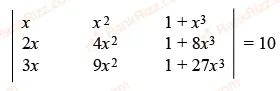
    The total number of distinct x∈Rx \in R for which

    Answer: ____________

    rr2.rankrizz.com/jee-advanced/maths/matrices-and-determinants/q/2016-paper-1-q50

  4. 51 · JEE ADVANCED 2015 · PAPER 1

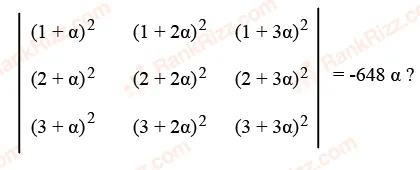
    Which of the following values of α\alpha satisfy the equation

    1. (A)

      -4

    2. (B)

      9

    3. (C)

      -9

    4. (D)

      4

    rr2.rankrizz.com/jee-advanced/maths/matrices-and-determinants/q/2015-paper-1-q50

Matrix multiplication, powers and matrix equations 3

  1. 52 · JEE ADVANCED 2022 · PAPER 2

    If M=(5232−32−12)M = \begin{pmatrix} \dfrac{5}{2} & \dfrac{3}{2} \\ -\dfrac{3}{2} & -\dfrac{1}{2} \end{pmatrix}, then which of the following matrices is equal to M2022M^{2022}?

    1. (A)

      (30343033−3033−3032)\begin{pmatrix} 3034 & 3033 \\ -3033 & -3032 \end{pmatrix}

    2. (B)

      (3034−30333033−3032)\begin{pmatrix} 3034 & -3033 \\ 3033 & -3032 \end{pmatrix}

    3. (C)

      (30333032−3032−3031)\begin{pmatrix} 3033 & 3032 \\ -3032 & -3031 \end{pmatrix}

    4. (D)

      (30323031−3031−3030)\begin{pmatrix} 3032 & 3031 \\ -3031 & -3030 \end{pmatrix}

    rr2.rankrizz.com/jee-advanced/maths/matrices-and-determinants/q/2022-paper-2-q16

  2. 53 · JEE ADVANCED 2017 · PAPER 1

    Which of the following is(are) NOT the square of a 3×3 matrix with real entries?

    1. (A)

      [100010001]\begin{bmatrix}1 & 0 & 0\\0 & 1 & 0\\ 0 & 0 & 1\end{bmatrix}

    2. (B)

      [10001000−1]\begin{bmatrix}1 & 0 & 0\\0 & 1 & 0\\ 0 & 0 & -1\end{bmatrix}

    3. (C)

      [1000−1000−1]\begin{bmatrix}1 & 0 & 0\\0 & -1 & 0\\ 0 & 0 & -1\end{bmatrix}

    4. (D)

      [−1000−1000−1]\begin{bmatrix}-1 & 0 & 0\\0 & -1 & 0\\ 0 & 0 & -1\end{bmatrix}

    rr2.rankrizz.com/jee-advanced/maths/matrices-and-determinants/q/2017-paper-1-q41

  3. 54 · JEE ADVANCED 2013 · PAPER 2

    Let ω\omega be a complex cuberoot of unity with ω≠1\omega \neq 1 and P=[pij]P = [p_{ij}] be a n×nn \times n matrix with pij=ωi+jp_{ij} = \omega^{i+j}. Then P2≠0P^2 \neq 0, when n =

    1. (A)

      57

    2. (B)

      55

    3. (C)

      58

    4. (D)

      56

    rr2.rankrizz.com/jee-advanced/maths/matrices-and-determinants/q/2013-paper-2-q43

Trace and special matrices 3

  1. 55 · JEE ADVANCED 2020 · PAPER 2

    The trace of a square matrix is defined to be the sum of its diagonal entries. If A is a 2×22 \times 2 matrix such that the trace of A is 3 and the trace of A3A^3 is −18, then the value of the determinant of A is _____

    Answer: ____________

    rr2.rankrizz.com/jee-advanced/maths/matrices-and-determinants/q/2020-paper-2-q40

  2. 56 · JEE ADVANCED 2017 · PAPER 2

    How many 3×33\times3 matrices M with entries from {0,1,2} are there, for which the sum of the diagonal entries of MTMM^{T}M is 5?

    1. (A)

      126

    2. (B)

      198

    3. (C)

      162

    4. (D)

      135

    rr2.rankrizz.com/jee-advanced/maths/matrices-and-determinants/q/2017-paper-2-q41

  3. 57 · JEE ADVANCED 2011 · PAPER 2

    Let M be a 3×33 \times 3 matrix satisfying
    M[010]=[−123],M[1−10]=[11−1]M\begin{bmatrix}0\\1\\0 \end{bmatrix} = \begin{bmatrix}-1\\2\\3 \end{bmatrix}, M\begin{bmatrix}1\\-1\\0 \end{bmatrix} = \begin{bmatrix}1\\1\\-1 \end{bmatrix}, and M[111]=[0012]M\begin{bmatrix}1\\1\\1 \end{bmatrix} = \begin{bmatrix}0\\0\\12 \end{bmatrix}. Then the sum of the diagonal entries of M is

    Answer: ____________

    rr2.rankrizz.com/jee-advanced/maths/matrices-and-determinants/q/2011-paper-2-q56

Answer key

  1. 01 B, C, D
  2. 02 B, C
  3. 03 A
  4. 04 B
  5. 05 1
  6. 06 B, C, D
  7. 07 D
  8. 08 A
  9. 09 B
  10. 10 A
  11. 11 —
  12. 12 B
  13. 13 B
  14. 14 A
  15. 15 A-R, B-Q, C-P, D-S
  16. 16 A, C, D
  17. 17 C
  18. 18 3780
  19. 19 C
  20. 20 B, C, D
  21. 21 D
  22. 22 B, C, D
  23. 23 B, C
  24. 24 A, D
  25. 25 4
  26. 26 A, B
  27. 27 3
  28. 28 A, B
  29. 29 D
  30. 30 A
  31. 31 D
  32. 32 C
  33. 33 D
  34. 34 1
  35. 35 C
  36. 36 A, B, D
  37. 37 C, D
  38. 38 C, D
  39. 39 C, D
  40. 40 D
  41. 41 C
  42. 42 A
  43. 43 B
  44. 44 A
  45. 45 B, D
  46. 46 B
  47. 47 1
  48. 48 16
  49. 49 —
  50. 50 2
  51. 51 B, C
  52. 52 A
  53. 53 B, D
  54. 54 B, C, D
  55. 55 —
  56. 56 B
  57. 57 9

“—” marks a question whose key we have not checked yet; its page shows the latest on it.

Past questions are reproduced with their sitting. Not affiliated with NTA or the IITs. Every question, online and free: rr2.rankrizz.com/jee-advanced/maths/matrices-and-determinants