Surface Chemistry JEE Advanced PYQs with answer key
CHEMISTRY · 16 PAST QUESTIONS · 2 TOPICS · 2007–2026
HOW TO USE THIS SHEET
Every JEE Advanced Surface Chemistry question we hold, grouped by topic, most-asked topic first and newest first inside each. The answer key is at the end (14 of 16 questions have a checked key); the worked solution is on each question’s page, printed beside it.
Adsorption and adsorption isotherms 9
At a given temperature, 0.45 g of acetic acid in 50 mL of water is shaken with 1.0 g of charcoal and the pH of the resulting solution is 3.0. Assume, the adsorption of acetic acid from the aqueous solution by charcoal follows Freundlich isotherm,
If the plot of against gives a straight line with slope 1, the value of in L mol is ___.
Given: The molar mass of acetic acid is 60 g mol.
The acid dissociation constant of acetic acid is at the given temperature.
is the mass (in grams) of acetic acid adsorbed. is the mass (in grams) of charcoal.
is the equilibrium concentration of acetic acid in the solution after the adsorption is complete.
and are constants for acetic acidcharcoal system at the given temperature.Answer: ____________
rr2.rankrizz.com/jee-advanced/chemistry/surface-chemistry/q/2026-paper-2-q29
Adsorption of phenol from its aqueous solution on to fly ash obeys Freundlich isotherm. At a given temperature, from 10 mg g and 16 mg g aqueous phenol solutions, the concentrations of adsorbed phenol are measured to be 4 mg g and 10 mg g, respectively. At this temperature, the concentration (in mg g) of adsorbed phenol from 20 mg g aqueous solution of phenol will be ______.
Use:
Answer: ____________
rr2.rankrizz.com/jee-advanced/chemistry/surface-chemistry/q/2025-paper-2-q43
To form a complete monolayer of acetic acid on 1 g of charcoal, 100 mL of 0.5 M acetic acid was used. Some of the acetic acid remained unadsorbed. To neutralize the unadsorbed acetic acid, 40 mL of 1 M NaOH solution was required. If each molecule of acetic acid occupies surface area on charcoal, the value of P is ________.
[Use given data : Surface area of charcoal = ; Avogadro's number () = ]
Answer: ____________
rr2.rankrizz.com/jee-advanced/chemistry/surface-chemistry/q/2024-paper-2-q42
The correct option(s) related to adsorption processes is(are)
- (A)
Chemisorption results in a unimolecular layer.
- (B)
The enthalpy change during physisorption is in the range of 100 to 140 kJ mol.
- (C)
Chemisorption is an endothermic process.
- (D)
Lowering the temperature favors physisorption processes.
rr2.rankrizz.com/jee-advanced/chemistry/surface-chemistry/q/2022-paper-1-q46
- (A)
The correct statement(s) about surface properties is(are)
- (A)
Adsorption is accompanied by decrease in enthalpy and decrease in entropy of the system
- (B)
The critical temperatures of ethane and nitrogen are 563 K and 126 K, respectively. The adsorption of ethane will be more than that of nitrogen on same amount of activated charcoal at a given temperature
- (C)
Cloud is an emulsion type of colloid in which liquid is dispersed phase and gas is dispersion medium
- (D)
Brownian motion of colloidal particles does not depend on the size of the particles but depends on viscosity of the solution
rr2.rankrizz.com/jee-advanced/chemistry/surface-chemistry/q/2017-paper-2-q26
- (A)
When is adsorbed on a metallic surface, electron transfer occurs from the metal to . The TRUE statement(s) regarding this adsorption is(are)
- (A)
is physisorbed
- (B)
heat is released
- (C)
occupancy of of is increased
- (D)
bond length of is increased
rr2.rankrizz.com/jee-advanced/chemistry/surface-chemistry/q/2015-paper-2-q35
- (A)
Methylene blue, from its aqueous solution, is adsorbed on activated charcoal at . For this process, the correct statement is
- (A)
The adsorption requires activation at .
- (B)
The adsorption is accompanied by a decreasein enthalpy.
- (C)
The adsorption increases with increase of temperature.
- (D)
The adsorptionis irreversible.
rr2.rankrizz.com/jee-advanced/chemistry/surface-chemistry/q/2013-paper-1-q23
- (A)
The given graph / data I, II, III and IV represent general trends observed for different physisorption and chemisorption processes under mild conditions of temperature and pressure. Which of the following choice (s) about I, II, III and IV is (are) correct
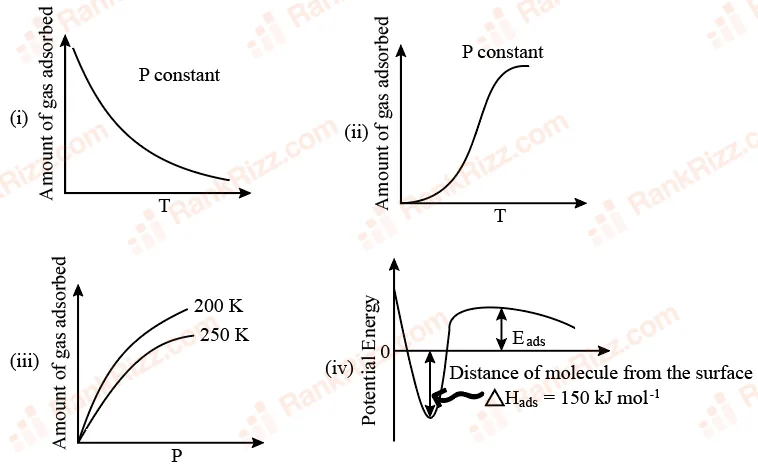
- (A)
I is physisorption and II is chemisorption
- (B)
I is physisorption and III is chemisorption
- (C)
IV is chemisorption and II is chemisorption
- (D)
IV is chemisorption and III is chemisorption
rr2.rankrizz.com/jee-advanced/chemistry/surface-chemistry/q/2012-paper-2-q36
- (A)
The correct statement(s) pertaining to the adsorption of a gas on a solid surface is (are)
- (A)
Adsorption is always exothermic
- (B)
Physiosorption may transform into chemisorption at high temperature
- (C)
Physiosorption increases with increasing temperature but chemisorption decreases with increasing temperature
- (D)
Chemisorption is more exothermic than physiosorption, however it is very slow due to higher energy of activation
rr2.rankrizz.com/jee-advanced/chemistry/surface-chemistry/q/2011-paper-1-q10
- (A)
Properties of colloids and coagulation 7
Consider the following statements related to colloids.
(I) Lyophobic colloids are not formed by simple mixing of dispersed phase and dispersion medium.
(II) For emulsions, both the dispersed phase and the dispersion medium are liquid.
(III) Micelles are produced by dissolving a surfactant in any solvent at any temperature.
(IV) Tyndall effect can be observed from a colloidal solution with dispersed phase having the same refractive index as that of the dispersion medium.
The option with the correct set of statements is
- (A)
(I) and (II)
- (B)
(II) and (III)
- (C)
(III) and (IV)
- (D)
(II) and (IV)
rr2.rankrizz.com/jee-advanced/chemistry/surface-chemistry/q/2023-paper-2-q36
- (A)
The correct statement(s) related to colloids is(are)
- (A)
The process of precipitating colloidal sol by an electrolyte is called peptization.
- (B)
Colloidal solution freezes at higher temperature than the true solution at the same concentration.
- (C)
Surfactants form micelle above critical micelle concentration (CMC). CMC depends on temperature.
- (D)
Micelles are macromolecular colloids.
rr2.rankrizz.com/jee-advanced/chemistry/surface-chemistry/q/2021-paper-1-q51
- (A)
The qualitative sketches I, II and III given below show the variation of surface tension with molar concentration of three different aqueous solutions of KCl, and at room temperature. The correct assignment of the sketches is
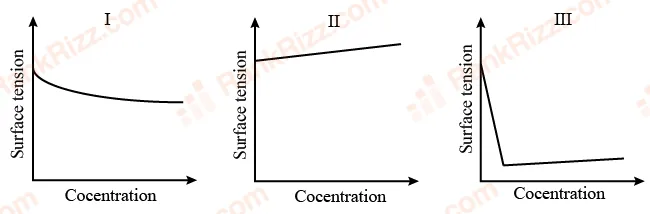
- (A)
I. II. III.
- (B)
I. II. III.
- (C)
I. II. III.
- (D)
I. II. III.
rr2.rankrizz.com/jee-advanced/chemistry/surface-chemistry/q/2016-paper-2-q20
- (A)
Choose the correct reason(s) for the stability of the lyophobic colloidal particles.
- (A)
Preferential adsorption of ions on their surface from the solution
- (B)
Preferential adsorption of solvent on their surface from the solution
- (C)
Attraction between different particles having opposite charges on their surface
- (D)
Potential difference between the fixed layer and the diffused layer of opposite charges around the colloidal particles
rr2.rankrizz.com/jee-advanced/chemistry/surface-chemistry/q/2012-paper-1-q32
- (A)
Among the electrolytes and , the most effective coagulating agent for is
- (A)
- (B)
- (C)
- (D)
rr2.rankrizz.com/jee-advanced/chemistry/surface-chemistry/q/2009-paper-1-q7
- (A)
Among the following, the surfactant that will form micelles in aqueous solution at the lowest molar concentration at ambient conditions is
- (A)
- (B)
- (C)
- (D)
rr2.rankrizz.com/jee-advanced/chemistry/surface-chemistry/q/2008-paper-2-q52
- (A)
STATEMENT-1 : Micelles are formed by surfactant molecules above the critical micellar concentration (CMC).
because
STATEMENT-2 : The conductivity of a solution having surfactant molecules decreases sharply at the CMC.- (A)
Statement-1 is True, Statement-2 is True; Statement-2 is a correct explanation for Statement-1
- (B)
Statement-1 is True, Statement-2 is True; Statement-2 is NOT a correct explanation for Statement-1
- (C)
Statement-1 is True, Statement-2 is False
- (D)
Statement-1 is False, Statement-2 is True
rr2.rankrizz.com/jee-advanced/chemistry/surface-chemistry/q/2007-paper-1-q35
- (A)
Answer key
- 01 —
- 02 —
- 03 2500
- 04 A, D
- 05 A, B
- 06 B, C, D
- 07 B
- 08 A, C
- 09 A, B, D
- 10 A
- 11 B, C
- 12 D
- 13 A, D
- 14 C
- 15 A
- 16 B
“—” marks a question whose key we have not checked yet; its page shows the latest on it.
Past questions are reproduced with their sitting. Not affiliated with NTA or the IITs. Every question, online and free: rr2.rankrizz.com/jee-advanced/chemistry/surface-chemistry