p-Block Elements: Groups 15 to 18 JEE Advanced PYQs with answer key
CHEMISTRY · 54 PAST QUESTIONS · 8 TOPICS · 2007–2026
HOW TO USE THIS SHEET
Every JEE Advanced p-Block Elements: Groups 15 to 18 question we hold, grouped by topic, most-asked topic first and newest first inside each. The answer key is at the end (49 of 54 questions have a checked key); the worked solution is on each question’s page, printed beside it.
Phosphorus and its compounds 24
Match the reactions (in the given stoichiometry of the reactants) in List-I with one of their products given in List-II and choose the correct option.
List-I List-II (P) (1) (Q) (2) (R) (3) (S) (4) (5) - (A)
P 2; Q 3; R 1; S 5
- (B)
P 3; Q 5; R 4; S 2
- (C)
P 5; Q 2; R 1; S 3
- (D)
P 2; Q 3; R 4; S 5
rr2.rankrizz.com/jee-advanced/chemistry/p-block-elements-groups-15-to-18/q/2023-paper-1-q48
- (A)
The correct statement(s) related to oxoacids of phosphorous is(are)
- (A)
Upon heating, H3PO3 undergoes disproportionation reaction to produce and .
- (B)
While can act as reducing agent, cannot.
- (C)
is a monobasic acid.
- (D)
The H atom of P-H bond in is not ionizable in water.
rr2.rankrizz.com/jee-advanced/chemistry/p-block-elements-groups-15-to-18/q/2021-paper-2-q44
- (A)
With reference to aqua regia, choose the correct option(s)
- (A)
Aqua regia is prepared by mixing conc. HCl and cone. in 3 : 1 (v/v) ratio
- (B)
Reaction of gold with aqua regia produces an anion having Au in +3 oxidation state
- (C)
Reaction of gold with aqua regia produces in the absence of air
- (D)
The yellow colour of agua regia is due to the presence of NOCl and
rr2.rankrizz.com/jee-advanced/chemistry/p-block-elements-groups-15-to-18/q/2019-paper-2-q20
- (A)
Among , the total number of molecules containing covalent bond between two atoms of the same kind is ___________
Answer: ____________
rr2.rankrizz.com/jee-advanced/chemistry/p-block-elements-groups-15-to-18/q/2019-paper-1-q31
The compound(s) which generate(s) N2 gas upon thermal decomposition below is (are)
- (A)
- (B)
- (C)
- (D)
rr2.rankrizz.com/jee-advanced/chemistry/p-block-elements-groups-15-to-18/q/2018-paper-1-q19
- (A)
Based on the compounds of group 15 elements, the correct statement(s) is (are)
- (A)
is more basic than
- (B)
is more covalent than
- (C)
boils at lower temperature than
- (D)
The N−N single bond is stronger than the P−P single bond
rr2.rankrizz.com/jee-advanced/chemistry/p-block-elements-groups-15-to-18/q/2018-paper-1-q21
- (A)
W and X are, respectively
- (A)
and
- (B)
and
- (C)
and
- (D)
and
rr2.rankrizz.com/jee-advanced/chemistry/p-block-elements-groups-15-to-18/q/2017-paper-2-q33
- (A)
Y and Z are, respectively
- (A)
and
- (B)
and
- (C)
and
- (D)
and
rr2.rankrizz.com/jee-advanced/chemistry/p-block-elements-groups-15-to-18/q/2017-paper-2-q34
- (A)
The nitrogen containing compound producedin the reaction of with
- (A)
can also be prepared by reaction of and
- (B)
is diamagnetic
- (C)
contains one N-N bond
- (D)
reacts with Na metal producing a brown gas
rr2.rankrizz.com/jee-advanced/chemistry/p-block-elements-groups-15-to-18/q/2016-paper-2-q29
- (A)
The total number of lone pairs of electrons in is
Answer: ____________
rr2.rankrizz.com/jee-advanced/chemistry/p-block-elements-groups-15-to-18/q/2015-paper-1-q23
The product formed in the reaction of with white phosphorous is
- (A)
- (B)
- (C)
- (D)
rr2.rankrizz.com/jee-advanced/chemistry/p-block-elements-groups-15-to-18/q/2014-paper-2-q25
- (A)
Concentrated nitric acid, upon long standing, turns yellow-brown due to the formation of
- (A)
- (B)
- (C)
- (D)
rr2.rankrizz.com/jee-advanced/chemistry/p-block-elements-groups-15-to-18/q/2013-paper-1-q22
- (A)
The reaction of white phosphorous with aqueous NaOH gives phosphine along with another phosphorus containing compound. The reaction type; the oxidation states of phosphorous in phosphine and the other product are respectively
- (A)
redox reaction; -3 and -5
- (B)
redox reaction; 3 and +5
- (C)
disproportionation reaction ; -3 and +5
- (D)
disproportionation reaction ; -3 and +3
rr2.rankrizz.com/jee-advanced/chemistry/p-block-elements-groups-15-to-18/q/2012-paper-2-q22
- (A)
Which ordering of compoundsis according to the decreasing order of the oxidation state of nitrogen?
- (A)
- (B)
- (C)
- (D)
rr2.rankrizz.com/jee-advanced/chemistry/p-block-elements-groups-15-to-18/q/2012-paper-1-q29
- (A)
Extra pure can be obtained by heating-
- (A)
with
- (B)
- (C)
- (D)
rr2.rankrizz.com/jee-advanced/chemistry/p-block-elements-groups-15-to-18/q/2011-paper-1-q4
- (A)
Among the following, the number of compoundsthan can react with to give is
Answer: ____________
rr2.rankrizz.com/jee-advanced/chemistry/p-block-elements-groups-15-to-18/q/2011-paper-2-q13
The nitrogen oxide(s) that contain(s) N-N bond(s) is(are)
- (A)
- (B)
- (C)
- (D)
rr2.rankrizz.com/jee-advanced/chemistry/p-block-elements-groups-15-to-18/q/2009-paper-2-q8
- (A)
The reaction of with X leads selectively to . The X is
- (A)
Dry
- (B)
A mixture of and
- (C)
Moist
- (D)
in the presence of aqueous
rr2.rankrizz.com/jee-advanced/chemistry/p-block-elements-groups-15-to-18/q/2009-paper-1-q8
- (A)
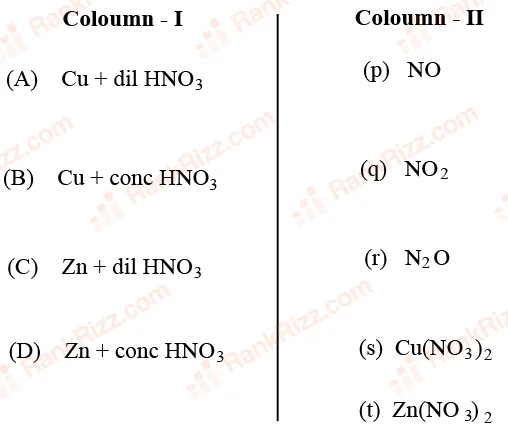
Match each of the reactions given in Column I with the corresponding product(s) given in Column II.
rr2.rankrizz.com/jee-advanced/chemistry/p-block-elements-groups-15-to-18/q/2009-paper-2-q10
A solution of colourless salt H on boiling with excess NaOH produces a non-flammable gas. The gas evolution ceases after sometime. Upon addition of Zn dust to the same solution, the gas evolution restarts. The colourless salt(s) H is (are)
- (A)
- (B)
- (C)
- (D)
rr2.rankrizz.com/jee-advanced/chemistry/p-block-elements-groups-15-to-18/q/2008-paper-1-q55
- (A)
Among the following, the correct statement is
- (A)
Phosphates have no biological significance in humans
- (B)
Between nitrates and phosphates, phosphates are less abundant in earth’s crust
- (C)
Between nitrates and phosphates, nitrates are less abundantin earth’s crust
- (D)
Oxidation of nitrates is possible in soil
rr2.rankrizz.com/jee-advanced/chemistry/p-block-elements-groups-15-to-18/q/2008-paper-1-q64
- (A)
Among the following, the correct statement is
- (A)
Between and is a better electron donor because the lone pair of electrons occupies spherical ‘s’ orbital and is less directional
- (B)
Between and is a better electron donor because the lone pair of electrons occupies orbital and is more directional
- (C)
Between and is a better electron donor because the lone pair of electrons occupies orbital and is more directional
- (D)
Between and is a better electron donor because the lone pair of electrons occupies spherical ‘s’ orbital and is less directional
rr2.rankrizz.com/jee-advanced/chemistry/p-block-elements-groups-15-to-18/q/2008-paper-1-q65
- (A)
White phosphorus on reaction with gives as one of the products. This is a
- (A)
dimerization reaction
- (B)
disproportionation reaction
- (C)
condensation reaction
- (D)
precipitation reaction
rr2.rankrizz.com/jee-advanced/chemistry/p-block-elements-groups-15-to-18/q/2008-paper-1-q66
- (A)
The percentage of p-character in the orbitals forming P—P bondsin is
- (A)
25
- (B)
33
- (C)
50
- (D)
75
rr2.rankrizz.com/jee-advanced/chemistry/p-block-elements-groups-15-to-18/q/2007-paper-1-q29
- (A)
Oxoacids of halogens and interhalogen compounds 10
With respect to hypochlorite, chlorate and perchlorate ions, choose the correct statement(s).
- (A)
The hypochlorite ion is the strongest conjugate base.
- (B)
The molecular shape of only chlorate ion is influenced by the lone pair of electrons of Cl.
- (C)
The hypochlorite and chlorate ions disproportionate to give rise to identical set of ions.
- (D)
The hypochlorite ion oxidizes the sulfite ion.
rr2.rankrizz.com/jee-advanced/chemistry/p-block-elements-groups-15-to-18/q/2020-paper-1-q29
- (A)
The correct statement(s) about the oxoacids, and , is(are)
- (A)
The central atom in both and is hybridized
- (B)
is more acidic than because of the resonance stabilization of its anion
- (C)
is formed in the reaction between and
- (D)
The conjugate base of is weaker base than
rr2.rankrizz.com/jee-advanced/chemistry/p-block-elements-groups-15-to-18/q/2017-paper-1-q21
- (A)
The colour of the molecules of group 17 elements changes gradually from yellow to violet down the group. This is due to
- (A)
the physical state of at room temperature changes from gas to solid down the group
- (B)
decrease in ionization energy down the group
- (C)
decrease in gap down the group
- (D)
decrease in HOMO-LUMO gap down the group
rr2.rankrizz.com/jee-advanced/chemistry/p-block-elements-groups-15-to-18/q/2017-paper-1-q22
- (A)
The correct statement(s) regarding, and is(are)
- (A)
The numberof Cl = O bonds in (ii) and (iii) together is two
- (B)
The number of lone pairs of electrons on Cl in (ii) and(iii) together is three
- (C)
The hybridization of Cl in (iv) is
- (D)
Amongst(i) to (iv), the strongest acid is(i)
rr2.rankrizz.com/jee-advanced/chemistry/p-block-elements-groups-15-to-18/q/2015-paper-2-q32
- (A)
P and Q,respectively, are the sodium salts of
- (A)
hypochlorus and chloric acids
- (B)
hypochlorus and chlorus acids
- (C)
chloric and perchloric acids
- (D)
chloric and hypochlorus acids
rr2.rankrizz.com/jee-advanced/chemistry/p-block-elements-groups-15-to-18/q/2013-paper-2-q31
- (A)
R, S and T, respectively, are
- (A)
and
- (B)
and
- (C)
and
- (D)
and
rr2.rankrizz.com/jee-advanced/chemistry/p-block-elements-groups-15-to-18/q/2013-paper-2-q32
- (A)
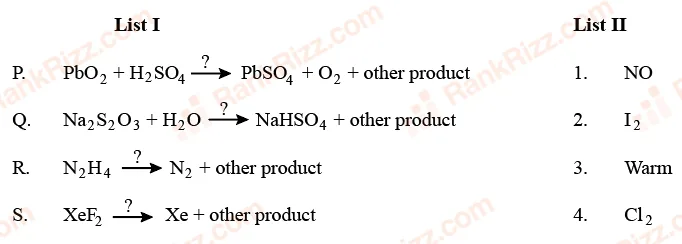
The unbalanced chemical reactions given in List I show missing reagent or condition (?) which are provided in List II. Match List I with List Il and select the correct answer using the code given below the lists :
- (A)
P-4, Q-2, R-3, S-1
- (B)
P-3, Q-2, R-1, S-4
- (C)
P-1, Q-4, R-2, S-3
- (D)
P-3, Q-4, R-2, S-1
rr2.rankrizz.com/jee-advanced/chemistry/p-block-elements-groups-15-to-18/q/2013-paper-2-q38
- (A)
25mL of household bleach solution was mixed with 30mL of 0.50MKI and 10mL of 4N acetic acid. In the titration of the liberated iodine, 48mL of 0.25 N was used to reach the end point. Themolarity of the household bleach solution is
- (A)
0.48 M
- (B)
0.96 M
- (C)
0.24 M
- (D)
0.024 M
rr2.rankrizz.com/jee-advanced/chemistry/p-block-elements-groups-15-to-18/q/2012-paper-2-q31
- (A)
Bleaching powder contains a salt of an oxoacid as one of its components. The anhydride of that oxoacid is
- (A)
- (B)
- (C)
- (D)
rr2.rankrizz.com/jee-advanced/chemistry/p-block-elements-groups-15-to-18/q/2012-paper-2-q32
- (A)
Which of the following hydrogen halides react(s) with to give a precipitate that dissolves in ?
- (A)
HCl
- (B)
HF
- (C)
HBr
- (D)
HI
rr2.rankrizz.com/jee-advanced/chemistry/p-block-elements-groups-15-to-18/q/2012-paper-1-q34
- (A)
Group 18: noble gases and xenon compounds 7
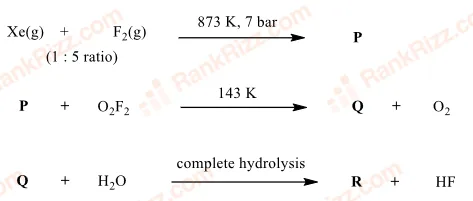
Correct statement(s) about the compounds P, Q and R is(are)
- (A)
has two lone pairs of electrons on the central atom.
- (B)
has a perfect octahedral geometry.
- (C)
can act as a fluorinating agent.
- (D)
The molecular structure of is trigonal pyramidal.
rr2.rankrizz.com/jee-advanced/chemistry/p-block-elements-groups-15-to-18/q/2026-paper-2-q24
- (A)
The reaction of Xe and OF gives a Xe compound P. The number of moles of HF produced by the complete hydrolysis of 1 mol of P is _______.
Answer: ____________
rr2.rankrizz.com/jee-advanced/chemistry/p-block-elements-groups-15-to-18/q/2022-paper-2-q40
At 143 K,the reaction of with produces a xenon compound Y. The total number of lone pair(s) of electrons present on the whole molecule of Y is
Answer: ____________
rr2.rankrizz.com/jee-advanced/chemistry/p-block-elements-groups-15-to-18/q/2019-paper-1-q32
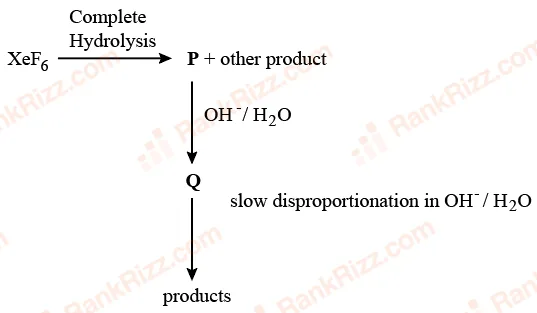
Under ambient conditions, the total number of gases released as products in the final step of the reaction scheme shown below is
- (A)
0
- (B)
1
- (C)
2
- (D)
3
rr2.rankrizz.com/jee-advanced/chemistry/p-block-elements-groups-15-to-18/q/2014-paper-2-q26
- (A)
Argon is used in are welding because of its
- (A)
low reactivity with metal
- (B)
ability to lower the melting point of metal
- (C)
flammability
- (D)
high calorific value
rr2.rankrizz.com/jee-advanced/chemistry/p-block-elements-groups-15-to-18/q/2007-paper-1-q36
- (A)
The structure of is
- (A)
linear
- (B)
planar
- (C)
pyramidal
- (D)
T-shaped
rr2.rankrizz.com/jee-advanced/chemistry/p-block-elements-groups-15-to-18/q/2007-paper-1-q37
- (A)
and are expected to be
- (A)
oxidizing
- (B)
reducing
- (C)
unreactive
- (D)
strongly basic
rr2.rankrizz.com/jee-advanced/chemistry/p-block-elements-groups-15-to-18/q/2007-paper-1-q38
- (A)
Group 15: trends and hydrides 4
The compound(s) with P-H bond(s) is(are)
- (A)
HPO
- (B)
HPO
- (C)
HPO
- (D)
HPO
rr2.rankrizz.com/jee-advanced/chemistry/p-block-elements-groups-15-to-18/q/2025-paper-2-q38
- (A)
The species formed on fluorination of phosphorus pentachloride in a polar organic solvent are
- (A)
and
- (B)
and
- (C)
and
- (D)
and
rr2.rankrizz.com/jee-advanced/chemistry/p-block-elements-groups-15-to-18/q/2024-paper-2-q38
- (A)
Dissolving 1.24 g of white phosphorous in boiling NaOH solution in an inert atmosphere gives a gas Q. The amount of CuSO (in g) required to completely consume the gas Q is ______.
[Given : Atomic mass of H = 1, O = 16, Na = 23, P = 31, S = 32, Cu = 63]
Answer: ____________
rr2.rankrizz.com/jee-advanced/chemistry/p-block-elements-groups-15-to-18/q/2022-paper-1-q41
The treatment of galena with HNO produces a gas that is
- (A)
paramagnetic
- (B)
bent in geometry
- (C)
an acidic oxide
- (D)
colorless
rr2.rankrizz.com/jee-advanced/chemistry/p-block-elements-groups-15-to-18/q/2022-paper-1-q48
- (A)
Sulphur and its compounds 3
Consider the following reactions (unbalanced)
Zn + hot conc.
Zn + conc.
G + (a precipitate) + X + Y
Choose the correct option(s)- (A)
Z is dirty white in colour
- (B)
The oxidation state of Zn in T is +1
- (C)
R is a V-shaped molecule
- (D)
Bond order of Q is 1 in its ground state
rr2.rankrizz.com/jee-advanced/chemistry/p-block-elements-groups-15-to-18/q/2019-paper-2-q21
- (A)
The correct statement(s) about is(are)
- (A)
bond lengths are equal.
- (B)
Thermal decomposition of is endothermic.
- (C)
is diamagnetic in nature.
- (D)
has a bentstructure.
rr2.rankrizz.com/jee-advanced/chemistry/p-block-elements-groups-15-to-18/q/2013-paper-2-q21
- (A)
The total number of diprotic acids among the following is

Answer: ____________
rr2.rankrizz.com/jee-advanced/chemistry/p-block-elements-groups-15-to-18/q/2010-paper-2-q7
Group 17: halogens and hydrogen halides 3
Correct statement(s) about the compounds , and is(are)
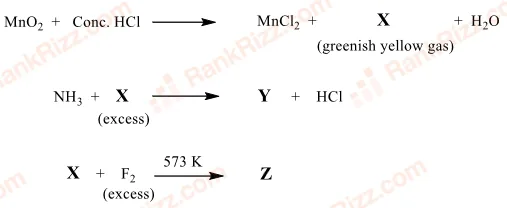
- (A)
is used for sterilizing drinking water.
- (B)
has a planar structure.
- (C)
is used in the enrichment of .
- (D)
is a stronger Lewis base than ammonia.
rr2.rankrizz.com/jee-advanced/chemistry/p-block-elements-groups-15-to-18/q/2026-paper-1-q22
- (A)
The complete hydrolysis of ICl, ClF and BrF, respectively, gives
- (A)
IO, ClO and BrO
- (B)
IO, ClO and BrO
- (C)
IO, ClO and BrO
- (D)
IO, ClO and BrO
rr2.rankrizz.com/jee-advanced/chemistry/p-block-elements-groups-15-to-18/q/2025-paper-2-q34
- (A)
The reaction of HClO with HCl gives a paramagnetic gas, which upon reaction with O produces
- (A)
ClO
- (B)
ClO
- (C)
ClO
- (D)
ClO
rr2.rankrizz.com/jee-advanced/chemistry/p-block-elements-groups-15-to-18/q/2022-paper-2-q52
- (A)
Dinitrogen, ammonia, nitric acid and oxides of nitrogen 2
The heating of NHNO at 60-70 C and NHNO at 200-250 C is associated with the formation of nitrogen containing compounds X and Y, respectively. X and Y, respectively, are
- (A)
N and NO
- (B)
NH and NO
- (C)
NO and NO
- (D)
N and NH
rr2.rankrizz.com/jee-advanced/chemistry/p-block-elements-groups-15-to-18/q/2025-paper-1-q33
- (A)
At room temperature, disproportionation of an aqueous solution of in situ generated nitrous acid () gives the species
- (A)
, and
- (B)
, and
- (C)
, and
- (D)
, and
rr2.rankrizz.com/jee-advanced/chemistry/p-block-elements-groups-15-to-18/q/2024-paper-1-q36
- (A)
Group 16: trends, dioxygen, ozone and oxides 1
The compound(s) having peroxide linkage is(are)
- (A)
- (B)
- (C)
- (D)
rr2.rankrizz.com/jee-advanced/chemistry/p-block-elements-groups-15-to-18/q/2024-paper-2-q41
- (A)
Answer key
- 01 D
- 02 A
- 03 A, B, C
- 04 —
- 05 B, C
- 06 A, B, C
- 07 C
- 08 B
- 09 B, D
- 10 8
- 11 A
- 12 B
- 13 C
- 14 B
- 15 D
- 16 4
- 17 A
- 18 B
- 19 —
- 20 A
- 21 C
- 22 C
- 23 B
- 24 D
- 25 A, B, D
- 26 A, B, D
- 27 C, D
- 28 B, C
- 29 A
- 30 A
- 31 D
- 32 C
- 33 A
- 34 A, C, D
- 35 A, C, D
- 36 —
- 37 —
- 38 C
- 39 A
- 40 C
- 41 A
- 42 B, D
- 43 B
- 44 —
- 45 A, D
- 46 A, C, D
- 47 A, C, D
- 48 6
- 49 A, C
- 50 A
- 51 C
- 52 A
- 53 A
- 54 B, D
“—” marks a question whose key we have not checked yet; its page shows the latest on it.
Past questions are reproduced with their sitting. Not affiliated with NTA or the IITs. Every question, online and free: rr2.rankrizz.com/jee-advanced/chemistry/p-block-elements-groups-15-to-18