Electrochemistry JEE Advanced PYQs with answer key
CHEMISTRY · 32 PAST QUESTIONS · 3 TOPICS · 2007–2026
HOW TO USE THIS SHEET
Every JEE Advanced Electrochemistry question we hold, grouped by topic, most-asked topic first and newest first inside each. The answer key is at the end (26 of 32 questions have a checked key); the worked solution is on each question’s page, printed beside it.
Electrode potentials, electrochemical series and cell EMF 15
The reduction potential (, in V) of (aq)/Mn(s) is ______.
[Given : V ; V ; V]
Answer: ____________
rr2.rankrizz.com/jee-advanced/chemistry/electrochemistry/q/2022-paper-1-q38
Some standard electrode potentials at 298 K are given below:
Pb/Pb -0.13 V
Ni/Ni -0.24 V
Cd/Cd -0.40 V
Fe/Fe -0.44 V
To a solution containing 0.001 M of X and 0.1 M of Y, the metal rods X and Y are inserted (at 298 K) and connected by a conducting wire. This resulted in dissolution of X. The correct combination(s) of X and Y, respectively, is(are)
(Given: Gas constant, R = 8.314 J K mol, Faraday constant, F = 96500 C mol)- (A)
Cd and Ni
- (B)
Cd and Fe
- (C)
Ni and Pb
- (D)
Ni and Fe
rr2.rankrizz.com/jee-advanced/chemistry/electrochemistry/q/2021-paper-2-q42
- (A)
For the electrochemical cell,
(aq,1M) (aq,1M) the standard emf of the cell is 2.70 V at 300 K. When the concentration of is changed to 𝒙 M, the cell potential changes to 2.67 V at 300 K. The value of 𝒙 is ____.
(given , where F is the Faraday constant and 𝑅 is the gas constant,Answer: ____________
rr2.rankrizz.com/jee-advanced/chemistry/electrochemistry/q/2018-paper-1-q28
For the following cell, when the concentration of is 10 times the concentration of , the expression for ((in J ) is [F is Faraday constant; R is gas constant; T is temperature; ]
- (A)
1.1F
- (B)
2.303RT-2.2F
- (C)
2.303RT+1.1F
- (D)
-2.2F
rr2.rankrizz.com/jee-advanced/chemistry/electrochemistry/q/2017-paper-2-q20
- (A)
For the following electrochemical cell at 298 K,
and when .
Given :
The value of x is- (A)
-2
- (B)
-1
- (C)
1
- (D)
2
rr2.rankrizz.com/jee-advanced/chemistry/electrochemistry/q/2016-paper-2-q19
- (A)
All the energy released from the reaction is used for oxidizing as Under standard conditions, the number of moles of oxidized when one mole of X is converted to Y is [F = 96500 C ]
Answer: ____________
rr2.rankrizz.com/jee-advanced/chemistry/electrochemistry/q/2015-paper-1-q27
In a galvanic cell, the salt bridge
- (A)
does not participate chemically in the cell reaction.
- (B)
stops the diffusion of ions from one electrode to another.
- (C)
is necessary for the occurrence of the cell reaction.
- (D)
ensures mixing of the two electrolytic solutions.
rr2.rankrizz.com/jee-advanced/chemistry/electrochemistry/q/2014-paper-1-q26
- (A)
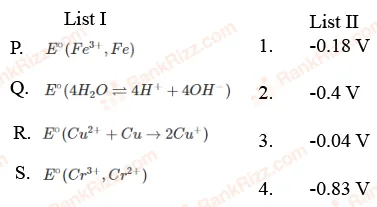
The standard reduction potential data at is given below.
;;
;
;
;
;
;
Match of the redox pair in List I with the values given in List II and select the correct answer using the code given below the lists:
- (A)
P-4, Q-1, R-2, S-3
- (B)
P-2, Q-3, R-4, S-1
- (C)
P-1, Q-2, R-3, S-4
- (D)
P-3, Q-4, R-1, S-2
rr2.rankrizz.com/jee-advanced/chemistry/electrochemistry/q/2013-paper-2-q39
- (A)
The solubility product () of at 298 based on the information available the given concentration cell is (take )
- (A)
- (B)
- (C)
- (D)
rr2.rankrizz.com/jee-advanced/chemistry/electrochemistry/q/2012-paper-2-q29
- (A)
The value of for the given cell is (take 1F = 96500 C )
- (A)
-5.7
- (B)
5.7
- (C)
11.4
- (D)
-11.4
rr2.rankrizz.com/jee-advanced/chemistry/electrochemistry/q/2012-paper-2-q30
- (A)
Consider the following cell reaction:
At atm and pH = 3, the cell potential at is- (A)
1.47 V
- (B)
1.77 V
- (C)
1.87 V
- (D)
1.57 V
rr2.rankrizz.com/jee-advanced/chemistry/electrochemistry/q/2011-paper-2-q4
- (A)
If the 0.05 molar solution of is replaced by a 0.0025 molar solution, then the magnitude of the cell potential would be
- (A)
- (B)
- (C)
- (D)
rr2.rankrizz.com/jee-advanced/chemistry/electrochemistry/q/2010-paper-1-q18
- (A)
For the reduction of ion in an aqueous solution, is +0.96 V. Values of for some metal ions are given below
V
V
V
V
The pair(s) of metals that is(are) oxidized by in aqueous solution is(are)- (A)
V and Hg
- (B)
Hg and Fe
- (C)
Fe and Au
- (D)
Fe and V
rr2.rankrizz.com/jee-advanced/chemistry/electrochemistry/q/2009-paper-2-q5
- (A)
Among the following, identify the correct statement.
- (A)
Chloride ion is oxidised by
- (B)
is oxidised by iodine
- (C)
Iodide ion is oxidised by chlorine
- (D)
is oxidised by chlorine
rr2.rankrizz.com/jee-advanced/chemistry/electrochemistry/q/2007-paper-2-q36
- (A)
While is stable, is not stable in acid solution because
- (A)
oxidises to
- (B)
oxidises both to and to
- (C)
oxidises to
- (D)
oxidises to
rr2.rankrizz.com/jee-advanced/chemistry/electrochemistry/q/2007-paper-2-q37
- (A)
Conductance, conductivity and molar conductivity 14
At 300 K, the molar conductivities of the aqueous solutions of three salts at two different concentrations are given below:
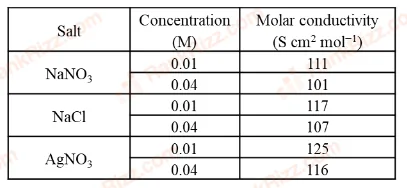
The conductivity of a saturated aqueous solution of AgCl is S cm at 300 K. If the solubility of AgCl in water at 300 K is mol L, then is
(Assume that AgCl dissolved in water ionizes completely and that the molar conductivity of saturated AgCl solution is equal to its limiting molar conductivity.)
- (A)
- (B)
- (C)
- (D)
rr2.rankrizz.com/jee-advanced/chemistry/electrochemistry/q/2026-paper-2-q19
- (A)
In an electrochemical cell, dichromate ions in aqueous acidic medium are reduced to Cr. The current (in amperes) that flows through the cell for 48.25 minutes to produce 1 mole of Cr is ________.
Use: 1 Faraday = 96500 C mol
Answer: ____________
rr2.rankrizz.com/jee-advanced/chemistry/electrochemistry/q/2025-paper-1-q40
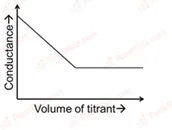
In a conductometric titration, small volume of titrant of higher concentration is added stepwise to a larger volume of titrate of much lower concentration, and the conductance is measured after each addition.
The limiting ionic conductivity () values (in mS ) for different ions in aqueous solutions are given below:
Ions 6.2 7.4 5.0 35.0 7.2 7.6 16.0 19.9 4.1 For different combinations of titrates and titrants given in List-I, the graphs of 'conductance' versus 'volume of titrant' are given in List-II.
Match each entry in List-I with the appropriate entry in List-II and choose the correct option.
List-I List-II (P) Titrate: KCl
Titrant:(1) 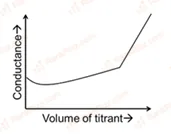
(Q) Titrate:
Titrant: KCl(2) 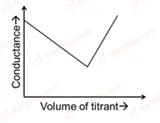
(R) Titrate: NaOH
Titrant: HCl(3) 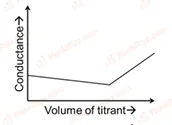
(S) Titrate: NaOH
Titrant:(4) 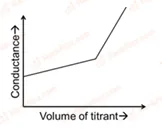
(5) 
- (A)
P-4, Q-3, R-2, S-5
- (B)
P-2, Q-4, R-3, S-1
- (C)
P-3, Q-4, R-2, S-5
- (D)
P-4, Q-3, R-2, S-1
rr2.rankrizz.com/jee-advanced/chemistry/electrochemistry/q/2024-paper-1-q48
- (A)
Plotting against for aqueous solutions of a monobasic weak acid (HX) resulted in a straight line with y-axis intercept of P and slope of S. The ratio P/S is
[ = molar conductivity, = limiting molar conductivity, c = molar concentration, = dissociation constant of HX]
- (A)
- (B)
- (C)
- (D)
rr2.rankrizz.com/jee-advanced/chemistry/electrochemistry/q/2023-paper-1-q39
- (A)
Consider the strong electrolytes ZX, UY and VX. Limiting molar conductivity () of UY and VX are 250 and 440 S cm mol, respectively. The value of (m + n + p) is _______.
Given:
Ion Z U V X Y (S cm mol) 50.0 25.0 100.0 80.0 100.0 is the limiting molar conductivity of ions
The plot of molar conductivity () of ZX vs c is given below.
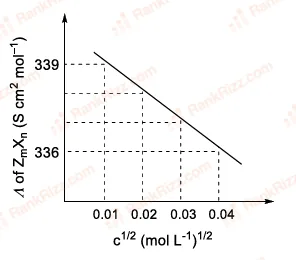
Answer: ____________
rr2.rankrizz.com/jee-advanced/chemistry/electrochemistry/q/2022-paper-2-q39
Molar conductivity of aqueous solution of sodium stearate, which behaves as a strong electrolyte, is recorded at varying concentrations (c) of sodium stearate. Which oneofthe following plots provides the correct representation of micelle formation in the solution?
(critical micelle concentration (CMC) is marked with an arrow in the figures- (A)
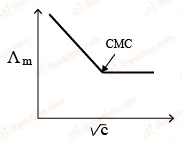
- (B)
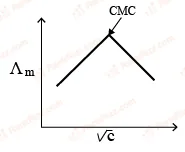
- (C)
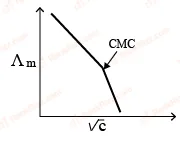
- (D)
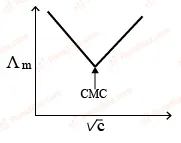
rr2.rankrizz.com/jee-advanced/chemistry/electrochemistry/q/2019-paper-1-q21
- (A)
The conductance of a 0.0015 M aqueous solution of a weak monobasic acid was determined by using a conductivity cell consisting of platinized Pt electrodes. The distance between the electrodes is 120 cm with an area of cross section of . The conductance of this solution was found to be . The pH of the solution is 4. The value of limiting molar conductivity of this weak monobasic acid in aqueous solution is . The value of Z is
Answer: ____________
rr2.rankrizz.com/jee-advanced/chemistry/electrochemistry/q/2017-paper-1-q27
The molar conductivity of a solution of a weak acid HX (0.01 M) is 10 times smaller than the molar conductivity of a solution of a weak acid HY (0.10 M). If , the difference in their values, , is (consider degree of ionization of both acids to be
Answer: ____________
rr2.rankrizz.com/jee-advanced/chemistry/electrochemistry/q/2015-paper-2-q26
An aqueous solution of X is added slowly to an aqueous solution of Y as shown in List J. The variation in conductivity of these reactions is given in List II. Match List I with List II and select the correct answer using the code given below the lists:
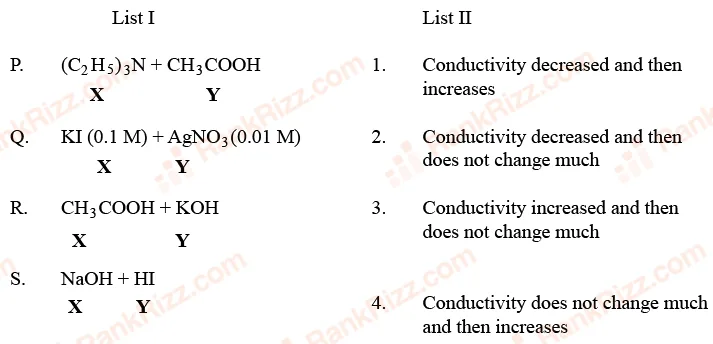
- (A)
P-3, Q-4, R-2, S-1
- (B)
P-4, Q-3, R-2, S-1
- (C)
P-2, Q-3, R-4, S-1
- (D)
P-1, Q-4, R-3, S-2
rr2.rankrizz.com/jee-advanced/chemistry/electrochemistry/q/2013-paper-2-q40
- (A)
(aq.) was added to an aqueous KCl solution gradually and the conductivity of the solution was measured. The plot of conductance versus the volume of is-
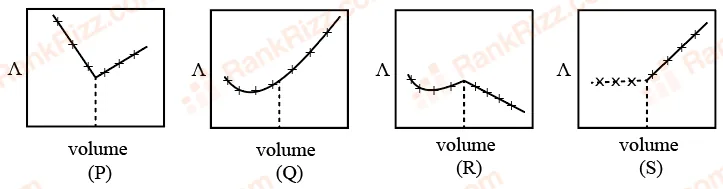
- (A)
(P)
- (B)
(Q)
- (C)
(R)
- (D)
(S)
rr2.rankrizz.com/jee-advanced/chemistry/electrochemistry/q/2011-paper-1-q2
- (A)
Electrolysis of dilute aqueous NaCl solution was carried out by passing 10 milli ampere current. The time required to liberate 0.01 mol of H, gas at the cathode is (1 Faraday = 96500 C mol)
- (A)
sec
- (B)
sec
- (C)
sec
- (D)
sec
rr2.rankrizz.com/jee-advanced/chemistry/electrochemistry/q/2008-paper-2-q51
- (A)
The total number of moles of chlorine gas evolved is
- (A)
0.5
- (B)
1.0
- (C)
2.0
- (D)
3.0
rr2.rankrizz.com/jee-advanced/chemistry/electrochemistry/q/2007-paper-1-q39
- (A)
If the cathode is a Hg electrode, the maximum weight (g) of amalgam formed from this solution is
- (A)
200
- (B)
225
- (C)
400
- (D)
446
rr2.rankrizz.com/jee-advanced/chemistry/electrochemistry/q/2007-paper-1-q40
- (A)
The total charge (coulombs) required for complete electrolysis is
- (A)
24125
- (B)
48250
- (C)
96500
- (D)
193000
rr2.rankrizz.com/jee-advanced/chemistry/electrochemistry/q/2007-paper-1-q41
- (A)
Batteries, fuel cells and corrosion 3
An electrochemical cell is fueled by the combustion of butane at 1 bar and 298 K. Its cell potential is volts, where is the Faraday constant. The value of is ______.
Use: Standard Gibbs energies of formation at 298 K are: kJ mol; kJ mol; kJ mol
Answer: ____________
rr2.rankrizz.com/jee-advanced/chemistry/electrochemistry/q/2025-paper-2-q46
An aqueous solution of hydrazine () is electrochemically oxidized by , thereby releasing chemical energy in the form of electrical energy. One of the products generated from the electrochemical reaction is .
Choose the correct statement(s) about the above process
- (A)
ions react with at the anode to form and water, releasing 4 electrons to the anode.
- (B)
At the cathode, breaks to and nascent hydrogen released at the electrode reacts with oxygen to form water.
- (C)
At the cathode, molecular oxygen gets converted to .
- (D)
Oxides of nitrogen are major by-products of the electrochemical process.
rr2.rankrizz.com/jee-advanced/chemistry/electrochemistry/q/2024-paper-2-q39
- (A)
Consider a 70% efficient hydrogen-oxygen fuel cell working under standard conditions at 1 bar and
298 K. Its cell reaction is
The work derived from the cell on the consumption of mol of (g) is used to compress
1.00 mol of a monoatomic ideal gas in a thermally insulated container. What is the change in the
temperature (in K) of the ideal gas?The standard reduction potentials for the two half-cells are given below.
,.
Use .
Answer: ____________
rr2.rankrizz.com/jee-advanced/chemistry/electrochemistry/q/2020-paper-1-q33
Answer key
- 01 —
- 02 —
- 03 —
- 04 B
- 05 D
- 06 4
- 07 A, C
- 08 D
- 09 B
- 10 D
- 11 D
- 12 C
- 13 —
- 14 C
- 15 D
- 16 C
- 17 100
- 18 C
- 19 A
- 20 7
- 21 D
- 22 6
- 23 3
- 24 A
- 25 D
- 26 B
- 27 B
- 28 D
- 29 D
- 30 —
- 31 A, C
- 32 —
“—” marks a question whose key we have not checked yet; its page shows the latest on it.
Past questions are reproduced with their sitting. Not affiliated with NTA or the IITs. Every question, online and free: rr2.rankrizz.com/jee-advanced/chemistry/electrochemistry