Chemical Kinetics JEE Advanced PYQs with answer key
CHEMISTRY · 33 PAST QUESTIONS · 5 TOPICS · 2007–2026
HOW TO USE THIS SHEET
Every JEE Advanced Chemical Kinetics question we hold, grouped by topic, most-asked topic first and newest first inside each. The answer key is at the end (27 of 33 questions have a checked key); the worked solution is on each question’s page, printed beside it.
Radioactivity and nuclear reactions 11
A sample initially contains only U-238 isotope of uranium. With time, some of the U-238 radioactively decays into Pb-206 while the rest of it remains undisintegrated.
When the age of the sample is years, the ratio of mass of Pb-206 to that of U-238 in the sample is found to be 7. The value of P is ______.
[Given : Half-life of U-238 is years; = 0.693]
Answer: ____________
rr2.rankrizz.com/jee-advanced/chemistry/chemical-kinetics/q/2024-paper-2-q45
is known to undergo radioactive decay to form by emitting alpha and beta particles. A rock initially contained g of If the number of alpha particles that it would emit during its radioactive decay of to in three half-lives is Z \times 10^{18}, then what is the value of Z?
Answer: ____________
rr2.rankrizz.com/jee-advanced/chemistry/chemical-kinetics/q/2020-paper-1-q35
In the decay sequence

are particles/radiation emitted by the respective isotopes. The correct option(s) is(are)- (A)
will deflect towards negatively charged plate
- (B)
- (C)
-ray
- (D)
Z is an isotope of uranium
rr2.rankrizz.com/jee-advanced/chemistry/chemical-kinetics/q/2019-paper-1-q28
- (A)
A plot of the number of neutrons (NV) against the number of protons (P) of stable nuclei exhibits upward deviation from linearity for atomic number, Z > 20. For an unstable nucleus having N/P ratio less than 1, the possible mode(s) of decay is(are)
- (A)
decay ( emission)
- (B)
orbital or K-electron capture
- (C)
neutron emission
- (D)
decay (positron emission)
rr2.rankrizz.com/jee-advanced/chemistry/chemical-kinetics/q/2016-paper-1-q25
- (A)
A closed vessel with rigid walls contains 1 mol of and 1 mol of air at 298 K. Considering complete decay of to the ratio of the final pressure to the initial pressure of the system at 298 K is
Answer: ____________
rr2.rankrizz.com/jee-advanced/chemistry/chemical-kinetics/q/2015-paper-2-q27
The periodic table consists of 18 groups. An isotope of copper, on bombardment with protons, undergoes a nuclear reaction yielding element X as shown below. To which group, element X belongs in the periodic table ?
Answer: ____________
rr2.rankrizz.com/jee-advanced/chemistry/chemical-kinetics/q/2012-paper-1-q37
Bombardment of aluminum by - particle leads to its artificial disintegration in two ways, (i) and (ii) as shown. Products X, Y and Z respectively are-
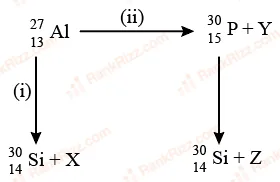
- (A)
proton, neutron, positron
- (B)
neutron, positron, proton
- (C)
proton, positron, neutron
- (D)
positron, proton, neutron
rr2.rankrizz.com/jee-advanced/chemistry/chemical-kinetics/q/2011-paper-1-q3
- (A)
The number of neutrons emitted when undergoes controlled nuclear fission to and is
Answer: ____________
rr2.rankrizz.com/jee-advanced/chemistry/chemical-kinetics/q/2010-paper-1-q28
The total number of and particles emitted in the nuclear reaction is
Answer: ____________
rr2.rankrizz.com/jee-advanced/chemistry/chemical-kinetics/q/2009-paper-2-q15
STATEMENT-1: The plot of atomic number (y-axis) versus number of neutrons (x-axis) for stable nuclei shows a curvature towards x-axis from the line of slope as the atomic numberis increased.
and
STATEMENT-2: Proton-proton electrostatic repulsions begin to overcome attractive forces involving protons and neutrons in heavier nuclides.- (A)
STATEMENT-1 is True, STATEMENT-2 is True; STATEMENT-2 is a correct explanation for STATEMENT-1
- (B)
STATEMENT-1 is True, STATEMENT-2 is True; STATEMENT-2 is NOT a correct explanation for STATEMENT-1
- (C)
STATEMENT-1 is True, STATEMENT-2 is False
- (D)
STATEMENT-1 is False, STATEMENT-2 is True
rr2.rankrizz.com/jee-advanced/chemistry/chemical-kinetics/q/2008-paper-1-q59
- (A)
A positron is emitted from . The ratio of the atomic mass and atomic number of the resulting nuclide is
- (A)
- (B)
- (C)
- (D)
rr2.rankrizz.com/jee-advanced/chemistry/chemical-kinetics/q/2007-paper-2-q29
- (A)
Integrated rate laws and half-life (zero and first order) 7
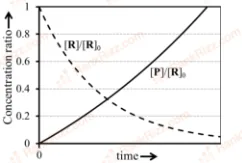
For a reversible reaction , at constant temperature, both the forward and the backward reactions are first order elementary reactions with rate constants and , respectively. At time zero, the concentration of is and the concentration of is zero. At any given time, and are the concentrations of and , respectively. If , the correct graphical representation of the reaction is
- (A)
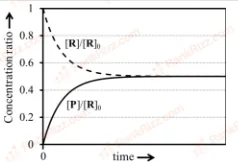
- (B)
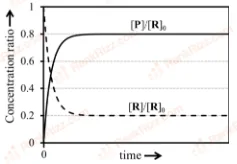
- (C)
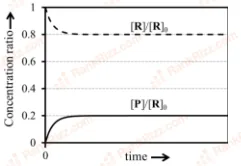
- (D)
rr2.rankrizz.com/jee-advanced/chemistry/chemical-kinetics/q/2026-paper-1-q18
- (A)
For a first-order reaction at a given temperature, is the rate constant. For this reaction, at the given temperature, the concentrations of and at a time are and , respectively. The correct graphical representation(s) for this reaction is(are)
- (A)
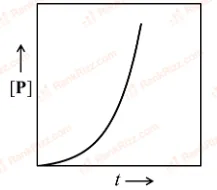
- (B)
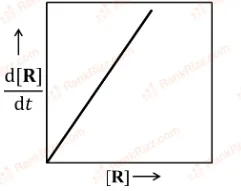
- (C)
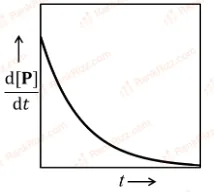
- (D)
rr2.rankrizz.com/jee-advanced/chemistry/chemical-kinetics/q/2026-paper-2-q23
- (A)
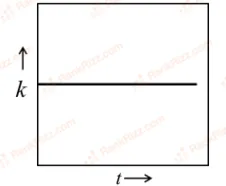
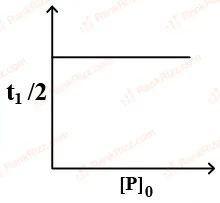
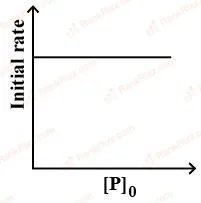
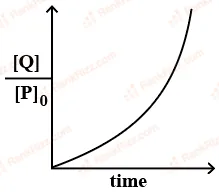
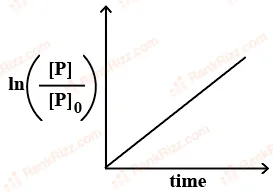
Which of the following plots is(are) correct for the given reaction?
( is the initial concentration of P)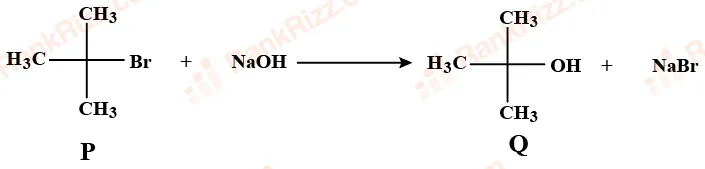
- (A)
- (B)
- (C)
- (D)
rr2.rankrizz.com/jee-advanced/chemistry/chemical-kinetics/q/2020-paper-2-q26
- (A)
The decomposition reaction
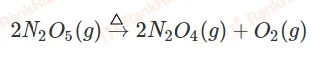
is started in a closed cylinder under isothermal isochoric condition at an initial pressure of 1 atm. After , the pressure inside the cylinder is found to be 1.45 atm. If the rate constant of the reaction is , assuming ideal gas behavior, the value of Y is __________ .Answer: ____________
rr2.rankrizz.com/jee-advanced/chemistry/chemical-kinetics/q/2019-paper-2-q29
An organic compound undergoes first-order decomposition. The time taken for its decomposition to and of its initial concentration are and respectively. What is the value of ? (take )
Answer: ____________
rr2.rankrizz.com/jee-advanced/chemistry/chemical-kinetics/q/2012-paper-1-q40
For the first order reaction
- (A)
the concentration of the reactant decreases exponentially with time.
- (B)
the half-life of the reaction decreases with increasing temperature.
- (C)
the half-life of the reaction depends on the initial concentration of the reactant.
- (D)
the reaction proceeds to 99.6 % completion in eight half-life duration.
rr2.rankrizz.com/jee-advanced/chemistry/chemical-kinetics/q/2011-paper-2-q11
- (A)
Under the same reaction conditions, initial concentration of 1.386 mol dm of a substance becomes half in 40 seconds and 20 seconds through first order and zero order kinetics, respectively. Ratio of the rate constants for first order and zero order of the reactions is
- (A)
0.5 mol dm
- (B)
1.0 mol dm
- (C)
1.5 mol dm
- (D)
2.0 mol dm
rr2.rankrizz.com/jee-advanced/chemistry/chemical-kinetics/q/2008-paper-1-q51
- (A)
Rate law, order and molecularity 6
Consider a reaction . The rate of this reaction is measured to be . At the start of the reaction, the concentration of , , is 10-times the concentration of , . The reaction can be considered to be a pseudo first order reaction with assumption that is constant. Due to this assumption, the relative error (in %) in the rate when this reaction is 40% complete, is ______.
[ and represent corresponding rate constants]
Answer: ____________
rr2.rankrizz.com/jee-advanced/chemistry/chemical-kinetics/q/2025-paper-2-q44
The plot of log versus for a reversible reaction A(g) P(g) is shown.
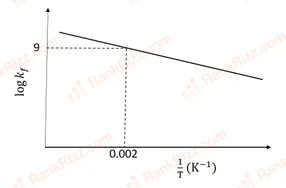
Pre-exponential factors for the forward and backward reactions are s and s, respectively. If the value of log K for the reaction at 500 K is 6, the value of at 250 K is ______.
[K = equilibrium constant of the reaction,
= rate constant of forward reaction,
= rate constant of backward reaction]Answer: ____________
rr2.rankrizz.com/jee-advanced/chemistry/chemical-kinetics/q/2023-paper-1-q44
Match the rate expressions in LIST-I for the decomposition of X with the corresponding profiles provided in LIST-II. and k constants having appropriate units.
LIST-I LIST-II (I) rate = , under all possible initial concentration of X (P) 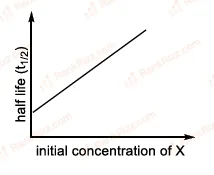
(II) rate = , where initial concentration of X are much less than (Q) 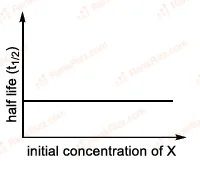
(III) rate = , where initial concentration of X are much higher than (R) 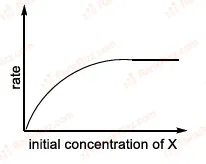
(IV) rate = , where initial concentration of X is much higher than (S) 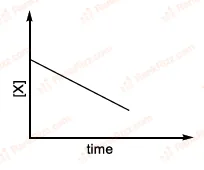
(T) 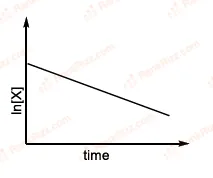
- (A)
I P; II Q; III S; IV T
- (B)
I R; II S; III S; IV T
- (C)
I P; II Q; III Q; IV R
- (D)
I R; II S; III Q; IV R
rr2.rankrizz.com/jee-advanced/chemistry/chemical-kinetics/q/2022-paper-1-q51
- (A)
For the following reaction
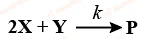
the rate of reaction is . Two moles of X are mixed with one mole of Y to make 1.0 L of solution. At 50 s, 0.5 mole of Y is left in the reaction mixture. The correct statement(s) about the reaction is(are)
(Use: ln 2 = 0.693)- (A)
The rate constant, k, of the reaction is .
- (B)
Half-life of X is 50 s.
- (C)
At 50 s,
- (D)
At 100 s,
rr2.rankrizz.com/jee-advanced/chemistry/chemical-kinetics/q/2021-paper-2-q41
- (A)
Consider the kinetic data given in the following table for the reaction A + B + C Product.
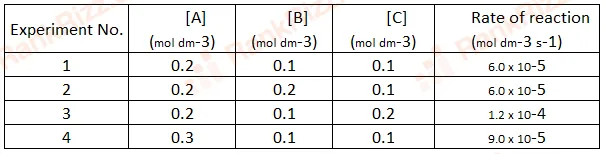
The rate of the reaction for is found to be . The value of Y is _______ .Answer: ____________
rr2.rankrizz.com/jee-advanced/chemistry/chemical-kinetics/q/2019-paper-1-q35
In dilute aqueous , the complex diaquodioxalatoferrate(II) is oxidized by . For this reaction, the ratio of the rate of change of to the rate of change of is
Answer: ____________
rr2.rankrizz.com/jee-advanced/chemistry/chemical-kinetics/q/2015-paper-2-q28
Methods to determine order of reaction 5
Consider the following reaction,
which follows the mechanism given below:
(fast equilibrium)
(slow reaction)
(fast reaction)
The order of the reaction is ______?
Answer: ____________
rr2.rankrizz.com/jee-advanced/chemistry/chemical-kinetics/q/2024-paper-1-q43
For the elementary reaction , the rate of disappearance of M increases by a factor of 8 upon doubling the concentration of M. The order of the reaction with respect to M is
- (A)
4
- (B)
3
- (C)
2
- (D)
1
rr2.rankrizz.com/jee-advanced/chemistry/chemical-kinetics/q/2014-paper-2-q28
- (A)
In the reaction,
the time taken for 75% reaction of P is twice the time taken for 50% reaction of P. The concentration of Q varies with reaction time as shown in the figure. The overall order of the reaction is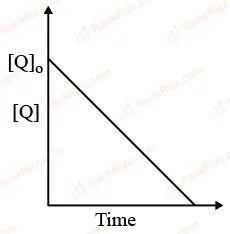
- (A)
2
- (B)
3
- (C)
0
- (D)
1
rr2.rankrizz.com/jee-advanced/chemistry/chemical-kinetics/q/2013-paper-1-q29
- (A)
The concentration of R in the reaction was measured as a function of time and the following data is obtained:

The order of the reaction isAnswer: ____________
rr2.rankrizz.com/jee-advanced/chemistry/chemical-kinetics/q/2010-paper-1-q27
Consider a reaction Products. When concentration of both the reactants G and is doubled, the rate increases by eight times. However, when concentration of G is doubled keeping the concentration of H fixed, the rate is doubled. The overall order of the reaction is
- (A)
0
- (B)
1
- (C)
2
- (D)
3
rr2.rankrizz.com/jee-advanced/chemistry/chemical-kinetics/q/2007-paper-2-q31
- (A)
Collision theory and effect of catalyst on rate 4
In a bimolecular reaction, the steric factor P was experimentally determined to be 4.5. The correct option(s) among the following is(are)
- (A)
The activation energy of the reaction is unaffected by the value of the steric factor
- (B)
Experimentally determined value of frequency factor is higher than that predicted by Arrhenius equation
- (C)
Since P = 4.5, the reaction will not proceed unless an effective catalyst is used
- (D)
The value of frequency factor predicted by Arrhenius equation is higher than that determined experimentally
rr2.rankrizz.com/jee-advanced/chemistry/chemical-kinetics/q/2017-paper-2-q28
- (A)
According to the Arrhenius equation,
- (A)
a high activation energy usually implies a fast reaction.
- (B)
rate constant increases with increase in temperature. This is due to a greater number of collisions whose energy exceeds the activation energy.
- (C)
higher the magnitude of activation energy, stronger 1s the temperature dependence of the rate constant.
- (D)
the pre-exponential factor is a measure of the rate at which collisions occur, irrespective of their energy.
rr2.rankrizz.com/jee-advanced/chemistry/chemical-kinetics/q/2016-paper-1-q24
- (A)
Plots showing the variation of the rate constant (k) with temperature (T) are given below. The plot that follows Arrhenius equation is
- (A)
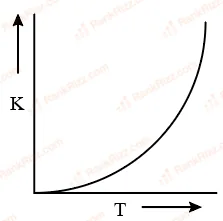
- (B)
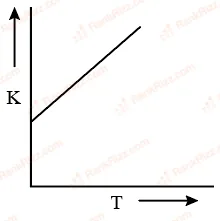
- (C)
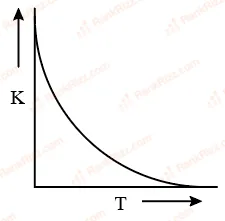
- (D)
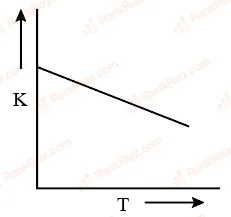
rr2.rankrizz.com/jee-advanced/chemistry/chemical-kinetics/q/2010-paper-1-q6
- (A)
For a first order reaction , the temperature (T) dependent rate constant (k) was found to follow the equation . The pre-exponential factor A and the activation energy , respectively, are
- (A)
and 9.2 kJ mol
- (B)
and 16.6 kJ mol
- (C)
and 16.6 kJ mol
- (D)
and 38.3 kJ mol
rr2.rankrizz.com/jee-advanced/chemistry/chemical-kinetics/q/2009-paper-2-q1
- (A)
Answer key
- 01 —
- 02 —
- 03 A, B, C
- 04 B, D
- 05 9
- 06 8
- 07 A
- 08 4
- 09 —
- 10 A
- 11 C
- 12 C
- 13 C, D
- 14 D
- 15 —
- 16 9
- 17 A, B, D
- 18 A
- 19 —
- 20 5
- 21 A
- 22 B
- 23 —
- 24 8
- 25 3
- 26 B
- 27 D
- 28 0
- 29 D
- 30 A, B
- 31 B, C, D
- 32 A
- 33 D
“—” marks a question whose key we have not checked yet; its page shows the latest on it.
Past questions are reproduced with their sitting. Not affiliated with NTA or the IITs. Every question, online and free: rr2.rankrizz.com/jee-advanced/chemistry/chemical-kinetics